









Introduction
Hybrid Work Adoption Statistics: Hybrid work, which started during the pandemic, has now basically turned into a lasting way of operating. In 2026, it is reshaping global workplaces in a way that feels permanent, more or less. Companies are trying to juggle employee flexibility with face-to-face teamwork, so they are putting money into digital workplace tools and AI-powered collaboration platforms, as well as cybersecurity, employee experience software, and smart office infrastructure.
Reports and research from places like Gallup, Microsoft, Stanford University, McKinsey, and Owl Labs suggest that hybrid work is now the preferred mode for knowledge workers. At the same time, it seems to bring measurable gains in productivity, better retention, and even smarter real estate use. And since more organizations keep redesigning their spaces, hybrid work is expected to stay one of those defining business themes of the decade, opening multi-billion dollar opportunities across enterprise tech and workplace services.
This article will give you the current scenario of hybrid work adoption statistics, including market size, the US and UK hybrid workforce, AI adoption, and cost impact.
Editor’s Choice
- Hybrid work is now the dominant kind of flexible work, with 53% of remote-capable employees already working in hybrid arrangements.
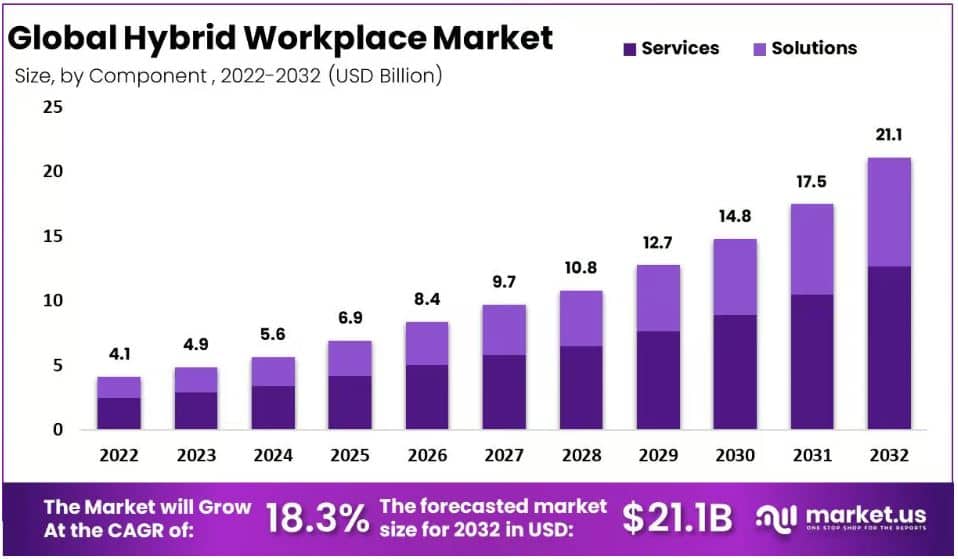
- The global hybrid workplace market is expected to jump from USD 4.9 billion (2023) to USD 21.1 billion by 2032, expanding at an impressive 18.3% CAGR.
- North America leads, holding 39% of the global hybrid workplace market and showing strong momentum in enterprise digital workplace investments.
- SMEs make up 72% of hybrid workplace adoption, which kind of proves that flexible work is mainstream across companies, big and small.
- Employees rate workplace flexibility very high; they even connect hybrid work with nearly an 8% annual salary increase in perceived benefits.
- Organisations can save close to USD 11,000 per employee each year with hybrid work, largely by trimming office spend, lowering turnover, and easing day-to-day operational costs.
- Office usage looks pretty steady now, sitting around 50–55% of what it used to be before the pandemic, and this is shifting commercial real estate demand in a kind of lasting way.
- About 80% of employees now use, or at least test, AI in their jobs, which really shows how fast AI is blending into hybrid workplace operations.
- Nearly 83% of employees say they prefer hybrid work, and still 40% would consider swapping jobs if workplace flexibility were removed.
Hybrid Workplace Market Size
(Source: market.us)
- The hybrid workplace arena is moving into a stretch of sustained growth, backed by broad adoption across companies and continued spending on digital workplace technologies.
- The market was estimated at USD 4.9 billion in 2023, and it is projected to climb to USD 21.1 billion by 2032, posting a strong 18.3% CAGR. This signals a long-term shift toward a more flexible work environment.
- Looking at segmentation, services make up around 60% of total revenue. That points to a stronger dependence on virtual collaboration tools, IT help, and cybersecurity offerings as businesses modernize their work setup.
- Adoption is being pushed mostly by small and mid-sized enterprises, aka SMEs, which represent 72% of the market.
- By industry, the IT and telecommunications segment holds the biggest revenue slice at 32%, and that sector is leading the uptake of hybrid workplace solutions.
- Regionally, North America still seems to run the show, with about 39% of global revenue, and it keeps that head start via broad enterprise adoption, plus ongoing technology spend.
- Meanwhile, Europe and the Asia Pacific region trail right behind, and they add the next chunk of momentum, helping the market grow overall.
- The stats above really suggest that the hybrid work style is turning into a common business way of doing things.
- With continued strong market growth, a solid level of SME involvement, meaningful service revenue, and North America leading by region, organizations that invest in flexible workplace tools and digital collaboration solutions should still see fresh opportunities.
U.S. Hybrid Work Statistics Reflect A Stable and Lasting Workplace Model
(Reference: makerstations.io)
- The latest workforce stats kind of show that hybrid work has moved from a pandemic-driven thing to a steadier long-term employment model here in the United States.
- According to the Bureau of Labor Statistics (March 2026), 22.6% of U.S. employees worked remotely at least some of the time in March 2026, and that’s a small drop from the earlier peak in early 2025, which was 23.7%. So, it looks more like remote work is settled, not really dropping hard or anything.
- The Bureau of Labor Statistics says 53.1% of those workers are in hybrid roles, while 46.9% work fully remotely, which makes it sound like most remote-capable employees lean toward a mixed setup, like combining office time and home-based work, instead of going all in one direction.
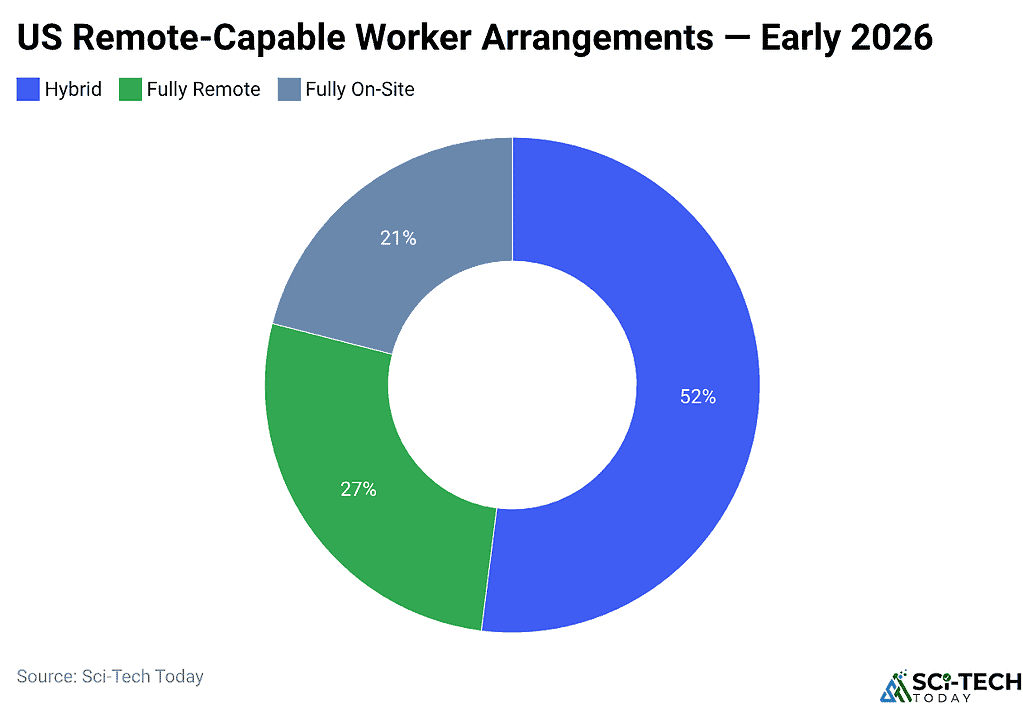
- Gallup’s Hybrid Work Indicator (Q1 2026) reports that 52% of remote-capable workers are in hybrid arrangements, 27% are fully remote, and 21% are entirely on-site.
- Fully remote slipped from 29% to 27%, and fully on-site moved from 19% to 21%. That pattern suggests a modest swing back toward the office, but not in a way that reduces the overall value of workplace flexibility.
- These numbers basically suggest that hybrid work is at a more mature stage in the U.S. labor market.
- Instead of zooming up or falling off, the whole system seems to have found a sustainable middle ground, where employers keep juggling flexibility with in-office collaboration, so hybrid work ends up being a lasting fixture of modern employment.
UK Hybrid Work Statistics
(Source: statista.com)
- The UK workforce seems to be in a kind of stable era of flexible employment, with hybrid work starting to look like the preferred option, over fully remote work, or so it feels.
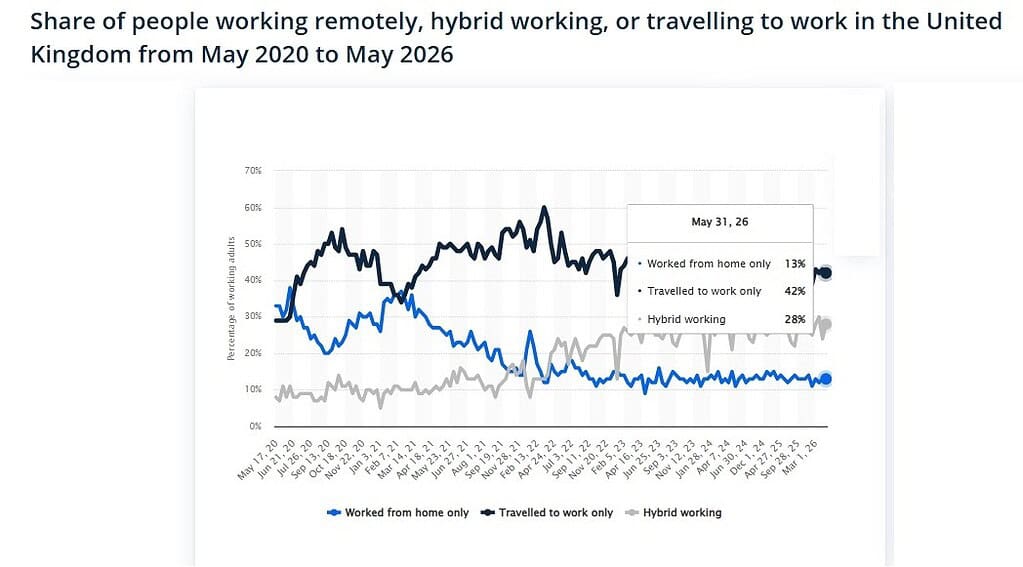
- According to D. Clark (June 2026), in May 2026, about 13% of people in Great Britain worked exclusively from home, but 28% also worked from home while still traveling to the workplace, so hybrid arrangements turned out to be more than twice as common as fully remote work.
- At the same time, 42% of workers went to the workplace only, which basically says that the old office-centred model is still the largest single work setup.
- The portion of employees working only from the workplace hit 60% in March 2022, while fully remote work was at its peak in June 2020.
- Hybrid work had its own high point in November 2023, when 31% of respondents said they worked in a hybrid arrangement, according to D. Clark (June 2026).
- As of April 2026, just 6% of employees aged 16–29 worked mainly from home, while 15% of workers aged 30–49 did, and 16% of those aged 50–60 did too, which suggests that older employees may be better positioned to take advantage of these flexible setups.
- In 2020, more than 50% of workers in agriculture mostly worked from home, which is the highest figure among the industries, but only 6% of employees in accommodation and food services worked remotely, making that sector the least flexible one.
- Flexible working keeps on expanding across UK organizations, and honestly, it’s kind of hard to miss. A 2023 survey said 62% of employers give either regular or ad hoc work-from-home setups, and that makes it the most common flexible working policy.
- On top of that, flextime is showing up more, with the number of people able to shift their working hours climbing from 3.2 million back in 2013 to roughly 4.4 million by 2025.
- Also, 41% of UK workers reported that flexible work makes the commute feel way more manageable, so there’s this practical payoff that helps explain why adoption has kept going.
- The numbers suggest hybrid work is now staying put as a real part of the UK labor market. It seems to be powered by steady employer uptake, more kinds of flexible arrangements, and ongoing employee pressure for more control over where and when work happens.
Hybrid Work Trends And Statistics Shaping The Future Of The Global Workforce
- Hybrid work has moved out of the “temporary fix” category into something closer to a long-term business plan, and global data pretty much backs that up. The most recent workforce figures show that 53% of employees who can work remotely are now using a hybrid pattern.
- Meanwhile, 27% are fully remote, and only 20% remain entirely on-site.
- 80% of knowledge workers get some sort of flexibility, according to Gallup. That kind of change feels pretty major in terms of modern employment.
- Globally, hybrid work is still gathering speed. Findings tied to the Survey of Working Arrangements and Attitudes (SWAA) indicate that employees in 35 countries work an average of 1.4 days from home each week.
- People in English-speaking nations average 1.7 remote days, which signals that hybrid work is not just a phase, but a continuing feature of the international labor market, in a practical sense too.
- A 2024 Nature study, conducted at Trip.com by researchers including Stanford economist Nicholas Bloom, kind of found the strongest evidence for hybrid work. It references a Nature randomized controlled trial with 1,612 employees, and the results showed no measurable decline in productivity, performance reviews, or even promotion rates.
- In other words, employees working three days in the office and two days remotely didn’t seem to lose ground, at least based on the trial.
- The same study also said there was a 33% reduction in employee quit rates, so flexible work arrangements really do help with workforce retention, in practice.
- According to the Flex Index, 75% of companies that now have hybrid policies require structured office schedules.
- The three-day office model is used by something like 40–44% of organizations, so it’s not just a niche approach. Employee demand backs it up, too.
- According to Owl Labs, 83% of workers prefer a mix of remote and in-office work. Meanwhile, 40% would start looking for a new job if workplace flexibility disappeared.
- 22% said they would want higher compensation, and 5% would resign right away, no waiting around.
- On top of that, economic research from the SWAA suggests employees effectively value hybrid flexibility at about 8% of their yearly salary.
- So, many people are willing to accept an equivalent pay decrease, just to keep remote working privileges. This kind of frames flexibility as a competitive advantage for both talent acquisition and retention.
- Kastle Systems reports that Tuesday through Thursday are the busiest office days, with mid-week occupancy reaching nearly twice that of Mondays and Fridays.
- Overall office utilization has more or less plateaued around 50% of pre-pandemic occupancy, which suggests hybrid work has really changed the way physical office space gets used.
- According to Robert Half, 24% of new job postings in Q4 2025 were advertised as hybrid, and that’s a lot higher than the 9% reported in early 2023. In the same window, fully remote job postings climbed from 10% to 15%.
- Taken together, these numbers imply flexible work has become a central part of recruitment strategies, not just a side option.
Hybrid Work Adoption Increases With Seniority Levels
| Seniority Level | Hybrid Postings | Remote Postings |
| Senior / Executive | 31% | 14% |
| Mid-Level | 25% | 12% |
| Entry-Level | 18% | 10% |
(Source: makerstations.io)
- Hybrid work opportunities keep expanding, and with that, career progression seems to show up more often too, meaning workplace flexibility is kind of easier to access at senior levels than at entry-level.
- According to Robert Half’s Q2 2025 Job Posting Analysis, 31% of senior and executive job postings included hybrid work, while 14% were fully remote, so it turns out senior professionals are the biggest recipients of these more flexible arrangements.
- For mid-level roles, it looks like 25% of postings were hybrid and 12% were remote, which shows the pattern is pretty consistent among experienced talent.
- Meanwhile, entry-level positions had 18% hybrid options and 10% remote roles, and that split really points to a gap in flexibility when people are just starting, or at least that’s what the numbers imply.
- Once employees move closer to leadership roles, access to hybrid and even remote work tends to rise, and it suggests companies are still placing real weight on flexibility for seasoned teams and senior decision-makers.
AI Adoption In Hybrid Work In 2026
- Artificial intelligence is now sliding into the hybrid workplace as a central piece, and employee adoption keeps speeding up.
- According to the Owl Labs 2025 U.S. Survey, 80% of employees say they are using or trialing AI tools at work, up from 72% in 2024. That’s an 8-percentage-point lift, within a single year. This kind of growth suggests AI isn’t just for early tests anymore; it’s becoming a normal productivity method for day-to-day work, even if people started off cautiously before.
- In the survey, 27% of employees now use AI tools every day to automate routine tasks and make things run faster, kind of showing how AI is becoming part of regular work activities.
- 64% of employees say their organizations actively support AI implementation in 2025, compared with 62% of workers in 2024 who reported using AI on their own without much encouragement from the company, as Owl Labs noted.
- The survey found that 51% of employees are open to using AI avatars during meetings, which suggests more acceptance of AI-assisted communication, especially in hybrid settings where everyone’s mixed in and out.
- 56% of Gen Z leaders think digital tools will shape the future of hybrid work, versus only 34% for Baby Boomers, according to the Owl Labs 2025 Survey.
- Overall, the numbers suggest that AI adoption is getting embedded in hybrid work for real, with higher day-to-day usage, stronger company backing, and more confidence.
The Cost Savings and Real Estate Impact Of Hybrid Work
- The financial advantages of hybrid work have become more and more measurable, savings that can stretch past the obvious cut in office space.
- Global Workplace Analytics says that employers can average about USD 11,000 per employee each year if workers spend two to three days per week working remotely.
- Global Workplace Analytics estimates that the average U.S. office space costs around USD 18,000 per employee annually. Then, if companies adopt 40–50% desk sharing, those expenses can drop in a noticeable way.
- Fortune also noted that organizations may cut as much as 50% of their real estate costs with hybrid work.
- Cisco is an example that people love to cite; it managed a 50% drop in its real estate footprint, which translated into roughly USD 500 million in savings.
- Global Workplace Analytics estimates that if 50% of the U.S. workforce in telework- compatible roles worked remotely half the time, the economy could produce more than USD 700 billion each year. That figure includes over USD 500 billion in business savings alone.
- Separate company case studies back up the same story: IBM saving USD 50 million, Sun Microsystems lowering yearly real estate costs by USD 68 million, and McKesson reporting about USD 2 million in annual savings.
- According to the Kastle Systems Back-to-Work Barometer, average office occupancy hit 55.2% in June 2026, while premium A+ buildings logged 78–79% weekly occupancy, and peak daily occupancy went past 90% too.
- Still, Fortune points to Kastle Systems, saying overall market occupancy should probably hover around 60%, so it looks like office space is still underused a bit.
- Harvard, Stanford, and Global Workplace Analytics say businesses can save as much as USD 11,000 per hybrid employee each year.
- Employees get benefits that are basically like an 8% salary bump, mostly from less commuting time and cost.
- Vena Solutions adds that highly remote work setups may generate at least USD 20,000 in annual savings per employee, and around 60% of employees say productivity is higher in hybrid or remote roles.
- So in general, these figures suggest hybrid work brings real monetary value, lower operating expenses, better office utilization, meaningful real estate savings, and stronger workforce performance.
Conclusion
Hybrid work has really taken hold as a durable workplace approach, not just some stopgap reacting to shifts in business conditions. Most studies keep showing that flexible work helps with employee retention, keeps output steady, cuts down operational costs, and speeds up digital transformation. At the same time, many organizations are pouring effort into AI-driven coordination, cybersecurity protections, and smart workplace tools, so remote and in-person teams can actually function as one.
And as hybrid models keep maturing, companies are also rethinking their office layouts, adjusting real estate spending, and using more structured in-office days that try to keep the benefits of face-to-face teamwork while still leaving room for agility. In short, businesses that lean into hybrid work are better prepared to lure talent, raise day-to-day satisfaction, trim expenses, and stay sharp against change in the global workforce landscape.
FAQ
About 83% of employees say they prefer a blend of remote work and in-office time.
Organizations can often save roughly USD 11,000 per employee each year.
It’s projected to reach USD 21.1 billion by 2032, growing at an 18.3% CAGR.
Evidence suggests hybrid work does not create meaningful negative effects on productivity or career progression.
Roughly 80% of employees use or test AI tools to boost productivity at work.