









Introduction
Field Marketing Statistics: By 2026, field marketing had turned into an accountable, revenue-generating channel from a field-based approach. Field activities like trade shows, regional events, roadshows, executive dinners, conferences, customer meet-ups, product demonstrations, and account-based activation have gained more popularity among companies for pipeline development. According to the PQ Media 2026 report, experiential expenditures are expected to rise by 10.3%, with B2B experiential spending expected to climb by 8.9%.
The crucial factor for field marketers is that investments would generate qualified conversations, account engagement, opportunities, pipeline acceleration, revenue, and customer expansion, rather than just companies being willing to spend more on live events. According to the Bizzabo research, 78% of organizers claim that in-person conferences and summits are the best marketing channel for the companies.
Editor’s Top Choice
- The B2B experiential industry improved to $41.7 billion in 2025, up 9.7% compared to last year, and the growth is estimated at 8.9% in terms of 2026;
- 78% of organizers regard in-person conferences, summits, and conventions as their most successful marketing channel.
- 40% of organizers plan to increase event volume in 2026.
- 45% employ anywhere from one to three employees in terms of event teams,
- Most successful organizations hold around 25 events in one year, having 412 registrations for them and an average of 269 participants.
- In 2026, in terms of number of event planners, the ROI decreased from 70% in 2025 to 40%.
- Dynamic registration flows result in a 24.4% conversion rate, as opposed to 11.6% for traditional ones.
- Out of all respondents, 61% of planners witness a significant increase in the number of webinar participants, whereas 53% said attendees are going to participate in more webinars in 2026.
- Around 82% of event organizers create video-on-demand content based on events, with 53% using part of it.
- Virtual attendees spend an average of 46 minutes attending sessions, showing 71% of all sessions.
- Freeman’s research states that 95% of attendees decide to trust the brands more.
- 87% of professionals are keen on receiving additional information about the brands they visited after attending a live event.
- Forrester found 2/3rd of companies use their event operations, which are connected to other sales and marketing tools, which is an increase.
The Global Field Marketing Opportunity Is Expanding
- The term “field marketing” encompasses certain elements of various types of marketing such as experiential, exhibition, trade shows, roadshows and account-based marketing.
- The whole phenomenon of B2B experiential marketing gives the closest understanding of its market value.
- PQ Media Global B2C & B2B Experiential Marketing report forecast 2026-2030: businesses have spent 138.9 billion dollars on experiential marketing in 2025, representing an increase of 58.3% compared to the figure for 2020, with a CAGR of 9.6%.
- 41.7 billion dollars correspond to B2B marketing, while the rest is accounted for by B2C marketing, showing that the B2B sector showed the highest growth in this context in 2025 (increased by 9.7% compared to the earlier 7.7% record of the B2C segment).
- In 2026, PQ Media is going to see another growth in B2B experiential marketing spending by approximately 8.9%.
- With the rise in B2B marketing spending with regard to the previous year, estimate that the B2B marketing market value is going to be approximately equal to 45.4 billion dollars in 2026, a derived estimate rather than a separately published PQ Media market-size figure.
- Organizations increasingly view face-to-face engagement as a strategic acquisition and relationship channel rather than merely an awareness expense.
Field and Experiential Marketing
- PQ Media and Statista calculate that spending on such marketing will be equal to approximately $128.35 billion worldwide in 2024, which means 10.5% growth compared to the previous year, showing that companies continue to invest quite a lot of money in face-to-face interactions.
- The data regarding responses from consumers shows evidence presented by G2 that 85% of consumers are likely to purchase after taking part in a live marketing event.
- G2 research study recommends that 91% of people admit that experiential marketing does make them more willing to buy, but when taken together, both facts prove that physical interaction with a brand matters.
- Experiential marketing can also play a role in establishing the relationship with customers on a long-term basis.
- G2 research states that around 70% of customers tend to become repeat customers after having an experience with a brand in person.
- An EventTrack survey of Fortune 1000 marketers mentioned by G2 says that roughly 74% of marketers expect to increase experiential marketing spending in 2025.
- Strong spending growth, high purchase intent, and potential repeat-customer value, although individual campaign results can vary by execution, audience, and industry.
Event (Field) Budget, Resourcing and ROI Benchmarks for 2026
- In 2026, event marketing indicates changes in the process from enhancing budget to efficiency, scalability, and measurable results.
- According to a Bizzabo report, 40% believe that the budget will rise further, while 40% also think that the budget will not change at all, and 20% expect that the budget will fall further.
- This growth showing the idea that many teams are operating in conditions of the strict budget rather than the idea of expansion of the budget.
- Bizzabo report states that 45% of event specialists are working with only 1-3 members of the crew, which makes the technology distribution and the use of repeatable processes more critical.
- Despite small teams, effective companies are organizing about 25 events a year, making 412 registrations and 269 attendees per event, with about 52% visits.
- According to the data from Bizzabo, 40% of event managers have difficulty in proving the ROI of events in 2026, but this is a high advancement in comparison to 70% in 2025, pointing to the fact that confidence in the measurement of event performance is increasing.
- Overall visit-to-registration conversion reached 21.5%, while dynamic registration flows reached 24.4%, compared with 11.6% for static flows.
- Field marketers are increasingly expected to do more with limited resources while proving business impact beyond attendance, including pipeline, sales velocity, and retention.
Virtual, Webinar and Hybrid Event Statistics 2026
- Virtual, webinar, and Hybrid trends indicate that they have become part of event marketing rather than acting merely as substitutes for offline events.
- According to Bizzabo’s survey, 53% of event participants will attend more virtual events in 2026, while 61% of event organizers noted annual growth in the number of webinars attended.
- Bizzabo’s research shows that 82% of event organizers use video-on-demand content from events, while 53% place restrictions on access to this type of content, allowing companies to make use of the previous live event, even after it has finished.
- Virtual attendees would complete 71% of the session, which takes around 46 minutes on average.
- According to the Bizzabo analysis, only 63% of events were offline, 33% were virtual, and 4% were hybrid.
- The organizations are choosing formats based on specific objectives rather than automatically combining physical and digital experiences.
- Overall, 2026 shows that a balanced event strategy- showing webinars provide ongoing engagement while in-person events remain the dominant format and hybrid is used selectively.
Field Marketing Statistics: In-Person Events Strengthen Brand Trust
- Field marketing is gaining importance in the quest for brands to establish trust and engage more effectively than solely through digital channels.
- The 2025 Freeman study, which was carried out by The Harris Poll, indicates the efficiency of in-person marketing as a field-marketing channel, having discovered that as many as 95% of participants trust brands more after immersion in in-person events, showing that the strength of face-to-face events lies in their ability to raise brand trustworthiness and credibility.
- An interesting fact is that most brands (71% of them) were experiencing declining of reputation through various channels, whereas in-person events tend to deliver the opposite results, thus suggesting that events have good prospects.
- Live events (field shows) are credited by as many as 92% of professionals positively because they feel that their perception of brands improved due to the experience.
- According to the research, for the eagerness to interact with products online, 87% of professionals pay attention to a particular brand, showing higher chances for brands to generate more demand online.
B2B Event Marketing Statistics 2026 (Forrester’s Survey)
(Source: forrester.com)
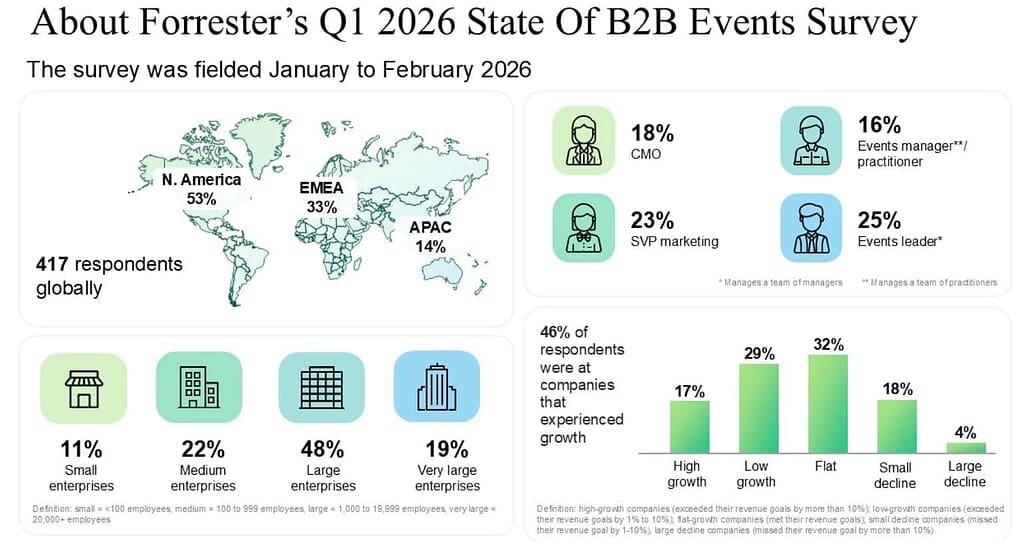
- Forrester’s Q1 2026 State of B2B Events Survey says B2B event teams are working in a tighter and more number-led setting.
- The study had 417 respondents in total; 53% were in North America, 33% in EMEA, and 14% in APAC.
- There were 25% event leaders, 23% SVP marketing executives, CMOs made up 18%, and event managers and other practitioners were 16%.
- 48% said they worked at large enterprises, 22% came from medium enterprises, 19% were from very large enterprises, and 11% were from small enterprises.
- For budget control, 46% of people were from firms seeing growth, 29% said growth was low, 32% reported flat growth, 18% saw a small decline, and 4% saw a large decline.
- The portion of groups raising event budgets by more than 10% has doubled since last year, while about two-thirds have flat budgets or lower budgets; because of that, nearly 70% are cutting the event count and putting more focus on the attendee experience.
- Many respondents plan to grow smaller networking events and in-person events under 200 attendees. Only 18% plan more big hosted events.
- On the virtual side, most of the groups planning more virtual events have grown two times year over year, reflecting that digital options are being seen again as a practical way to reach more people.
- Around two-thirds of organizations plan more workshops, roundtables, and structured networking, and more than half say they want net new lead generation as the main goal for their events.
- The top strategic goals picked by over 90% of groups are getting more audience reach, getting more value from event data, and showing clear impact.
- About two-thirds say they connected their main event platform with their sales and marketing tools, and that is up 44% from last year. Adoption in key event tasks has grown twofold. Still, under 25% say they use AI to tailor experiences for attendees, and most of the rest point to data quality and access as the main issue.
AI-Powered Field Marketing and Event Networking in 2026
- AI is shifting field marketing away from manual outreach and pushing toward experiences that are more tied to real data.
- The best uses of AI-Powered Field Marketing bring together registration details, account info, past activity, session actions, and CRM data that attendees agreed to share. Then the system can help with matchmaking, suggest agendas, set up meetings, and improve follow-up.
- In B2B events, AI can spot useful buyer-to-seller links and peer groups by looking at things like job role, industry, seniority, business problems, and buying goals.
- It can also react to what people do during the event, which helps attendees find sessions, sponsors, and networking chances that fit them. It does not rely on one-size-fits-all picks.
- Forrester found that 25% of groups now use AI for personalised attendee experiences, while 63% cite data quality and access as a blocker.
- Earlier Forrester work put AI use for attendee experience at around 7% to 15%, so overall, the trend looks like it is still in the early stages.
- AI will matter more when data is well kept, privacy is handled, recommendations can be understood, people review the work, and results can be counted.
- The count outcomes include meeting quality, the number of good leads, how much the pipeline moves, and whether revenue changes.
Field Marketing Measurable Growth Strategy
- Field marketing in 2026 is growing differently, as it is less about hosting more events.
- Marketers want each program to pay off in a clear way, which means events must link to digital work, pointing to tighter ties to ABM plans, partners, sales teams, and customer success.
- Events can now help marketers understand which accounts are actively researching solutions, involve several decision-makers, build trust, and support opportunities through longer B2B buying cycles.
- Forrester points to event teams are under more pressure to show real business impact, and Gartner also keeps pushing for better tracking and smarter use of budget.
- Strong field marketing programs need to show how engagement contributes to pipeline, revenue, account progression, and customer relationships. In 2026, the most effective approach is therefore selective, connected, and data-driven, helping marketing teams defend investment with clearer commercial evidence.
- In 2026, the best path is to be selective, to connect the event to other channels, and to use data to back up claims. That gives marketing teams a stronger case when they ask for continued spend.
Conclusion
In 2026, field marketing is playing a clearer role in B2B growth. Budgets are still strong, but teams are now focused on getting more from each activity, better engagement, and stronger business results.
Live meetings continue to lead, while webinars and short video sessions help keep value going once the event ends and also support campaigns on digital channels. Measurement is improving, although 40% of organizers still struggle to prove ROI. About 40% of event organizers say it is hard to prove results. Tools are improving too. Technology integration and AI are advancing, but data quality remains a key problem.
The best programs link events with sales efforts, ABM work, digital campaigns, and customer records, using clear metrics for engagement, pipeline, and revenue results that support the investment.
FAQ
78% say in-person events are the most impactful channel.
It is expected to grow by 8.9% in 2026.
40% of organizers still struggle to prove event ROI.
Dynamic flows reach a 24.4% visit-to-registration conversion rate. Static flows reach 11.6%.
Fewer than 25% of organizations use AI for personalized attendee experiences.