









Overview
AI In Lending Statistics: Artificial intelligence is transforming the lending industry by helping banks, credit unions, and fintech companies make faster and more informed credit decisions. AI tools are now used for loan underwriting, fraud detection, borrower-risk assessment, document processing, customer support, loan pricing, and portfolio management. The growth reflects increasing investment in automated lending tools that can improve efficiency, reduce manual work, and support more personalized loan offers.
This article on AI in lending statistics covers market growth, adoption trends, major use cases, business benefits, company developments, and the risks lenders must manage. While AI can improve efficiency, fraud prevention, and access to credit, lenders must also maintain strong model governance, data controls, cybersecurity, and fair-lending practices.
Key Takeaways by the Editor
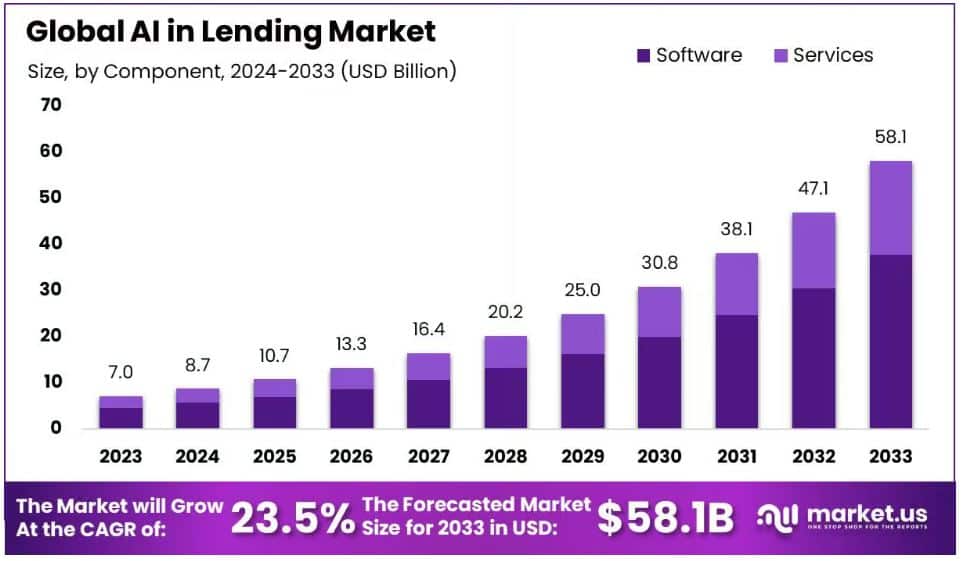
- Global AI in lending market projected to grow from USD 7.0 billion in 2023 to USD 58.1 billion by 2033, a 23.5% CAGR.
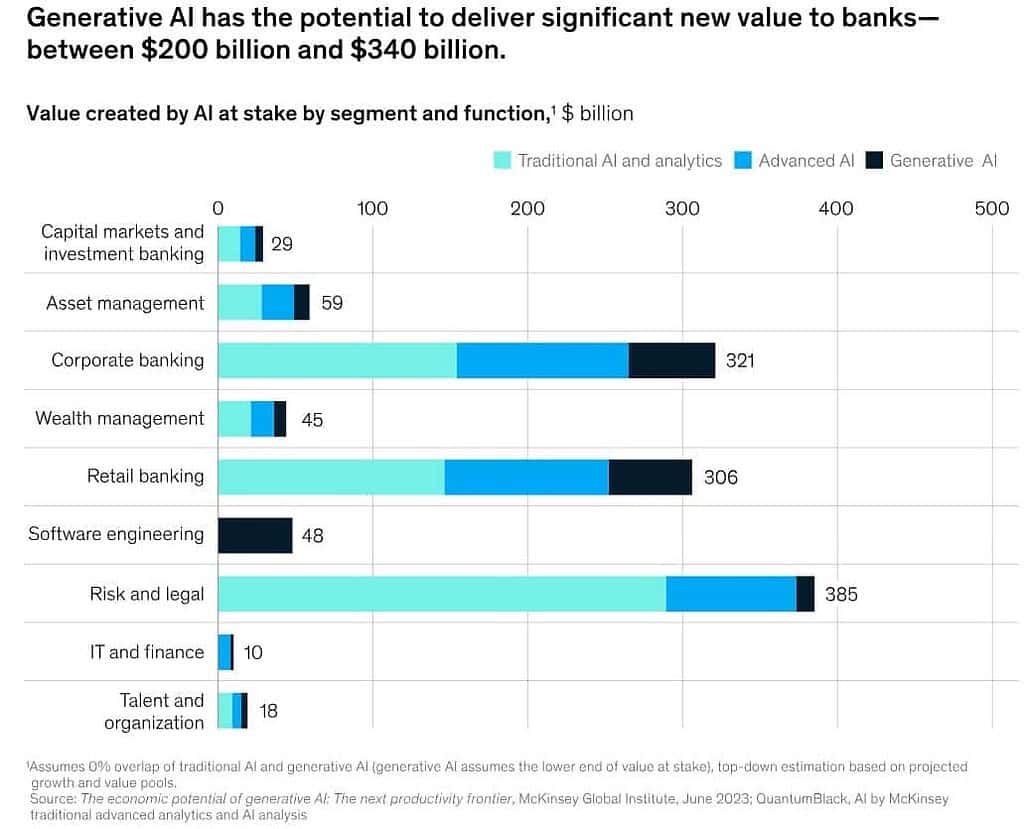
- McKinsey estimates generative AI could create USD 200 billion to USD 340 billion in additional value for banks.
- Risk and legal functions hold the largest AI value potential for banks at USD 385 billion.
- AI-powered tools such as optical character recognition and natural language processing can automate up to 90% of manual loan-application tasks.
- AI can eliminate up to 75% of manual credit-decisioning work by auto-approving low-risk loan applications.
- Virtual assistants powered by large language models can handle more than 50% of borrower interactions and lift service-level performance by 20% or more.
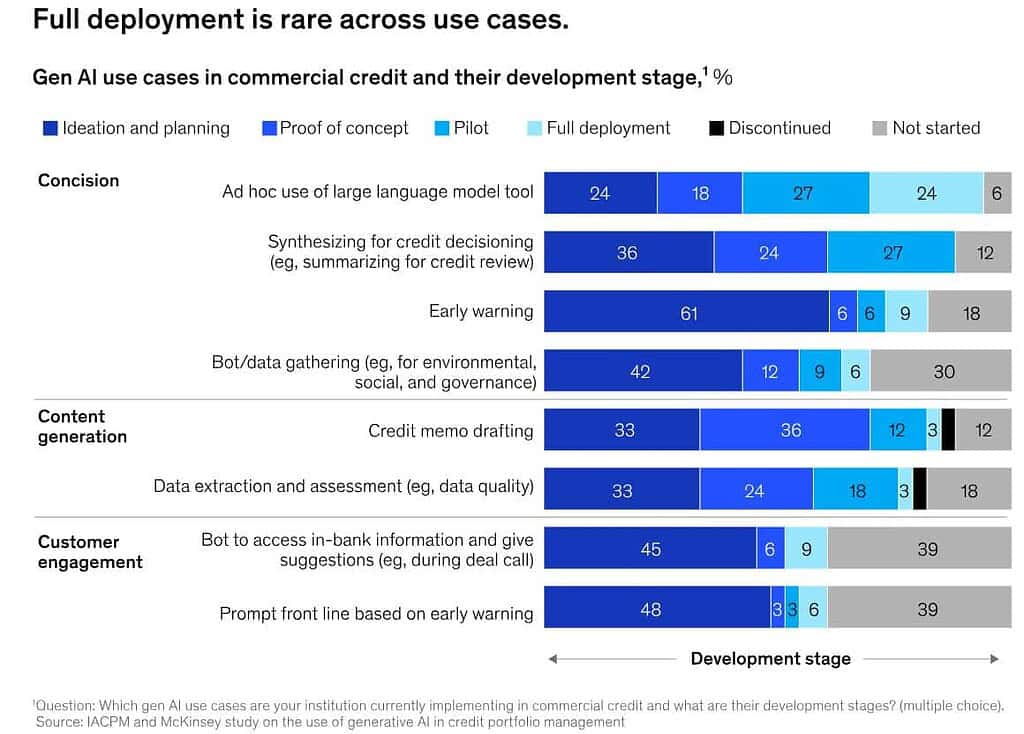
- For credit-decisioning summaries, 36% of institutions remain in ideation and planning, while 27% are running pilots.
- Affirm has extended more than USD 100 billion in loans to over 50 million consumers and saved them USD 387 million in late fees.
Global AI in Lending Market Growth
(Source: market.us)
- The global AI in lending market was valued at USD 7.0 billion in 2023.
- The market is expected to grow to USD 8.7 billion in 2024, USD 10.7 billion in 2025, and USD 13.3 billion in 2026.
- By 2033, the global AI in lending market is expected to reach USD 58.1 billion.
- From 2023 to 2033, the market is projected to grow at a compound annual growth rate of 23.5%.
Generative AI’s Value for Banks
- Generative AI could create between USD 200 billion and USD 340 billion in additional value for banks.
- Risk and legal functions have the largest overall AI value potential at USD 385 billion, including value from traditional AI and analytics, advanced AI, and generative AI.
- Corporate banking could generate USD 321 billion in value from AI technologies.
- Retail banking could create USD 306 billion in AI-related value.
- Asset management could gain USD 59 billion in value through AI adoption.
- Software engineering could generate USD 48 billion in value from AI.
- Wealth management could create USD 45 billion in AI-related value.
- Capital markets and investment banking could generate USD 29 billion in value.
- Talent and organization functions could create USD 18 billion in value, while IT and finance could generate USD 10 billion.
(Source: mckinsey.com)
Generative AI Adoption in Commercial Credit
- For ad hoc use of large language models, 24% of institutions are in ideation and planning, 18% are at the proof-of-concept stage, 27% are running pilots, 24% have achieved full deployment, and 6% have not started.
- For credit-decisioning summaries, 36% of institutions are in ideation and planning, 24% are testing proofs of concept, 27% are running pilots, and 12% have not started. The chart does not show a meaningful full-deployment share for this use case.
- For early-warning systems, 61% of institutions are in ideation and planning, 6% are at the proof-of-concept stage, 6% are running pilots, 9% have fully deployed the technology, and 18% have not started.
- For bots that collect environmental, social, and governance data, 42% of institutions are in ideation and planning, 12% are at proof of concept, 9% are running pilots, 6% have full deployment, and 30% have not started.
- For credit-memo drafting, 33% of institutions are in ideation and planning, 36% are at proof of concept, 12% are running pilots, 3% have fully deployed the technology, and 12% have not started.
- For data extraction and assessment, including data-quality checks, 33% of institutions are in ideation and planning, 24% are at proof of concept, 18% are running pilots, 3% have achieved full deployment, and 18% have not started.
- For customer-engagement bots that access internal bank information and provide suggestions during calls, 45% of institutions are in ideation and planning, 6% are at proof of concept, 9% are running pilots, and 39% have not started.
- For prompt-based front-line support using early-warning data, 48% of institutions are in ideation and planning, 3% are at proof of concept, 3% are running pilots, 6% have full deployment, and 39% have not started.
(Source: mckinsey.com)
How AI Is Used in Lending
- AI helps lenders personalize loan offers by analyzing a customer’s digital footprint, such as spending patterns and online behavior. This can improve customer retention and help lenders generate more revenue.
- AI-powered tools such as optical character recognition, natural language processing, and image analysis can automate up to 90% of manual loan-application tasks. This can make loan processing faster and more accurate.
- AI can help prevent fraud by identifying identity theft, employee fraud, customer fraud, and payment fraud. It can also detect know-your-customer and anti-money-laundering violations before they cause financial losses.
- AI evaluates borrower risk profiles and creditworthiness more accurately. It can support financial inclusion and improve loan-approval rates by up to 30% while keeping credit risk low.
- AI can automatically approve low-risk loan applications without manual review. It can eliminate up to 75% of manual credit-decisioning work, speed up loan approval, and improve borrower satisfaction.
- AI helps lenders set competitive and profitable loan prices by analyzing borrower risk, marketable credit rates, expected gains, price elasticity, and a borrower’s ability to pay.
- Virtual assistants powered by large language models can handle more than 50% of borrower interactions and support customer service 24/7. They can also reduce the time spent on repetitive, high-value tasks and improve service-level performance by 20% or more.
- AI gives lenders a real-time view of loan-portfolio risk. It can recommend actions such as early debt collection, loan extensions, restructuring, or loan sales to improve portfolio profitability and reduce losses.
Recent AI in Lending Developments
- On January 16, 2026, Pagaya closed a USD 350 million asset-backed securitization backed by consumer loans originated through its AI-driven network; the transaction includes a 24-month revolving period.
- On January 26, 2026, Pagaya signed a forward-flow agreement with Sound Point Capital Management for the purchase of up to USD 720 million in point-of-sale loans sourced through Pagaya’s platform.
- In 2026, Upstart reported that its AI lending marketplace connects millions of consumers with more than 100 banks and credit unions that use its AI models and cloud applications for credit products.
- On December 17, 2025, Tech CU partnered with Upstart to provide personal loans and prepare for auto-refinance lending in early 2026; Tech CU has nearly USD 5 billion in assets and serves more than 177,000 members.
- On November 4, 2025, Zest AI completed an oversubscribed customer-led funding round led by five investors: SchoolsFirst, Members 1st, ORNL, Truliant, and Citi Ventures.
- On August 13, 2025, ABNB Federal Credit Union announced a personal-loan partnership with Upstart after joining its referral network in May 2025; ABNB serves more than 76,000 members nationwide.
- On May 28, 2025, All in Credit Union partnered with Upstart to offer AI-enabled personal lending; the credit union serves about 200,000 members and has USD 3.6 billion in assets.
- On April 30, 2025, Affirm launched AdaptAI, an AI-powered promotions platform that gives consumers personalized financing offers, including special APRs, repayment terms, and instant cash savings.
- In 2025, Affirm reported that it had extended more than USD 100 billion in loans to over 50 million consumers since its founding and saved consumers USD 387 million in late fees through its underwriting approach.
Closing Statement
AI is transforming lending by improving credit scoring, fraud detection, underwriting speed, and loan pricing across banks, credit unions, and fintech companies. Adoption of generative AI and automated decisioning is accelerating, unlocking substantial value across corporate banking, retail banking, and risk functions, though institutions still face early-stage adoption in several use cases and must maintain strong governance, fairness, and data controls to manage risks.
FAQ
AI in lending refers to the use of machine learning, predictive analytics, and automation by banks and financial institutions to evaluate creditworthiness, process loan applications, detect fraud, and manage risk more efficiently than traditional manual methods.
AI models analyze a wider range of data, including transaction history, income patterns, and alternative data sources, to assess credit risk more accurately, helping lenders extend credit to borrowers who may be overlooked by traditional scoring methods.
AI automates document verification, income assessment, and risk evaluation, allowing lenders to process loan applications faster, reduce manual errors, and make more consistent lending decisions.
AI systems analyze transaction patterns and application data in real time to flag unusual behavior, identity theft, or falsified information, helping lenders catch fraudulent applications before loans are approved.
AI has the potential to reduce human bias by relying on data driven criteria, but poorly designed models can also inherit or amplify existing biases in historical data, making fairness testing and regulatory compliance essential.
Key risks include algorithmic bias, lack of transparency in decision making, data privacy concerns, regulatory compliance challenges, and over reliance on automated systems without adequate human oversight.
AI is expected to automate routine tasks like document processing and initial risk screening, but most experts suggest loan officers will remain important for complex cases, customer relationships, and final decision making rather than being fully replaced.


