









Preface
Cloud Billing Statistics: Cloud services have changed the way businesses manage their IT needs. But as cloud usage grows, keeping track of every expense can become difficult. This is where cloud billing comes in. It helps businesses see how much they spend on cloud resources such as storage, computing, databases, and software. Companies can use billing data to track usage, manage budgets, find unnecessary costs, and make smarter spending decisions. With different pricing plans and usage-based charges, understanding cloud costs is more important than ever.
In this article, we explore cloud billing, how it works, its key benefits, common challenges, and the trends shaping the future of cloud spending.
Featured Choice
- The global cloud billing market is projected to grow from USD 9.71 billion in 2025 to USD 11.63 billion in 2026.
- Global public cloud spending is expected to exceed USD 1 trillion before 2030.
- Public cloud accounted for 66.1% of the cloud billing market in 2025.
- North America generated the highest revenue in 2025, at USD 2,141.88 million.
- The United States led the market with revenue of USD 1,655.65 million in 2025.
- Microsoft’s cloud billing spans Azure, Dynamics 365, and Microsoft 365, with Q3 revenue rising 18% and Q4 reaching USD 90.01 billion.
- SaaS companies typically allocate 8%- 15% of their revenue to cloud spending.
- Cloud bills rose 18% for some organizations in 2026.
- Organizations estimate that 29% of IaaS and PaaS cloud spending is wasted.
- Around 45% of organizations will have a formal FinOps practice in 2026.
- 89% of professionals say limited cloud cost visibility affects their work.
- Cost efficiency and savings are the leading metrics used by 81% of respondents to assess cloud progress.
Cloud Billing Market Outlook
(Source: thebusinessresearchcompany.com)
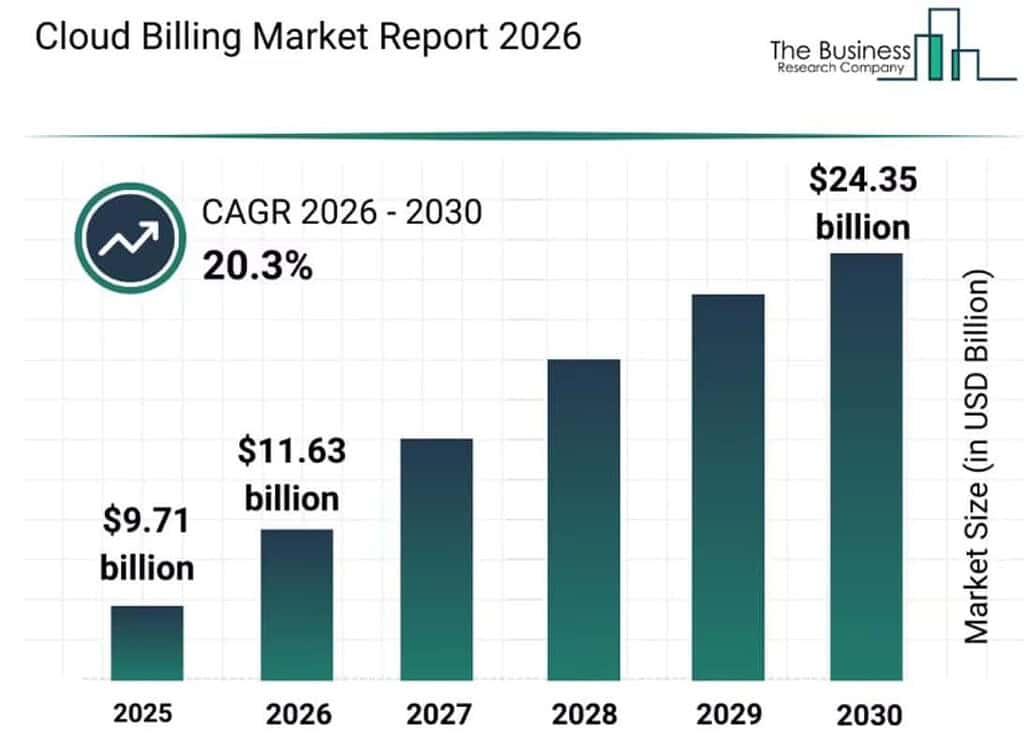
- The global cloud billing market was valued at USD 9.71 billion in 2025.
- The market is expected to reach USD 11.63 billion in 2026.
- By 2030, the market is projected to reach USD 24.35 billion, growing at a CAGR of 20.3% from 2026 to 2030.
- Global public cloud spending is expected to exceed USD 1 trillion before 2030, according to a report shared by OMR Global.
- Subscription and usage-based models generate over 65% of digital service revenue in IT and telecom.
- More than 85% of enterprises are expected to adopt cloud-first strategies by 2030.
Cloud Billing Market Trends by Segment
(Source: mordorintelligence.com)
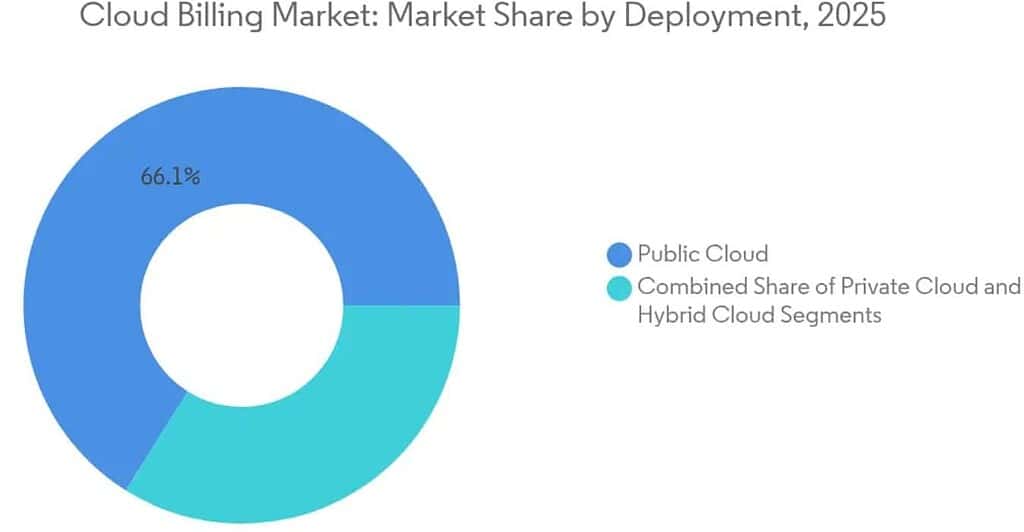
- Mordor Intelligence reported that Public cloud accounted for 66.1% of the cloud billing market in 2025. Meanwhile, hybrid cloud is projected to grow at a 15.81% CAGR through 2031.
- Platforms generated 60.10% of revenue in 2025, and services are expected to expand at a 16.62% CAGR through 2031.
- Subscription billing held 56.60% of the market in 2025. Usage-based billing is forecast to grow at a 15.34% CAGR through 2031.
- Large enterprises generated 60.5% of 2025 revenue, while SMEs are expected to grow at a 16.86% CAGR through 2031.
- SaaS billing accounted for 46.80% of 2025 sales, while PaaS billing is projected to expand at a 16.04% CAGR.
- Retail and e-commerce-led end-user industries accounted for 25.85% of revenue in 2025. Healthcare is forecast to grow at a 15.78% CAGR.
Regional Market Growth
- Future Market Insights noted that in 2025, North America holds 35.2% of the global market, while Europe accounts for 22.4%.
- The United States leads with 23.1%, followed by Germany at 8.8%, Japan at 5.7%, and Australia at 2.1%.
- From 2025 to 2035, India is projected to grow at a 19.1% CAGR, ahead of the United Kingdom at 17.2% and China at 16.3%.
Cloud Billing Statistics: Top Countries by Revenue, 2025
(Source: cognitivemarketresearch.com)
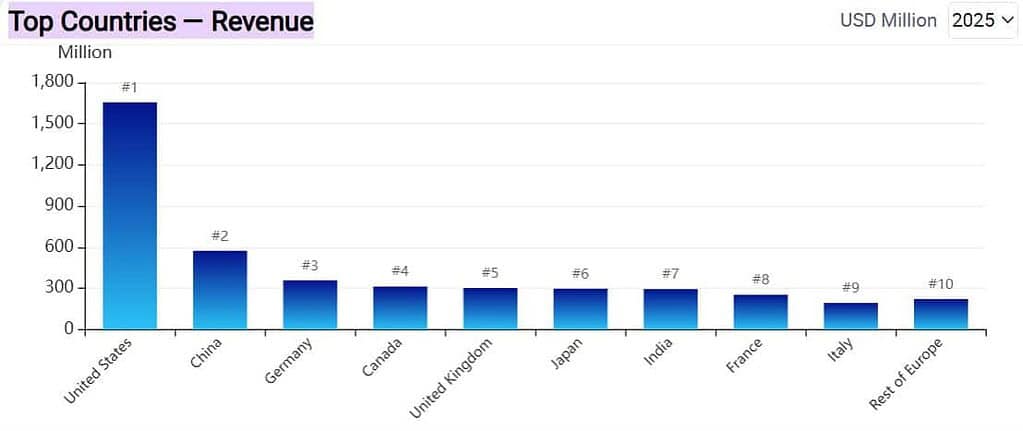
- The United States led the market with revenue of USD 1,655.65 million in 2025, significantly exceeding other countries.
- China ranked second, generating USD 573.796 million, followed by Germany at USD 358.494 million.
- Canada, the United Kingdom, Japan, and India recorded revenues of USD 312.736 million, USD 302.014 million, USD 297.389 million, and USD 294.236 million, respectively.
- France, Italy, and the rest of Europe generated USD 252.886 million, USD 193.276 million, and USD 221.807 million, respectively.
Regional Revenue Breakdown
(Source: cognitivemarketresearch.com)
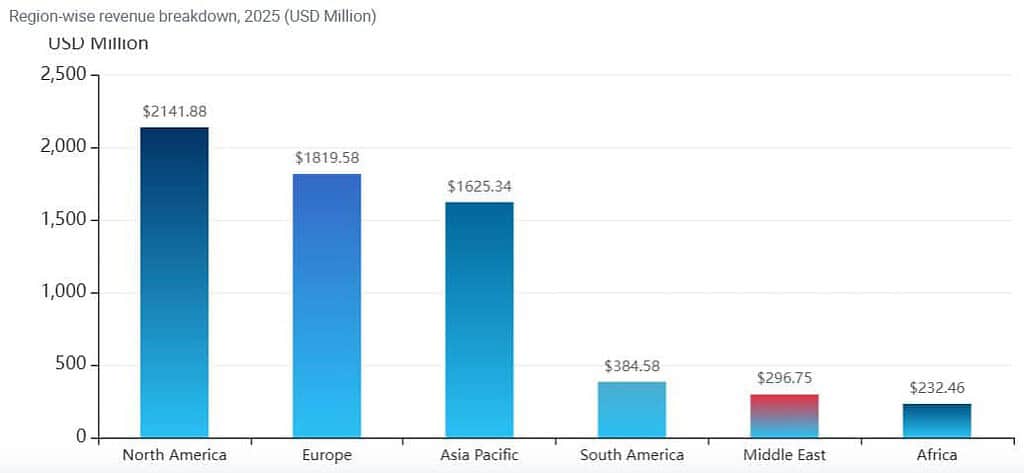
- North America generated the highest revenue in 2025, at USD 2,141.88 million.
- Europe followed with revenue of USD 1,819.58 million, while Asia Pacific recorded USD 1,625.34 million.
- South America generated USD 384.58 million during the year.
- The Middle East and Africa reported comparatively lower revenues of USD 296.75 million and USD 232.46 million, respectively.
Key Companies in Cloud Billing
- Microsoft integrates cloud billing across Azure, Dynamics 365, and Microsoft 365. In 2026, Q3 revenue grew by 18%, while Q4 revenue reached USD 90.01 billion. Its market capitalization in September 2026 was about USD 3.72 trillion.
- Oracle reported 2026 revenue of USD 67.4 billion, up 17%, with cloud revenue at USD 34.0 billion, up 39%. In Q1 2027, cloud revenue reached USD 11.61 billion, up 62%. Market capitalization was about USD 437.11 billion.
- In Q1 2026, SAP revenue reached EUR 9.555 billion, including EUR 5.962 billion in cloud revenue, up 27%. Its 2026 cloud outlook is EUR 25.8-26.2 billion, compared with EUR 21.02 billion in 2025. Market capitalization was about USD 213.82 billion.
- Salesforce revenue in 2026 reached USD 41.5 billion, up 10%, including USD 399 million from Informatica. Market capitalization was approximately USD 191.99 billion.
- AWS generated USD 42.2 billion in Q2 2026 sales, up 37%, representing an annualized run rate of about USD 169 billion. Amazon’s total sales were USD 200.6 billion, up 20%, and its market capitalization was about USD 2.75 trillion.
- IBM reported 2025 revenue of USD 67.5 billion, up 8%. In Q1 2026, revenue reached USD 15.9 billion, up 9%, while software revenue increased 11%. Its 2026 growth outlook was 4%-5%, with a market capitalization of about USD 217.99 billion.
- Zuora was acquired for USD 1.7 billion in 2025 and is privately held in 2026. Its November 2024 quarterly revenue was USD 116.9 million, including USD 105.3 million from subscriptions.
- Chargebee serves more than 6,500 businesses and was valued at USD 3.5 billion after raising USD 250 million in 2022. Its total disclosed funding was about USD 470-475 million.
Industry-Wise Cloud Spending Share
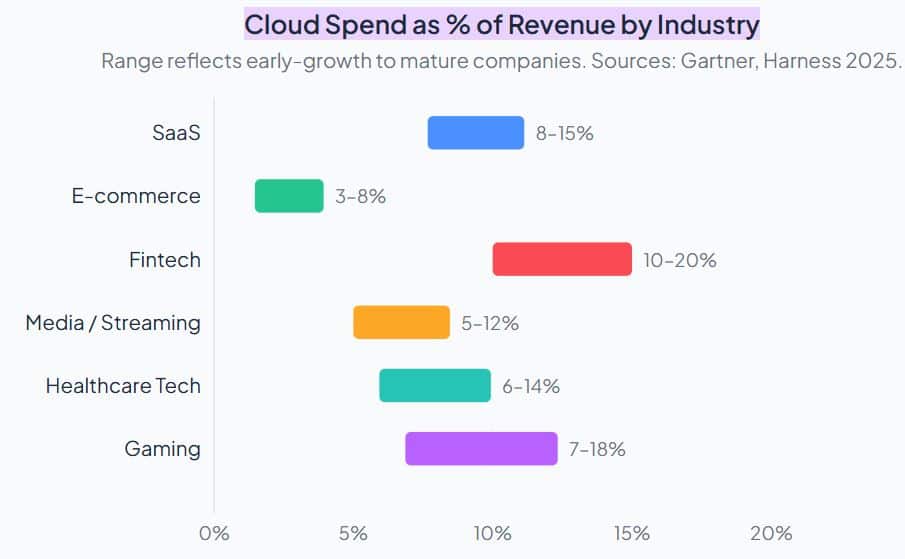
(Source: spendark.com)
| Industry / Company Type | Typical Cloud Spend as Share of Revenue |
| SaaS companies | 8%-15% |
| E-commerce companies | 3%-8% |
| Fintech companies | 10%-20% |
| Media and streaming companies | 5%-12% |
| Gaming companies | 7%-18% |
| SaaS company at USD 1 million ARR | 15% |
| Mature SaaS companies | 8%-10% |
| Efficient public SaaS companies | 4%-6% gross-margin impact |
Cloud Costs in 2026: Where the Money Goes
- According to Rack2cloud, cloud bills rose 18% for some organizations in 2026, even when traffic, users, and applications changed little.
- AWS, Azure, and Google Cloud charge for public IPv4 addresses, creating extra costs for unused or unnecessary addresses.
- Moving data between availability zones can increase expenses. Some companies reportedly spend 30% of their EC2 bill on this traffic.
- Private servers can incur additional data-processing charges. A pipeline moving 500GB of Docker images daily through NAT can increase costs.
- A USD 50,000 EC2 bill could potentially include USD 12,000 in networking-related waste.
Estimated Cloud Spend Efficiency
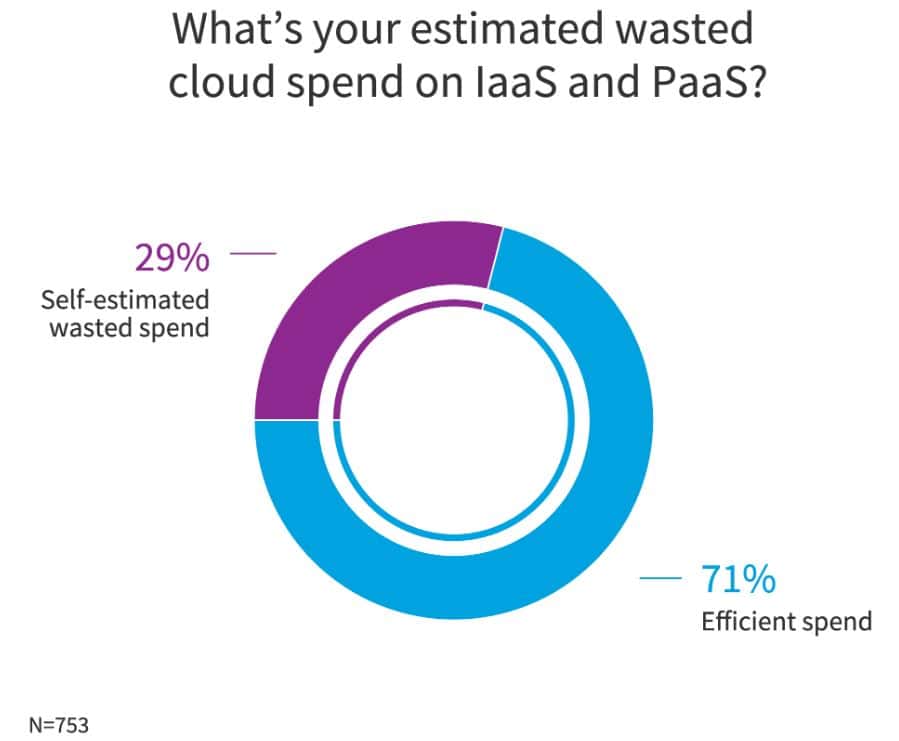
(Source: flexera.com)
- Organizations estimate that 29% of IaaS and PaaS cloud spending is wasted.
- The remaining 71% of cloud expenditure is considered efficient.
FinOps Adoption and Cloud Cost Management
- Around 45% of organizations will have a formal FinOps practice in 2026.
- wring.co research surveyed 1,192 respondents representing more than USD 83 billion in annual cloud spending.
- Organizations spending USD 100 million or more on cloud typically maintain lean FinOps teams.
- These large organizations average 8-10 FinOps practitioners and 3-10 contractors.
- Automation and distributed teams help FinOps groups manage larger cloud environments efficiently.
- 98% of FinOps teams now manage AI spending, compared with 31% in 2024.
- 90% of FinOps teams manage or plan to manage SaaS spending as part of their cost controls.
- 64% manage technology licensing costs, while 57% manage private-cloud spending.
- 48% of FinOps teams also manage data center costs.
- 78% of FinOps teams report to the CTO or CIO.
Strategies to Reduce Cloud Spending
- A report published by Forbes Councils stated that about 89% of enterprises use a multi-cloud strategy.
- Around 89% of professionals say limited cloud cost visibility affects their work.
- 61% do not right-size instances; 71% do not use spot orchestration.
- 58% do not use reserved instances or savings plans. These options can reduce costs by up to 90%.
- 65% plan to include SaaS spending in FinOps, up from 40%.
- Meanwhile, enterprises manage over 130 SaaS subscriptions.
Key Metrics for Measuring Cloud Progress
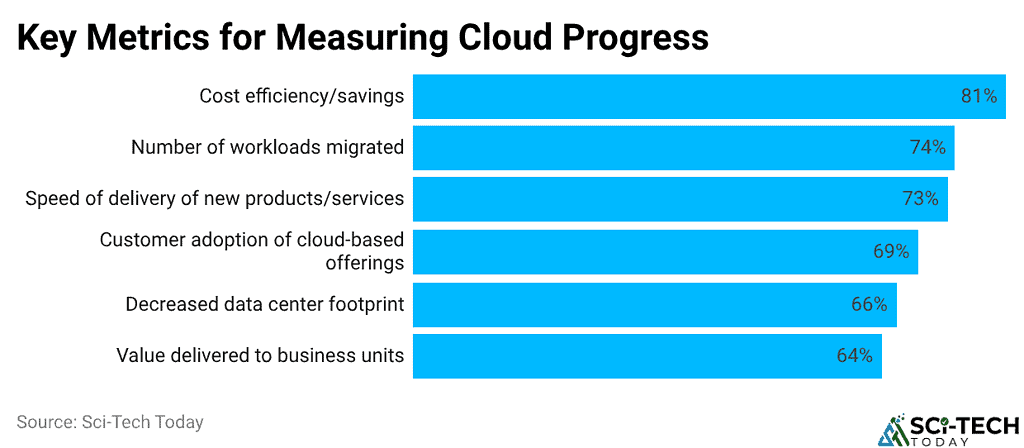
(Reference: flexera.com)
- Cost efficiency and savings are the leading metrics used by 81% of respondents to assess cloud progress.
- 74% track the number of workloads migrated.
- Meanwhile, 73% measure faster delivery of new products and services.
- Customer adoption of cloud-based offerings is monitored at 69%.
- The reduced data center footprint and the value delivered to business units are measured at 66% and 64%, respectively.
Recent Industry Developments
- In April 2026, Google introduced prepay billing for the Gemini API, helping developers control costs and avoid unexpected increases in billing.
- In April 2026, Oracle expanded OCI regions across Asia Pacific, North America, and Latin America to improve data access and reduce latency.
- In March 2026, UGG adopted Aria Billing Cloud, ServiceNow CRM, and Tenon, completing its first deployment in 3 months.
Final analysis
Cloud billing gives businesses a clear view of their cloud expenses. It helps teams track usage, identify extra costs, and manage their budgets more effectively. By checking bills regularly and using cost-control tools, businesses can avoid waste and use cloud resources wisely.
As more companies move their work to the cloud, good billing practices will remain important for keeping costs under control and making the most of cloud services.
FAQ
Google Cloud bills based on your usage of services, resources, data storage, and network traffic.
A Cloud Billing account tracks, manages, and pays for your cloud service usage.
Cloud billing is complex because costs vary across services, usage levels, regions, pricing models, discounts, and hidden charges.

Sources