









Foreword
AI In Retail Statistics: AI is changing the retail industry, from how products are recommended to how stores manage daily operations. Retailers now use AI to understand customer needs, predict demand, manage inventory, detect fraud, and improve customer support. AI-powered tools can also make shopping more personal by suggesting products based on customer interests and past purchases. Generative AI is adding another layer by helping retailers create content, assist shoppers, and automate routine tasks.
In 2026, these technologies are becoming more common across both online and physical stores. For retailers, AI offers new ways to save time, improve efficiency, reduce costs, and deliver smoother shopping experiences.
Top Choice
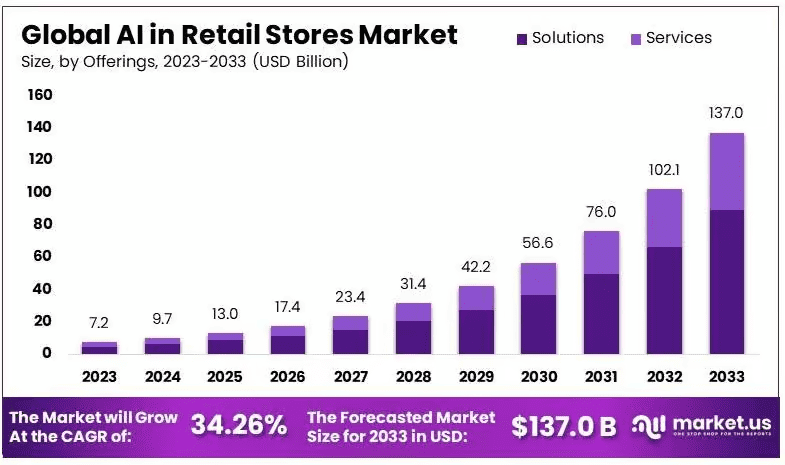
- The market was valued at USD 13 billion in 2025. It is expected to increase to USD 17.4 billion in 2026.
- Retail AI spending is expected to reach USD 19.9 billion in 2026, up from USD 6.4 billion in 2021, at a 25.2% CAGR.
- About 9 in 10 retailers expect higher AI budgets in 2026.
- North America leads global AI retail spending at 39.4%, worth USD 5.90 billion.
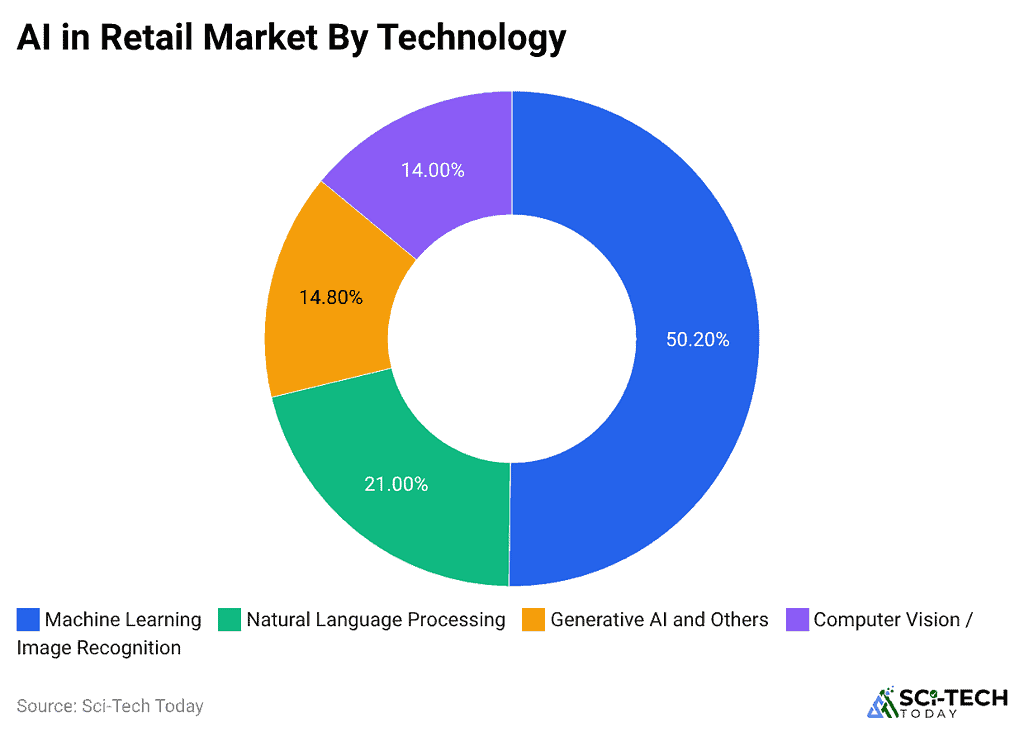
- Machine learning leads with a 50.2% market share in 2026.
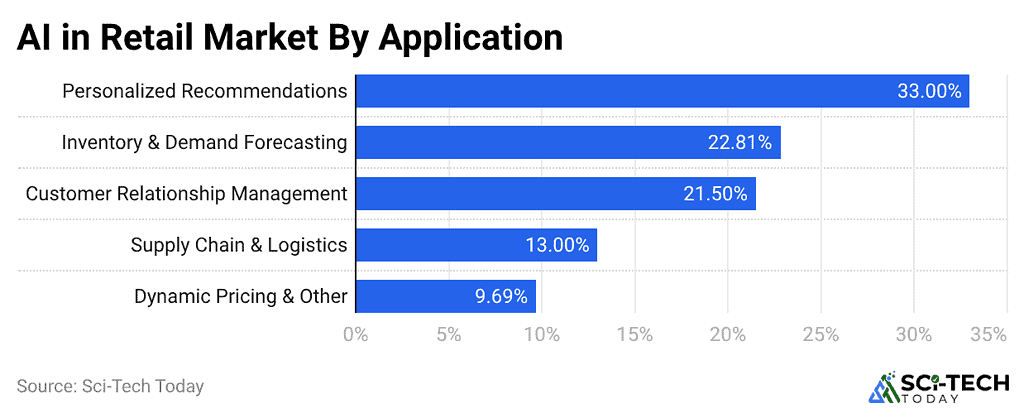
- Personalized recommendations lead with a 33% market share.
- AI adoption helps retailers achieve 2.3 times higher sales.
- As of 2026, 89% of retailers are actively using or testing AI.
- 77% of eCommerce professionals use AI daily across their retail operations.
- Fraud detection and cybersecurity lead adoption, with 64% currently using AI and 29% planning to adopt it within 12 months.
- By 2026, 43% expect generative AI to weaken brand loyalty by emphasizing value and product fit.
- AI personalization can increase retail revenue by 10%-15%.
- The AI customer service market reached USD 15.12 billion in 2026 and is expected to reach USD 47.82 billion by 2030.
- 54% believe AI can provide more personalized service than humans.
- From January to March 2026, AI traffic to U.S. retail sites rose 393% YoY, while March alone saw a 269% YoY increase.
- The U.S. retail e-commerce sales through AI platforms are expected to be USD 20.5 billion in 2026.
Global AI in Retail Stores Market Size
(Source: market.us)
- The market was valued at USD 13 billion in 2025. It is expected to increase to USD 17.4 billion in 2026.
- By 2032, the market is forecast to reach USD 102.1 billion.
- Overall, the market is projected to grow at a strong CAGR of 34.26% during 2023-2033.
Key Market Insights
- Ringly’s report further stated that Retail AI spending is expected to reach USD 19.9 billion in 2026, up from USD 6.4 billion in 2021, at a 25.2% CAGR.
- AI-enabled e-commerce reached USD 8.65 billion in 2025 and could reach USD 22.60 billion by 2032, growing at a 14.60% CAGR.
- Agentic AI in retail is valued at USD 60.43 billion in 2026.
- Generative AI is growing at a 35.51% CAGR through 2031, while machine learning held a 37.62% share in 2025.
- AI inventory management could reach USD 30.01 billion by 2030 at a 24.8% CAGR.
AI Investment and Spending Trends in Retail
- NVIDIA reports that 97% of retailers expect to increase their AI spending during the next fiscal year.
- About 9 in 10 retailers expect higher AI budgets in 2026, as per Gartner.
- Global generative AI spending is forecast to reach USD 644 billion in 2025, with retail as a key sector.
- Mordor Intelligence reported that inventory and demand forecasting account for 22.81% of retail AI spending.
- China’s AI retail investment could reach USD 18.8 billion by 2027, as mentioned in Coherent Market Insights.
AI Revenue and ROI Impact in Retail
- According to Prismetric, 87% of retailers report that AI has improved revenue.
- AI users achieve 2.9 times higher marketing ROI through better targeting and customer segmentation.
- Mindit.io noted that AI-powered dynamic pricing can improve gross margins by 3%-6%.
- For a mid-sized retailer, this could generate USD 1.8-4.5 million in additional revenue.
- Walmart reportedly saved USD 75 million through AI-driven supply chain optimization and another USD 55 million through inventory rerouting.
- Envive.ai mentioned that among AI users, 89% of retailers report higher revenue, while 95% report lower operating costs.
- Another 89% of marketers report positive ROI from AI personalization.
AI in Retail Market by Region, 2026
- A report published by Companies History shows that North America leads global AI retail spending at 39.4%, worth USD 5.90 billion.
- Europe holds about 26%, while Asia Pacific accounts for roughly 24% of the market.
- Latin America represents around 6%, and the Middle East & Africa contribute approximately 4.6%
AI in the Retail Market by Technology
(Reference: companieshistory.com)
- Machine learning leads with a 50.2% market share in 2026.
- NLP holds 21%, while computer vision accounts for 14%.
- Generative AI and others represent 14.8% and are expanding rapidly, with generative AI projected to grow at a 35.51% CAGR through 2031.
Major AI Applications in Retail
(Reference: companieshistory.com)
- Personalized recommendations lead with a 33% market share.
- Inventory and demand forecasting account for 22.81%.
- Customer relationship management represents 21.50%.
- Supply chain and logistics account for 13% of the share.
- Dynamic pricing and other applications make up the remaining 9.69%.
AI in Retail Statistics and Business Impact
(Source: spcdn.shortpixel.ai)
- AI adoption helps retailers achieve 2.3 times higher sales.
- These retailers also report 2.5 times higher profitability
- NVIDIA’s 2026 survey found that 89% of retailers reported AI-driven revenue gains, while 95% saw cost reductions.
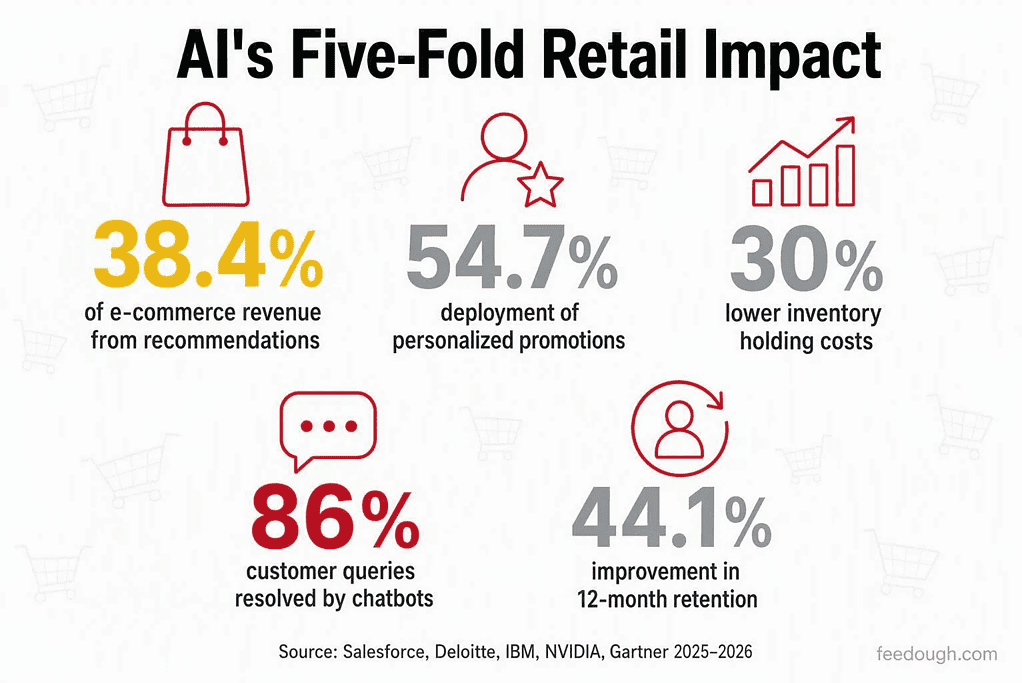
- Recommendation engines drive 63% of product discovery and 38.4% of e-commerce revenue across 500 retailers.
- Personalized promotion tools are used by 54.7% of the top 1,000 global retailers.
- AI forecasting can reduce inventory holding costs by up to 30%.
- AI chatbots resolve 86% of customer queries without human help.
- AI personalization can improve 12-month customer retention by 44.1%.
AI Adoption Among Retailers
(Reference: companieshistory.com)
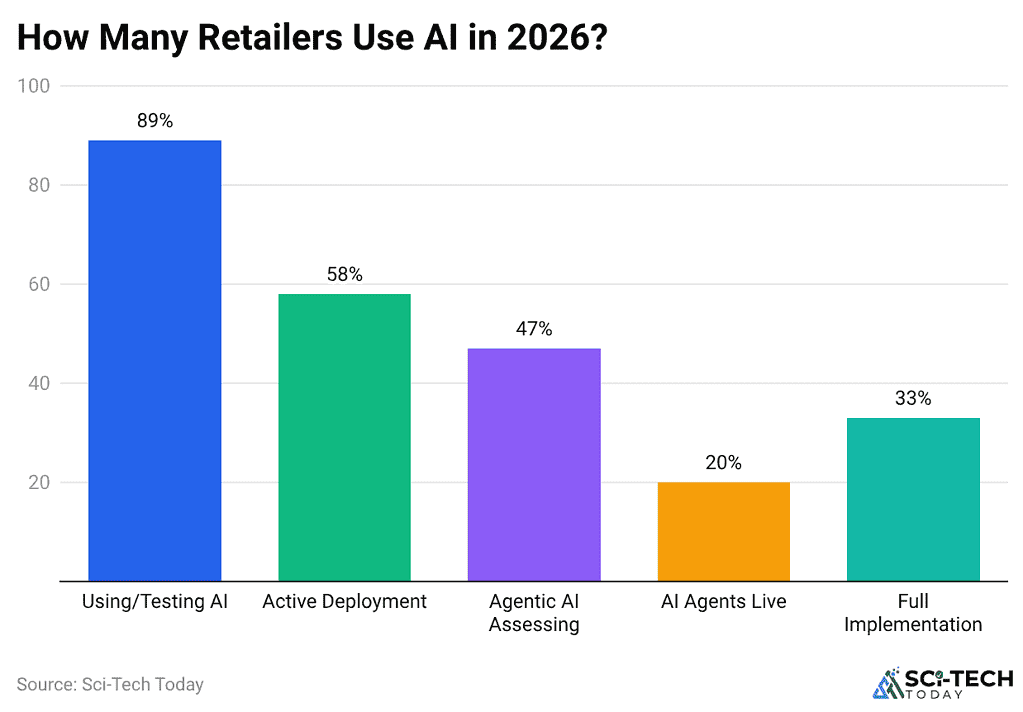
- As of 2026, 89% of retailers are actively using or testing AI.
- About 58% of retailers actively deploy AI solutions, up from 42% the previous year, a 16% increase.
- Around 47% of retailers use or assess agentic AI, while 20% already have AI agents active in operations.
- Nearly 90% of retailers plan to raise AI budgets in 2026.
- Only 33% of online stores report full AI implementation.
AI Daily Use and Omnichannel Retail Adoption Trends
- According to Coherent Market Insights, 77% of eCommerce professionals use AI daily across their retail operations.
- AI-driven omnichannel strategies can improve customer retention by 20%-30%.
- AI adoption can support annual revenue growth of 5%-15%.
- Retailers can reduce operating costs by up to 30% through AI.
- AI-based inventory optimization can reduce stockouts by 50%.
- Predictive supply chain analytics can reduce logistics costs by 10%- 20%.
Retailers Accelerate AI Adoption
(Source: deloitte.com)
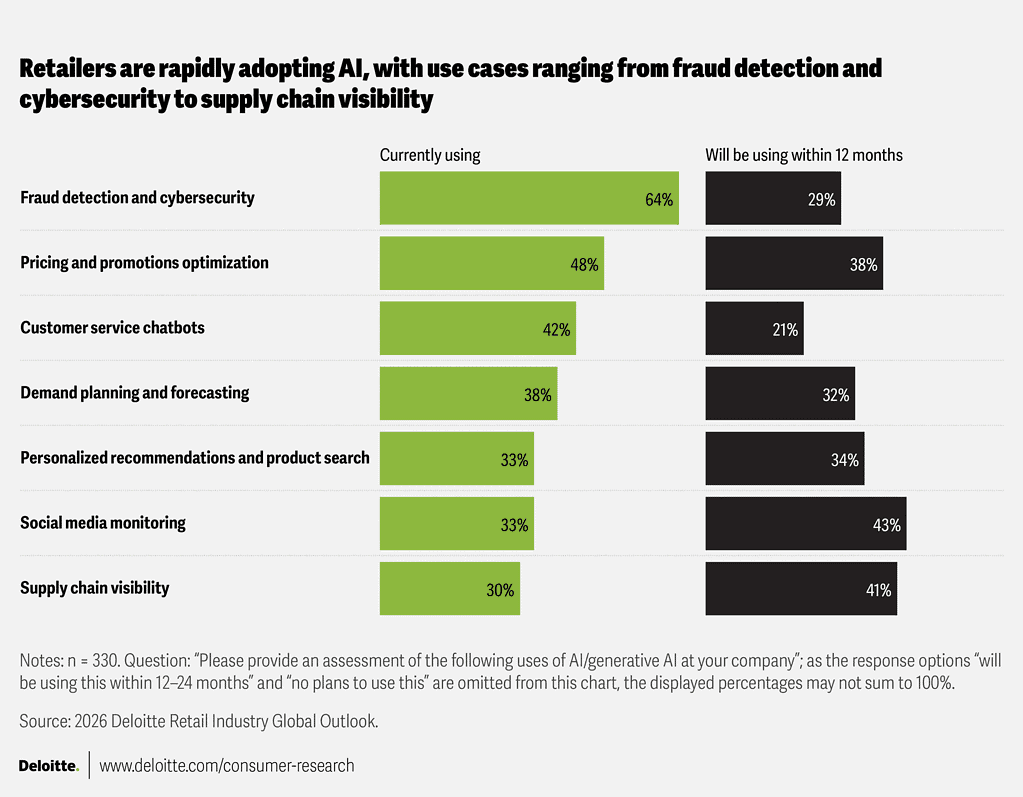
- Fraud detection and cybersecurity lead adoption, with 64% currently using AI and 29% planning to adopt it within 12 months.
- Pricing and promotion optimization records 48% current use and 38% planned use.
- Customer-service chatbots show 42% current use and 21% planned use.
- Demand planning and forecasting account for 38% of current use and 32% of planned use.
- Personalized recommendations and product search report 33% current use and 34% planned use.
- Social-media monitoring records 33% current use and 43% planned use.
- Supply-chain visibility shows 30% current use and 41% planned use.
Expected Mainstream Adoption of AI in Shopping
(Source: marketingcharts.com)
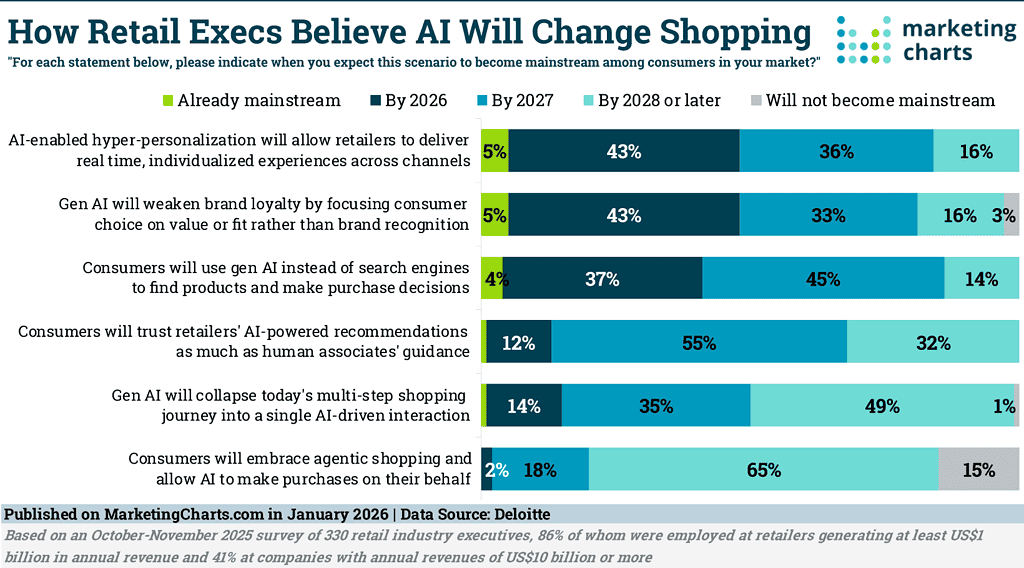
| AI Development in Retail | Already Mainstream | By 2026 | By 2027 | By 2028 or later |
| Generative AI will weaken brand loyalty by prioritizing value or product fit. | 5% | 43% | 33% | 16% |
| AI-powered hyper-personalization will deliver individualized experiences across channels. | 5% | 43% | 36% | 16% |
| Consumers will use AI instead of search engines to discover products and make purchasing decisions. | 4% | 37% | 45% | 14% |
| Consumers will trust retailers’ AI recommendations as much as guidance from human sales assistants. | – | 12% | 55% | 32% |
| Generative AI will convert multi-step shopping journeys into single AI-driven interactions. | 14% | 35% | 49% | |
| Consumers will allow AI shopping agents to make purchases on their behalf. | 2% | 18% | 65% |
AI Personalization and Recommendations in Retail
- AI personalization can increase retail revenue by 10%-15%, according to a McKinsey report.
- Personalized recommendations can raise average order value by up to 369% among highly engaged shoppers.
- Amazon’s AI personalization contributes about 35% of its total revenue.
- Personalized recommendations represent 33% of the AI retail market in 2026.
- AI-personalized emails generate 29% higher open rates and 41% higher click-through rates.
- About 9 in 10 shoppers prefer retailers that understand their needs, according to Ringly.
AI in Retail Customer Service
(Reference: quantumrun.com)
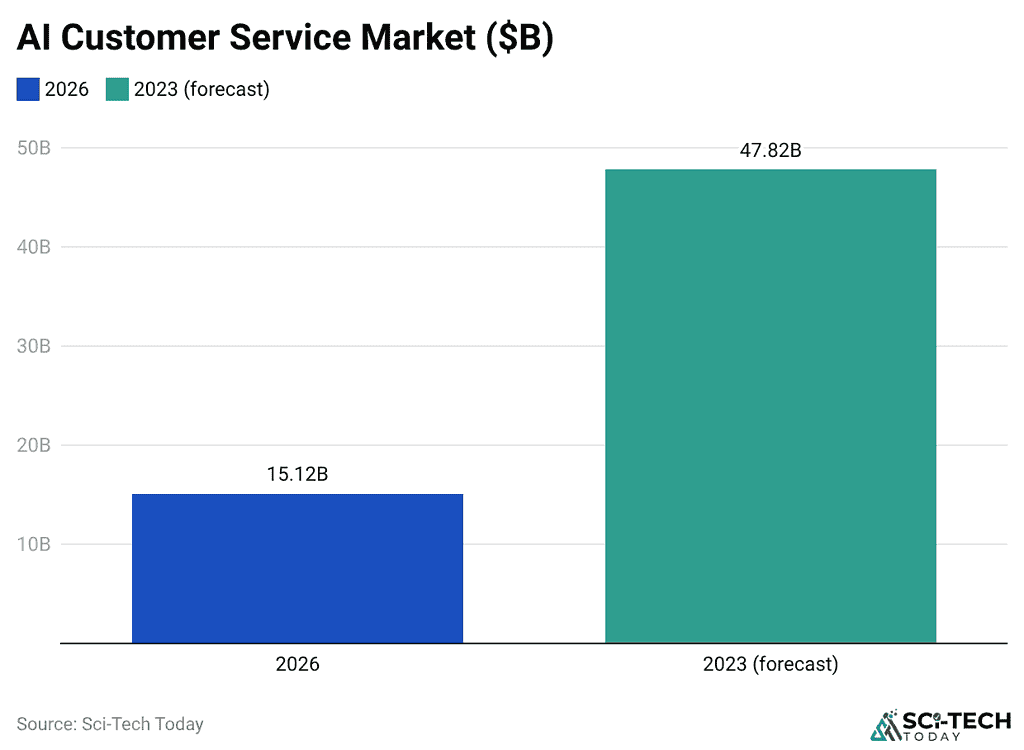
- The AI customer service market reached USD 15.12 billion in 2026 and is expected to reach USD 47.82 billion by 2030.
- Conversational AI could help contact centers save USD 80 billion by 2026.
- H&M’s chatbot reduced customer response times by 70%.
- Retail and eCommerce account for 27.95% of chatbot spending
- Companies reportedly receive USD 3.50 for every USD 1 invested, equal to a 250% return.
- Gartner forecasts USD 80 billion in call-center labor cost savings, with 10% of interactions fully automated.
- 62% of customers prefer chatbots, rising to 74% for simple questions, while 91% of service leaders face pressure to adopt AI.
AI Personalization and Consumer Behavior in Retail
- According to careertrainer.ai, 70% of consumers expect personalized retail experiences.
- 60% are willing to share personal data for tailored recommendations and experiences.
- 54% believe AI can provide more personalized service than humans.
- 49% would switch brands for better personalization.
- Personalized recommendations make consumers 110% more likely to add products to their carts and 40% more likely to spend more.
- 63% show greater engagement with brands that offer relevant recommendations.
- 42% are comfortable using AI to improve retail experiences.
- 30% are open to using chatbots for customer service.
AI-Driven Operational Improvements
- Quantumrun estimates that AI can reduce inventory levels by 20%- 30%.
- AI can reduce logistics costs by 5% to 20% through improved planning and routing.
- AI can reduce procurement spending by 5% to 15% by improving purchasing decisions.
- AI can reduce forecasting errors by 20%- 50%.
- AI can improve service levels by up to 65%.
AI-Driven Retail Traffic Trends in the United States
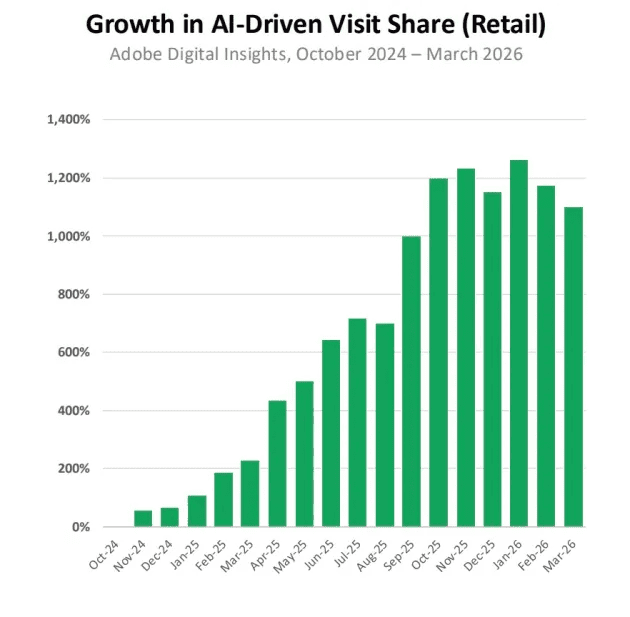
(Source: techcrunch.com)
- From January to March 2026, AI traffic to U.S. retail sites rose 393% YoY, while March alone saw a 269% YoY increase.
- During November-December 2025, AI traffic jumped 693% YoY.
- 39% of consumers had used AI for online shopping, and 85% said it improved their experience.
- In March 2026, AI traffic converted 42% better than other traffic, compared with 38% worse in March 2025.
- Around 66% of consumers considered AI results accurate.
- AI visitors recorded 12% higher engagement, spent 48% longer on sites, and viewed 13% more pages per visit.
Retail Website AI Visibility
- The U.S. retail homepages averaged a 75% AI visibility score.
- Category pages scored 74%, while product pages reached only 66%.
- Store locators scored 73%, followed by customer service pages (79%), contact pages (81%), returns pages (82%), loyalty pages (78%), and FAQs (80%).
- The strongest retail websites averaged 82.5%, compared with 54.2% for the weakest performers.
U.S. AI-Driven E-Commerce Sales
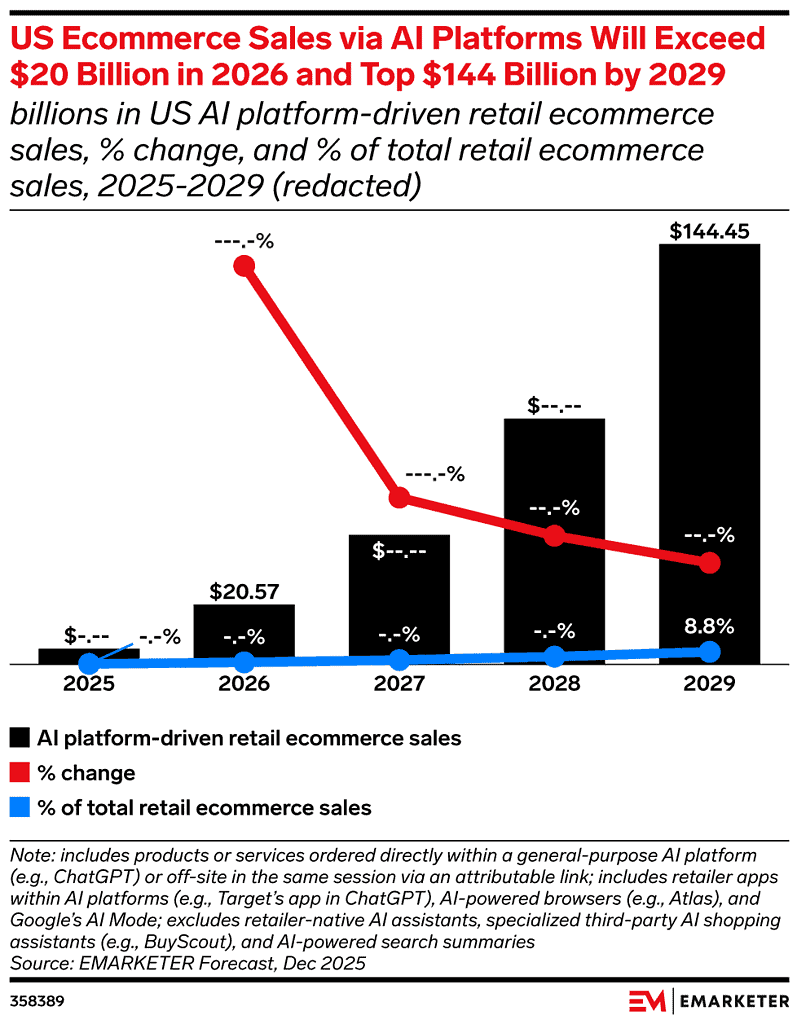
(Source: emarketer.com)
- U.S. retail e-commerce sales through AI platforms are expected to be USD 20.5 billion in 2026.
- Sales are projected to increase substantially between 2025 and 2029, reaching USD 144.45 billion by 2029.
- AI platforms are forecast to account for 8.8% of total U.S. retail e-commerce sales in 2029.
Summary
AI is becoming an important part of modern retail. It helps stores understand customers, manage stock, predict demand, improve service, and reduce costs. From personalized product suggestions to faster customer support, AI is making shopping easier for both businesses and customers.
As more retailers adopt these tools, the focus will remain on using AI responsibly, keeping data secure, and maintaining human involvement. Overall, AI will continue to shape faster, smarter, and more convenient retail experiences.
FAQ
AI helps retailers with personalized recommendations, demand forecasting, inventory management, chatbots, fraud detection, dynamic pricing, and customer behavior analysis.
Yes, AI helps retailers predict demand, track stock levels, reduce waste, and prevent overstocking or shortages.
AI helps retailers personalize offers, predict demand, improve pricing, and increase sales.

Sources