









Introduction
AI In Law Statistics: AI in law means tools that help lawyers look up case law, write contracts, go through discovery documents, and sum up court rulings. These tools are trained on legal text and backed by trusted sources like Westlaw. What started as careful testing has now become a normal part of how big law firms work, with tools like Harvey and CoCounsel used firm-wide instead of just tried out in small pilot programs. Company legal teams are using these tools too, hoping to get more done without hiring more staff.
Meanwhile, law schools and new lawyers are getting ready for a future where AI helps with writing and research from the very start of their careers. Courts have also made new rules requiring lawyers to double-check AI-written citations, after some well-known cases where AI made up fake case law. As AI starts handling more complex legal tasks on its own, the real question isn’t whether lawyers will use AI; it’s how much of the work AI should actually be trusted to do.
Must Read by the Editor
- The global AI in law market is projected to grow from USD 1.1 billion in 2023 to USD 16.9 billion by 2033.
- AI adoption stands at 81% among in-house counsel, versus 55% among law firm attorneys.
- Immigration lawyers lead AI adoption at 47%, ahead of personal injury lawyers at 37%.
- 69% of 1,300+ US legal professionals now use tools like ChatGPT, Gemini, or Claude.
- ChatGPT leads legal-sector AI usage at 66%, ahead of Microsoft Copilot at 42%.
- 58% of legal professionals use GenAI for client emails and general research alike.
- Data security tops AI adoption barriers at 46%, followed by ethics at 42%.
- 78% of corporate clients see AI-enabled quality gains as essential, yet only 6% see firms delivering them.
- Only 9% of legal professionals currently use agentic AI tools, while 26% plan to.
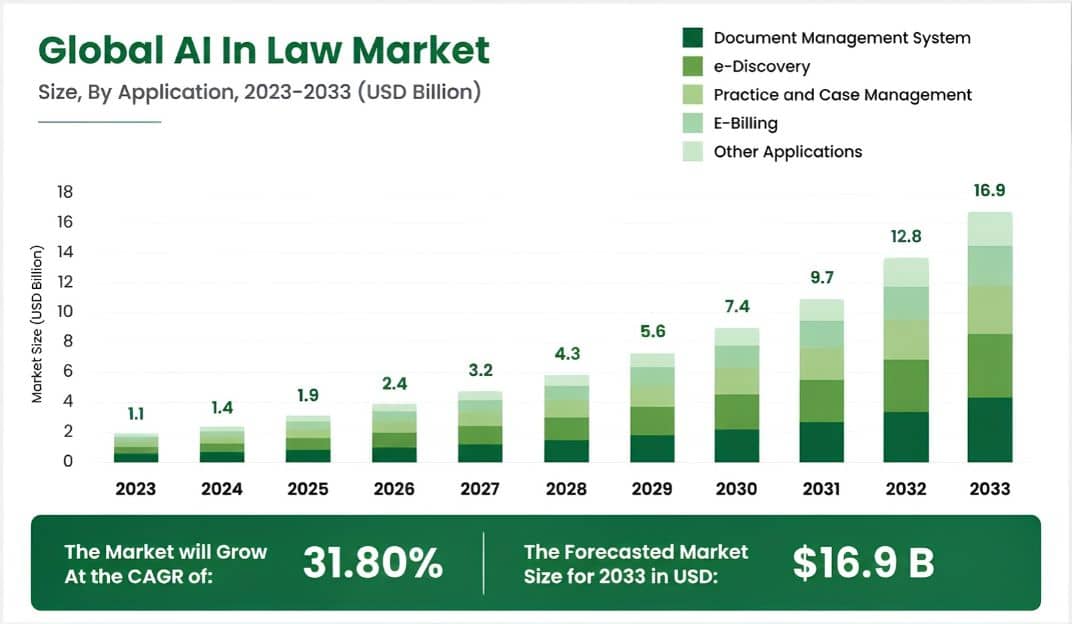
Global AI in Law Market Growth
- The global AI in law market is projected to grow from USD 1.1 billion in 2023 to USD 16.9 billion by 2033, at a CAGR of 31.80%.
- The chart shows market values of USD 1.4 billion in 2024, USD 1.9 billion in 2025, and USD 2.4 billion in 2026.
- Market revenue is projected to increase to USD 7.4 billion in 2030, USD 9.7 billion in 2031, and USD 12.8 billion in 2032.
AI Adoption Rates in the Legal Sector
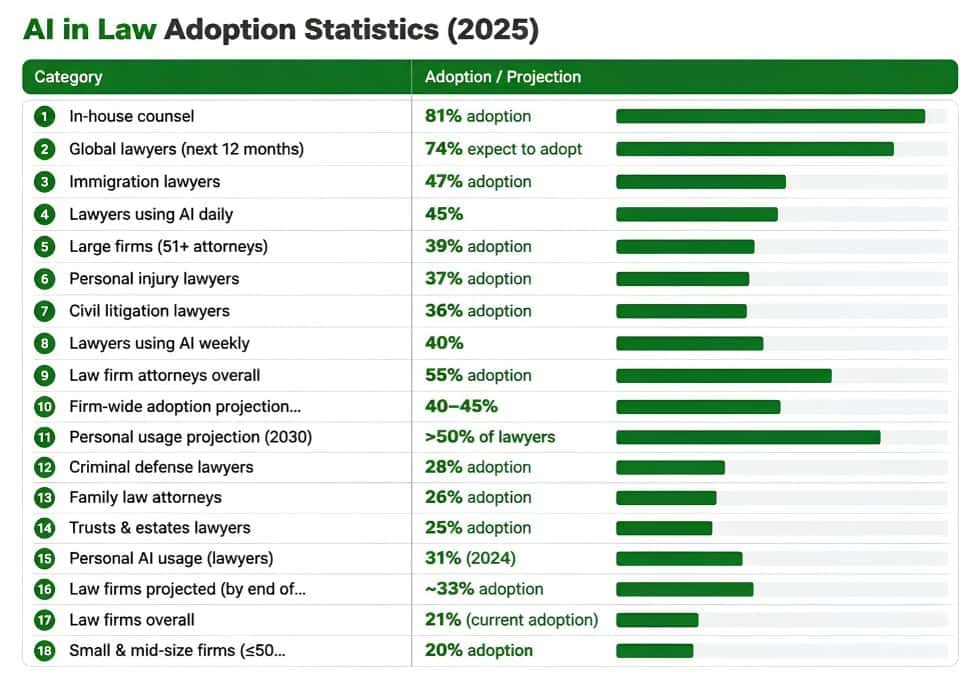
- AI adoption stands at 81% among in-house counsel and 55% among law firm attorneys overall.
- Among lawyers globally, 74% expect to adopt AI within the next 12 months.
- Daily AI usage among lawyers stands at 45%, while weekly usage is reported at 40%.
- Large law firms with 51 or more attorneys report 39% AI adoption, compared with 20% among small and mid-sized firms with 50 or fewer attorneys.
- Immigration lawyers report 47% AI adoption, followed by personal injury lawyers at 37% and civil litigation lawyers at 36%.
- AI adoption reaches 28% among criminal defense lawyers, 26% among family law attorneys, and 25% among trusts and estates lawyers.
- Overall law firm AI adoption stands at 21%, while a separate projection places adoption at approximately 33%, without a fully specified deadline.
- A separate firm-wide AI adoption projection ranges from 40% to 45%, although its timeframe is unspecified.
- Personal AI usage among lawyers stood at 31% in 2024 and is projected to exceed 50% by 2030.
AI Usage Among Legal Professionals
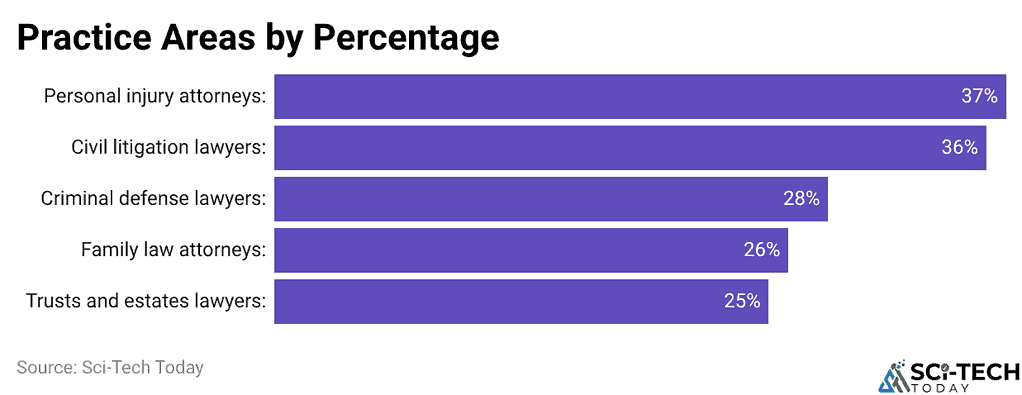
- Immigration lawyers lead AI adoption at 47%, mainly because their work involves large volumes of repetitive documents.
- Personal injury lawyers rank second, with 37% using AI in their legal work.
- Civil litigation lawyers closely follow, reporting an AI adoption rate of 36%.
- Criminal defense lawyers report a lower AI adoption rate of 28%.
- Family law attorneys have an AI adoption rate of 26%.
- Trusts and estates lawyers report the lowest AI adoption rate at 25%.
AI Tools Used in Law
- 69% of 1,300+ US legal professionals use tools such as ChatGPT, Gemini, or Claude, up from 31% one year earlier.
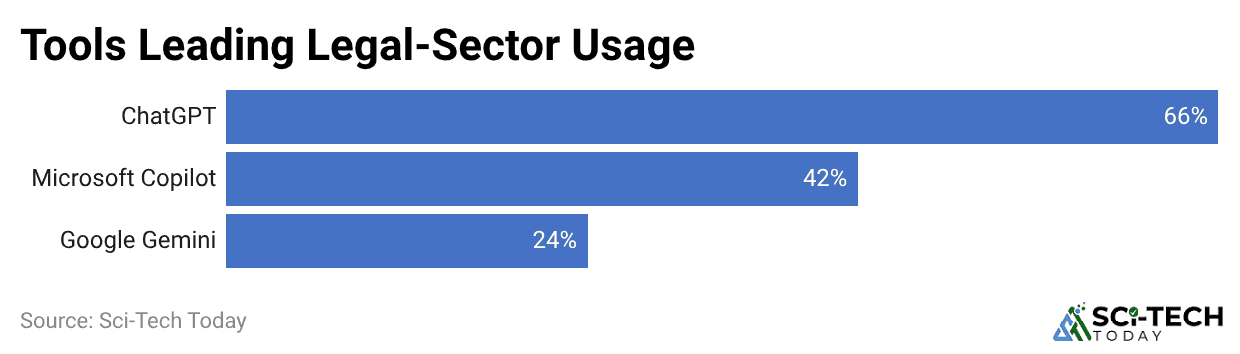
- ChatGPT leads legal-sector usage at 66%, followed by Microsoft Copilot at 42% and Google Gemini at 24%.
- Wolters Kluwer found that 92% of 810 lawyers use at least 1 AI tool in their daily work.
- Among surveyed lawyers, 62% save 6%–20% of weekly working time, while 60% expect AI investment to increase over 3 years.
- GenAI usage reached 41% at law firms in 2026, rising from 28% in 2025.
- GenAI usage reached 47% in corporate legal departments, more than doubling from 23% in 2025.
- Lawyers use GenAI for correspondence drafting at 58%, general research at 58%, brainstorming at 54%, and document summaries at 47%.
- Among 70+ senior UK law-firm leaders, 50% have deployed legal AI tools, but only about 20% have embedded them into standard workflows.
- All 40 surveyed firms with at least 500 lawyers used legal-specific AI tools, while 78% of their lawyers completed AI training.
- Although professional AI adoption is rising, 34% of law-firm professionals use tools their employers have not approved.
- GenAI saves 1–5 hours weekly for 38% of legal professionals and 6–10 hours for another 14%.
- Only 9% currently use agentic AI tools, while another 26% intend to adopt them.
- AI spending increased at 67% of legal organizations, but fewer than 15% reported measurable business impact.
- Firms cite data security at 46%, ethics at 42%, privilege at 39%, and unreliable results at 39% as adoption barriers.
AI Use Cases in Law
- 58% of legal professionals use GenAI to prepare client emails, letters, and routine communications; this rose from 54% in 2025.
- 58% use GenAI for general research and information synthesis, increasing from 46% in 2025.
- 54% use GenAI to explore legal arguments, case strategies, and possible scenarios, compared with 47% in 2025.
- 47% use GenAI to summarize lengthy legal material, including records, transcripts, and depositions; this increased from 39% in 2025.
- 43% use GenAI to create initial drafts of motions, briefs, and agreements, while 39% use it to create reusable document templates.
- 38% use GenAI for targeted legal research, such as finding relevant case law and precedent; usage remained unchanged from 2025.
Key Challenges Faced by AI in Law
- 46% of legal professionals identify data security as a key barrier, reflecting risks around confidential client information and cybersecurity.
- 42% cite ethical issues, while 39% cite ethical and data-privacy concerns as major obstacles to AI implementation.
- 39% identify privilege protection as a barrier, as firms must prevent sensitive legal information from being improperly exposed or reused.
- 39% lack trust in AI results, and 43% of legal professionals worry about the accuracy of AI-generated outputs.
- 54% report that their firms provide no responsible-AI training and have no plans to do so, while 43% lack a formal AI policy.
Future of AI in Law
- 92% of 810 surveyed legal professionals already use at least 1 AI tool daily, while 60% expect their organisation’s AI investment to increase within 3 years.
- Fewer than 20% of firms currently implement agentic AI, but about 50% are planning or considering adoption, and most expect it to become central within 3–5 years.
- 78% of corporate clients consider AI-enabled quality improvements essential, yet only 6% say most law firms deliver them.
- 71% of in-house legal professionals expect outside counsel to revise commercial models as AI usage grows, but only 28% of law firms have adjusted pricing.
- 36% of law-firm professionals using professional AI tools would reject a job offer without access to them, while 48% remain concerned about AI’s effect on professional judgment.
Recent AI in Law Findings
- In October 2026, Legora added USD 50 million, bringing Series D funding to USD 600 million and its valuation to USD 5.6 billion.
- In September 2026, Harvey raised USD 550 million at a USD 15.5 billion valuation to help legal teams build proprietary institutional intelligence.
- In March 2026, Legora raised USD 550 million at a USD 5.55 billion valuation to accelerate its US legal AI expansion.
- In February 2026, Thomson Reuters reported 1 million CoCounsel users across legal, tax, and compliance, demonstrating professional AI adoption beyond experimentation.
- In November 2025, Clio acquired vLex for USD 1 billion, securing USD 500 million equity and USD 350 million debt at a USD 5 billion valuation.
- In November 2025, Thomson Reuters announced 3 CoCounsel Legal beta capabilities, including bulk review of up to 10,000 documents and customizable agentic workflows.
- In August 2025, LexisNexis surveyed 700+ legal professionals, finding GenAI adoption reached 61%, versus 46% in January; 51% of AI users used legal-specific tools.
- In June 2025, Thomson Reuters projected legal professionals could save nearly 240 hours annually through AI, unlocking USD 19,000 in annual value per professional.
Final Thoughts
AI adoption in law is accelerating fast, with daily use among lawyers rising sharply and firms moving tools like ChatGPT, Copilot, and legal-specific platforms into core workflows. Immigration and personal injury lawyers lead adoption, while drafting, research, and summarization remain the top use cases.
Yet trust gaps persist: many professionals worry about accuracy, lack formal AI policies, and cite data security and ethics as barriers. As agentic AI edges toward mainstream use and corporate clients demand measurable quality gains, the legal industry’s AI maturity still lags its enthusiasm.
FAQ
AI is transforming the legal industry by automating repetitive tasks like document review and legal research, allowing lawyers to focus more on strategy, client interaction, and complex legal reasoning, ultimately improving efficiency and accuracy.
Common uses include contract analysis, legal research, e-discovery, due diligence, predictive case outcomes, document automation, and chatbot-based client support for answering basic legal questions.
AI-powered tools can quickly search through vast amounts of case law, statutes, and legal documents to find relevant information, significantly reducing the time lawyers spend on manual research compared to traditional methods.
Benefits include faster document review, reduced operational costs, improved accuracy in contract analysis, enhanced legal research capabilities, and the ability to handle larger caseloads more efficiently.
Challenges include concerns over data privacy, potential bias in AI algorithms, lack of transparency in decision-making, ethical considerations, and the need for human oversight to ensure accurate legal interpretations.
While AI can automate many routine legal tasks, it is unlikely to fully replace lawyers, as legal work often requires human judgment, ethical reasoning, negotiation skills, and personalized client relationships that AI cannot fully replicate.