









Introduction
Sales Commission Statistics: In 2026, sales commission strategies are becoming stricter, emphasising performance incentives and being closely tied to the profit level of businesses. Companies now prefer moving from systematically similar compensation systems to rewards programs focused on accountability, profitable growth, renewals, and long-term engagement with customers.
In this article, we will present the most relevant commission benchmarks from different industries and information about how to calculate them.
Key Highlights
- In accordance with Sales Cookie’s 2026 benchmark guide, the commission variable ranges from 5% up to 20%, depending on the industry.
- Life insurance agents can get commission ranging from 50% up to 120% based on the initial premium, contrary to retail and e-commerce salespeople, who typically earn commission in the range between 2% and 7%.
- The research from Xactly in 2026 shows that the average pay for account executives can differ by $199,000 when comparing the best and the worst 10% of this job.
- At SaaS companies, Account Executives are paid an average of $95,000 in base salary and $180,000 in overall compensation.
- Agencies involved in both property insurance and casualty insurance typically receive a 10%–15% commission for the premiums from the new policies and an 8%–12% commission for the renewals of existing policies.
- According to WorldatWork, the actual salary increase budgets in the U.S. in 2026 have reached 3.6%. The same figure is projected for 2027 as well.
- A total of 66% of companies implemented compensation changes aimed at enhancing the relationship between pay and performance.
- Alexander Group discovered that 57% of companies admitted that quota setting was the most significant challenge they faced in sales compensation.
- According to Bridge Group, quota accomplishment is 57% in companies that have the highest levels of AI utilization compared to 39% in organizations with the lowest utilization levels.
What Is a Good Sales Commission Rate in 2026?
- A solid sales commission rate should keep two things in line. It should support what staff earns, and it should also fit the firm’s revenue and cost goals.
- In many B2B teams, people often point to about 8% to 12% of new revenue as a starting point, and deals that are more routine, or roles with lots of smaller transactions, may use rates that sit lower.
- Sales Cookie’s 2026 benchmark paper lists wide swings by industry; commission can fall around 5% to 20% of the sale amount, with very low rates in mass retail, under 2%.
- For life insurance, it mentions figures that can go over 50% of the first-year premium, giving context, not to set a single rule for everyone.
- Xactly’s 2026 pay study reports that many companies reward strong, proven account executives more heavily, while they often cut pay and raise pressure for newer sellers. The result is a larger gap between top and typical performers.
- The OTE gap grew by 1.7% from 2024, with the gap now sitting at $199,000, and Low performers average $95,000 OTE, while top performers average $294,000.
- The best commission rate depends on three items: Those are on-target earnings, how much of pay is tied to results, and the sales quota.
- A common way to estimate it is this: Commission rate = Target variable pay ÷ Quota.
- For instance, say someone has $180,000 OTE and a 50/50 split between base and variable pay means target variable pay is $90,000.
- If the quota is $900,000, the commission rate is 10%, and the quota moves up to $1.08 million, but target earnings stay the same, the commission rate drops to 8.3%.
- In B2B software, a 5% commission may be considered small for new business but acceptable for renewals.
- In the car industry, a commission of 7% of gross profit would be very low in comparison with the industry norm of 25%.
- Therefore, commission rates have to be based on realistic goals, deal profitability, and desired income, rather than only on percentage rates.
Average Sales Commission Rates by Industry
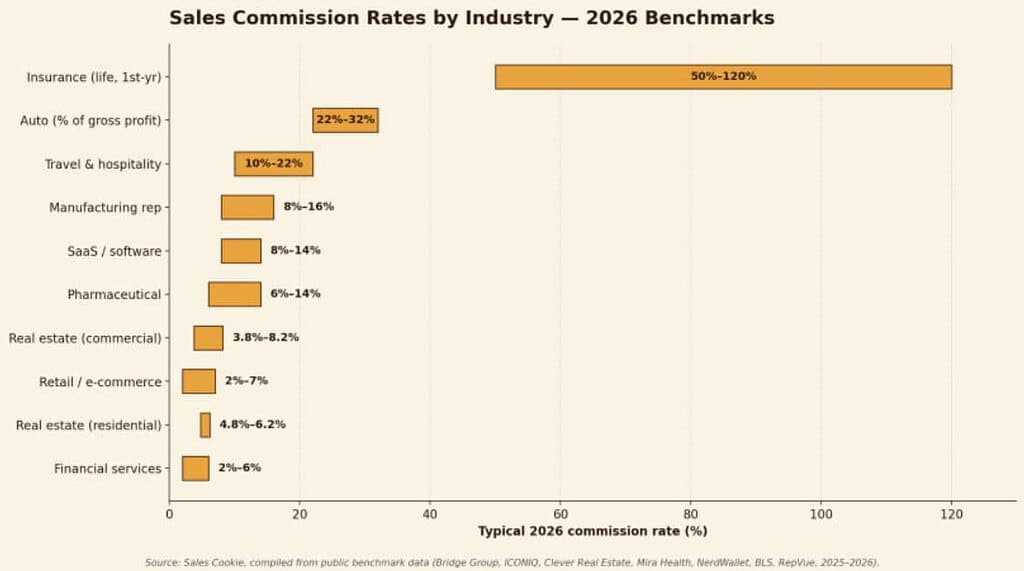
(Source: salescookie.com)
- The sales commission benchmarks of 2026 show the variations in revenue among different sectors, which means that the sales level of different industries differs depending on the type of contracts that are being sold, their profit margins, and the efforts put into the sales process.
- Thus, insurance would be the top area since it has the highest percentage, showing that commission earned from selling life insurance in the first year may be between 50% and 120%.
- Auto sales commission, calculated based on the gross profit percentage, is between 22 and 32%.
- Travel and hospitality would be the next sector showing the commission from 10% to 22%.
- Manufacturing salespeople would see a commission between 8% and 16%, and SaaS and software salespeople receive commissions ranging from 8% to 14%, and Pharmaceutical salespeople gain commissions that are between 6% and 14%.
- The commercial real estate sector offers commissions in the range of 3.8% and 8.2%, while residential real estate earns commissions between 4.8% and 6.2%.
- Retail and e-commerce commissions range from 2% to 7% and financial services sector shows the lowest rate of commission of the entire spectrum of sales from 2% to 6%.
- Sales Cookie, using public benchmark figures from Bridge Group, ICONIQ, Clever Real Estate, Mira Health, NerdWallet, the U.S. Bureau of Labor Statistics (BLS), and RepVue, shares these ranges as industry references.
- The key takeaway is to compare both the percentage and its calculation base before evaluating a sales opportunity.
SaaS Sales Rep Compensation Statistics for 2026
| Role | Median base | Median OTE | Pay mix | Reps at quota |
|---|---|---|---|---|
| SDR / BDR | ~$60K | ~$85K | ~71/29 | 45% to 60% |
| Mid-Market AE | $95K | $180K | 53/47 | 42% |
| Account Executive (all segments) | ~$100K | $200K | 50/50 to 53/47 | 42% |
| Enterprise AE | $140K | $280K | 50/50 | 41% |
(Source: visdum.com)
- SaaS sales pay in 2026 is shaped by a mix of steady salary, upside pay, and the challenge of hitting quota.
- RepVue’s September 2026 figures show that OTE depends a lot on the job, with the Enterprise and closing sales roles paying more, but quota success is not as common.
- SDRs and BDRs tend to earn about $60,000 in base pay; OTE is closer to $85,000, with the pay mix being about 71% base and 29% variable.
- Quota results land around 45% to 60% of goal, based on the benchmarks given.
- Mid-Market AEs have a median base of $95,000, and their OTE is about $180,000.
- Looking across AE groups, base pay often sits near $100,000, while OTE in those groups goes to about $200,000, and Quota attainment for these roles is about 42%.
- Enterprise AEs are paid more, with Median base pay at $140,000, and OTE is around $280,000, but about 41% reach quota or go past it. Larger and more complex deals appear to drive that gap.
- For closing AE roles, base pay makes up roughly half of total target earnings, about 50% to 53%, and the rest comes from performance.
- Sales Engineers and SDRs usually have a bigger fixed-pay share; base is near 71% of OTE.
- Overall, the data suggests that bigger pay can come with harder targets.
- SaaS firms should compare pay by role, set quotas that match real conditions, and align variable pay with the sales cycle.
- The above numbers use RepVue’s September 2026 data for AE, Enterprise AE, Mid-Market AE, and Sales Salary Guide and SDR benchmarks referenced via Sales Comp Lab.
Insurance Agent Commission Rates by Policy Type in 2026
| Line | New business | Renewal |
|---|---|---|
| P&C (agency level) | 10% to 15% of premium | 8% to 12% |
| Term life | 50% to 80% of first-year premium | 2% to 5% (years 2 to 10) |
| Whole/universal life | 70% to 120% of first-year target premium | Low, tapering |
| Major medical health | 3% to 6% of premium | Varies by state |
(Source: visdum.com)
- The revenue of an insurance agent is dependent on a particular policy type, premium amount, and maybe how the commissions are received from new clients or repeat customers.
- Data obtained from Agentero indicated that there are huge variations in commission structures among different types of insurance policies.
- For instance, life insurance agents usually receive higher first-year commissions than health and property and casualty (P&C) agents.
- Agents selling property and casualty insurance typically receive a commission ranging from 10% to15% for new clients and from 8% to 12% for past clients.
- Depending on the split of the compensation, individual producers may only get about 30% to 90% of the commission.
- Term life insurance has a good first-year commission with rates ranging from 50 to80%. After the first year of selling the policies, renewal commissions drop to the level of 2% to 5% for the next 10 years.
- Whole life and universal life policies pay much more than other policies, having a commission rate of 70% to 120% of the first-year premium with very low renewal commission rates in the following years.
- Major health insurers usually pay agents around 3% to 6% of the premium, although renewal rules can differ from one state to another. This structure can reward new customer acquisition but also creates financial risk when policies lapse early.
- Chargebacks may require agents to repay previously received commissions, depending on their agreements. Therefore, evaluating insurance earnings requires more than comparing headline commission rates.
- Agents should look at renewal income, the split inside the agency, how well policies stay active, and the chance of chargebacks. Those items help show what earnings are likely to last.
Sales Compensation Plan Changes in 2026
- In 2026, sales pay plans are being rebuilt, with firms putting more weight on results, how they compete, and goals that people can actually hit, and seem to be moving away from big changes in base salary alone.
- Per Alexander Group’s 2026 Sales Compensation Trends Survey and The Bridge Group’s 2026 AE Report, updates were tied to pay and performance.
- WorldatWork’s July 2026 2026–2027 Salary Budget Survey said US salary increase plans in 2026 landed at 3.6%, which was lower than the 4.1% that was forecast in 2024, and for 2027, the budgets were expected to stay at 3.6%.
- Also, 66% of firms said they made changes to better connect pay with performance.
- The most frequent changes included performance metrics, how much weight each metric gets, incentive payout shapes, and the mix of fixed pay and variable pay.
- For outside pressure, competition and industry pressure led the list. It was named by 77% of respondents.
- Alexander Group showed that 57% of enterprises considered quota establishment as their main problem, while 46% experienced difficulties with timely quota allocation.
- Whereas the current projections for sales compensation budgets are at 2.7%, and sales costs stay almost unchanged.
- The salary increase budget of WorldatWork fell to 3.6% compared to the previous 4.1%.
- The forecasts regarding quota achievement differ significantly. The businesses expect 55% of sellers will hit their quota in 2026.
- The number was 48% according to the research by Bridge Group and approximately 42% according to RepVue data. Such differences are important in terms of incentive cost forecasting and setting achievable goals.
- As Bridge Group states, the quota achievement in organizations from the highest group in terms of AI Engagement Score was 57%, while in the lowest group it was 39%, but this does not show a cause-and-effect relationship.
- Compensation planning in 2026 would require proper quota setting, well-thought-out incentives, and proper budgeting instead of just raising the pay.
Quota attainment
- A commission offer only makes sense when the quota is reachable. RepVue reports that in SMB, mid-market, enterprise, and strategic AE jobs, under half of reps made quota; in enterprise roles, the number drops to 40.9%.
- Most pay plans use variable pay that starts below 100% attainment, but the main point stands. More than half did not hit the full incentive goal, so the attainment split matters when you look at any stated OTE.
- Xactly’s older SaaS data looks even rougher; it says 79% of SaaS reps missed quota, and also lists 14% who got under 10% of quota.
- Across time in the dataset, the average attainment is 58%, split across company size and market groups. These numbers are internal benchmarks, and the time window and the sample may not match RepVue. So you should not merge them into one single 2026 rate.
- Alexander Group’s 2024 survey shows a different view, reporting an 89% average aggregate quota attainment for core sellers, while it notes that the share getting target incentive can be higher than the share who reach quota because secondary metrics and bonus rules affect pay. It can also be lifted when a small group of top sellers run far above target, even if many others miss.
- Average quota attainment and quota participation track different parts of the story, whereas Average attainment is the total or mean performance as a percentage of quota, while quota participation is the share of sellers who each hit at least 100%.
How to Use Sales Compensation Benchmarks to Set the Right Commission Rate
- Determining a competitive sales commission rate should first begin with understanding what the company can pay instead of just imitating what competitors do.
- A sustainable compensation scheme should offer a balance among motivating employees, boosting revenues, and keeping costs within reasonable limits.
- The first thing to do is to create a budget for variable compensation as part of the new revenue. After that, it is important to choose a pay mix that reflects the duties of each position.
- For instance, it may be effective to go with a 50/50 pay mix for Account Executives, while a 70/30 mix is preferable for Sales Development Representatives and Sales Engineers.
- At the same time, industrialists selling with the help of longer sales cycles may need higher salaries to ensure stable income.
- SaaS companies may also benefit from using a 4x and 5x quota-to-on-target earnings (OTE) ratio for planning purposes, with the understanding that the final target would depend on contract value achieved and time needed for the representative to ramp up.
- After setting quotas and variable compensation targets, compute commission rates by dividing target variable compensation by quota.
- Benchmark actual performance to assess if only sales taking part in all scenarios need to be noted as a point of reference.
- Financial planning should, therefore, also be based on actual performance, involving calculations using completion of 45% of the quota, including payments for those employed in the top 10% of the workforce.
- Finally, the proposed plan should be verified against the previous year’s actual sales, including commission ranges and other allowances.
Conclusion
In 2026, when it comes to planning the commission on sales, it is necessary to strike a balance between attractive income, feasible quotas, and costs of running businesses. Data on different industries reveal great discrepancies in commission rates, from relatively low in retail to relatively high in life insurance. In the software-as-a-service industry, attractive on-target earnings do not guarantee actual payout, as reaching quotas is still challenging for account executives in this industry.
Thus, organizations are revising such factors as performance metrics, pay mix, and quota-setting procedures to improve the effectiveness of incentive schemes. It would be better for companies to take the analyst perspective to calculate commission based on the target variable compensation and achievable quotas, simulate some attainment scenarios, and consider such factors as renewals, chargebacks, and acceleration of payoffs.
FAQ
When it comes to B2B sales teams, 8%-12% of sales revenue is a great starting point depending on economics, margins, and quotas.
Divide total variable compensation by sales quota: $90,000 in target variable compensation divided by $900,000 in quota gives you 10% commission.
According to official benchmarks, the median OTE is $200,000 for Account Executives and $280,000 for Enterprise Account Executives.
As per the Sales Cookie report, life insurance commissions are 50%-120% of the first-year premium amount.
Quota attainment shows how often representatives are able to achieve their quota and whether OTE is achievable as claimed in the advertisement.

Sources