









Introduction
Sales Technology Statistics: Sales technology in 2026 is evolving with AI agents, connected data, revenue intelligence, and self-service buying tools. In the future, sales tech will be measured on whether it can aid sellers in automating administrative work, understanding customers, ensuring reliable data, and supporting the prioritization of the right sales actions.
Salesforce State of Sales reported that 87% of sales organizations have adopted AI to support some combination of prospecting, forecasting, lead scoring, and email drafting. Unfortunately, the simple adoption of AI in the sales organization does not translate to higher sales performance. In 2028, AI agents will likely outnumber salespeople by 10 to 1, and AI productivity gains will be reported by less than 40% of salespeople.
This article will present the trending sales technology statistics in 2026.
Top Picks
- AI is helping salespeople with a number of activities. In sales prospecting and email drafting, 87% of sales organizations have adopted AI.
- For 81% of sales leaders, AI can handle tasks related to scheduling and follow-up in the sales process.
- The sales teams believe 66% of customer personalization is driven by AI.
- Many sales professionals (45%) find that too many tools have a negative impact.
- There has been an observed increase (52%) in B2B buyers who use the option for self-service.
- AI-enabled revenue intelligence software is 20% more accurate than CRM data and 22% more accurate than sales reps in predicting the future revenue of a company.
- Salespeople who don’t recognize email red flags will see a 33% decline in sales opportunities. Sales cycles take 31% longer.
- 84% of sales teams that lack a single platform say they plan to consolidate their technology stack to meet the need for simplified and better connected systems.
Sales Technology Trends
- Buying and selling in a new, complex digital landscape has driven the demand for more advanced tools and better automation.
- Sales tools need to better connect customers and sellers and need to enable buyers to better navigate a more complex purchasing process.
- According to the HubSpot Sales Trends Report, most sales teams struggle to adopt and optimize their current stack.
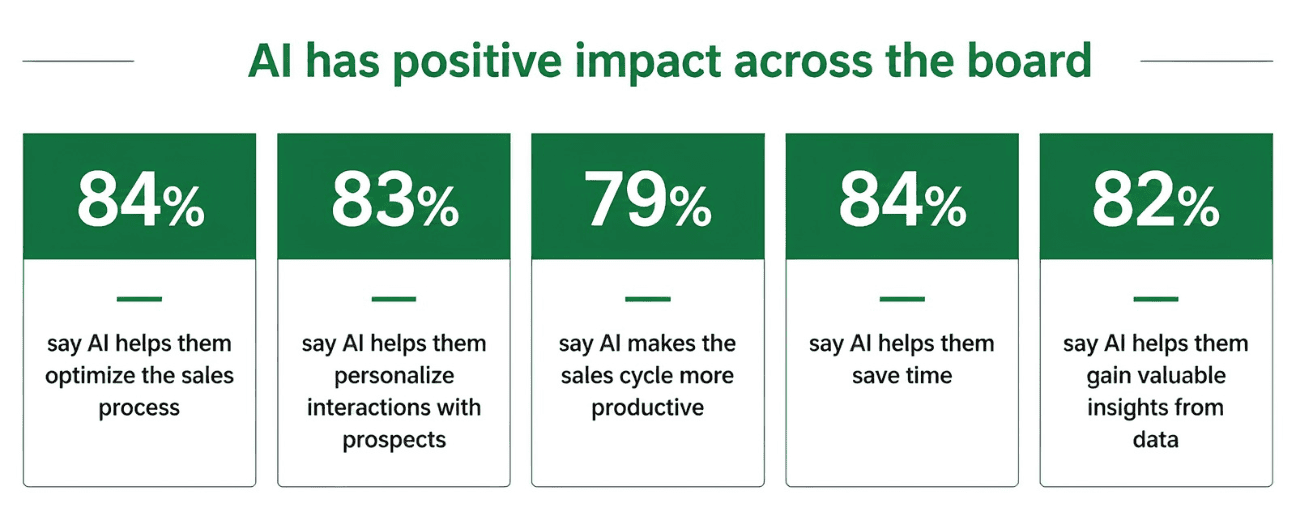
- The field of Artificial Intelligence has been rapidly increasing in sales workflows. 81% of sales leaders feel that AI reduces the time that has to be spent on administrative and clerical work.
- An equal 63% feel that it has created more opportunities to be competitive and can improve customer experience and understanding, especially for the majority of sales professionals.
- In addition, only 23% of salespeople say they use it regularly, while almost half, or 49%, feel that it is helpful occasionally.
- However, too much of a good thing can create a headache for a salesperson. For example, almost half of salespeople (45%) report being stressed and feeling as though they have too much software. That stress and frustration of having too many sales apps also crosses the C-level.
- Nearly 1/3 (29%) believe streamlining the sales apps and removing the software that does not add value would increase efficiency.
- Workplace processes can change along with the expectations of the client. As a result of changing behaviors and expectations, more than half of B2B salespeople (52%) feel that clients now use self-serve solutions rather than engaging salespeople to perform their role. This change in customer behavior has had a significant impact on salespeople.
- As many as 47% of sales professionals feel as though having these options gives them a competitive edge over their colleagues and the ability to exceed the goals they are set to reach.
- There is an overwhelming consensus among sales professionals that their CRM contributes to a more integrated sales and marketing function, and almost four-fifths of them agree.
- Based on a HubSpot survey, there is evidence that the best results come from sales teams working a hybrid schedule.
- Teams who are fully remote or fully in office have results that are 28% less than teams who are hybrid.
- The above figures indicate an approach that leverages a combination of AI-assisted selling and effective use of CRM along with customer self-service, and a more accessible technology stack.
- The goal here is not the automation of selling but the development of technology-supported selling and customer service that is more personalized and responsive.
AI and Technology Trends to Support Growth Through
- Sales technology, the structure that underpins the automation of sales and support, is direct.
- For instance, CRM and automation usage is documented as a sales technology trend. This trend is an important signal to other businesses to evaluate the investments supporting digital business growth.
- The demand, driven by AI, is expected to continue for some time, as shown by the sales figures and trends documented by SEMI.
- SEMI forecasts that the sales of semiconductor manufacturing equipment in 2025 will be US$125.5 billion, representing an 8% increase from 2024.
- Furthermore, SEMI forecasts that sales will continue to grow through 2026, reaching US$138.1 billion, and will further sustain growth with continued demand for sales technologies supporting AI systems.
- In the context of sales technology, semiconductor investments have greater significance; while direct impacts aren’t fully measured, they provide context to the support ecosystem for AI CRM systems, analytics, and automation technologies.
- One important segment to focus on in semiconductor manufacturing is wafer fabrication equipment. In 2024, wafer fabrication equipment sales were expected to reach US$104.3 billion.
- SEMI forecasted a 6% increase in 2025 and an 8% increase in 2026. This would make wafer fabrication equipment sales in 2025 equal to US$110.8 billion, and in 2026 equal to US$122.1 billion.
- AI-related hardware will become even more significant according to other forecasts. For instance, in 2025 semiconductor test equipment sales will rise 23.2% to US$9.3 billion, and assembly and packaging equipment will go up 7.7% to US$5.4 billion. In 2026, these segments will increase by 5% and 15%, respectively.
- Foundry and logic equipment sales for 2025 will be US$64.8 billion and for 2026 will be US$69 billion.
- Sales of NAND equipment in 2025 and 2026 are forecasted at US$13.7 billion and US$15 billion, respectively.
- For 2025, investment in DRAM equipment will be 6.4% higher than in the previous year, and for 2026, it will be 12.1% higher than in the previous year.
- Hardware used to support AI and the digital transformation will see more investment in the coming years.
- However, this data should not be looked at as sales of a specific technology or an indication of the return on investment of that technology. Instead, these data points represent the hardware industry as a whole.
Revenue Intelligence and Automated Forecasting
- Revenue intelligence is using data such as customer records, email interactions, phone logs, and product usage to create automated suggestions to improve the chances of closing deals.
- With one million emails and nearly 30,000 sales calls, Gong Labs demonstrated the insufficiency of using CRM and sales data to create forecasts.
- Gong uses data points from over 2.5 billion customer interactions to power a machine learning model. This model has a 20% higher accuracy than CRM data, and a 22% higher accuracy than sales representatives.
- The AI detected potential issues that sales representatives missed in roughly 15% of opportunities. Opportunities flagged by the AI had a 33% lower chance of closing and took 31% longer.
- Later opportunities were more likely to close with the addition of legal stakeholders, and opportunities where over 50% of emails focused on scheduling saw a 50% decrease in likelihood to close.
- Mentioning competitors at the early stages of enterprise deals increased the likelihood to close by 32%.
- Deals completed in alignment with AI suggestions achieved a 50% higher win rate, and deal cycles for deals where sales representatives followed up promptly decreased by 11%.
- Some Gong customers, Frontify and Verse.ai, were able to see improvement in forecast accuracy, conversion rate, and revenue by 20% to 76%. While these improvements were possible for them, it doesn’t guarantee the same results for you.
- According to a 2025 Forrester Consulting report that was ordered by Clari, a US$10 billion firm was evaluated, and it was discovered that forecast variance dropped from 8%–9% down to 5%–6%.
- Forecasting took 33% less time, administrative tasks were reduced by 50%, and the revenue surge over a period of three years turned out to be US$3.8 million.
- Win rates increased by 2.5 points in the first year, 4 points in the second, and 6 points in the third. Clari reported 398% ROI, US$96.2 million in NPV, and payback in less than six months.
- Based on a survey done by Clari Labs among 400 corporate decision-makers from different companies in North America, 87% of firms that did not apply Clari and Salesloft missed the revenue plans for 2025.
- Furthermore, 48% of them were not equipped with AI-enabled revenue data, and 42% had no formal data governance.
- Only one-third of companies believed in the trustworthiness of the forecasting data; 55% found discrepancies in forecast signals, whereas 39% updated their forecasts on a weekly or monthly basis.
- The most significant challenge is to utilize continuous monitoring and a combination of human involvement and trustworthy data.
Sales Engagement and Omnichannel Outreach
- Sales engagement is changing from sole emails and phone calls to coordinated and multichannel communication in 2026.
- Findings from McKinsey’s 2026 Global B2B Pulse Survey suggest that, on average, the buyer is using 10 different channels in their buying journey.
- Therefore, it is important to communicate consistently across email, phone, social networking, video, and meetings in B2B sales.
- Sales platforms like Salesloft and Outreach assist SDRs and/or BDRs in automating these interactions by performing automatic activity tracking, activity scheduling, activity analytics, etc.
- Data from Outreach in 2025 suggests that making the first contact with a potential customer requires five to seven touches.
- Data from Cirrus Insight in 2026 suggests around eight contacts to be made before making the first meeting or conversion, whereas five is for the highest performers.
- Although the above data serves as a directional approximation, there are many variables like targeting, seniority level of buyer, complexity of deal, and relevance of message that affect the final number.
- Outreach further claims that deals exceeding US$10,000 that included live meetings had sales cycles that were 32 days shorter and higher public success rates than deals that did not involve live meetings.
- HubSpot has ranked in-person meetings, phone calls, emails, social media, video conferences, and live chats according to their effectiveness in this exact order.
- Salesloft’s meeting analytics enables teams to track meetings and activities, bookings, cancellations, attendance, and results.
- Thanks to AI, capabilities are enhanced by highlighting potential leads, creating personalized messages, summarizing account profiles, and providing answers.
- The best framework for sales leaders encompasses more than the metrics of meetings scheduled or emails distributed.
- The parameters that provide the most accurate representation of results include attended qualified meetings, opportunities created, pipeline contribution, conversion rates, revenue, unsubscribes, and negative responses.
- In addition, trying out five-touch vs. seven-touch methods on different audience segments allows one to understand what works better overall.
- Finally, effective sales involvement combines automation, appropriate messaging, and human intelligence in order to enhance customer experience and drive better sales.
Sales Technology Consolidation Statistics 2026
- In 2026, companies are focusing on consolidating sales technology, which is important for boosting revenue performance, as disparate applications cause duplicate records, fragmented customer data, high operational costs, and hurdles for using AI effectively.
- According to Gartner’s definition, revenue technologies are applications that support the entire process of earning revenue.
- The organisation’s research stated the necessity of reliable data, governance, and interconnected workflows.
- According to the 2026 State of Sales report by Salesforce, more than half (51%) of sales leaders claimed they faced difficulties in their AI efforts due to the disintegrated nature of the systems they use.
- HubSpot added that up to 45% of sales agents find their existing tech too much to deal with, while one in four sales leaders believe there are too many tools in use in their respective companies.
- Technology pricing can differ based on the size of the company, the licensed number of users, and the deployed tools.
- According to Apollo, organizations spend around $1,200 yearly per rep on sales tools, and 67% of functionalities are going unused.
- The research conducted on sales technology in 2026 provided an estimate of 8.3 tools per sales development representative, while the expenses carried about $187 monthly.
- For enterprise software for sales development representatives, one can expect spending of around $32,000 per new employee on an annual basis. These estimates from vendors have to be treated as rough indicators.
Conclusion
In 2026, sales technology is set to be increasingly influenced by artificial intelligence (AI), revenue intelligence, omnichannel engagement, and technology consolidation, with statistics showing these technologies can lead to improved forecasting, more personalized customer interactions, and additional efficiency in the sales process. However, mere adoption does not ensure performance improvement. Issues such as misaligned systems, underutilization of software functionalities, fragmented information, and tool complexity can hinder the proper functioning of technology investments.
It is vital for organizations to focus on data management, system integration, user adoption, and human judgment when adopting their next technology system. By analyzing forecast accuracy, qualified leads, conversion rate, sales period length, and software acquisition cost, C-level managers can understand whether their technology stack generates any tangible business effect.
FAQ
Some examples of advancements in sales technology in the year 2026 would include more utilization of AI in sales processes, the appearance of revenue intelligence systems, automation in the sales process, and self-service purchases.
Some examples of using AI in sales technology include finding leads, analyzing messages, and preparing marketing messages.
Revenue intelligence means combining records from customer relationship management systems and communications, thereby providing signals that will show whether a lead is worth working on or not.
By consolidating tools, companies want to eliminate unnecessary expenses, avoid using tools with the same features, thus increasing the quality of information being used and establishing links between processes in order to benefit from the acquisitions of AI technologies.
Some measures of the effectiveness of sales technologies include the accuracy of the forecasts, the number of won deals, the total duration of the sales cycle, and so forth.