








Disclaimer: This press release/article is provided by a third party, which is solely responsible for its content. It is published on Sci-tech Today exactly as received from the issuing organization, without any edits, verification, or endorsement by Sci-tech Today.
Sci-tech Today does not guarantee the accuracy, completeness, or reliability of the information. Readers are advised to independently verify all information and do their research before acting on it or investing any money. Sci-tech Today is not responsible for any financial loss that may result from reliance on this content.
Overview
Open RAN Statistics: Open RAN, which lets operators combine radio and software components from different vendors, is moving from trials to commercial rollout worldwide. In the United States, the NTIA runs a ten-year, USD 1.5 billion Innovation Fund to advance open wireless networks, aiming to foster competition and strengthen supply chain resilience. Its second funding round, worth USD 420 million, targets the commercialization of open radio units. AT&T plans to spend about USD 14 billion over five years, aiming to carry 70% of its wireless traffic on open platforms by the end of 2026.
Outside North America, Vodafone has deployed Open RAN across 2,500 UK sites and targets 30% of its European sites by 2030. In India, Bharti Airtel plans to start with 2,500 rural sites and scale to 10,000. Supply chain diversification, vendor competition, and security are the main growth drivers. Future opportunities lie in AI-assisted network optimization, such as Rakuten’s nationwide RAN intelligent controller deployment.
Top Picks in the Editor’s Eye
- Open RAN deployment among operators reached 34% in 2026, up from 10% in 2024.
- Only 8% of operators run multi-vendor Open RAN, unchanged from 2025, while 24% use single-vendor equipment-provider solutions.
- AT&T’s agreement worth about USD 14 billion targets 70% of wireless traffic on open platforms by late 2026.
- 1&1 completed migrating over 12 million customers to Open RAN in under two years, peaking at 50,000 daily.
- NTIA awarded USD 117,369,604 to nine Open RAN radio projects, lifting cumulative awards above USD 530 million.
- An AI-enabled O-RAN digital-twin experiment cut power consumption 45.6%, saving 6.03 kWh per day.
- AI beamforming delivered up to 1.62× throughput with 32 layers versus zero-forcing, according to NVIDIA’s 2026 analysis.
- Only 6% of operators consider the vendor ecosystem healthy enough for Open RAN to thrive.
Open RAN Supplier Shortlist
- Samsung announced Rakuten Mobile’s 2026 Open RAN deployment using 700MHz, 1.7 GHz, and 3.8GHz radios.
- Ericsson introduced 10 AI-ready radios in February 2026, including AIR 3267 with 600MHz bandwidth and 13kg weight.
- Nokia’s 2026 Open-RAN-compatible Doksuri radios promise up to 30% better power efficiency, 25% lower weight, and 70% faster installation.
- 1Finity reported in October 2026 that Rakuten Mobile’s Open-RAN interoperability testing finished 40%–70% faster than with other radio vendors.
- Rakuten Symphony announced 2026 Open-RAN demonstrations across 7 countries, deploying approximately 100 base stations per country.
- Mavenir showcased its Open-RAN offering at MWC 2026; its published architecture supports 4G/5G, Split 7.2x and Split 2.
Open RAN Adoption Rate Among Mobile Network Operators
| Adoption indicator | 2026 numeric information | Research interpretation |
| Operators deploying any form of Open RAN | 34% in 2026, versus 32% in 2025 and 10% in 2024. | Adoption increased, but growth slowed considerably compared with the previous year. |
| Single-vendor Open RAN from established network equipment providers | 24% in 2026, versus 16% in 2025 and 4% in 2024. | Established suppliers’ single-vendor solutions accounted for much of the recent adoption growth. |
| Single-vendor Open RAN from challenger suppliers | 14% in 2026, versus 16% in 2025 and 10% in 2024. | Challenger-led adoption declined compared with 2025. |
| Multi-vendor Open RAN deployments | 8% in 2026, unchanged from 8% in 2025, compared with 2% in 2024. | Multi-vendor deployment remained limited despite wider adoption of open interfaces. |
| Strong integration into production RAN | 13% of respondents reported actively deploying or following O-RAN architecture and interfaces in production. | This represents operational integration rather than interest or future plans alone. |
| Open RAN leading future network evolution | 27% reported that O-RAN principles guided their future RAN evolution. | Strategic adoption does not necessarily indicate large-scale commercial deployment. |
| Combined production integration and strategic adoption | 40%, comprising the 13% strongly integrated group and the 27% strategically integrated group. | This combined group represents respondents reporting meaningful operational or strategic adoption. |
| Partial integration into network planning | 33% referenced selected O-RAN elements as useful to their networks. | Partial use indicates influence, but a lower commitment than the 40% adoption group. |
Open RAN vs Traditional RAN vs vRAN
- Open RAN: Samsung’s March 2026 Rakuten agreement covers 700MHz, 1.7GHz and 3.8GHz radios, with deployment expected during 2026.
- Purpose-built RAN: Ericsson’s February 2026 SmarTone announcement claimed 30% lower AIR 3255 energy consumption than the previous generation.
- Purpose-built RAN: Ericsson reported 20% lower embodied CO2 for AIR 3255 and included 24kg triple-band radios in SmarTone’s deployment.
- vRAN: Samsung’s January 2026 commercial call used Intel Xeon 6700P-B processors with up to 72 cores on 1 HPE server.
- vRAN: Samsung’s May 2026 Power Class 1 testing used 3.7GHz radios, achieving up to 10× cell-edge uplink throughput versus Class 1.5.
- vRAN: Samsung reported up to 1.4× coverage range, a 40% increase versus Power Class 1.5, with commercialization expected in 2027.
Open RAN by 4G, 5G, and Future 6G
4G
- Airtel’s 2,500 rural Indian Open RAN sites appear in 2026 reporting, without a generation-specific breakdown.
- Across generations, 2026 survey findings show 13% deploying O-RAN and 27% applying its principles to future networks.
5G
- AT&T targets 70% of wireless traffic on open-capable platforms by late 2026; this remains a target.
- Its Ericsson agreement could approach USD 14 billion over five years, rather than representing 2026 spending alone.
- Dell’Oro’s February 2026 forecast places multivendor RAN revised-up of total RAN by 2030, revising 5–10%.
6G
- In 2026, Open RAN’s 6G role remains prospective; commercial 6G systems are expected around 2030.
- Ericsson expects initial 6G technical specifications through 3GPP Release 21 in 2028; these remain projected milestones.
Operator Open-RAN Investment
- AT&T’s multiyear Open-RAN agreement totals approximately USD 14 billion over 5 years, targeting 70% of wireless traffic on open-capable platforms by late 2026.
- SURGE planned up to 4,800 Open-RAN base stations for its initial 2026 Indonesian deployment, supporting 1.4GHz fixed-wireless access.
- 1&1 reported Open-RAN household coverage above 34% in its H1 2026 presentation, compared with above 27% in 2025.
- Deutsche Telekom’s 3,000-site Open-RAN rollout target shifted from year-end 2026 to year-end 2027, according to July 2026 reporting.
Open RAN Market Size
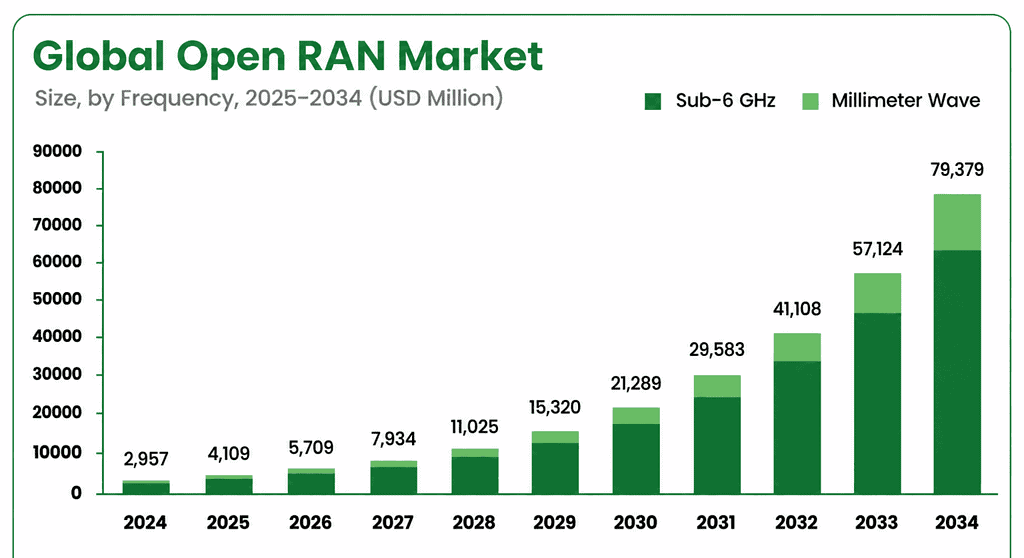
- Market.us estimates the global Open RAN market at USD 2,957 million in 2024 and projects a compound annual growth rate of 38.9%.
- The market is forecast to reach USD 4,109 million in 2025 and USD 5,709 million in 2026.
- Market value is projected to reach USD 57,124 million in 2033 and USD 79,379 million in 2034.
- Sub-6 GHz accounts for the larger share throughout the forecast, while millimeter-wave technology represents the smaller segment; exact segment values are not provided.
How AI Optimizes Open RAN Performance
- An AI-enabled O-RAN digital-twin experiment reduced power consumption by 45.6%, saving 6.03 kWh/day while maintaining connectivity.
- T-Mobile’s 2026 commercial trials achieved nearly 10% higher spectral efficiency and up to 15% greater downlink throughput.
- T-Mobile’s 2026 trials improved peak-hour downlink throughput 16% and spectral efficiency 12% through AI-managed antenna optimization.
- Deutsche Telekom’s 2026 laboratory tests delivered typical uplink throughput improvements of 10–15%; field validation remained pending.
- NVIDIA’s 2026 analysis found AI beamforming delivered up to 1.62× throughput with 32 layers versus zero-forcing.
- Research highlighted in NVIDIA’s 2026 review achieved up to 70% throughput improvement under high-mobility conditions.
- At MWC 2026, AI-RAN demonstrations included 36 Gbps throughput, sub-10ms latency, and 20 component carriers.
Barriers to Large-Scale Open RAN Adoption
| Barrier | Numerical evidence reported in 2026 | Why it restricts large-scale adoption |
| Multi-vendor integration complexity | Only 8% of surveyed operators deployed multi-vendor Open RAN, unchanged from 2025; 24% deployed single-vendor equipment-provider Open RAN. | Integrating different suppliers remains difficult, encouraging operators to select simpler, single-vendor deployments. |
| Slow realization of investment benefits | 47% expected Open RAN’s value after 2–3 operational years; 37% expected 4 years or longer. | Benefits take time to emerge, complicating investment justification. These figures describe expected value realization, not financial payback. |
| Limited supplier diversity and stability | Only 6% considered the vendor ecosystem healthy enough for Open RAN to thrive; 56% considered it viable. | Operators need suppliers with sustained development funding and long-term support; weaker vendors risk exiting. |
| Massive-MIMO radio maturity | Just 7% rated massive-MIMO open radios “very mature,” versus 20% for standard radios; another 49% rated massive-MIMO products “mature.” | Advanced radios must meet demanding performance and feature requirements before operators commit to widespread deployment. |
| Distributed-unit product maturity | Only 13% rated appliance-based open distributed units “very mature”; virtual open distributed units received the same 13%. | Limited confidence in this critical baseband function can delay deployment decisions. |
| Operational complexity and coordination | For broader open-network transformation, operators used an average of 5.4 vendor categories; 68% partnered with systems integrators. | Multiple suppliers increase coordination demands and dependence on integration expertise. These figures are not exclusively Open RAN-specific. |
| Legacy automation migration | Over the following 3 years, 50% expected to evolve existing self-organizing networks into service-management-and-orchestration platforms. | Operators must introduce new management capabilities while continuing to support traditional networks. |
| Weak commitment to multi-vendor automation | Only 21% called multi-vendor automation support “critical”; 60% wanted it but acknowledged possible compromises. | Simpler single-vendor management can outweigh the perceived benefits of independent, multi-vendor control. |
| Cloud-platform scaling difficulties | Only 14% had horizontal cloud platforms spanning core, RAN, and edge, down from 24% in 2025. | Different technical requirements and cloudification speeds complicate shared infrastructure. These figures cover broader open networks. |
Open RAN Use Cases
- A 2026 Open RAN experiment reduced power consumption by 45.6%, saving 6.03 kWh/day while maintaining connectivity.
- A 2026 Open RAN study achieved 95.7% validation accuracy, guiding energy-saving base-station sleep decisions.
- Multi-vendor connectivity: In March 2026, AT&T demonstrated commercial Open RAN calling using 2 vendors: Ericsson basebands and 1Finity radios.
- Cloud-based modernization: AT&T reported Cloud RAN operating in 2 cities in March 2026, supporting its Open RAN readiness strategy.
Recent Open RAN Developments
- In October 2026, O-RAN ALLIANCE announced 66 new or updated technical documents, including 5 new titles, expanding its catalogue to 162 titles.
- In June 2026, O-RAN ALLIANCE reported Spring PlugFest participation from 31 organizations, with 13 hosts conducting interoperability testing across 9 laboratories.
- In March 2026, Samsung announced Rakuten Mobile’s 5G Open RAN supply agreement, covering 700MHz, 1.7 GHz, and 3.8GHz, with commercial deployment expected during 2026.
- In March 2026, AT&T reported over 50% radio replacement, over 50% traffic on open-capable hardware, and live Cloud RAN in 2 cities.
- In November 2025, OREX–SURGE announced Open RAN plans for up to 4,800 stations in 2026, offering up to 100Mbps at approximately USD 6/month.
- In November 2025, 1&1 completed migrating over 12 million customers to Open RAN in under 2 years, peaking at 50,000 migrations daily.
- In January 2025, NTIA awarded USD 117,369,604 to 9 Open RAN radio projects, taking cumulative Wireless Innovation Fund awards above USD 530 million.
The End
Open RAN is moving from trials to commercial rollout, backed by large operator investments and steady government support, yet adoption remains uneven. Single-vendor deployments still dominate, multi-vendor use is limited, and operators cite integration complexity, product maturity, and supplier stability as key barriers.
AI-driven optimization shows promising efficiency gains, though many results come from trials. Open RAN’s long-term success will depend on stronger interoperability, healthier vendor ecosystems, and proof of clear cost and performance benefits at scale.
FAQ
Open RAN (Open Radio Access Network) is an approach to building mobile networks using open, standardized interfaces between radio hardware and software. It lets operators mix components from different vendors instead of relying on a single supplier for the entire radio network.
AI is used in Open RAN to optimize network performance in real time, predict traffic and faults, manage energy use, and automate configuration. It works mainly through intelligent controllers that analyze network data and adjust radio resources without constant manual intervention.
The RAN Intelligent Controller is the software layer in Open RAN that hosts AI and machine learning applications. It comes in two forms: a near-real-time RIC that controls the network within milliseconds to a second, and a non-real-time RIC that handles longer-term policy and model training.
xApps and rApps are applications that run on the RIC to perform specific network tasks. xApps run on the near-real-time RIC and handle tasks like load balancing and interference management, while rApps run on the non-real-time RIC and focus on optimization, analytics, and policy management over longer timescales.
AI can improve network efficiency, reduce operating costs, and cut energy consumption by adjusting resources to actual demand. It also supports faster fault detection, better user experience, and the ability to add new services through third-party applications.
Key challenges include integrating components from multiple vendors, ensuring data quality for AI models, maintaining security across an open architecture, and meeting strict real-time performance requirements. Operators also need skilled teams to manage and validate AI-driven decisions.