









Overview
Extended Reality Statistics: Extended Reality (XR) is quickly reshaping how we work, learn, play, and connect, blending the physical and digital worlds into experiences that once felt like pure science fiction. Combining Virtual Reality, Augmented Reality, and Mixed Reality under one umbrella, XR has moved beyond gaming and entertainment into serious business applications like employee training, product design, healthcare simulations, and remote collaboration.
In 2025, the global XR market continued its impressive growth, fueled by more affordable headsets, major product launches from Apple, Meta, and Samsung, and growing enterprise adoption across industries worldwide. And in 2026, the momentum shows no signs of slowing down, with the market expected to keep growing at a strong pace as AI integration, improved hardware, and 5G connectivity make immersive experiences more accessible than ever before. Let’s dive further into this.
Key Takeaways by the Editor
- The Global Extended Reality (XR) Market is expected to grow to around USD 519.5 billion by 2032, up from USD 49.6 billion in 2023.
- The market value of global virtual reality is forecasted to be USD 20.83 billion in 2025 and is expected to increase from USD 26.71 billion in 2026 to USD 171.33 billion by 2034 at a CAGR of 26.20%.
- As per findings of LM Ericsson, the 5G adoption rate in North America is forecasted to surpass 90% by 2028.
- Revenue from the global consumer VR market is estimated to have exceeded USD 18 billion in 2025, up from less than USD 16 billion in 2024.
- 70% of consumers believe AR offers valuable advantages in 2025.
- More than 1.4 million real estate agents used VR in 2025.
- Smart glasses have quietly become the industry’s most explosive growth story, with Counterpoint Research reporting that global shipments soared 110% year-over-year in the first half of 2025 alone.
- Analysts project that enterprise users will drive fully 60% of total VR revenue by 2030, signaling a structural shift away from gaming as the category’s primary commercial driver.
Key Extended Reality Facts
| Features | Description |
| Market Value in 2025 | USD 87.3 billion |
| Market Value in 2032 | USD 519.5 billion |
| CAGR (2023-2032) | 30.8% |
| Key Region | North America |
| Key Institutions | Qualcomm Technologies Inc., Accenture PLC, SoftServe Inc., SphereGen Technologies LLC, Northern Digital Inc., Microsoft Corporation, Softweb Solutions Inc. (Avnet Inc.), Tata Elxsi Limited, Varjo Technologies Oy, etc. |
| Technology Type | AR (Augmented Reality) technology |
Global Extended Reality Market Statistics
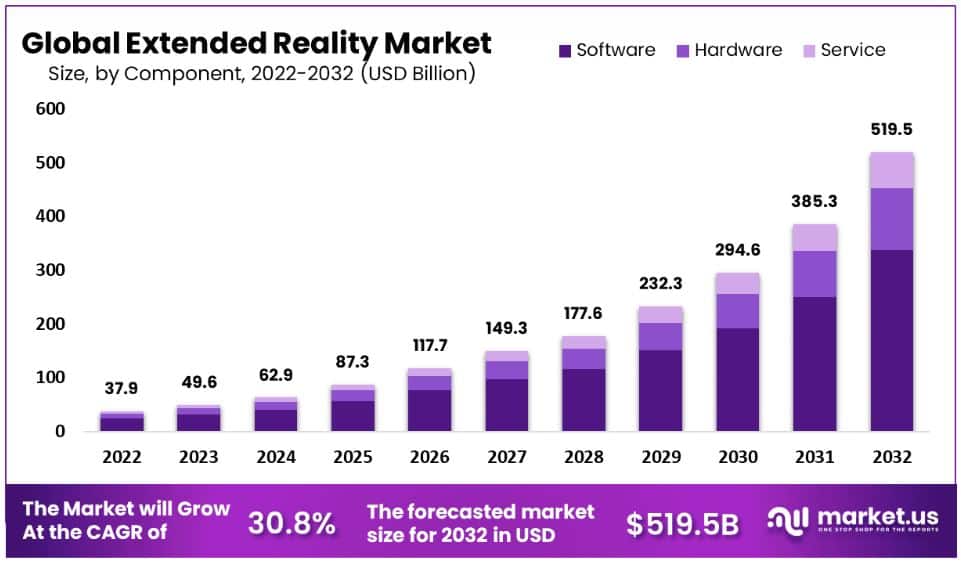
- The Global Extended Reality (XR) Market is expected to grow to around USD 519.5 billion by 2032, up from USD 49.6 billion in 2023, growing at a strong rate of 30.8% each year between 2024 and 2033.
- In 2025, the global Extended Reality market is expected to reach USD 87.3 billion, continuing its steady upward growth from USD 62.9 billion in 2024.
- In 2026, the market is projected to grow to USD 117.7 billion, crossing the USD 100 billion milestone for the first time.
- By 2031, the market is forecast to hit USD 385.3 billion, showing massive long-term growth on the way to USD 519.5 billion by 2032.
- Meta remains the biggest name in the consumer Virtual Reality (VR) space, holding an impressive 80% share of the market.
- Sony, with its PlayStation VR, continues to lead the tethered VR segment and holds more than 40% market share in 2025.
(Source: market.us)
Virtual Reality Market Share Statistics
- The market value of global virtual reality is forecasted to be USD 20.83 billion in 2025 and is expected to increase from USD 26.71 billion in 2026 to USD 171.33 billion by 2034 at a CAGR of 26.20%, per Fortune Business Insights.
- Based on a more restricted market definition, Mordor Intelligence estimated VR at USD 15.64 billion in 2026, growing to USD 40.71 billion by 2031 at a CAGR of 21.08%.
- According to Mordor, North America will account for 37.36% of VR revenue in 2025 while Asia Pacific will have the highest CAGR of 23.49% through 2031.
- The combination of augmented reality with virtual reality is forecasted to increase from USD 40.76 billion in 2026 to USD 441.51 billion by 2034 at a CAGR of 34.69%.
Regional Extended Reality Statistics
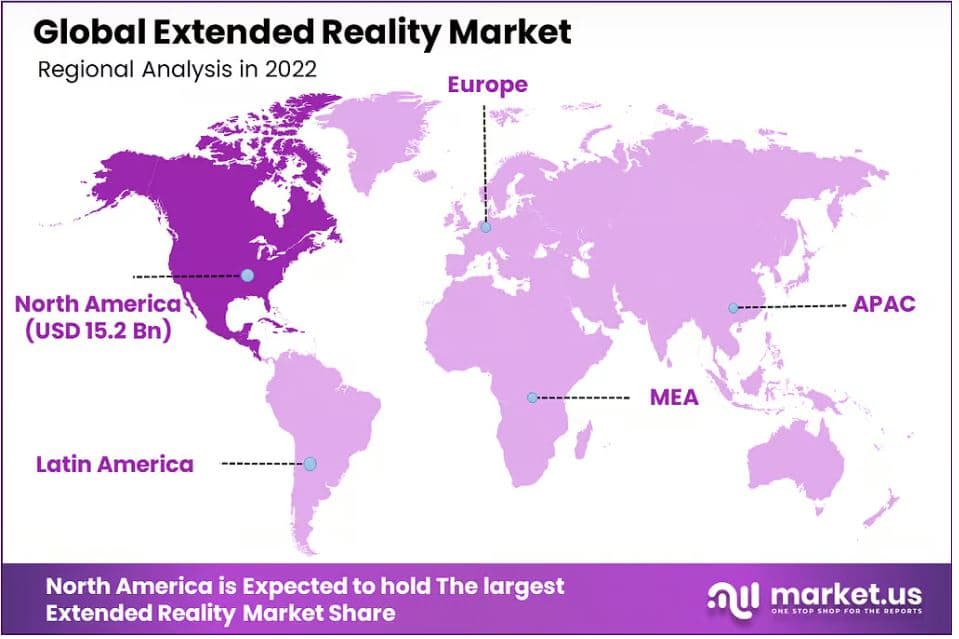
- North America is likely to be the dominant region of the extended reality market globally. It is the dominant region with a 40% share and is predicted to register a CAGR of 32.2% during 2022-2032.
- The rise in smartphone usage is responsible for the dominance of North America in the extended reality market. Adoption of smart devices and implementation of 5G networks. An increase in demand for extended reality technology for different applications.
- As per findings of LM Ericsson, the 5G adoption rate in North America is forecasted to surpass 90% by 2028.
(Source: market.us)
Virtual Reality Statistics
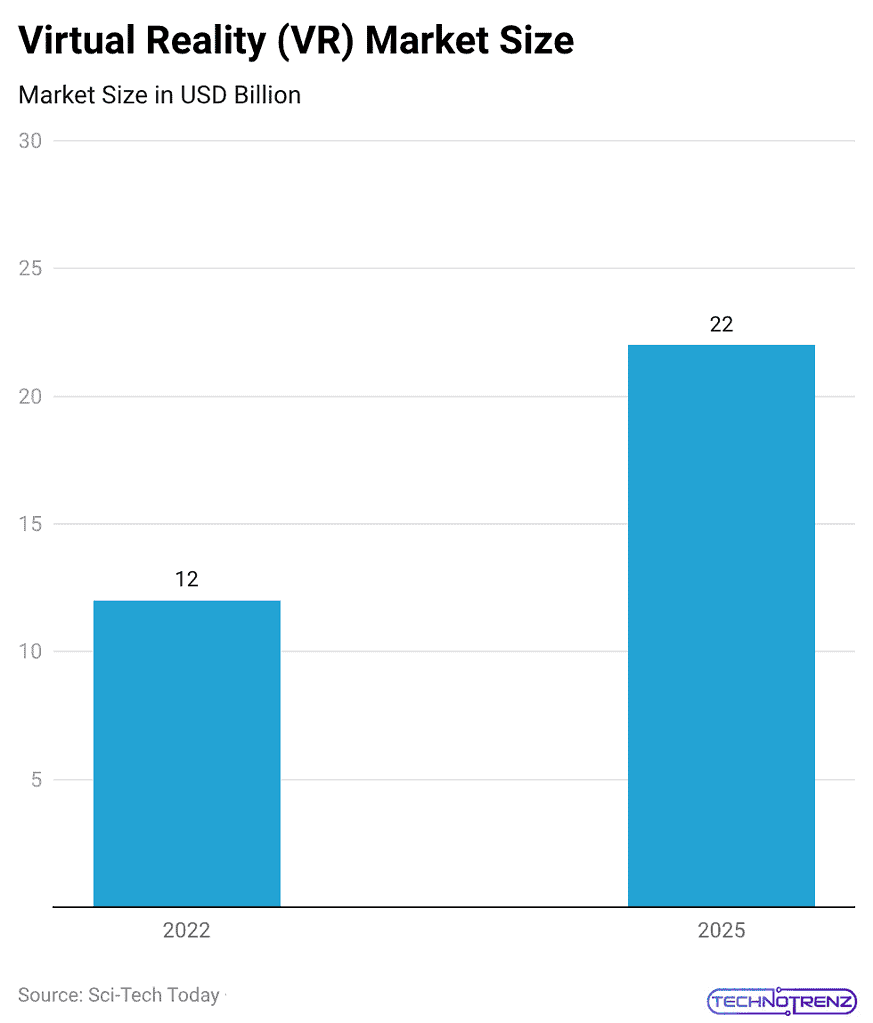
- Revenue from the global consumer VR market is estimated to have exceeded USD 18 billion in 2025, up from less than USD 16 billion in 2024.
- Meta remained the dominant vendor in 2025, holding about 68% of global quarterly VR-headset shipments during the year
- Meta subsequently introduced the lower-cost Quest 3S, which helped lift Meta’s market share to 84% in Q4 2024.
- Apple announced the Apple Vision Pro at WWDC on June 5, 2023, and it has since moved from announcement to commercial availability: it launched in the United States on February 2, 2024, starting at USD 3,499, before expanding to additional international markets.
- Global VR-headset shipments fell 12% year over year in 2024, marking a third consecutive annual decline, even as Meta retained a 77% full-year shipment share and enterprise demand showed greater resilience.
(Reference: market.us)
Extended Reality in E-commerce and Retail
- Mobile AR user progressed to reach approximately 1.7-1.8 billion active mobile AR users by 2025.
- 70% of consumers believe AR offers valuable advantages in 2025.
- Around 59% of consumers now prefer or use AR before purchasing.
- Approximately 200% engagement increased for AR eCommerce as of Dec 2025.
- 2025 data suggest up to 80% of retail brands plan to use AR for customer engagement by 2025.
- According to a study on augmented reality consumers by Google, 66% of people show immense interest in using augmented reality technology to help them in their shopping experience.
- As per research carried out with AR partner of Facebook, Vertebrae, it has been found that retailers using AR technology during the COVID-19 pandemic see an incredible 19% rise in consumer engagement.
- Moreover, the consumer conversion rate is 90% higher for those engaging with AR than for those who don’t engage with it.
- According to Shopify, which is an e-commerce platform, products that have VR/AR technology used in advertising their ads have a conversion rate 94% higher than those products that do not use VR/AR technology in their ads.
- It has been claimed by Deloitte that 40% of consumers would like to pay more for products tested with AR technology.
Extended Reality in Real Estate
- Around 21% of sellers’ agents stage all listings, while 83% of buyers’ agents say staging helps buyers visualize a property as their future home.
- More than 1.4 million real estate agents used VR in 2025.
- Survey results from VRARA show that panoramic tours contribute a lot to purchase decisions for 40.4% of apartment buyers. As much as 72.7% of customers who participated in panoramic tours gave positive remarks about the tool.
- 55.8% of customers say 3D/VR content helps them compare developer offers.
Latest Technology in Extended Reality
- Smart glasses have quietly become the industry’s most explosive growth story, with Counterpoint Research reporting that global shipments soared 110% year-over-year in the first half of 2025 alone.
- This momentum only intensified in the back half of the year, as shipments doubled with a 139% year-on-year jump, and AI-enabled glasses accounted for a striking 88% of all units shipped during that period.
- Meta has effectively cornered this emerging category, holding an 82% share of the global smart glasses market in the second half of 2025, largely on the strength of its Ray-Ban and Oakley collaborations with EssilorLuxottica.
- EssilorLuxottica itself disclosed that it sold more than 7 million Ray-Ban and Oakley Meta smart glasses in 2025, which is more than triple the roughly 2 million units it moved across both 2023 and 2024 combined.
- Omdia’s research paints a similarly bullish picture, calculating that global AI glasses shipments reached 8.7 million units in 2025, a staggering 322% increase, and the firm expects this figure to surpass 15 million units in 2026.
- India represents a particularly compelling growth frontier, having seen a 15-fold expansion in smart glasses shipments following Meta’s official market entry in May 2025, even though its overall global volume share remains modest at just 2%.
- Meanwhile, traditional standalone headsets have not been standing still, as Meta maintained its position as the dominant force in the VR and mixed reality headset market with a commanding 77% share throughout 2024.
- Apple’s Vision Pro told a more cautionary tale during this same period, as the premium device experienced a steep 43% quarter-over-quarter shipment decline in the fourth quarter of 2024, reflecting a cooling of initial market hype.
- By some estimates, total Vision Pro sales for all of 2025 landed in the range of just 300,000 to 350,000 units, a modest figure that underscores how enterprise and mainstream headsets are struggling against the more accessible smart glasses format.
- Enterprise adoption of XR technology, however, tells a genuinely encouraging story, as more than 75% of Fortune 500 companies have now adopted virtual reality for training and education purposes, according to industry tracking.
- Analysts project that enterprise users will drive fully 60% of total VR revenue by 2030, signaling a structural shift away from gaming as the category’s primary commercial driver.
Recent Extended Reality Statistics
- In February 2024, Apple launched the Vision Pro headset, selling over 200,000 units within the first two weeks despite its USD 3,499 price tag.
- In June 2024, Meta reported that Quest headset sales surpassed 20 million units cumulatively since launch, with the Quest 3 driving a 35% increase in active VR users compared to the previous year.
- In January 2025, the global Extended Reality market was valued at approximately USD 87.3 billion, with enterprise adoption accounting for over 40% of total XR spending across training, design, and remote collaboration applications.
- In Q2 2025, Samsung and Google announced a joint XR platform partnership, unveiling a new mixed reality headset built on Android XR, targeting a release with over 50 optimized applications at launch.
- In May 2025, Microsoft reported that its HoloLens enterprise partnerships expanded to over 5,000 companies globally, with manufacturing and healthcare sectors driving the majority of new XR training deployments.
- In August 2025, Sony announced that PlayStation VR2 sales surpassed 3 million units worldwide, with over 500 compatible VR games and experiences available on the platform.
- In Q2 2026, Meta unveiled its next-generation Quest 4 headset, featuring improved AI-powered hand tracking and a 30% lighter design, aiming to capture a larger share of the consumer VR market ahead of the holiday season.
Ending
Extended Reality is quickly moving from a futuristic concept to an everyday reality, and the numbers make it clear this shift is only accelerating. With the global market projected to grow from USD 117.6 billion in 2026 to over USD 519.5 billion by 2032, driven by falling hardware costs, AI integration, and rising enterprise adoption, XR is set to become a core part of how businesses train employees, design products, and connect with customers.
As tech giants like Apple, Meta, Samsung, and Sony continue pushing the boundaries of what’s possible, Extended Reality is well on its way to becoming one of the most transformative technologies of the next decade.
FAQ
Extended Reality (XR) is an umbrella term that combines Virtual Reality (VR), Augmented Reality (AR), and Mixed Reality (MR), creating immersive digital experiences that blend the physical and virtual worlds.
Gaming, healthcare, education, retail, and manufacturing are among the leading industries adopting XR technology, using it for immersive training, virtual product demos, and enhanced customer experiences.
VR creates a fully immersive virtual environment, AR overlays digital elements onto the real world, and MR blends both by allowing virtual objects to interact with the physical environment in real time.
Businesses use XR for employee training, virtual meetings, product design, remote collaboration, and immersive marketing experiences, helping improve efficiency and engagement across various operations.
Extended Reality (XR) works by combining hardware, sensors, and software to merge the physical world with digital environments.

Sources