









Preface
Fitness Industry Statistics: The fitness industry is growing faster than ever as more people choose healthy and active lifestyles. Today, fitness is not just about going to the gym. It includes home workouts, fitness apps, wearable devices, healthy eating, and mental wellness. New technology has made it easier for people to exercise anytime and anywhere. As health awareness continues to rise, the demand for fitness products and services is increasing worldwide.
This growth has created many business opportunities and changed the way people think about health and fitness. The fitness industry now plays an important role in improving people’s lives while shaping the future of health and wellness.
Curated Choice
- The global fitness market is estimated to reach USD 134 billion in 2026 and USD 157.6 billion by 2029.
- Fitness app revenue climbed to USD 16.2 billion, with +19% ARPU, while paid subscriptions contribute 40% of total revenue.
- Gyms and health clubs are expected to generate the highest revenue, at USD 114.7 billion, in 2026.
- The fitness tracker market is expected to generate USD 77.7 billion in revenue in 2026.
- Fitness bands remained the largest product category, increasing from USD 28.15 billion in 2025 to USD 33.64 billion in 2026, with 19.5% growth.
- Global wearable device shipments are projected to grow steadily from 590.7 million units in 2025 to 614.1 million in 2026.
- Fitness trackers are expected to hold the largest product share at 45.9% in 2026.
- In 2026, cardiovascular training equipment leads the market with a 38% share, followed by weight training machines (34%) and weight lifting machines (28%).
- Google Health (Fitbit) ranked #1, generating about USD 0.91 billion annually and USD 7 million/month. The Fitbit app was officially rebranded as Google Health on May 19, 2026.
- 54% of U.S. adults plan to focus on health, fitness, and exercise in 2026, representing approximately 140 million people.
- 81 million Americans held gym memberships in 2025, representing a record 26.1% market penetration.
- 74% of the individuals prefer to work out under the professional guidance of a fitness instructor.
Global Fitness Industry Market Reach
- According to Amra and Elma, the global fitness market is estimated to reach USD 134 billion in 2026 and USD 157.6 billion by 2029, growing at an 8.7% CAGR from a 2024 base of USD 101.45 billion.
- Online fitness accounted for USD 67.4 billion, with +41% YoY growth in Southeast Asia and a 33.1% annual growth rate.
- Fitness app revenue climbed to USD 16.2 billion, with +19% ARPU, while paid subscriptions contribute 40% of total revenue.
- Wearable fitness technology is worth USD 71.3 billion, with 398 million+ units shipped.
- Health club memberships reached 82 million (+6% YoY), while 58% of adults aged 18-34 now prioritize strength training.
- 63% of gyms offer hybrid access, 2.1 billion fitness app downloads have been recorded, and 74% of Americans use fitness apps.
- Gen Z spends USD 2,164 annually on wellness (+22%), while fitness content has surpassed 980 billion views on TikTok.
- The USD 46.3 billion personal training market and the USD 4.1 billion VR fitness sector continue to expand, while the global wellness economy has reached USD 7.8 trillion.
- 81.3% of adults now prioritize health, helping U.S. fitness center spending increase to USD 39.4 billion, marking +9.2% YoY growth.
Fitness Industry Market Revenue By Segment
- According to RunRepeat, gyms and health clubs are expected to generate the highest revenue, at USD 114.7 billion, in 2026.
- Fitness trackers will reach USD 85.8 billion, followed by online and digital fitness at USD 44.7 billion.
- Boutique fitness will generate USD 41.4 billion, while fitness equipment and Fitness apps will generate USD 23.7 billion and USD 13.6 billion, respectively.
Market Share Trends
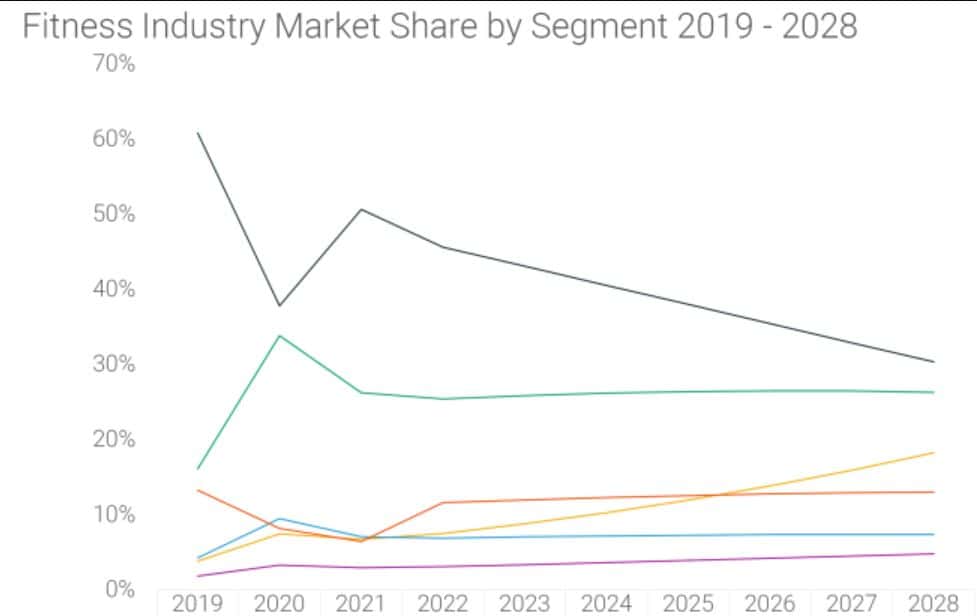
(Source: runrepeat.com)
- In 2026, Gyms and Health Clubs continue to hold the largest share of the fitness industry at 35%.
- Moreover, fitness trackers held the second market share at 26%, followed by online and digital fitness (14%), boutique fitness (13%), fitness equipment (7%), and fitness apps (4%).
By Country
- China is expected to grow at a 10.2% CAGR from 2026 to 2036, driven by rapid urbanization and increasing middle-class fitness spending.
| Country | CAGR |
| India | 9.8% |
| Brazil | 8.5% |
| USA | 7.2% |
| Germany | 6.8% |
| UK | 6.7% |
| France | 6.5% |
Fitness Trackers Market Size
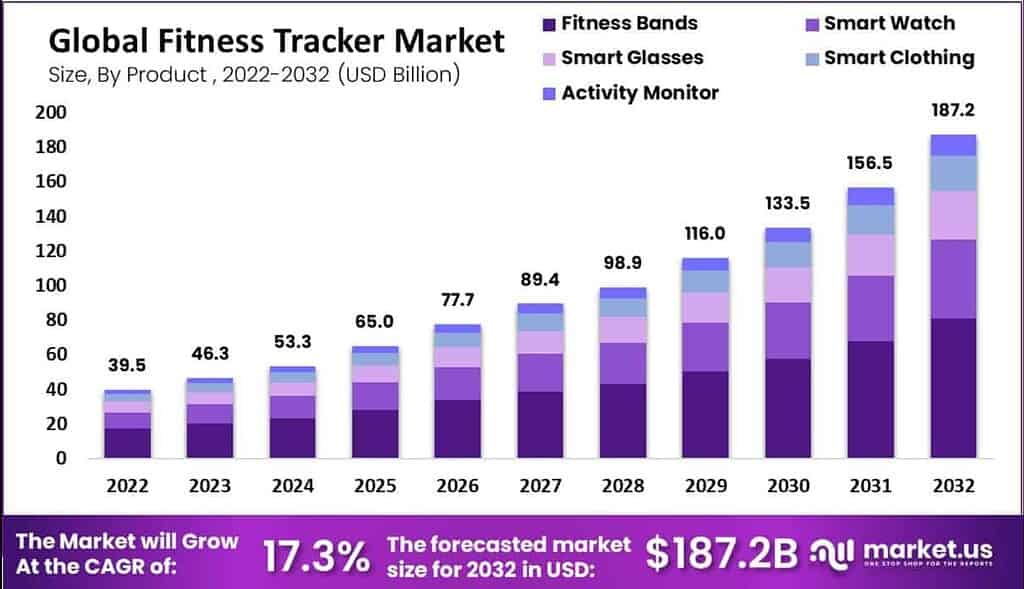
(Source: market.us)
- The fitness tracker market is expected to generate USD 77.7 billion in revenue in 2026.
- The market will grow at a 17.3% CAGR, reaching USD 187.2 billion by 2032.
By Products
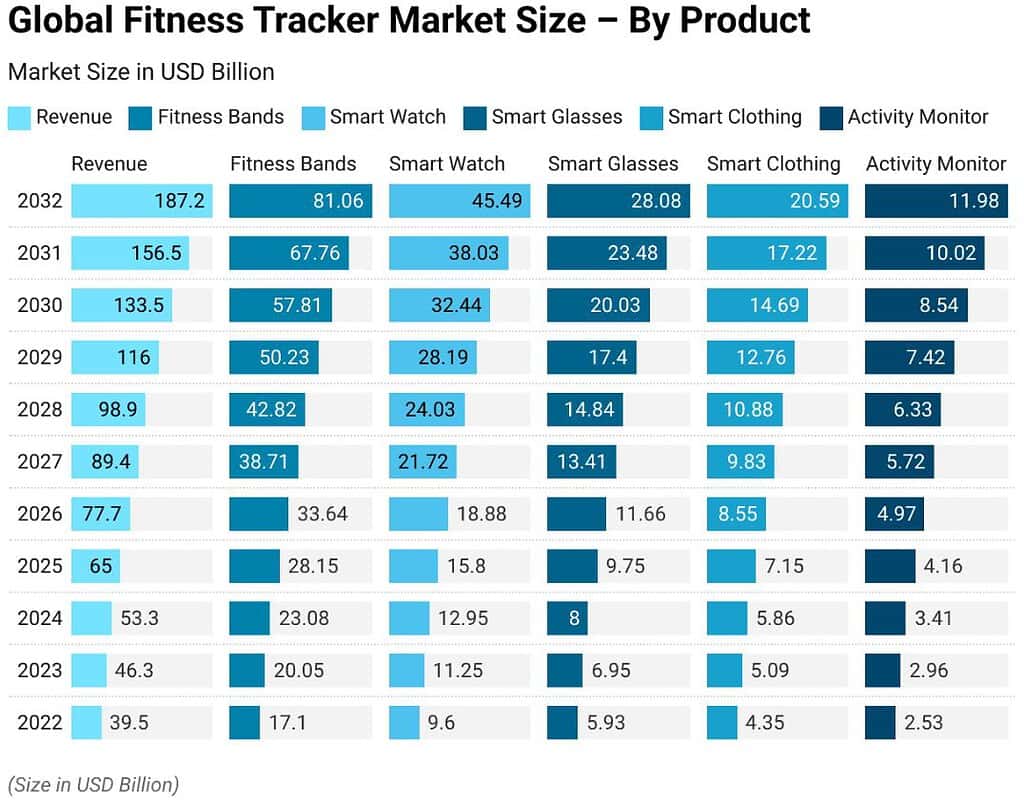
(Source: market.us)
- Fitness bands remained the largest product category, increasing from USD 28.15 billion in 2025 to USD 33.64 billion in 2026, with 19.5% growth.
- Smartwatches expanded from USD 15.8 billion to USD 18.88 billion, representing approximately 19.5% growth.
- Smart glasses grew from USD 9.75 billion in 2025 to USD 11.66 billion in 2026, representing 19.5% growth.
- Smart clothing increased from USD 7.15 billion to USD 8.55 billion, achieving 19.6% growth.
- Activity monitors rose from USD 4.16 billion to USD 4.97 billion, reflecting 19.5% annual growth.
- By 2032, the total market is projected to reach USD 187.2 billion, including USD 81.06 billion (fitness bands), USD 45.49 billion (smart watches), USD 28.08 billion (smart glasses), USD 20.59 billion (smart clothing), and USD 11.98 billion (activity monitors).
- Between 2025 and 2026, every product segment recorded a similar annual growth rate of approximately 19%-20%.
By Application
- Market.us News shows that running tracking held the largest market share at 43%, followed by sports tracking (17%) and cycling tracking (15%).
- Heart rate tracking accounted for 9%, while glucose and sleep measurement tracking each accounted for 8% of the global fitness tracker market.
The Leading Fitness Tracker Apps Worldwide By Downloads (January 2026)
| App Names | Downloads (in million) |
| Strava | 4.8 |
| Google Fit | 4.4 |
| Huawei Health | 3.8 |
| Zepp (Amazfit) | 3.5 |
| Samsung Health | 3.2 |
| Fitbit (Google Health) | 2.9 |
| Mi Fitness (Xiaomi Wear) | 2.7 |
| Garmin Connect | 2.4 |
| Wearfit Pro | 2.2 |
| Glory Fit | 2 |
Fitness Wearable Device Shipment Trends
- Global wearable device shipments are projected to grow steadily from 590.7 million units in 2025 to 614.1 million in 2026, 632.3 million in 2027, and 645.7 million by 2028.
- Across product categories, shipments continue rising between 2025 and 2028, with earwear reaching 402.25 million units, clothing 374.28 million, and smartwatches 208.63 million by 2028.
Health And Fitness Club Market Report
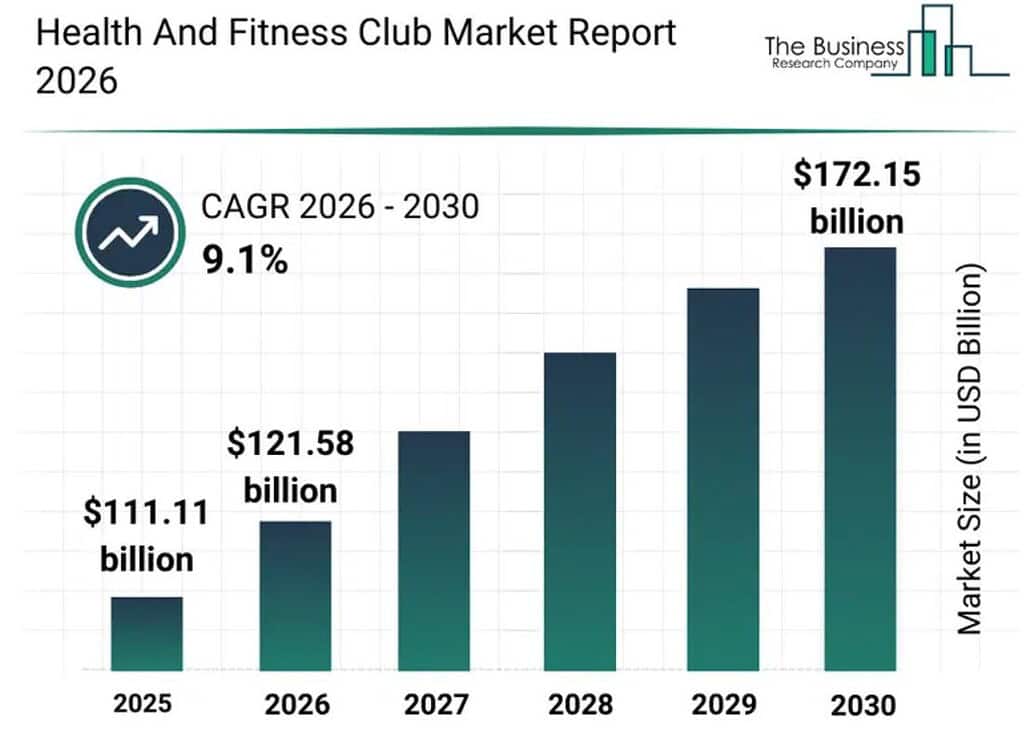
(Source: thebusinessresearchcompany.com)
- The global Health and Fitness Club market was valued at USD 111.11 billion in 2025 and is projected to reach USD 121.58 billion in 2026.
- Moreover, the market will reach USD 172.15 billion by 2030, expanding at a steady 9.1% CAGR between 2026 and 2030.
By Segmental Analyses
- Membership fees are projected to account for 52.5% of the health and fitness club market in 2026, according to Future Market Insights.
- Women are expected to account for 45% of the market share in the same period.
- From 2026 to 2036, South Korea is forecast to record the highest CAGR of 8.1%, followed by the United Kingdom (7.3%), Japan (7.0%), China (6.6%), and the United States (6.1%).
Smart Fitness Market Size
- Coherent Market Insights further stated that the global smart fitness market is estimated at USD 99.12 billion in 2026 and is projected to reach USD 213.71 billion by 2033, growing at a 11.6% CAGR.
- Fitness trackers are expected to hold the largest product share at 45.9% in 2026.
- The online distribution channel is projected to account for 58.7% of the market share.
- North America is expected to lead the market with a 41.8% share.
- Asia Pacific is projected to account for 28.4% of the global smart fitness market.
By Product Types
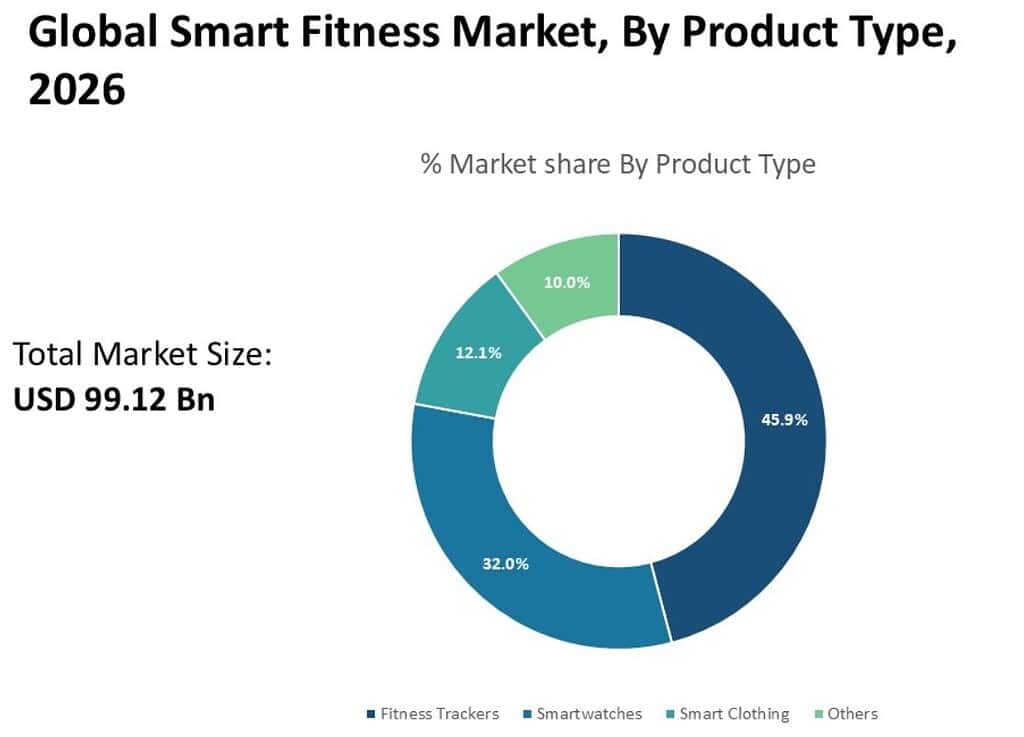
(Source: coherentmarketinsights.com)
- Fitness trackers led the market with a 45.9% share in 2026, followed by smartwatches at 32.0%, together accounting for nearly 78% of the global smart fitness market.
- Smart clothing accounted for 12.1%, while other products held the remaining 10.0% of the market share.
By Distribution Channel
- In 2026, the online distribution channel captured the largest market share at 58.7%.
- The offline channel accounted for the remaining 41.3% of the global smart fitness market.
Boutique Fitness Studio Market
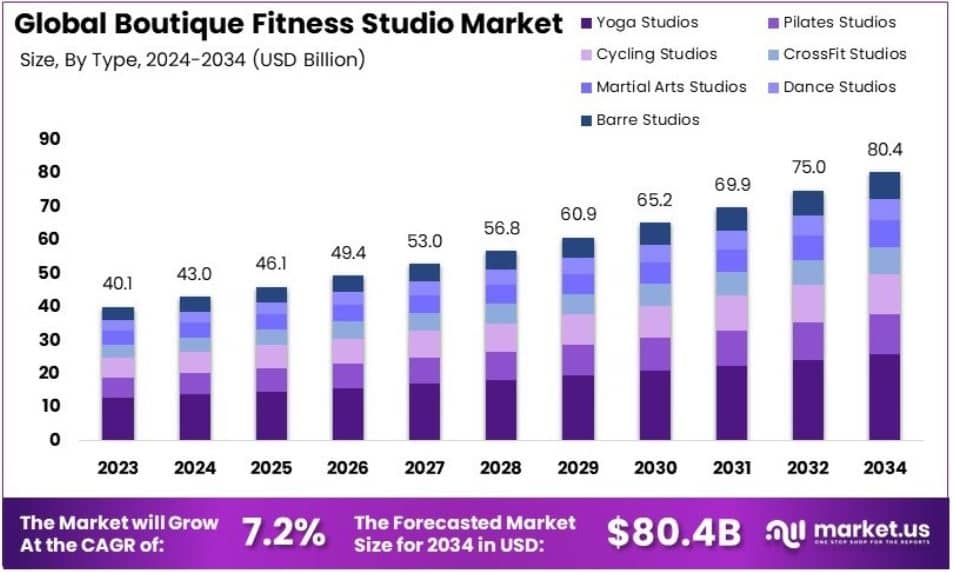
(Source: market.us)
- The global boutique fitness studio market was valued at USD 46.1 billion in 2025 and is projected to reach USD 49.4 billion in 2026.
- The market is projected to nearly double, reaching USD 80.4 billion by 2034, growing at a CAGR of 7.2% from 2026 to 2034.
Fitness Equipment Market Analysis
- The global fitness equipment market is valued at USD 13.89 billion in 2026 and is projected to reach USD 19.94 billion by 2033, growing at a 5.3% CAGR.
- In 2026, Cardiovascular training equipment is expected to lead the market with a 38% share, followed by weight training machines (34%) and weight lifting machines (28%).
- Home/individual users held the largest market share at 44.7%, followed by fitness centers/gyms at 31.3%, with other commercial organizations accounting for the remaining 24%
- North America is forecast to lead the global market with a 39% share.
Sports and Fitness Apps Market Size
- The global sports and fitness apps market is valued at USD 15,629.6 million (USD 15.63 billion) in 2026, as per Coherent Market Insights.
- Besides, it is projected to reach USD 94,948.3 million (USD 94.95 billion) by 2033, growing at a strong CAGR of 29.4% from 2026 to 2033.
- The Android segment dominates with a 79.2% market share in 2026, followed by iOS at 15.8% and other platforms at 5%.
- Smartphones hold the largest share at 53.4% of the total market in 2026, followed by Wearable Devices at 29.3% and Tablets at 17.3%.
- From a regional perspective, North America leads the global market with a 26.1% share in 2026, while Asia-Pacific is the fastest-growing region, capturing a 23.2% share.
Top 10 Fitness and Health Apps
- Google Health (Fitbit) ranked #1, generating about USD 0.91 billion annually and USD 7 million/month. The Fitbit app was officially rebranded as Google Health on May 19, 2026.
- MyFitnessPal ranked #2, with an estimated USD 293 million revenue in 2025, USD 16.1 million/month, 220 million registered users, and 30 million monthly active users.
- AllTrails (#3) reached 95 million global users by March 2026, while Strava (#4) generated around USD 500 million and surpassed 180 million registered users.
- Flo generated USD 200 million+, Calm reached USD 210 million with USD 8 million/month, and Lose It! reported an estimated USD 30–50 million with 50 million+ registered users.
- Finch (#5) and MacroFactor (#9) continued to expand their user bases, while Fitbod (#10) generated about USD 4.8 million annually and USD 400K/month.
United States Health And Fitness Goals
- 54% of U.S. adults plan to focus on health, fitness, and exercise in 2026, representing approximately 140 million people.
- Americans are expected to spend around USD 60 billion on health and fitness in 2026, with an average monthly spending of USD 61 among those with fitness goals.
- 86% of respondents believe fitness facilities are important for achieving their goals, while 89% consider regular physical activity an effective form of preventive healthcare.
- The leading fitness goals for 2026 include building muscle (50%), improving mobility, flexibility, and posture (48%), and supporting mental health through exercise (46%).
- Only 23% of respondents would reduce fitness spending, prioritizing it over dining, travel, and entertainment expenses.
Global Gym Membership And Consumer Trends
- Gymdesk reported that 81 million Americans held gym memberships in 2025, representing a record 26.1% market penetration.
- Boutique studios generated 34% of new member sign-ups, reflecting growing demand for specialized fitness experiences.
- Adults aged 25-44 accounted for 33.8% of members, while the under-25 group increased to 30.8%.
- Gen Z accounted for around 35% of memberships and nearly half of all new gym memberships in 2025.
- Adults aged 65+ recorded 44% YoY growth in fitness app adoption.
- Males held 51.5% of U.S. memberships, up from 49.6% in 2019, while the female segment is projected to grow at a 10.79% CAGR.
- Low-cost gyms accounted for 38% of new memberships; boutique Pilates studios grew 66% YoY.
- Households earning USD 75K+ accounted for just over 50% of memberships, compared with 18% for households earning below USD 50K and 35% for higher-income earners.
Fitness Report Of Gymgoers’ Behavior
- 74% of the individuals prefer to work out under the professional guidance of a fitness instructor.
- On average, Americans spend between USD 20 and USD 100 per month on their gym memberships.
- Fitness Industry Statistics report that only 20% of people actively utilize their gym memberships.
- The average cost of boutique fitness studio memberships paid by individuals is USD 90 per month.
- Around 35% of Americans are attending in-person training programs they found online.
Key Challenges Affecting Global Physical Activity
- In 2022, 31% of adults worldwide, equal to 1.8 billion people, did not meet physical activity guidelines, and inactivity is projected to reach 35% by 2030, according to WHO.int.
- The most common barriers to regular exercise are lack of time, energy, and motivation.
- 41% of gym cancellations are due to cost, while 68% of non-members cite cost as the main reason for not joining.
- Around 50% of new gym members leave within 6 months, and 67% rarely or never use their memberships.
- Globally, 81% of adolescents meet recommended activity levels, whereas only 20%-28% of U.S. children do.
- Physical inactivity is estimated to cost the United States USD 192 billion in healthcare spending each year.
Conclusion
The fitness industry is growing steadily as more people focus on healthy lifestyles and preventive healthcare. Demand for fitness trackers, smart devices, digital fitness apps, and gym memberships continues to rise across all age groups.
AI-powered solutions, wearable technology, and hybrid fitness models are changing how people exercise and track their health. With strong consumer spending and continuous innovation, the global fitness industry is expected to create significant growth opportunities in the coming years.

Sources