









Introduction
AI Search Statistics: AI-enabled search is creating new patterns in information discovery, comparative shopping, and the determination of which websites to visit. Pew Research Center in 2026 stated that AI-generated search summaries are being used by 60% of U.S. adults, while 49% use AI chatbots.
The distinction between search summaries and active chatbot use means this behavior is not only being limited to a small group of early adopters. Researchers indicate AI summaries correlate with lower search clicks on more traditional results. Retail data from Adobe from September 2026 indicate that visitors originating from AI referrals have a substantially higher conversion rate as well as a higher revenue per visit.
The article below delineates the current 2026 data versus previous research, which is still relevant.
Top Picks
- With 64.5% of the AI search market share, ChatGPT is dominant.
- ChatGPT’s US monthly active users have nearly doubled since June 2025 to almost 50 million.
- Over that same period, Meta AI’s US monthly active users jumped over fourfold to close to 9 million.
- AI-generated search traffic results showed a 67.8% engagement rate, while Google’s organic search traffic had a 61.8% engagement rate.
- A 4.4-fold increase in AI search traffic visitors’ conversion over traditional organic search visitors.
- The presence of AI summaries reduced the percentage of traditional search results being clicked to 8%.
- Adobe Digital Insights, which examines data about shoppers’ experiences, noted that 56% of US shoppers used AI during the 2025 holiday shopping season.
- Also from Adobe in March 2026, AI-referred traffic experienced a conversion rate that was 42% higher than non-AI traffic, in contrast to a previous 38% lower conversion rate.
- In June 2025, 1.6% of prompts with ChatGPT received AI-powered search answers containing source citations, and this figure reached 6.8% in May 2026.
- 16% of large companies report tracking AI search, thus highlighting an unmet demand to measure this channel of information access.
AI Search Platform Reach and Market Share
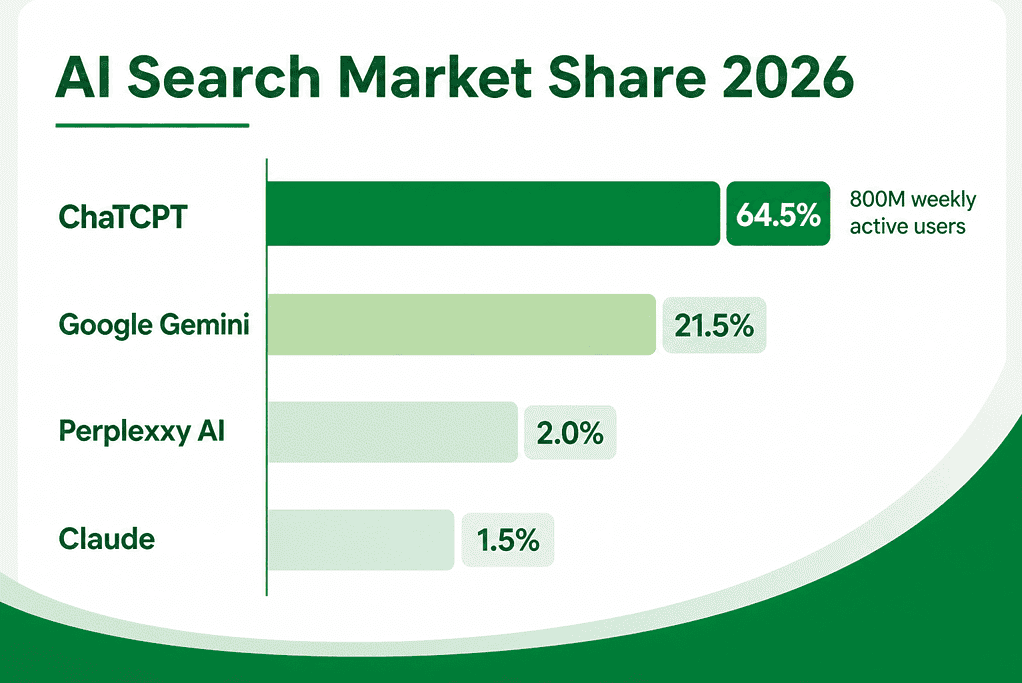
- As AI search becomes more popular for users in search of information and in making purchase decisions, AI search use is consolidated among just a few companies, with the most popular of these being ChatGPT.
- According to a 2026 analysis of market share by Statista, ChatGPT has a 64.5% share of AI search, and the next most popular AI searches are Google Gemini at 21.5% and Perplexity at 2%.
- User statistics are an alternative way of measuring AI search platform usage. For instance, ChatGPT has an estimated 800 million weekly active users, whereas Perplexity has 22 million active users.
- As an alternative to platform user figures, Master of Code estimates that there are over 4.7 billion AI searches made each month on ChatGPT.
- The AI Search data demonstrates the fragmentation of the market and the opportunities this provides for marketing teams.
- ChatGPT may lead the market, but the overall market consists of many competing offerings that complement one another.
- Marketers cannot rely on a single solution, and instead must examine each AI Search tool for market position, usage, and traffic share to determine the right solution to serve their AI search strategy and measure the impact of content in the form of AI-generated answers.
AI App Growth Statistics
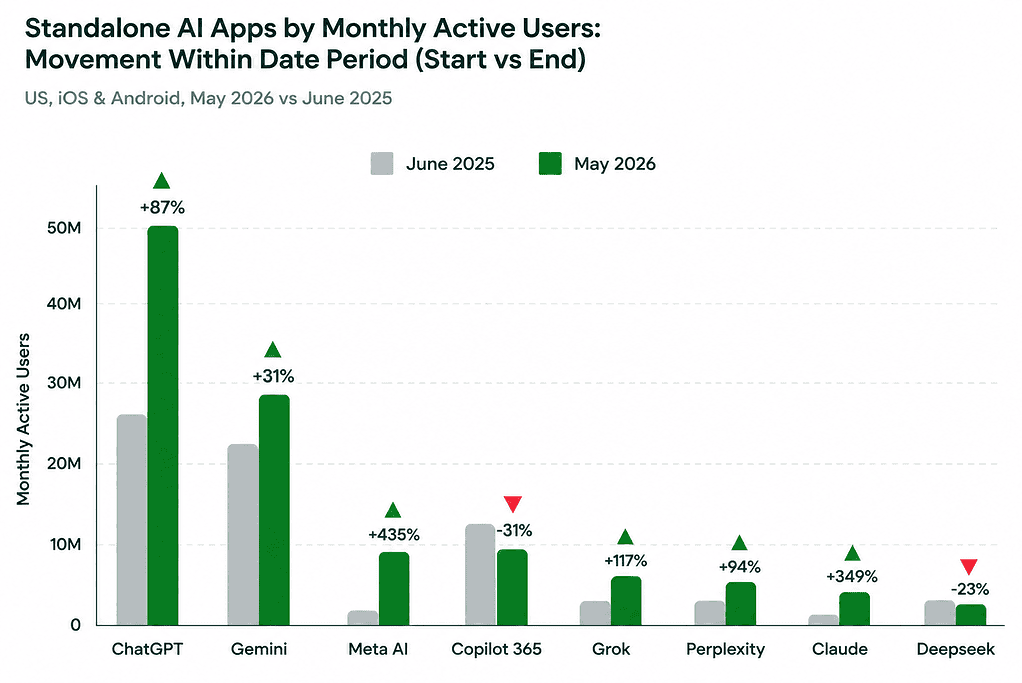
- AI Search monthly active users from June 2025 to May 2026, including the United States, show ChatGPT as the largest standalone app with 87% growth to approximately 50 million monthly users.
- Gemini grew by 31% to about 29 million, while Meta AI was the fastest grower at 435% to nearly 9 million users.
- Grok was the next fastest grower at 117% to around 6 million users, while Perplexity was 94% to approximately 5 million users.
- Claude expanded 349% to about 4 million monthly users.
- In contrast, Microsoft 365 Copilot declined 31% to approximately 8 million monthly users, and DeepSeek declined 23% to approximately 2 million monthly users.
- Claude’s international expansion is further supported by the 180% increase Anthropic reported in unique visitors in the second half of the year over the first.
- The growth story for Meta AI takes another path: distribution over Meta’s existing apps.
- Meanwhile, the number of absolute visits for ChatGPT hasn’t significantly changed. The broader market has increased.
- Gemini utilizes Google’s ecosystem while Claude captures the attention of technical users and developers.
- Marketers should understand that relying only on ChatGPT leaves significant portions of your audience ignored.
- GEO strategies must consider user intent, platform reach, and the level of brand visibility across different AI services.
AI Search Engagement and Conversion Statistics
- The interest from users finding AI search traffic to be valuable is promising, with AI search results displaying higher engagement and conversion statistics.
- According to an analysis conducted by Goodie, from February 2026 to May 2026, engagement on AI traffic was 58.5 seconds, compared to 44.2 seconds on Google organic traffic and 47.9 seconds on Bing organic traffic.
- With the higher engagement rate on AI search results, users were also interacting with content on websites more than they would with organic search results.
- The value of an AI search visitor is more significant compared to the value of a traditional search visitor, with a higher conversion rate, according to Semrush’s 2025 AI Search Study.
- According to Ahrefs’ 2025 AI Search Study, 0.5% of Ahrefs traffic originated from AI searches, but that accounted for 12.1% of signups on Ahrefs, representing a 23-times larger value of an AI visitor over an organic search visitor.
- Semrush compared data across many different sites, while Ahrefs studied a single site with an audience that was technical in nature.
- The takeaway from these results for marketers is that while traffic referrals from AI tools can bring highly engaged visitors to a site, the traffic results will depend heavily on the site’s industry and audience.
- Before implementing GEO targets, businesses should study their own engagement and conversion metrics.
Zero-Click Search and AI Overviews
- Google’s AI Overviews have transformed user engagement with search results, removing the need for a user to click again to find the answer.
- According to Semrush, AI Overviews were in about 6.5% of searches in January 2025, peaked at roughly 25% in July, and were at roughly 16% in November.
- Pew Research Center looked at 900 US adults. In instances when an AI summary was present, users clicked a link on the search results in roughly 8% of searches.
- On searches with no summary, users clicked a search result link roughly 15% of the time.
- Link clicks within the summaries were roughly 1%.
- There were 68,879 Google searches, and in roughly 18% of those cases, an AI summary was created.
- Users were more likely to leave the search after an AI summary, with roughly 26% of searches ending after the summary versus 16% when there was no summary.
- The Semrush study found the zero-click rate to be about 93%. That analysis was done on 69 million desktop searches that occurred between May and July 2025 in the United States.
- In July of 2025, Semrush published data saying that 90% of the ChatGPT citations ranked at position 21 and lower in regular Google searches.
- At the same time, Similarweb observed that in the United States, 6.8% of ChatGPT prompts were producing answers that contained citations compared with just 1.6% in June of 2025.
- Marketing teams need to understand that the days of tracking traditional ranking systems are long gone.
- For marketing teams to succeed in the search engine marketing age, the system needs to recognize the AI systems that answer the queries.
- Along with the content needing to be structured and pertinent, the AI systems need to see it as a credible resource.
The Impact of AI-Driven Search in Online Shopping
- Shoppers are using AI to inform their searches to discover, evaluate, and choose what they purchase.
- It also highlights that online shoppers are shifting from searching the web to consulting chatbots.
- According to research published by McKinsey in October 2025, over half of online shoppers across all age groups, including older shoppers, intentionally use AI for shopping. This shows that online shopping powered by AI is not just for the younger demographic.
- Adobe Digital Insights showed that US consumers significantly adopted the technology for shopping during the 2025 holiday season, with over half the consumers shopping using the technology, as compared with just over 1 in 10 shoppers in 2024.
- Similarweb’s 2026 AI Brand Visibility Report provided more insights on how these technologies are changing the customer buying process.
- AI-driven systems used by 35% of customers in the discovery and brainstorming phase are used more by 13.6% of customers.
- Additionally, the traffic driven by AI was 42% more effective in terms of conversion compared to non-AI-driven traffic, which reversed a 38% deficit that had been recorded twelve months ago.
- The above figures illustrate the importance of AI in the search systems used for both discovering and buying products.
Important factors to consider when reading AI Search Statistics
- Correct interpretation of AI search statistics helps reveal consumer behavioral changes. There are three key factors to keep in mind when interpreting these figures.
- Before a website gets a share of referral traffic, the answers generated by the AI are typically viewed many times.
- Low referral traffic shares may therefore not reveal brand visibility or strategic importance. In addition, the citation behaviors are not consistent.
- Nearly 50% to 60% of citations change every month, making the single monthly measures inconsistent.
- The performance of these models can also be inconsistent across platforms, which makes the combination of figures such as ChatGPT, Perplexity, AI Overviews, Claude, and Gemini mask the individual model’s important performance differences.
- Passionfruit’s research on AI search shows brands that are slow to act on their AI search presence risk getting outpaced.
- Passionfruit reports that 4% of large companies currently have AI search tracking.
- An initial assessment will help companies see what citations and information are already indexed, and the gap analysis will help businesses create an AI search presence that is fully built upon their already strong SEO presence.
Technical SEO Requirements for Generative Engine Optimization (GEO)
- The foundation for Generative Engine Optimization (GEO) is the same as for Traditional Search Engine Optimization (SEO).
- The foundation of both is the need for the content to be accessible, easily crawlable, and understandable.
- Google confirms there are no special AI tags that are needed for a page to appear in the AI Overview and AI Mode; rather, it is just like appearing with a search snippet, so being crawlable and indexable are the keys.
- GPTBot used for training, and OAI-searchBot used for search purposes are separated by OpenAI.
- Similarly, ClaudeBot and Claude-searchBot are separated by Anthropic.
- Blocking all robots from crawling websites could restrict search presence for a publisher who only wants to restrict training purposes.
- Google-extended is an exception, as it sets limits on what Gemini can do in terms of training and grounding.
- Access to technology is different from ‘robots.txt’. The crawlers may be blocked by the use of CDN restrictions, hosting policies, and concerns regarding security.
- Google advises verifying the bots based on their IP addresses and using reverse DNS, while OpenAI gives the IP lists of the crawlers.
- There are 3 main stages involved in Google’s JavaScript: crawling, rendering, and indexing.
- Given that not all bots are able to use JavaScript, server-side rendering and static generation can help bring to light the necessary content.
- It is also recommended that developers verify the URLs, crawlable links, HTTP responses, canonical tags, and the directives regarding indexing.
- The importance of structured data is to describe webpage entities; however, Google does not ask for the implementation of Schema.org for the purpose of generative search.
- JSON-LD is suggested as the format; nevertheless, it is essential that the information in it corresponds to the content that can be viewed.
- The dataset markup serves the purpose of supporting genuine research datasets, while correct authorship and authentic sources increase the credibility of the information.
- In the end, technical SEO relies on parameters that can be measured, such as crawler access, content that was rendered, the indexation of the content, and any mistakes in the structured data.
How to Optimize for AI Search
- While improving your visibility in AI search you should not limit yourself just to traditional optimization of the keywords.
- The user needs informative and clear content, a user-friendly website, and regular performance monitoring.
- With the help of this process, every element should be developed in 12 weeks and refined afterwards as the AI search system changes.
- In the early stages, it is necessary to achieve a technical basis. Using clear language while answering users’ questions, it is important that the text is arranged in a readable structure.
- Semrush Site Audit is useful for determining process slowdowns, indexing problems, and a lack of technical accessibility.
- Using the AI Visibility Overview and Cited Pages report makes it possible to understand what pages are present in the AI-produced dialogue.
- In weeks 5 to 8, the emphasis is placed on the improvements to the content. It will be necessary to complement the text with various images, videos, and examples, as well as to provide descriptive text for graphics used.
- From the moment week 9 starts, change from improving device performance to optimizing speed and page navigation.
- Start compressing images, reduce the number of irrelevant code scripts, and check structured data with the help of Google’s Rich Results Test and Semrush Site Audit.
- When the initial period of 12 weeks passes, remember to keep track of the brand mentions, citations, inbound traffic performance, engagement, and search visibility connected to ChatGPT, Gemini, and Perplexity.
- GEO is a process of optimization aimed at improving content, technical components, and performance measurement.
Conclusion
AI search influences the way people find information, consider various brands, and make buying decisions. Statistics show that the platforms are getting popular, while traffic from some AI referral visitors grows.
Yet, zero-click search and changes in citation organization make the measurement of visibility difficult through traditional means of website traffic only. As the analyst’s opinion suggests, companies should watch for AI citations, referral quality, and engagement rates on different platforms. Great technical accessibility, helpful content, and a solid SEO foundation remain very important.
FAQ
AI search refers to the application of artificial intelligence to formulate conversational responses, summaries, and recommendations in answer to user queries.
Based on the estimates for 2026 provided, ChatGPT represents 64.5% of AI search traffic, while Google Gemini follows with 21.5%.
Semrush showed that AI search users converted 4.4 times more than conventional organic users.
Pew Research showed that search results were clicked 8% of the time in the presence of AI summaries, as compared to 15% in their absence, which means that AI summaries decrease web traffic.
Companies can enhance their visibility in AI search by producing meaningful and helpful content, ensuring that their website is crawlable and indexable, controlling access for AI crawlers, and keeping track of citations, referral traffic, and conversions on all platforms.