








Brief Overview
Astronomy Publications and Research Statistics: I’d like to explain everything about astronomy publications and research statistics in this guide. I’d like to share the story of how humans explore, observe, and understand the universe through research and published documents. Imagine every paper, every report, and every study as a small piece of the cosmic riddle. Together, they help scientists, students, and even minds like ours understand the stars, planets, galaxies, black holes, and the vast space beyond our planet.
The field of astronomy is one of the most data-heavy areas in science. Every year, tens of thousands of papers are published, covering everything from discovering new exoplanets to mapping distant galaxies. These papers don’t just show growth; they tell us which areas are most studied, which countries are leading the research, and how collaboration is changing the future of space science.
In simple terms, astronomy publications and research help us see the bigger picture. They show how knowledge in astronomy spreads, which topics are trending, and how scientists are working together across the globe. By looking at these statistics, we can understand not just the science itself, but also the human effort behind it. It’s like looking at a star map, but instead of stars, we see research, discoveries, and collaboration lighting up the sky of knowledge.
So, in this article, we’ll explore the numbers, trends, and data behind astronomy publications & research. We’ll break it down into simple, understandable insights and show how this field is growing, changing, and influencing the way we understand the universe today. Let’s get into it without a do.
The Editor’s Ultimate Picks
- Over 25,000 astronomy papers are published each year globally, rising from less than 300 papers in the early 1900s.
- In the 1950s, publications were about 1,500 annually; by 2000, this had grown to 10,000 papers, showing exponential growth.
- Leading journals — The Astrophysical Journal (ApJ), Monthly Notices of the Royal Astronomical Society (MNRAS), Astronomy & Astrophysics (A&A), and Research in Astronomy and Astrophysics (RAA) — together publish 10,000+ high-impact papers annually.
- Single-author papers now make up less than 15%, while multi-author collaborations dominate, often involving 10–100 researchers.
- Top institutions include Harvard-Smithsonian Center for Astrophysics, Caltech, and Max Planck Institute for Astrophysics, each producing 500–1,000+ papers yearly.
- The USA, Germany, and the UK are leading contributors, responsible for over 40% of global astronomy publications.
- Key research subfields: Exoplanet Studies (5,000+ papers annually), Cosmology (4,000+), Stellar & Galactic Astronomy (6,000+), and High-Energy Astrophysics (3,500+).
- Citations are rising — ApJL’s impact factor reached 11.7 in 2024, a 33% year-over-year increase.
- Open access publications now account for nearly 40% of total astronomy output, while subscription models are slowly declining.
- Preprint servers like arXiv host over 2 million astronomy-related preprints, making data and findings widely accessible.
- Funding is driven by NASA (USD 25B annual budget), ESA (USD 7.5B), plus growing private sector contributions estimated at USD 1–2B annually.
- Recent analyses show that astronomy and astrophysics publications continued to grow through 2025, e.g., astrophysics submissions to arXiv increased 18,660 in 2025.
- Growth areas include dark matter studies, gravitational waves, and exoplanet atmospheres, expected to dominate research publications through 2030.
History, Astronomy Publications and Research

(Source: gender-gap-in-science.org)
- The first formal attempts of Astronomy Publications & Research began in the late 17th century when societies like the Royal Society of London published observational reports.
- By the 19th century, specialized journals such as Monthly Notices of the Royal Astronomical Society (MNRAS) and Astronomische Nachrichten became central to academic exchange.
- Since the twentieth century, journals went on from simple planetary observation records to astrophysically specialized articles.
- This can be proven by the fact that in the year 1900, only about 300 astronomy-based articles were being published across the world.
- This number increased to 1,500 in 1950 and 10,000 in 2000.
- This exponential rise shows how Astronomy Publications & Research became a foundation for scientific exchange and knowledge preservation.
| Period | Average annual astronomy papers | Key development |
| 1600 to 1700 | 50 | First recorded astronomical society reports |
| 1800 to 1900 | 300 | Rise of specialized journals |
| 1900 to 1950 | 1,500 | Growth of astrophysics as a field |
| 2000 | 10,000 | Modern era of astronomy publishing |
| 2020s | 25,000+ | Digital databases and open access expansion |
Growth of Astronomy Publishing Over the Decades

(Source: harvard.edu)
- The expansion of Astronomy Publications & Research has been directly tied to advances in telescopes, satellites, and computing.
- The launch of the Hubble Space Telescope in 1990 led to a sharp rise in publications, with over 15,000 papers citing Hubble data by 2020. ‘
- Similarly, surveys like the Sloan Digital Sky Survey (SDSS) resulted in more than 9,000 papers within two decades.
- By 2023, astronomy-related research output worldwide accounted for around 1.5% of all scientific publications, which is a large share considering the dominance of fields like medicine and biology.
- Recent analyses show that astronomy and astrophysics publications continued to grow through 2025, e.g., astrophysics submissions to arXiv increased from 16,333 in 2024 to 18,660 in 2025.
- The data reveal that astronomy produces about two times more citations per paper compared to the average across all sciences, proving its impact on knowledge creation.
| Decade | Average annual papers | Major driver |
| 1950s | 1,500 | Post-war telescope projects |
| 1970s | 3,000 | Radio astronomy and the space race |
| 1990s | 7,000 | Hubble & global collaborations |
| 2010s | 20,000 | Digital archives and sky surveys |
| 2020s | 25,000+ | Open access, AI-assisted astronomy |
Major Astronomy Journals
- The Astrophysical Journal (ApJ): A leading journal in the field, known for publishing high-impact research across various sub-disciplines of astronomy.
- Monthly Notices of the Royal Astronomical Society (MNRAS): One of the oldest and most respected journals, covering a wide range of topics in astronomy and astrophysics.
- Astronomy & Astrophysics (A&A): An international journal that publishes papers on all aspects of astronomy and astrophysics.
- Research in Astronomy and Astrophysics (RAA): Publishes research in the rapidly growing area of astronomy and astrophysics, with a worldwide audience.
Publication Growth Over Time
- 1970s: Approximately 3,000 papers published annually.
- 1990s: This number increased to about 10,000 papers per year.
- 2010s: The annual publications surged to over 20,000.
- 2020s: Exceeding 25,000 papers annually, reflecting the rapid expansion of the field.
| Decade | Average Annual Publications | Notable Trends |
| 1970s | 3,000 | Early growth phase |
| 1990s | 10,000 | Rise of space missions |
| 2010s | 20,000 | Digital archives and data sharing |
| 2020s | 25,000 | Open access and international collaborations |
Authors, Institutions, And Countries Leading The Research
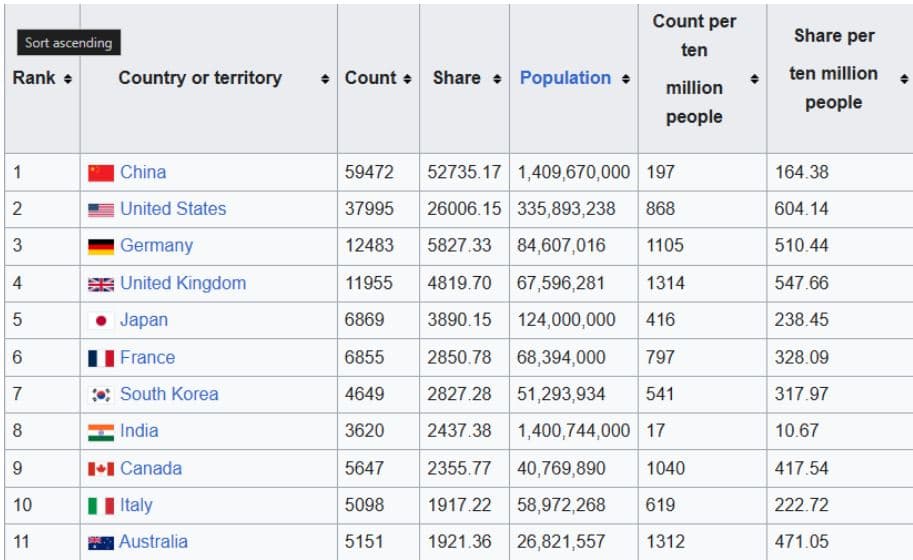
(Source: wikipedia.org)
Leading Authors
- Multiple Authors per Paper: The average number of authors per astronomy paper has increased significantly.
- Over the past decade, roughly 51% of papers had only one author, while now, one-author papers are less than 17% of the total number.
Prominent Institutions
- Harvard-Smithsonian Center for Astrophysics: A leading institution in astronomical research, contributing significantly to the field.
- California Institute of Technology (Caltech): Known for its contributions to space missions and theoretical research.
- Max Planck Institute for Astrophysics: A key player in astrophysical research and data analysis.
Leading Countries
- China is home to numerous top-tier research institutions and hosts several renowned universities and observatories.
- United States is home to numerous top-tier research institutions and space agencies like NASA.
- Germany: Known for its contributions through institutions like the Max Planck Institute.
| Category | Leading Entities |
| Authors | Multi-author collaborations dominate |
| Institutions | Harvard-Smithsonian, Caltech, Max Planck |
| Countries | China, USA, Germany, UK |
Subject Areas Inside Astronomy Research and Their Numbers

(Source: gender-gap-in-science.org)
- Exoplanet Studies: Research on planets outside our solar system has seen a surge, with thousands of exoplanets discovered.
- Cosmology: Studies related to the origin and evolution of the universe continue to be a major focus.
- Stellar and Galactic Astronomy: Research on star formation, evolution, and the structure of galaxies remains central.
- High-Energy Astrophysics: Investigations into phenomena like black holes and neutron stars are ongoing.
| Sub-discipline | Focus Area |
| Exoplanet Studies | Discovery and characterization of exoplanets |
| Cosmology | Universe’s origin and evolution |
| Stellar and Galactic Astronomy | Star formation and galactic structures |
| High-Energy Astrophysics | Black holes, neutron stars, high-energy phenomena |
Citations, Impact Factors, and Research Influence

(Source: frontiersin.org)
Citation Trends
- Increase in Citations: An increasing trend in citations per astronomy article has been observed, reflecting the increasing importance of the study.
Journal Impact Factors
- The Astrophysical Journal Letters (ApJL): Successfully attained an impact factor of 11.7 in 2024, registering a 33% increase from the last year.
| Metric | Value/Trend |
| Citation Increase | Rising steadily |
| ApJL Impact Factor | 11.7 (2024), 33% increase from 2023 |
Open Access vs Subscription Statistics

(Source: frontiersin.org)
Open Access Growth
- Increase in Open Access Publications: A significant portion of astronomy papers are now published open access, facilitating wider dissemination.
Subscription-Based Journals
- Continued Relevance: Subscription-based journals remain important, though the trend is shifting towards open access.
| Type | Trend/Statistic |
| Open Access | Significant increase in publications |
| Subscription-Based | Still prevalent, but declining share |
Digital Transformation in Astronomy Publishing

(Source: mdpi.com)
Data Repositories
- Growth in Data Repositories: The volume of astronomical data has increased, leading to the establishment of extensive data repositories.
Online Journals and Preprints
- Rise of Online Platforms: Platforms like arXiv have become central to the dissemination of astronomical research.
| Aspect | Development |
| Data Repositories | Significant expansion |
| Online Journals | Increased adoption of platforms like arXiv |
Collaboration Trends in Astronomy Research

(Source: nationalacademies.org)
International Collaborations
- Global Partnerships: Astronomy research often involves international collaborations, pooling resources and expertise.
Interdisciplinary Research
- Cross-Disciplinary Studies: There is a growing trend of interdisciplinary research, integrating astronomy with fields like physics and computer science.
| Type of Collaboration | Trend/Statistic |
| International | Increased global partnerships |
| Interdisciplinary | Rise in cross-disciplinary studies |
Funding and Its Role in Publications

(Source: nationalacademies.org)
Government Funding
- Significant Contributions: Government agencies like NASA and the European Space Agency provide substantial funding for astronomical research.
Private Sector Involvement
- Emerging Role: Private companies are increasingly investing in space research, influencing publication trends.
| Source | Impact on Publications |
| Government Agencies | Major contributor to research funding |
| Private Sector | Growing influence on research initiatives |
Astronomy Publications and Research in the Future

(Source: frontiersin.org)
Emerging Technologies
- Advancements in Technology: The development of new technologies will drive future research and publications in astronomy.
Evolving Research Areas
- New Frontiers: Areas like dark matter, gravitational waves, and exoplanet atmospheres are expected to be prominent in future research.
| Aspect | Expectation |
| Technologies | Continued advancement |
| Research Areas | Focus on dark matter, gravitational waves, and exoplanet atmospheres |
Summary
In the end, these astronomy publications and research statistics show us more about how humans are exploring the universe step by step. From a few hundred papers a century ago to over 25,000 publications every year, the field keeps growing, evolving, and inspiring. These statistics highlight not only the volume of research but also the collaborations, institutions, and technologies driving discoveries in astronomy.
If you are curious about space, or even thinking of contributing to this amazing field, keeping an eye on these trends can help you understand where the research is heading and what areas are most active. So, overall, the universe is constantly expanding, and so is the knowledge about it. Explore it, follow the publications, and who knows, you might be part of the next big discovery. If you have any questions, kindly let me know in the comments section. Thanks.
FAQ
Astronomy research is the scientific study of celestial objects and the broader universe, spanning observational data collection and theoretical physics. Publications are the formal, peer-reviewed journals where these astronomical discoveries, computational models, and mathematical theories are shared with the global scientific community.
The US ranks the list for salaries in astronomical telescopes and instrumentation, followed by Canada, Germany, and the Netherlands.
Modern astronomy research spans from the search for distant exoplanets and cosmic evolution to the fundamental mysteries of dark matter and quantum gravity. Selecting a focus depends on the scale you wish to investigate.