








Brief Introduction
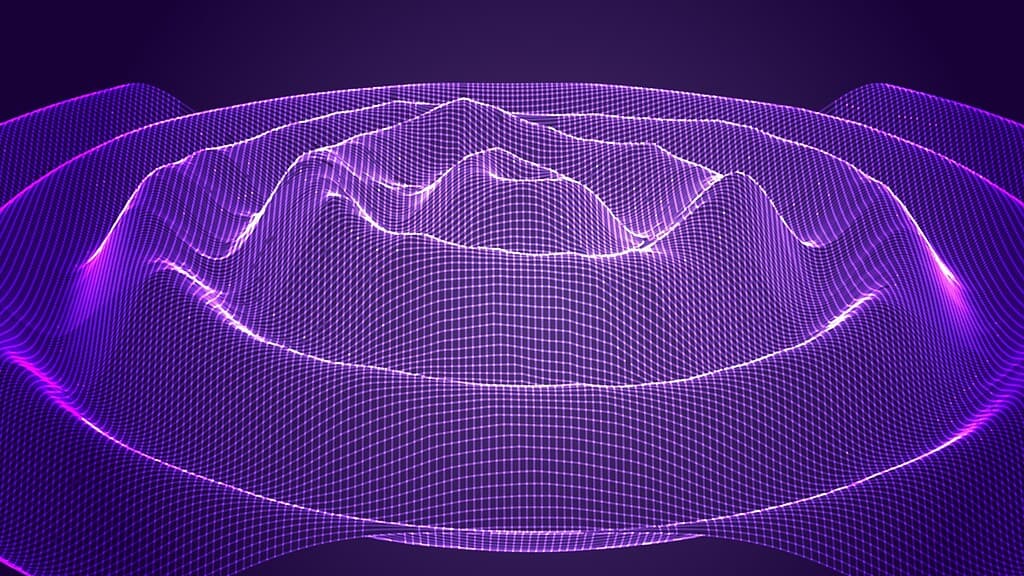
Gravitational Waves Detection Statistics: You imagine the universe as a giant trampoline. When massive objects like black holes or neutron stars move or collide, they create ripples on this trampoline. These ripples travel across the universe at the speed of light. Scientists call these ripples gravitational waves. Detecting them is like trying to feel tiny vibrations from a trampoline on the other side of the galaxy.
Gravitational waves detection is the process of finding and studying these ripples in spacetime. This field is one of the most exciting breakthroughs in modern science because it allows us to listen to the universe in a completely new way, beyond just looking at light with telescopes. Through these waves, we can observe collisions of black holes, neutron stars, and other cosmic events that were impossible to detect before.
The first direct detection of gravitational waves in 2015 by the LIGO observatory opened a new era in astronomy. Since then, scientists have detected hundreds of signals, learning about the most extreme events in the universe. Understanding gravitational waves helps us explore how the universe evolves, test Einstein’s theories, and even understand the nature of space and time itself.
In this article, I would like to explain more about gravitational wave detection, covering how it works, the instruments involved, the types of events detected, and important discoveries. By the end, you’ll get a complete picture of how scientists are listening to the universe in a way we never imagined before. Let’s get into it.
Handpicked By The Editor
- As of March 19, 2025, the LIGO-Virgo-KAGRA (LVK) network has recorded 390 gravitational wave events in total, combining 90 confirmed detections from observing runs O1 through O3, plus about 200 candidate signals from the ongoing O4 run.
- The O4 observing run began on May 24, 2023, and is planned to end on October 7, 2025, making it the longest run so far in the advanced detector era.
- The majority of detected gravitational wave signals come from colliding black holes, though there are some events involving other compact binaries (like neutron star-involving mergers).
- On March 19, 2025, the LVK collaboration officially announced its 200th candidate gravitational wave signal during the O4 run. In January 2025, the European Space Agency (ESA) officially adopted the LISA (Laser Interferometer Space Antenna) mission, the first space-based gravitational wave observatory, scheduled for launch in the mid-2030s.
| Feature | Stats |
| First Prediction |
1916 by Albert Einstein |
|
First Detection | GW150914, September 14, 2025, 1.4 billion light-years away |
| Total Detections (O1 to O4) | Over 390 events, 200+ candidates in |
|
Observation Runs | O1: 11, O2: 30, O3: 50, O4: 200+ candidates |
| Event Types |
Binary Black Hole: 80%, Binary Neutron Star: 15%, BH-NS: 5% |
|
Key Detectors | LIGO (US), Virgo (Italy), KAGRA (Japan) |
| Notable Events |
GW150914, GW170817, GW231123 |
|
Most Massive Black Hole Merger | GW231123 to final mass 225 solar masses |
| Future Developments |
Einstein Telescope, Cosmic Explorer, multi-messenger astronomy |
Historical Milestones
(Source: wikipedia.org)
Origin of Gravitational Waves
- 1916: Albert Einstein’s General Theory of Relativity predicts the existence of gravitational waves, ripples in spacetime caused by accelerating massive objects.
#1. First Detection
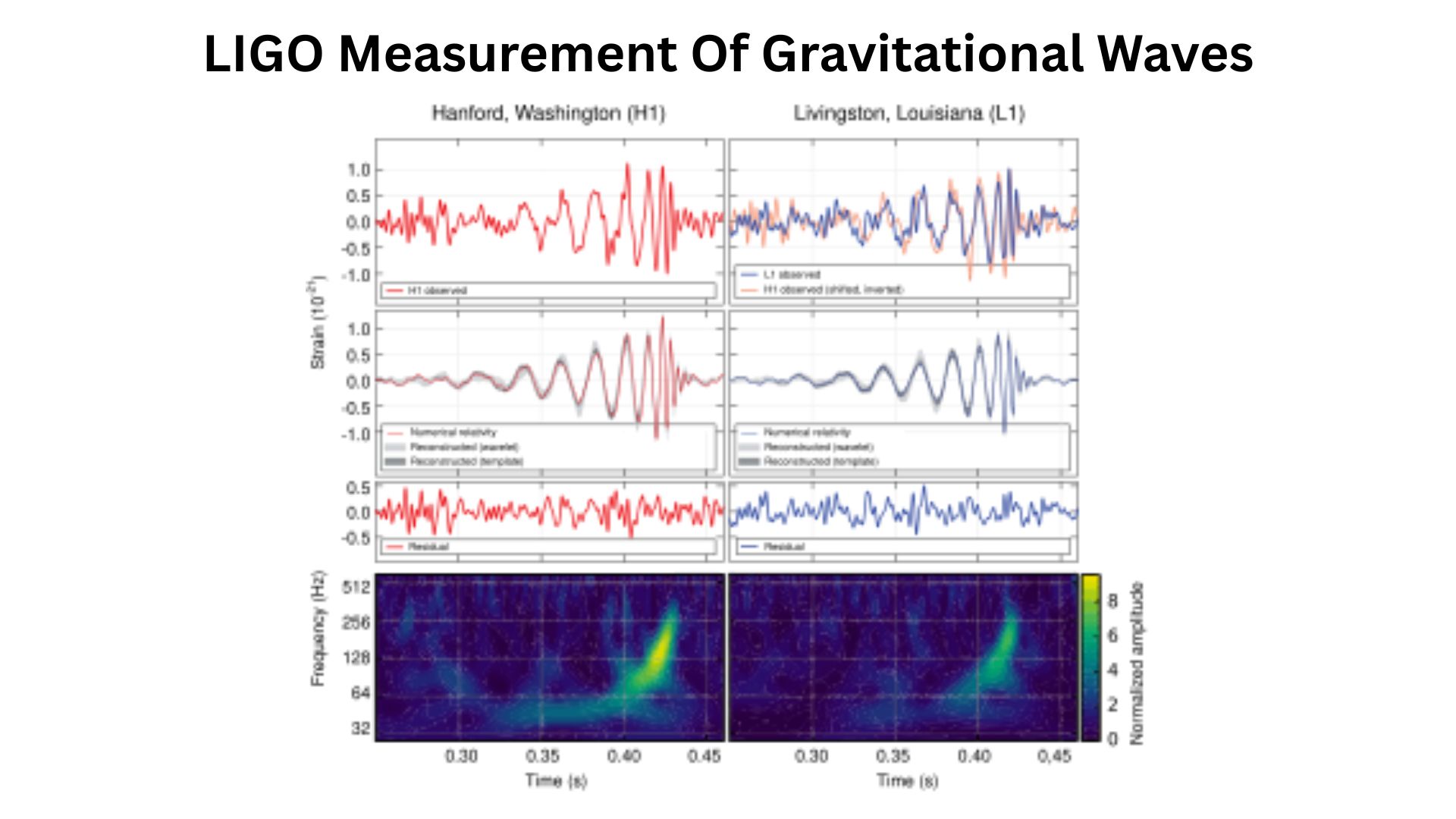
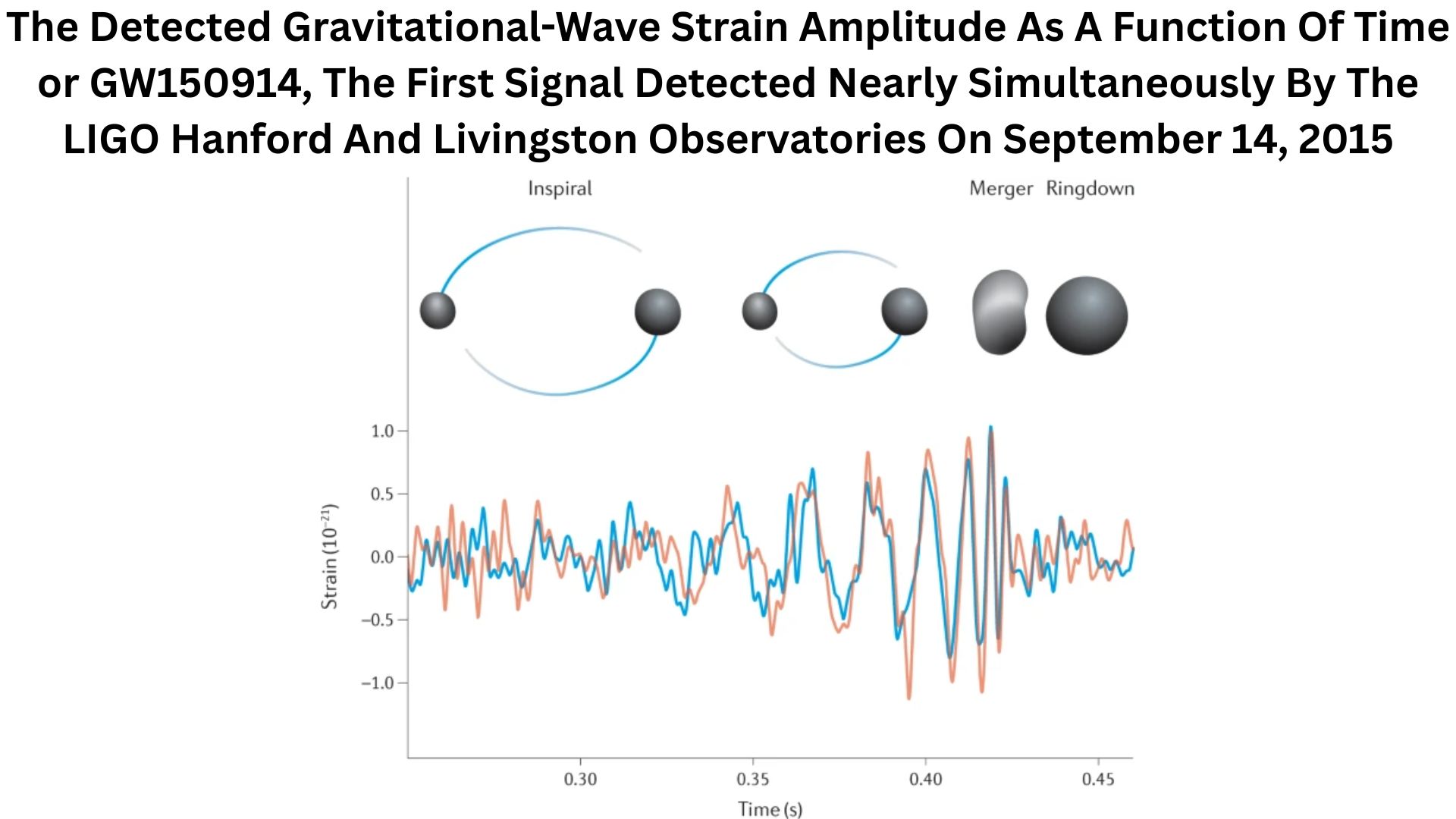
- September 14, 2015: The first gravitational wave signal is detected by LIGO from the merging of two black holes, which occurred 1.4 billion light-years away.
#2. Advancements in Detection
- 2017: Virgo, an interferometric gravitational wave detector located in Italy, joins sky localization capabilities.
#3. Recent Developments
- 2023: The LIGO-Virgo-KAGRA (LVK) collaboration announced the detection of the most massive black hole merger to date, GW231123, involving black holes with masses of approximately 100 and 140 solar masses, resulting in a final black hole of about 225 solar masses.
- Jan 2025: In January 2025, the European Space Agency (ESA) officially adopted the LISA (Laser Interferometer Space Antenna) mission, the first space-based gravitational wave observatory, scheduled for launch in the mid-2030s.
| Year | Event |
| 1916 | Einstein predicted gravitational waves in General Relativity |
| 2015 | First detection of gravitational waves (GW150914) by LIGO |
| 2017 | Virgo joins the LIGO network, enhancing detection capabilities |
| 2023 | Detection of the most massive black hole merger (GW231123) by the LVK collaboration |
Detection and Observing Runs
(Source: wikipedia.org)
Total Detections
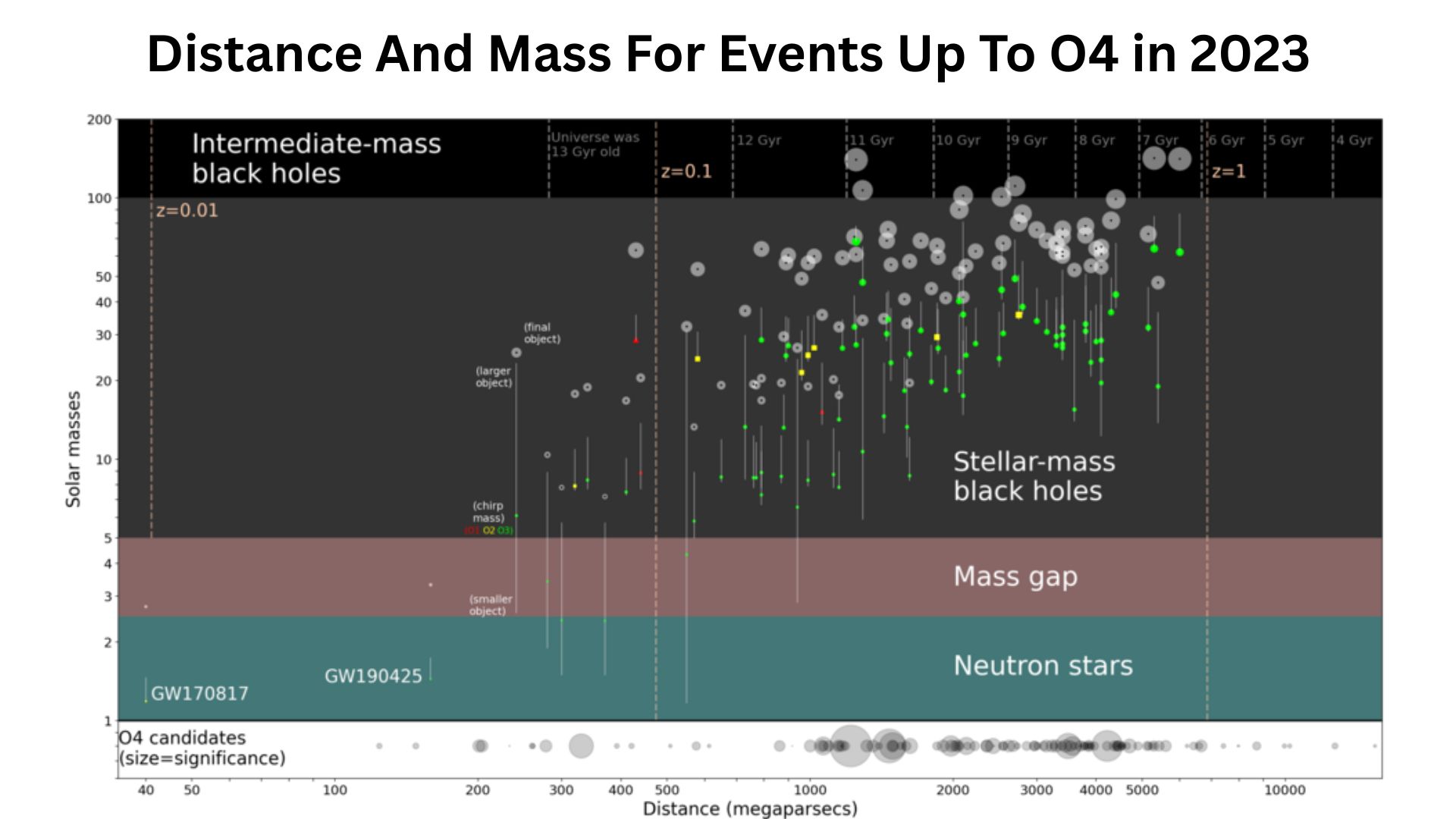
- As of March 19, 2025, the LVK network has recorded 390 gravitational wave events, including 90 detections from O1 to O3 and 200 candidates in the ongoing O4 run.
Observation Runs
- O1 (2015 to 2016): 11 detections.
- O2 (2016 to 2017): 30 detections.
- O3 (2019 to 2020): 50 detections.
- O4 (2023 to 2025): Over 200 candidate detections.
| Observation Run | Duration | Number of Detections |
| O1 | 2015 to 2016 | 11 |
| O2 | 2016 to 2017 | 30 |
| O3 | 2019 to 2020 | 50 |
| O4 | 2023 to 2025 (ongoing) | 200+ (candidates) |
Types of Gravitational Wave Events
(Source: caltech.edu)
Binary Black Hole Mergers
- The most common source accounts for approximately 80% of detections.
Binary Neutron Star Mergers
- Observed in around 15% of cases, which helps in understanding neutron star and nuclear physics.
Black Hole Neutron Star Mergers
- Making up 5% of observations, which provides unique information about the state of dense matter.
| Event Type | Percentage of Detections | Key Insights |
| Binary Black Hole Mergers | 80% | Properties of black holes, general relativity tests |
| Binary Neutron Star Mergers | 15% | Neutron star characteristics, nuclear physics, kilonovae |
| Black Hole Neutron Star Mergers | 5% | Equation of state of dense matter, extreme astrophysical environments |
Detector Sensitivity and Performance
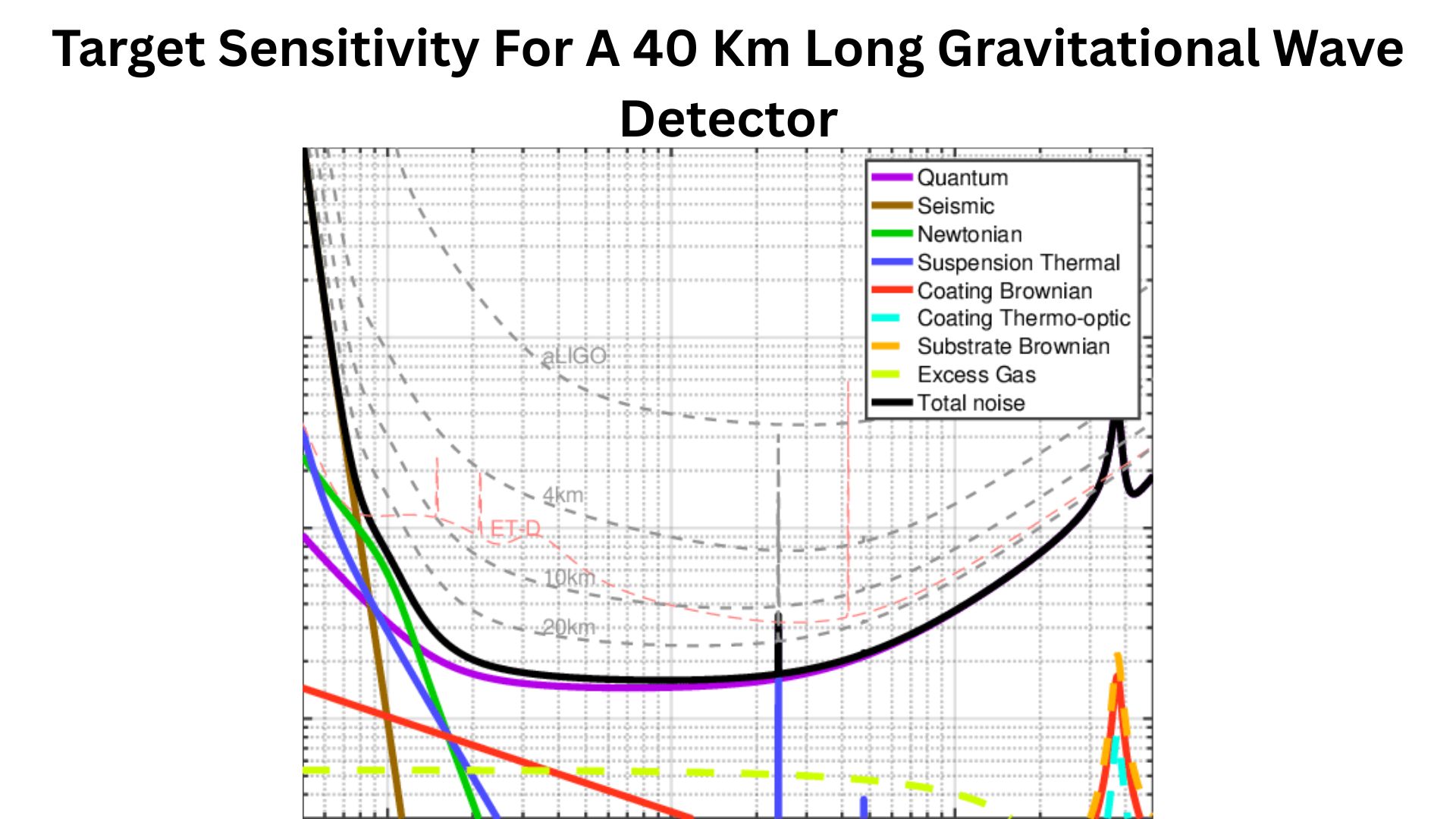
(Source: researchgate.net)
LIGO Detectors
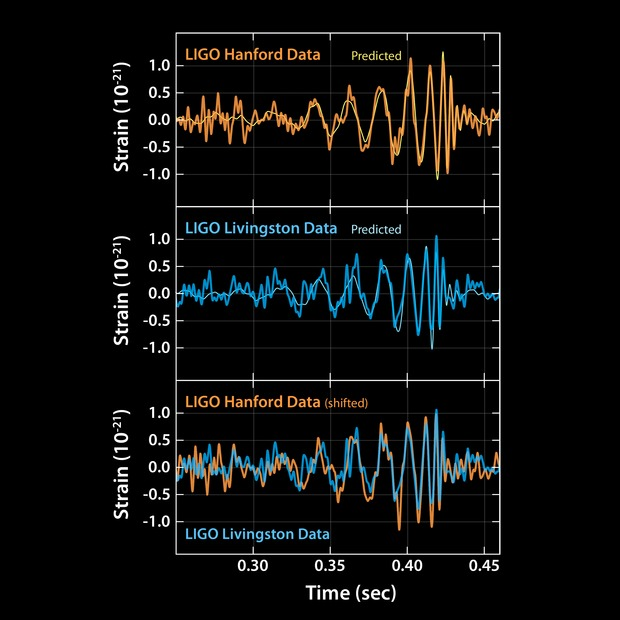
- Hanford (LHO) and Livingston (LLO) in the U.S. are the primary detectors, operating in tandem to combine signals.
Virgo Detector
- Located in Italy, Virgo joined the detection network in 2017, enhancing sky localization capabilities.
KAGRA Detector
- Situated in Japan, KAGRA contributes to the global network, particularly in detecting events from the Southern Hemisphere.
| Detector | Location | Operational Since | Contribution to Network |
| LIGO | U.S. (Hanford & Livingston) | 2015 | Primary detectors |
| Virgo | Italy | 2017 | Enhanced sky localization |
| KAGRA | Japan | 2020 | Southern Hemisphere coverage |
Notable Discoveries
(Source: theguardian.com)
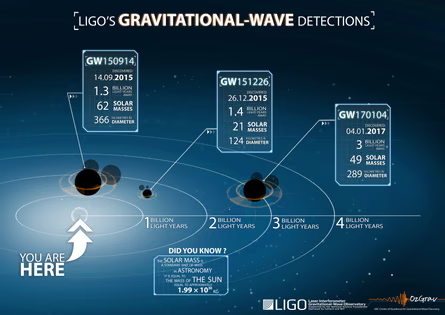
GW150914
- The first detected gravitational wave event resulted from a binary black hole merger.
GW170817
- A binary neutron star merger that was also observed across the electromagnetic spectrum, providing a wealth of data on kilonovae and heavy element synthesis.
GW231123
- The most massive black hole merger detected to date involved black holes with masses of approximately 100 and 140 solar masses, resulting in a final black hole of about 225 solar masses.
| Event | Date | Type | Significance |
| GW1509914 | 2015 | Binary Black Hole Merger | First direct detection of gravitational waves |
| GW170817 | 2017 | Binary Neutron Star Merger | Multi-messenger astronomy breakthrough, kilonova observation |
| GW231123 | 2023 | Binary Black Hole Merger | Most massive black hole merger detected, challenging formation models |
Future Prospects and Developments
(Source: nature.com)
Next-Generation Detectors
- Planned detectors like the Einstein Telescope and Cosmic Explorer have plans to detect fainter waves and study earlier periods of the universe.
Multi-Messenger Astronomy
- Integration of gravitational wave observations with electromagnetic and neutrino observations will help achieve a more holistic view of astrophysical phenomena.
Theoretical Implications
- Ongoing detections continue to test the limits of General Relativity and probe the nature of spacetime.
| Development Area | Description |
| Next-Generation Detectors | Development of more sensitive detectors like the Einstein Telescope and the Cosmic Explorer |
| Multi-Messenger Astronomy | Integration of gravitational wave data with electromagnetic and neutrino observations |
| Theoretical Implications | Testing and refining models of general relativity and spacetime structure |
Recent Developments
- As of early 2026, the recently issued Gravitational Wave Transient Catalogue-5.0 (GWTC-5) has been posted to the internet.
- The new catalogue includes 161 newly discovered gravitational waves resulting from merging black holes that were detected from April 2024 to January 2025 using Virgo in Italy, LIGO in the US, and KAGRA in Japan.
- The most significant of these events, dubbed GW240615, was detected using the two LIGO detectors in the US as well as Virgo in Italy on June 15, 2024.
Conclusion
Overall, gravitational waves have opened a completely new way of exploring the universe. By detecting these ripples in spacetime, scientists can observe cosmic events that were invisible before, like black hole collisions or neutron star mergers.
This type of gravitational wave discovery has less to do with seeing the universe and more to do with listening to it. With the aid of state-of-the-art facilities such as LIGO, Virgo, KAGRA, and other next-generation telescopes, the future of this discipline promises nothing but an array of exciting discoveries.
If you’re curious about how the universe really works, following updates on gravitational wave detection is a must. Keep exploring, keep questioning. I hope you like this one. If you have any questions, kindly let me know in the comments section.
FAQ
Astronomers have detected 390 confirmed gravitational wave events. The vast majority are binary black hole mergers, along with rarer collisions of neutron stars and black holes.
Gravitational waves are detected using giant, ultra-sensitive instruments called laser interferometers, such as those in the LIGO (Laser Interferometer Gravitational-wave Observatory) network.
Gravitational waves are detected using giant, L-shaped instruments called laser interferometers. The most well-known detectors are the twin NSF LIGO (Laser Interferometer Gravitational-wave Observatory) facilities in the US, operating alongside international partners like Virgo in Italy and KAGRA in Japan.