








Introduction
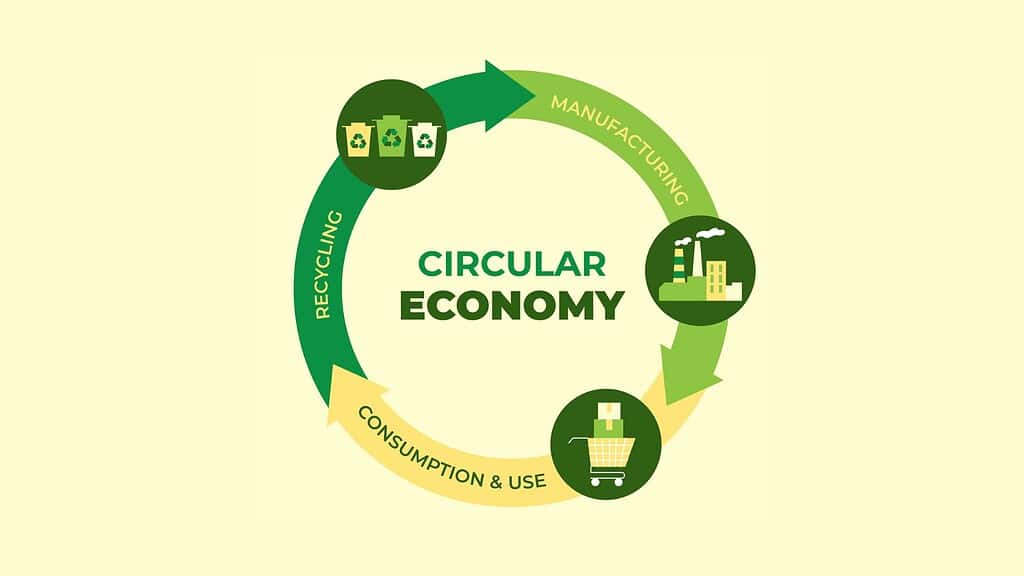
Circular Economy Business Statistics: In 2026, the circular economy is turning into one of the fastest-growing business models, and a lot of organizations are slowly moving away from the old “ take-make-dispose ” habit. Instead, they’re leaning on resource efficiency, recycling, remanufacturing, product-as-a-service, and just plain waste reduction. At the same time, governments are rolling out stricter sustainability rules, investors are looking very closely at ESG results, and consumers seem to increasingly pick brands that act more environmentally responsible.
The Ellen MacArthur Foundation notes that circular practices can meaningfully lower material consumption while also opening up new economic opportunities across manufacturing, retail, construction, electronics, automotive, and packaging. As more firms adopt these closed-loop ideas, the global market keeps expanding, helped by technological innovation, digital tracking, and sustainable product design.
This article will give an overview of the circular economy business statistics, which describe its market growth, startups, the role of digital tech, and regulatory drivers.
Editor’s Choice
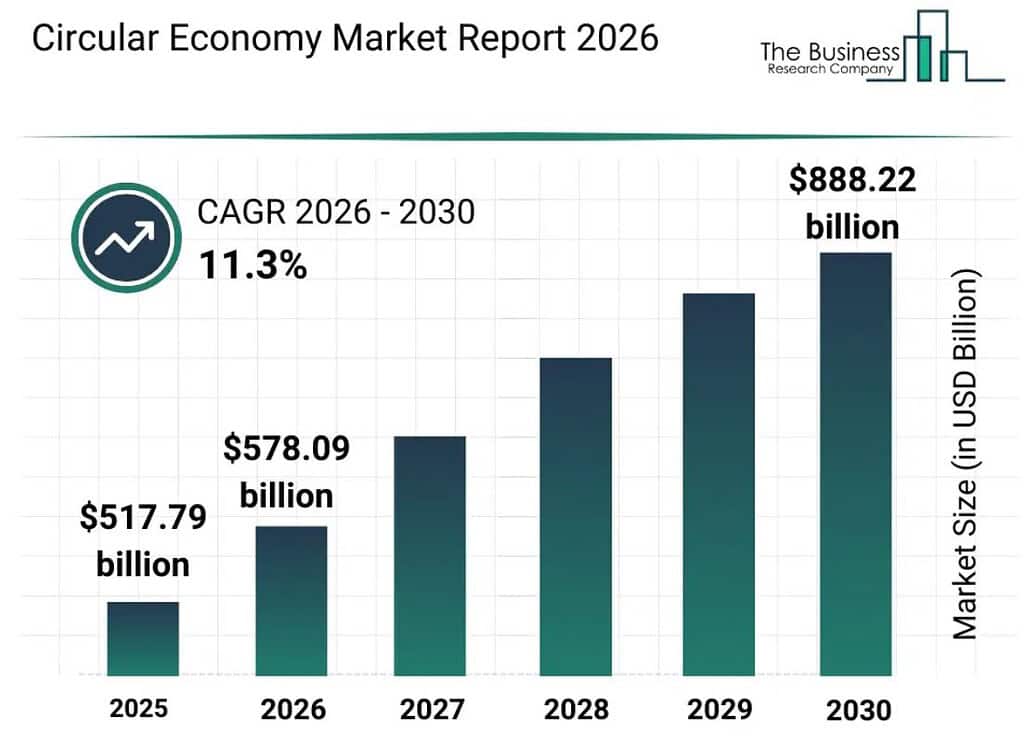
- The circular economy market is forecast to rise from USD 578.09 billion in 2026 to USD 888.22 billion by 2030, showing a strong 11.3% CAGR, plus steady adoption worldwide.
- Shifting toward a circular economy could unlock USD 4.5 trillion in economic value and create more than 7 million new jobs by 2030.
- The world currently produces around 2.1-2.3 billion tonnes of municipal solid waste each year, and that number is pushing up demand for circular business models and resource recovery.
- Digital Product Passports (DPPs) start rolling out in 2026, while battery passports become mandatory in February 2027, which will reshape product traceability across a bunch of industries.
- Firms that adopt DPPs 12-18 months early may end up with a notable competitive edge in the premium circular product segment, before the rules are fully mandatory.
- AI-powered recycling systems deliver over 95% sorting accuracy, which is way higher than manual sorting at around 60-80%, and it really ups recycling efficiency and material recovery noticeably.
- AI-based e-waste sorting boosts recovery of valuable metals by 15 percentage points, while hitting 92% classification accuracy.
- In the waste management market, AI is forecast to jump from USD 4.98 billion in 2025 to USD 32.87 billion by 2035.
- For CSRD sustainability reporting, it’s expected to reach nearly 50,000 European companies.
- Scope 3 emissions are about 70-90% of total corporate emissions, so businesses keep getting pushed into bigger sustainability investments.
- Seven U.S. states are rolling out packaging EPR laws, and producers will need to submit packaging data by May 31, 2026.
Circular Economy Market Growth
(Source: thebusinessresearchcompany.com)
- The Circular Economy Market is on a strong upward growth path, showing more money going into sustainable production, resource efficiency, and waste reduction programs that keep expanding.
- As noted by The Business Research Company (2026), the market should grow at a compound annual growth rate (CAGR) of 11.3% between 2026 and 2030, so you can basically see steady long-term demand for circular business models and cleaner technologies.
- Market size also moved up from USD 517.79 billion in 2025 to an estimated USD 578.09 billion in 2026, which signals pretty solid year-over-year expansion.
- Then the trend just keeps going through the forecast window, with the market forecast to hit USD 888.22 billion by 2030, meaning an increase of more than USD 370 billion compared with the 2025 level.
- These numbers suggest circular economy practices are becoming a more common economic play, not just some niche sustainability project.
- Also, the consistent double-digit growth rate points to broader uptake across different industries, especially as companies chase resource optimization, recycling, re-manufacturing, and regulatory compliance.
- Steady march toward the USD 888.22 billion mark by 2030 really reinforces the commercial weight of circular economy solutions, and how their role keeps expanding across the wider global sustainability space.
Circular Economy Startups Are Powering A Multi-Trillion-Dollar Sustainability Shift
- The circular economy is kinda rapidly evolving from an environmental initiative into a big global economic opportunity, with startups in a central role in speeding up sustainable production and consumption.
- As UNCTAD notes, if consumption patterns stay as they are, by 2030 the world would effectively need two planets to keep up with global production and resource demands, which makes the urgency pretty clear to move away from the old “make-take-waste” mindset.
- Going toward a circular economy could bring more than 7 million new jobs and potentially unlock as much as USUSD 4.5 trillion in economic growth by 2030.
- Each year, global municipal solid waste is in the range of 2.1 billion to 2.3 billion tonnes of solid waste, which adds pressure on governments and businesses to adopt circular business models, rather than leaning on single-use products. This is basically why innovative startups are getting more and more momentum across many industries.
- Chile’s Algramo is pushing reusable packaging systems and is also involved in tech-focused ventures in agriculture, waste management, and even artificial intelligence.
- UNCTAD also kind of emphasizes that stronger entrepreneurial ecosystems, better access to finance, more investment into research and development, and closer public-private collaboration will be essential to unlock the full economic plus environmental value of circular innovation.
- With trillions of dollars in potential economic gains and millions of future jobs at stake, circular economy startups are becoming more and more a key driver of sustainable global growth, rather than just an environmental trend, if that makes sense.
The Role of Digital Tech – AI and Material Passports
- Digital technologies are basically turning into the backbone of the circular economy, with the EU Digital Product Passport (DPP) and AI-driven recycling systems transforming product traceability and improving material recovery too.
- Under the EU Ecodesign for Sustainable Products Regulation (ESPR), which came into force on 18 July 2024, DPP implementation will roll out in phases between 2026 and 2030, starting with iron and steel in 2026, then textiles and tyres in 2027, and furniture, chemicals, and mattresses from 2028-2030.
- The EU Battery Regulation will make battery passports mandatory from February 2027, and 19 July 2026 is an important milestone for publishing extra DPP technical standards.
- Brands that adopt DPP systems early could get a 12-18-month competitive advantage, allowing them to capture premium circular product markets before the rules become mandatory.
- With the old style of human sorting, people are typically able to deal with only about 40-60 items per minute, and accuracy lands somewhere around 60-80%. Meanwhile, AI-based sorting systems push past 95% precision, which in turn boosts material recovery and also cuts down contamination.
- Also, a peer-reviewed e-waste study reported that a CNN-based AI sorting approach hit about 92% accuracy, and it lifted the recovery of high-value metals like gold and copper by 15 percentage points compared to conventional handling.
- When it comes to plastics, AI models such as VGG16 and ResNet50 showed classification accuracy around 75% and 81%, respectively, so the gap is noticeable in practical terms.
- The global AI in waste management and recycling market is projected to expand from USD 4.98 billion in 2025 to USD 32.87 billion by 2035, and programs like Saahas Zero Waste plus Google’s CircularNet are trying to process over 500 tonnes of waste each day by 2026.
- So overall, you can see AI’s role growing in large-scale circular economy operations, even if it’s still evolving fast.
Regulatory Drivers – EPR And Corporate ESG
- Regulatory frameworks have become one of the strongest forces pushing the circular economy, kind of reshaping how sustainability works, from voluntary good intentions into a legal business must.
- Extended Producer Responsibility, or EPR, policies now make producers finance and run the collection, recycling, and end-of-life handling of their products, which in turn nudges more funding toward circular product design and also better waste recovery.
- In the United States, at least seven states- California, Colorado, Maine, Oregon, and Washington- are rolling out packaging EPR laws.
- In those places, producers have to submit detailed packaging data by May 31, 2026, and that deadline is being framed as the country’s first coordinated, multi-state reporting moment.
- In Europe, the Corporate Sustainability Reporting Directive (CSRD) is expanding sustainability reporting in a big way.
- The rule is expected to reach close to 50,000 EU companies. It pushes mandatory disclosures of Scope 1, Scope 2 and Scope 3 emissions, plus climate transition plans that line up with the Paris Agreement.
- After Omnibus I (February 2026), CSRD will apply to companies with more than 1,000 employees and over €450 million in annual turnover, and also to non-EU businesses that earn more than €450 million in EU revenue if they qualify, basically.
- Scope 3 reporting has become really quite critical; it often ends up around 70-90% of total emissions for many industries that have complex supply chains.
- Meanwhile, the European Commission plans to push ahead with the Circular Economy Act in 2026, which should strengthen secondary raw material markets and increase demand for recycled content.
- EPR and CSRD are kind of nudging firms to swap fragmented reporting systems for integrated sustainability data platforms, so they can do compliance more efficiently, improve carbon accounting, support product circularity better, and build a durable competitive edge.
Conclusion
The circular economy is quickly shifting into a mainstream economic model that merges sustainability with long-term business growth. Strong market expansion, multi-trillion-dollar economic potential, and millions of future jobs show circular approaches are turning into a strategic necessity, not just an environmental “nice to have”. Progress in AI-powered recycling, Digital Product Passports, and enterprise sustainability platforms is boosting resource efficiency while also supporting regulatory compliance.
At the same time, policies like Extended Producer Responsibility (EPR) and the Corporate Sustainability Reporting Directive (CSRD) are speeding up corporate uptake around the world. Companies that invest early in circular innovation are more likely to secure stronger competitiveness, resilience, and long-term profitability.
FAQ
The global circular economy market is expected to reach USD 888.22 billion by 2030, with an 11.3% CAGR.
The circular economy could generate more than 7 million new jobs worldwide by 2030.
A Digital Product Passport is basically a digital record that follows a product’s materials, sustainability info, and lifecycle, so recycling improves and regulatory compliance stays easier.
AI-powered recycling systems can hit more than 95% sorting accuracy, which boosts material recovery while cutting contamination and lowering operational costs.
Most businesses are leaning into circular models to meet ESG rules, reduce waste, improve resource efficiency, cut costs, and reach longer-run sustainability goals.

Sources


