









Introduction
Live Stream Shopping Statistics: In 2026, live stream shopping has kind of shifted from a smaller, niche kind of e-commerce habit into one of the quickest-growing digital retail paths. It’s basically the mix of live video, influencer push, social commerce, plus instant purchasing, and together they form these super interactive shopping moments that, often, boost both engagement and conversion rates in a big way.
People today, they expect stuff like real-time product showings, discounts that only last for a short window, and the chance to ask questions directly to the host before buying. On top of that, the fast adoption of AI-powered suggestions, mobile shopping habits, and built-in payment features is pushing the whole market forward even faster.
As services such as TikTok Shop, Amazon Live, Taobao Live, YouTube Shopping, and Instagram Live keep spreading across regions, live commerce is turning into a key money maker for retailers, creators, and marketplaces everywhere.
Editor’s Choice
- The worldwide live stream e-commerce market is forecast to rise from USD 27.79 billion in 2026 to USD 287.17 billion by 2034, which means an outstanding 33.9% CAGR.
- Asia-Pacific is leading with 66.7% of the market share, bringing in USD 10.3 billion during 2024 and holding that top spot in live commerce adoption.
- Fashion and apparel make up more than 28% of live commerce sales, while social platforms contribute 44.3% of total market revenue.
- Live streaming tends to deliver around 3× higher engagement, 10× more comments, and 27% longer viewing time compared with pre-recorded video, so it ends up being the most talkative, most interactive digital format.
- LinkedIn Live can spark 24× more comments and 7× more reactions, whereas Instagram Live gives about 6× more engagement than typical video posts.
- Live commerce often lands at 7–10% conversion rates, sometimes as much as 5× what traditional e-commerce achieves, and the best events can reach 20–30% conversions.
- Product returns via live commerce are usually in the 10–15% range, while regular online retail sits more like 20–30%, so the whole thing can cut returns by as much as 40%.
- China is driving most of it, holding about 60% of worldwide live commerce sales, and there are more than 600 million folks regularly tuning into these live shopping streams.
- Creator monetization is also just getting stronger, like Kick running a 95/5 revenue split, whereas YouTube Super Chat has already paid creators over USD 1 billion.
- Live shopping viewers tend to stay in shopping sessions for around 15–30 minutes, not one minute or less, like people usually do on a classic product page.
Live Stream E-commerce Market Growth
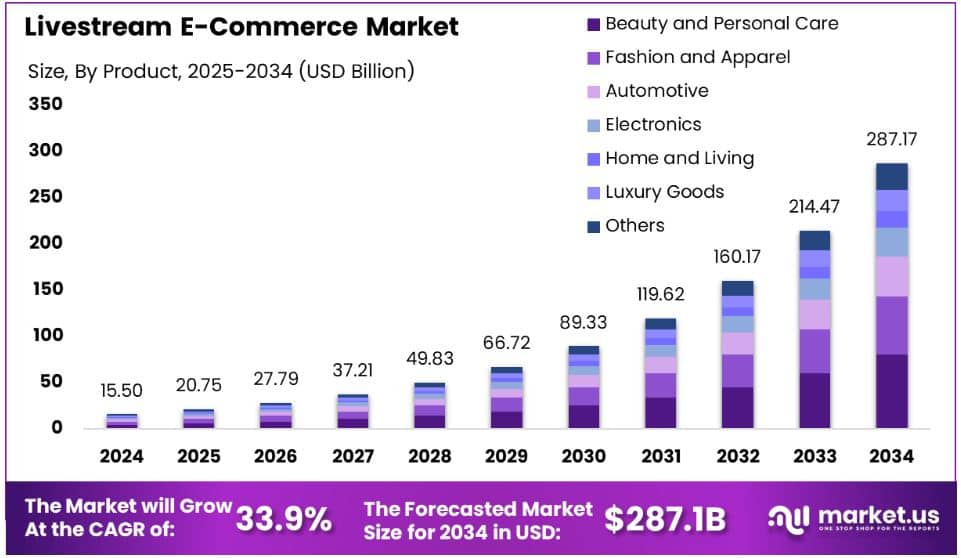
(Source: market.us)
- The livestream e-commerce industry is kind of moving into this fast expansion phase, and it is changing the way people find and then buy products online.
- Based on the Livestream E-Commerce Market report, the overall market was valued at USD 15.5 billion in 2024 and is projected to reach USD 287.17 billion by 2034, which is showing a strong 33.9% CAGR across the 2025–2034 forecast window.
- Also, for 2026, the figure is USD 27.79 billion, and this kind of jump points to the rising impact of interactive shopping moments, creator-led promotions, plus real-time consumer involvement that feels more direct.
- By region, Asia-Pacific (APAC) keeps pulling ahead. In 2024, APAC reportedly held more than 66.7% of the total market share, generating around USD 10.3 billion in revenue, according to that same Livestream E-Commerce Market report.
- Looking at products, fashion and apparel came in as the market leader, grabbing over 28% of the global market share in 2024.
- The Livestream E-Commerce Market report also suggests that influencer-driven shopping events, along with live product walkthroughs, keep improving how audiences engage, and they help push higher conversion rates within this segment, which honestly makes a lot of sense.
- In 2024, social media platforms accounted for more than 44.3% of the livestream e -commerce market, according to the Livestream E-Commerce Market report.
- The smooth blending of shopping functions right into social media applications has sped up livestream shopping adoption, which in turn makes those platforms one of the industry’s most reliable revenue engines.
- Overall, it looks like livestream commerce is turning into a mainstream digital retail model, with real long-term growth potential.
Global Live Commerce Penetration
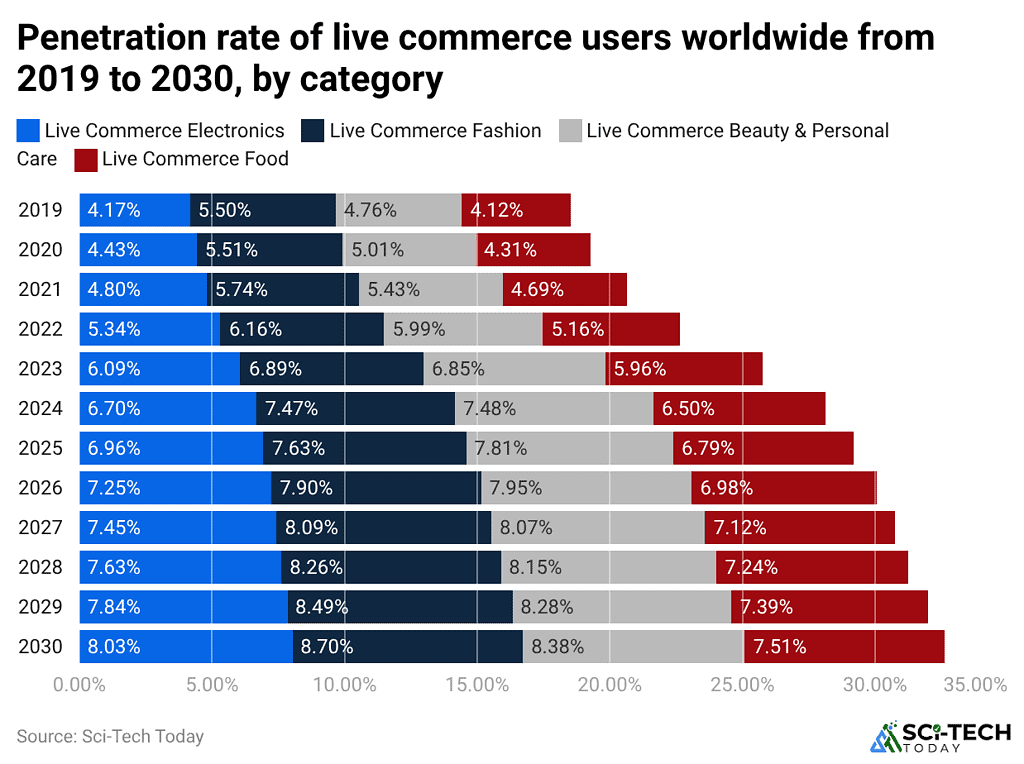
(Reference: statista.com)
- At the same time, the global live commerce market shows steady and consistent user growth across basically every major retail category, according to Statista (Release date: November 2025).
- Between 2019 and 2030 (estimated), live commerce penetration is expected to climb a lot, showing broader acceptance of interactive online shopping across the world, as people are actually warming up to it.
- According to Statista, user penetration should rise from 5.5% in 2019 to 6.89% in 2023, 7.47% in 2024, 7.90% in 2026, and reach 8.57% by 2030, so it remains the largest live commerce segment globally.
- Beauty & Personal Care is projected to move even quicker, with growth that jumps from 4.76% in 2019 to 6.09% in 2023, 7.47% in 2024, 7.90% in 2026, and 8.03% by 2030.
- Electronics also looks like it has strong momentum; user penetration rises from 4.17% in 2019 to 6.09% in 2023, 6.70% in 2024, 7.25% in 2026, and 8.03% by 2030.
- Meanwhile, Food keeps a more even expansion pattern, growing from 4.11% in 2019 to 5.99% in 2023, 6.50% in 2024, 6.98% in 2026, and 7.51% by 2030.
- The data suggests that live commerce is slowly but surely moving into the mainstream, not just showing up as quick spikes.
- Fashion keeps leading the pack, while Beauty & Personal Care is closing the distance through fast adoption.
- Electronics and Food are staying on a solid growth path, too, so it looks like by 2030, live commerce will be a normal, established sales channel across multiple retail industries, not something stuck in just one category.
Live Streaming Delivers Much Stronger Engagement
- Live streaming is still beating standard video formats, and it’s basically one of the strongest engagement tools in the digital space.
- Gyre.pro (2025) says live streams can bring in 10x more comments than pre-recorded videos, and also deliver 27% higher watch time minute-by-minute, which really shows how real-time audience back-and-forth changes results.
- On top of that, DemandSage and DigiExe (2026) report that live video gets 3 times more engagement than pre-recorded content across major platforms.
- LinkedIn Official Data (2025) notes LinkedIn Live drives 24 times more comments and 7 times more reactions than standard video posts, so it’s among the best professional content formats.
- At the same time, Cropink and NewswireJet (2025–2026) claim Instagram Live generates 6 times more interactions than conventional videos, plus more than 100 million users are watching Instagram Live every day.
- Viewer watch time has also moved up, from 10.6 minutes in 2024 to 14.2 minutes now, meaning people are sticking around longer and showing better retention.
- According to SuperAGI and Grand View Research (2025), livestreams with polls, Q&A, and trivia end up with something like 30% higher viewer participation, 25% more engagement, and they also get around 70% of viewers to actually take action.
- N24 2025 Webinar Benchmarks Report said that webinars that add polls and live chat show 22% higher engagement, and attendees who are already engaged are 30% more likely to convert. Then, for the best ones, the CTA conversion rates can hit up to 69%.
- All these numbers basically back up the idea that live streaming is now a real high-impact engagement tool, where the back-and-forth, in real time, keeps people watching longer and pushes more conversions than pre-recorded stuff.
Creator Monetization And 24/7 Streaming
- Live streaming has turned into a big piece of the creator economy, and platforms now offer monetization methods that keep getting more attractive.
- According to Kick Official and Streams Charts (2025), Kick comes with one of the highest revenue-sharing setups around, so creators can keep about 95% of subscription revenue through a 95/5 split.
- The platform also sent out USD 100 million to creators in 2023, plus it gives eligible streamers an extra incentive of roughly USD 16 per hour.
- YouTube keeps adding structure to creator earnings through fan support. According to YouTube Official and Learning Revolution (2025), YouTube Super Chat has paid out over USD 1 billion to creators, and streamers get 70% of that Super Chat revenue.
- Viewers may chip in anywhere from USD 1 to USD 500 per day, which means there’s another steady income stream for live broadcasters, not just the usual signals.
- Earning potential for Twitch seems to shift a lot depending on how big the audience actually is. As per Notta and CEO Today Magazine (2025–2026), creators who sit around 5–100 average viewers often land somewhere near USD 50 to USD 1,500 monthly, and once you’re in the 1,000–10,000 viewer band, you can see roughly USD 5,000 up to USD 30,000 per month.
- There’s the top slice of streamers with something like 70,000+ average viewers, and those folks can earn anywhere from USD 100,000 all the way to more than USD 500,000 each month.
- Gyre.pro (2025) points out that YouTube tends to recommend 24/7 live streams 96% of the time compared with 72% for more standard videos.
- On top of that, 80% of the total watch time on channels using continuous streaming comes straight from those live broadcasts.
- Average viewing sessions even reach 3 hours and 38 minutes, which is clearly more than the 2 hours and 2 minutes logged for regular videos.
- These numbers show that better monetization structures, stronger earning upside, and more platform exposure are making live streaming, and especially “always on”, more and more appealing for creators.
Live Streaming Expands Worldwide
- Live streaming has basically turned into a worldwide digital habit, with adoption rising in both developed and emerging markets.
- Uscreen notes that 41% of internet users globally have watched a live stream, so the real-time content wave is not slowing down.
- Meanwhile, the Asia-Pacific region still leads the overall picture, with over 600 million people in China tuning into live commerce streams regularly, and China making up 60% of global live-commerce sales, as reported by Comms8 and Immerss.
- In 2026, the United States is on pace to reach, or has reached, 164.6 million live stream viewers.
- The U.S. Chamber of Commerce says 20% of U.S. digital shoppers have purchased a live stream, showing how the increasing sway of live commerce is starting to shape consumer buying behavior more and more.
- According to DemandSage, only 5% of European online shoppers had tried live shopping as of 2022, even if brands keep quietly expanding their footprint, especially across fashion and automotive categories.
- DemandSage estimates TikTok Shop’s Southeast Asian GMV managed to scale up to USD 45.6 billion in 2025, and that helped push the overall global GMV to USD 66 billion.
- Nielsen reports that streaming viewership in the United States is up 71% since 2021, while traditional broadcast television fell by 21%.
- Globally, We Are Social notes that 91.9% of internet users watch some kind of streaming TV every month, compared with 87.8% who stick with traditional television.
- Live streaming is turning into a mainstream digital channel, one that supports deeper consumer engagement, stronger commerce, and heavier media consumption across markets worldwide.
Social Media Live Streaming
- Live streaming has basically turned into one of the biggest engagement drivers on social media, drawing people in with real-time back and forth, plus that more immersive vibe.
- Adam Connell says 22.7% of social media users mention watching live streams as a main reason they show up on social platforms. Cropink also reports that Facebook Live can create 3 times higher engagement than pre-recorded videos.
- Yans Media found that users are about 4 times more likely to watch a Facebook livestream than they are to watch a recorded video.
- Uscreen points out that TikTok users spend 1.6 times longer watching live videos compared to short clips, and by 2020, 26% of TikTok’s user base was already using TikTok Live monthly.
- DemandSage adds that YouTube Live pulled in more than 6 million concurrent viewers during the 2022 FIFA World Cup.
- Meanwhile, LinkedIn Live delivers 7 times more reactions and 24 times more comments than native videos, according to Uscreen.
- DemandSage reports that 42% of U.S. adults ages 18–34 prefer YouTube Live. For adults ages 35–54, 45% favor Facebook Live, while 39% of young adults in the 18–34 range use Instagram Live. It’s also said that nearly one-third of people ages 18–34 actively use Twitch.
- Taken together, it really shows that live streaming keeps finding a home across platforms and across generations, with preferences that are not the same everywhere.
The ROI Of Live Commerce: Conversion and Return Rates
- Live commerce is kind of rapidly becoming one of the more profitable digital retail ways, mostly because it boosts sales performance and also makes operations more efficient. If you look at normal e-commerce sites, they usually convert only about 1–2% of visitors.
- Globally, it’s around 1.6% to 3.0%, so really that’s like just 2–3 customers out of every 100 visitors who actually buy something.
- A peer-reviewed live streaming e-commerce study indicates that brand-hosted livestreams bring roughly three more customers per 100 visitors, and at the same time, they also generate about USD 290 extra in sales revenue per 100 visits compared with static online storefronts.
- Industry benchmarks, and Sprii too, suggest that when live shopping is done well, it often lands in the 7–10% conversion range. That’s about 3–5 times what you usually see from conventional e-commerce.
- During livestream events where viewers are actively tuned in, conversion can go as high as 20–30%.
- Some sessions that are more viewer-oriented have even reported conversion figures near 50–60%, while traditional non-interactive websites hover around 2.5%.
- McKinsey estimates retailers spend roughly USD 200 billion every year on product returns.
- In standard online retail, you often see 20–30% return rates, especially for fashion and other consumer goods, while live commerce more often reports 10–15% return rates, meaning returns can drop by as much as 40%.
- An SSRN empirical study found that brand-led livestreams cut return rates every two weeks by 16.2% compared to traditional e-commerce.
- Industry platform data suggests viewers usually stick around for 15–30 minutes in livestream shopping sessions, while they spend under one minute on normal product pages.
- According to McKinsey, returns can quietly squeeze retail margins by 20–30% once transportation, inspection, refurbishment, and resale losses are bundled together, so a lower return rate ends up being a big profitability lever.
- These statistics really do add up: live commerce tends to pair higher conversion rates (7–10% or more) with much lower return rates (10–15%), which means better revenue per visitor, fewer reverse logistics expenses, and a more sustainable retail setup overall.
- With rich product demonstrations, real-time Q&A, and longer customer attention spans, live commerce is being pushed into the category of one of the highest-return digital sales channels around today, as McKinsey, Sprii, and the SSRN live-streaming e -commerce study also point out.
Conclusion
Live stream shopping has become one of the fastest-growing digital commerce approaches because it mixes entertainment, instant interaction, and easy purchasing into basically one continuous customer experience. More and more businesses are using influencers, AI-driven recommendations, social commerce, and interactive product walkthroughs to lift engagement, raise conversions, and reduce returns.
The quick expansion of platforms like TikTok Shop, Amazon Live, YouTube Live, and Instagram Live shows that live commerce is shifting toward a mainstream retail strategy, not just a small trend. And since mobile commerce, creator monetization, plus more tailored shopping journeys keep accelerating, live stream shopping is expected to take a central place in future global e-commerce growth.
FAQ
Live stream shopping is an interactive e-commerce style where hosts show products live, and viewers can buy right away while the broadcast is going on.
The global live stream e-commerce market is valued at roughly USD 27.79 billion in 2026.
Live commerce mixes product demos, real-time Q&A, and limited-time promotions, which often lands conversion rates around 7–10%, versus about 1–3% for standard online stores.
Asia-Pacific takes the lead with 66.7% of the global market share, mostly due to China’s strong adoption of live shopping.
Yes, it usually shows 10–15% return rates, compared with 20–30% for conventional e-commerce, so retailers can improve profitability overall.

Sources


