









Introduction
Decentralized Identity Statistics: Decentralized identity (DID) sort of showed up as one of the most mind‑shifting digital identity technologies in 2026. It lets people and companies really keep their own digital credentials rather than leaning on centralized databases. It’s driven by blockchain, cryptography, verifiable credentials, and these self‑sovereign identity (SSI) frameworks, so decentralized identity is starting to pick up speed across financial services, healthcare, government, education, travel, and enterprise security stuff.
With identity fraud getting worse, tighter privacy rules everywhere, and people wanting passwordless authentication more and more, the global adoption is accelerating. Governments, tech providers, and enterprises keep putting serious money into decentralized identity infrastructure, like billions of dollars, so it’s basically becoming a core piece of Web3, digital wallets, and zero‑trust cybersecurity approaches.
This article will present the decentralized identity statistics, which include the market share, core technologies, and adoption challenges
Editor’s Choice
- The circular economy market is projected to expand from USD 578.09 billion in 2026 to USD 888.22 billion by 2030, and it’s doing that at an 11.3% CAGR.
- Between 2025 and 2030, the market will likely add over USD 370 billion in value, which points to ongoing commercial momentum.
- Switching to a circular economy could unlock around USD 4.5 trillion in economic value and help produce more than 7 million jobs by 2030.
- Globally, the world generates roughly 2.1-2.3 billion tonnes of municipal solid waste every year, which is feeding demand for circular business models.
- AI-driven recycling systems are reaching above 95% sorting accuracy, which is way better than traditional manual sorting, which is often around 60-80% accuracy.
- CNN-based AI sorting can improve valuable metal recovery by 15 percentage points while hitting about 92% classification accuracy in e‑waste recycling.
- The AI waste management and recycling market is forecast to jump from USD 4.98 billion (2025) to USD 32.87 billion (2035).
- The EU Corporate Sustainability Reporting Directive (CSRD) will impact nearly 50,000 companies, making sustainability reporting a mainstream business requirement.
- Scope 3 emissions account for 70-90% of total corporate emissions, making advanced circular tracking and reporting technologies increasingly essential.
- Early adoption of the Digital Product Passport (DPP) could provide businesses with a 12-18-month competitive advantage before compliance becomes mandatory.
Decentralized Identity Market
(Reference: precedenceresearch.com)
- The decentralized identity market is going into one of those really rapid expansion periods in the digital identity ecosystem.
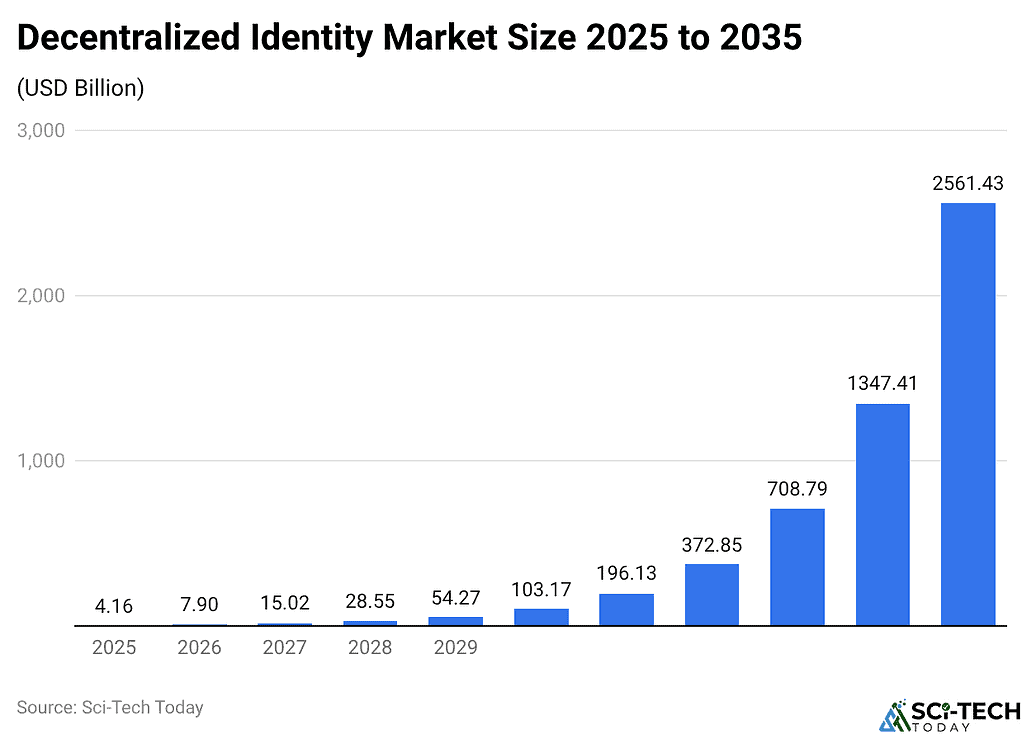
- In 2025, the space is estimated at USD 4.16 billion, then by 2026 it is projected to almost double, landing around USD 7.90 billion, which really shows early take-up across things like identity verification, digital credentials and privacy-centred authentication solutions.
- The long run looks even more pronounced, because the market is expected to climb to USD 15.02 billion in 2027, then USD 28.55 billion in 2028, and USD 54.27 billion in 2029.
- Growth, according to forecasts, keeps moving at a remarkable speed. The numbers climb to USD 103.17 billion in 2030 and USD 196.13 billion in 2031, then the market is expected to go beyond USD 372.85 billion by 2032 and USD 708.79 billion in 2033.
- By 2034, the industry could touch USD 1,347.41 billion, and then surge all the way to USD 2,561.43 billion in 2035, which translates into a very high compound annual growth rate (CAGR) of 90.10% from 2026 to 2035.
- These projections suggest decentralized identity is shifting from a niche or “emerging” capability into a core building block for the digital economy.
- Over the next decade, sustained double-digit expansion is expected, as organizations increasingly choose secure, user-controlled identity management, practically prioritizing it as a base layer for trustworthy digital interactions.
Decentralized Identity Market Share By Type
(Reference: precedenceresearch.com)
- Biometric authentication is kind of the clear leader in the decentralized identity market, sort of showing the growing demand for safer and also more user-friendly identity verification solutions.
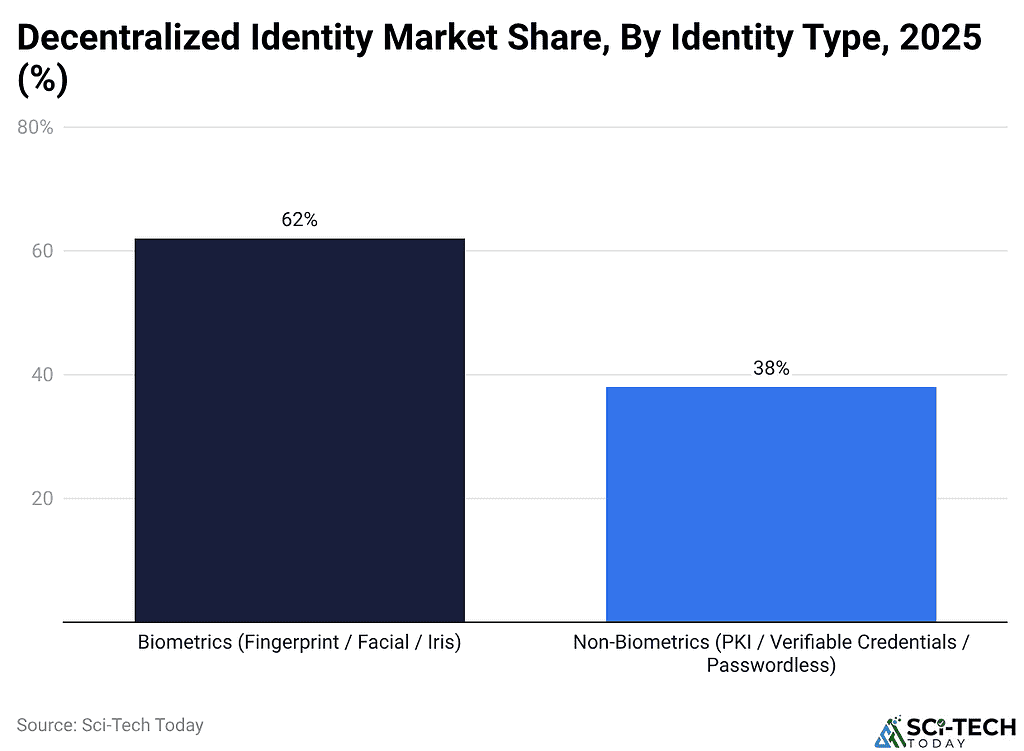
- In 2025, the Biometrics segment- fingerprint, facial recognition, and iris authentication pulled in 62% of the global market share, so it stands out as the dominant identity type as organizations move toward stronger authentication methods bit by bit.
- At the same time, the Non-Biometrics segment, with Public Key Infrastructure (PKI), verifiable credentials, and passwordless authentication, accounted for the remaining 38% of the market.
- Biometric technologies still have a notable edge right now, but non-biometric identity solutions still take up a meaningful portion. That means the market feels balanced, not one-sided, with different authentication approaches evolving in parallel to fit a wide range of enterprise and consumer security needs.
Decentralized Identity Market Share By Region
(Reference: precedenceresearch.com)
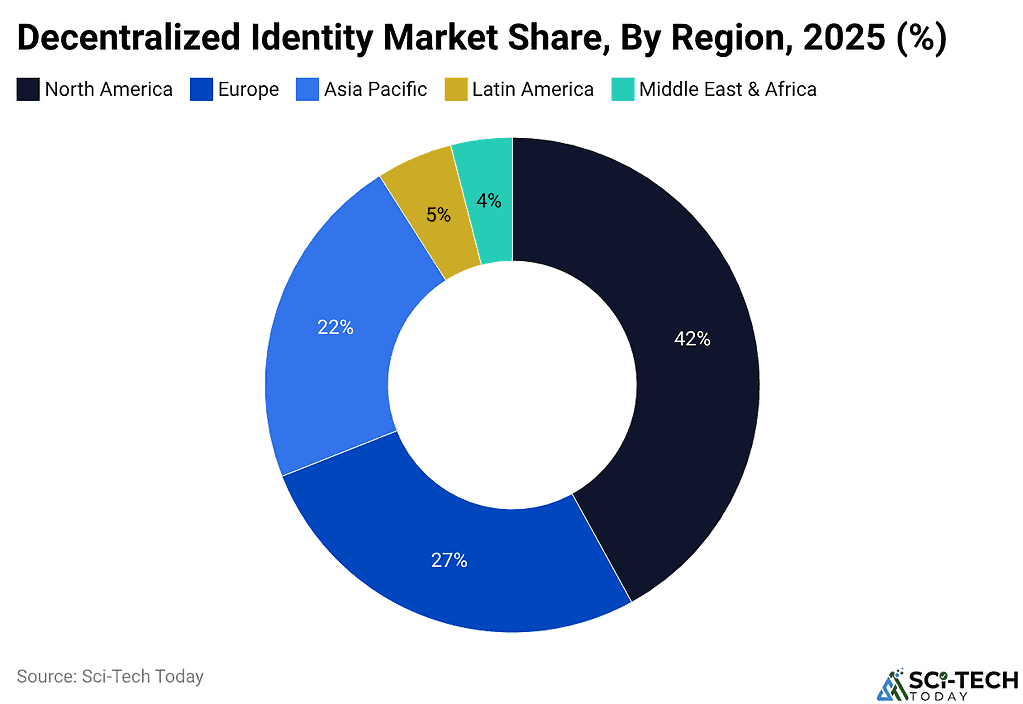
- The decentralised identity market seems to have this pretty obvious regional concentration, with North America taking the lead on worldwide adoption, by holding 42% of the market share in 2025, and honestly, it looks tied to its solid digital infrastructure plus fast enterprise take-up of identity tools and methods.
- Europe comes next with 27%, showing steady progress in decentralized identity use, mostly because the demand for protected digital identity solutions keeps climbing.
- Asia Pacific lands at 22% of the global market, basically pointing to an expanding role as governments and companies push forward with digital transformation programs.
- Then Latin America sits at 5%, while the Middle East & Africa is at 4%, which suggests these areas are still in earlier stages of market development, even if they also look like they could grow a lot later on.
- So overall, the regional layout feels like it’s guided by more developed economies, while emerging regions are slowly building momentum for decentralized identity adoption.
Core Technologies: How Decentralized Identity Works
- The fast rise of decentralized identity is mostly powered by a security-oriented design, built around blockchain, Decentralized Identifiers (DIDs), and Verifiable Credentials (VCs).
- Instead of keeping personal info directly on-chain, nowadays decentralized identity systems usually only store cryptographic hashes, assorted proofs, and DIDs, so all the sensitive stuff stays off-chain, safely sitting inside digital wallets.
- The W3C basically describes DIDs as globally unique, cryptographically verifiable identifiers that are designed to function without any kind of centralized registry, and that’s the big point.
- Meanwhile, VCs make it possible for trustworthy organizations to issue digitally signed credentials, which users end up permanently controlling.
- To make privacy even stronger, many setups also rely on zero-knowledge proofs, or ZKPs, so a person can prove something like age or residency without exposing extra personal details that are not necessary.
- In practice, this whole stack runs on a kind of three-party trust pattern with holders, issuers, and verifiers.
- Credentials get checked cryptographically, not by repeatedly pinging a centralized database, and that helps reduce fraud and overall makes the system feel more secure.
- 1Kosmos; BitLyft; 2025 Conceptual Overview on Decentralized Identity often point out that decentralized identity reduces the chance of huge breaches. It does that by removing centralized places that normally collect personally identifiable information, and it swaps those out with user-controlled wallet storage, which is a very different model.
- Since decentralized identity, alongside self-sovereign identity, is projected to grow from single-digit billions of dollars in 2026 to hundreds of billions, and maybe even trillions, by the mid 2030s, this privacy-first, cryptographically secure setup should become like the core layer for trusted digital ecosystems globally.
Barriers To Adoption and Challenges
- Decentralized identity is gathering momentum, but its path to mainstream use is still shaped by technical and regulatory headaches.
- Even if the digital identity industry grew by around 173% between 2020 and Q2 2023, that fast expansion also caused extra fragmentation in the ecosystem, so interoperability ends up being one of the biggest obstacles.
- Today, there are more than 130 DID methods, so an identity made under one framework may not function seamlessly on another, which raises integration effort and deployment costs a lot.
- Industry voices, including Chainlink, also point to inconsistent Verifiable Credential formats and standards that keep evolving as key reasons cross-platform compatibility stays messy.
- In Europe, North America, and parts of East and Southeast Asia, rollout is happening faster, largely because stronger regulations and institutional support are in place.
- Meanwhile, Latin America, Africa, Central Asia, and most of the Middle East seem to keep depending on trial deployments, mainly due to infrastructure gaps and funding limitations.
- Sustainability is a separate worry too, since the collapse of networks like Sovrin showed, in a very direct way, that governance choices and long-term financing stay crucial for decentralized identity ecosystems.
- For everyday people, managing digital wallets, handling private cryptographic keys, coordinating credential sharing, and dealing with recovery workflows remains difficult.
- So the learning curve ends up steeper than familiar password-based setups, even if the promise is better control.
- Developers face a parallel mess of requirements: they have to accommodate many DID approaches, integrate with wallet APIs, and adjust to protocols that keep changing, all while protecting security and staying aligned with compliance obligations.
- Implementation gets especially complicated around GDPR alignment, questions of liability, consent orchestration, and who actually owns governance responsibilities inside decentralized ecosystems
- Overall, even though decentralized identity could create meaningful long-term value, closing interoperability gaps, settling governance issues, and improving day-to-day usability will be essential before it can reach broad global adoption.
Conclusion
The circular economy is, like, quickly turning into a core business play instead of just some environmental thing. There’s more and more regulatory pressure, then digital innovation, AI-powered recycling, and tougher ESG expectations, pushing companies to adopt circular practices across industries worldwide. The market outlooks keep pointing to steady double-digit growth, and the “big money” aspect is pretty clear too, with trillion-dollar economic prospects, plus millions of new jobs that suggest circular business models have real long-term commercial weight.
On the technology side, things like Digital Product Passports, AI-led material recovery, and even more connected sustainability platforms help organisations get better at resource efficiency, lower waste, and meet compliance needs with less friction. And as governments plus businesses keep intensifying sustainability work, the circular economy looks ready to act as a major engine for global economic growth and industrial shift.
FAQ
The global circular economy market is expected to reach USD 888.22 billion by 2030, expanding at an 11.3% CAGR from 2026.
UNCTAD says the circular economy could bring up to USD 4.5 trillion in economic benefits and create more than 7 million jobs by 2030.
AI boosts recycling performance by reaching over 95% sorting precision, which improves material recovery, and it lowers contamination compared with manual sorting.
The Digital Product Passport is an EU initiative that offers digital information about products, so that traceability, recycling, and sustainability improve. The rollout, in phases, starts in 2026.
Businesses are investing to meet stricter ESG regulations, reduce waste, improve resource efficiency, comply with CSRD and EPR requirements, and gain long-term competitive and financial advantages.