









Overview
Desktop Browser Statistics: Desktop browsers are still the preferred choice for millions of people who work, study, shop, stream videos, and browse the internet every day. They offer bigger screens, better multitasking, faster performance, and more powerful features than most mobile browsers. Popular browsers like Google Chrome, Microsoft Edge, Safari, Mozilla Firefox, Opera, and Brave continue to improve with stronger security, AI-powered tools, and better privacy options. As online habits change, browser companies compete to deliver a faster and safer browsing experience.
This article explores the latest desktop browser statistics, including market share, user trends, browser performance, key features, and industry insights, to help you understand how the desktop browser market is evolving in 2026.
Recommended Picks
- Google Chrome dominated the global desktop browser market with a 70.58% share in July 2026, followed by Microsoft Edge (11.15%), Firefox (6.51%), and Safari (5.66%).
- Desktop and laptop devices generated 39% of global web traffic, while mobile accounted for 61%.
- 59.6% of internet users aged 16+ accessed the internet using a desktop or laptop in Q2 2025, down from 62.9% in 2023.
- Chrome held 79.64% of the desktop browser market in Asia, the highest regional share worldwide.
- In the United States, Chrome led with 59.90% desktop market share, ahead of Edge (12.86%) and Firefox (11.66%).
- Windows users preferred Chrome (69%), while Safari captured 26% of the macOS desktop market.
- WebAssembly is supported on 92.1% of websites, while HTTP/3 adoption reached 35.7%.
- 81.4% of users enabled dark mode, and 63.7% actively blocked online trackers.
- HTTPS is now required for advanced browser features such as geolocation, notifications, and service workers.
- Microsoft Edge PDF tools are used by 41.2% of users, while Brave has attracted about 2.1 million Tor-over-VPN users.
Top Desktop Browser Market Share
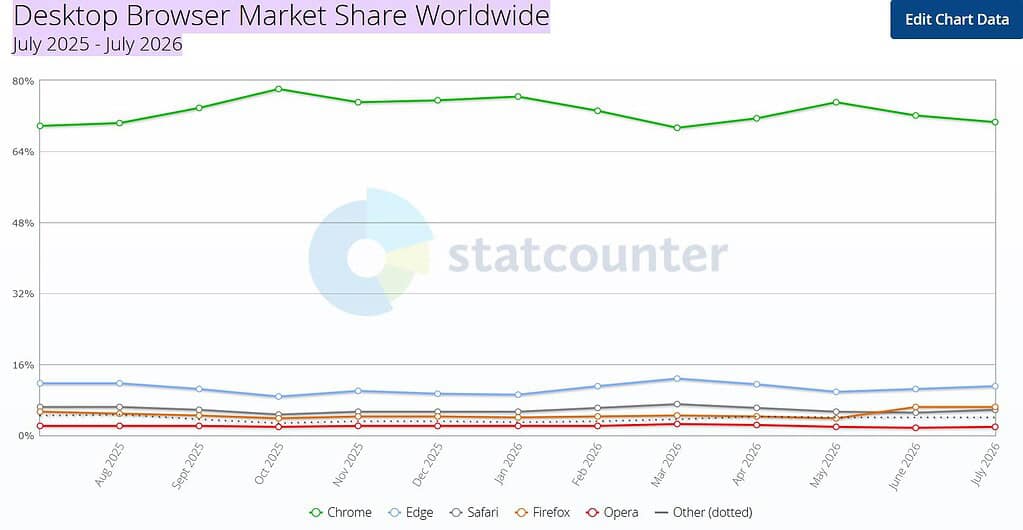
(Source: gs.statcounter.com)
- In July 2026, Chrome dominated desktop browsing with 70.58%, followed by Edge at 11.15%, Firefox at 6.51%, and Safari at 5.66%, indicating a highly concentrated market structure.
- Opera held 2%, while Samsung Internet accounted for 1.59%.
The table below includes all other monthly market share analyses of desktop browsers:
| Month, 2026 | Chrome | Edge | Safari | Firefox | Opera | Other |
| January | 72.0 | 9.5 | 6.0 | 5.0 | 2.0 | 5.5 |
| February | 70.0 | 10.0 | 6.5 | 5.0 | 2.0 | 6.5 |
| March | 71.0 | 12.0 | 7.0 | 5.0 | 2.0 | 3.0 |
| April | 73.0 | 11.0 | 6.5 | 4.5 | 2.0 | 3.0 |
| May | 75.0 | 10.5 | 6.0 | 4.0 | 2.0 | 2.5 |
| June | 72.0 | 11.0 | 6.5 | 4.0 | 2.0 | 4.5 |
By Operating System, 2026
- According to TechnologyChecker, in Windows, Google Chrome remained the leading browser on Windows with about 69% market share, followed by Microsoft Edge (19%), Mozilla Firefox (8%), Opera (2%), and Others (2%).
- In macOS, Chrome led with around 67% market share, while Safari maintained a strong 26% share because it is the default browser. It is followed by Firefox (4%), Opera (2%), and Others (1%), which accounted for the remaining usage.
- In Linux (Desktop), Chrome dominated Linux desktop usage with about 76% market share, followed by Firefox (15%), Opera (4%), and Others (5%).
Desktop Computer Internet Usage Statistics
- According to Datareportal, in Q2 2025, 59.6% of internet users aged 16+ used a laptop or desktop computer to access the internet, meaning fewer than 6 in 10 connected adults now go online with a computer.
- Computer usage has declined over time, falling from 62.9% in Q2 2023 to 59.6% in Q2 2025, a relative decrease of more than 5% in two years.
- Younger users are less likely to use computers, with only 56% of internet users aged 16-24 accessing the internet through a laptop or desktop.
- Across all age groups, men are about 9% more likely than women to use a laptop or desktop computer to go online.
Computer Use for Internet Access by Age and Gender, October 2025
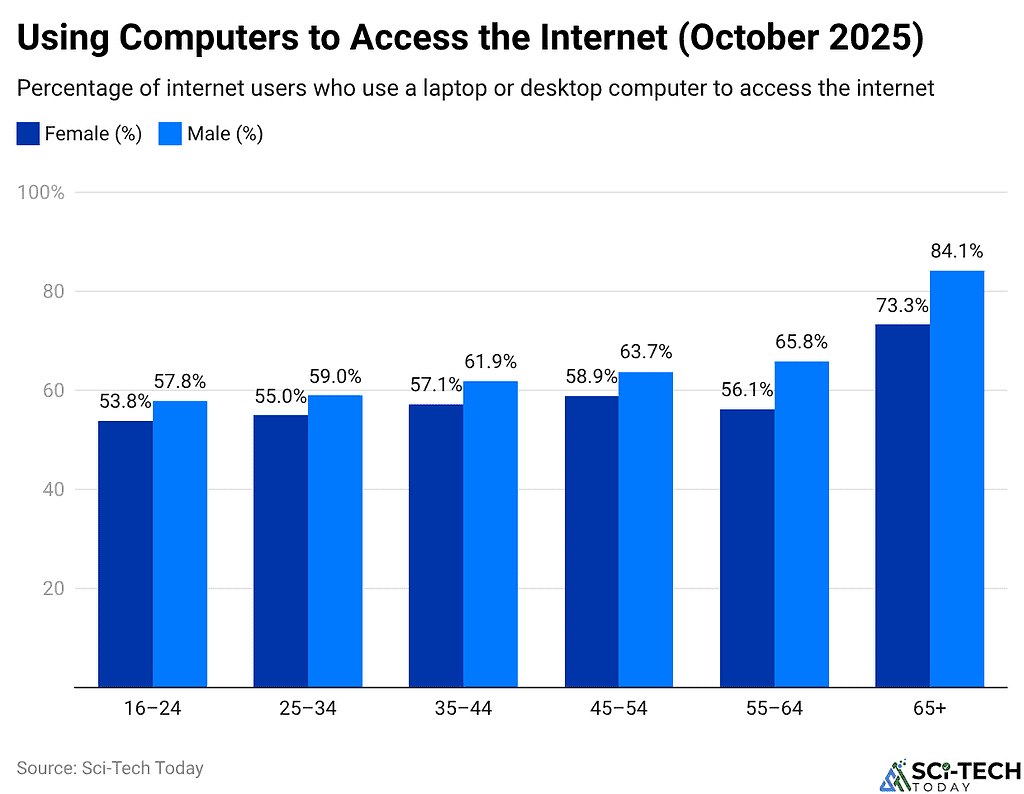
(Reference: squarespace-cdn.com)
- Among people aged 16-24, 53.8% of females and 57.8% of males use a computer to go online.
- In the 25-34 group, computer use rises to 55.0% for females and 59.0% for males.
- For ages 35-44, 57.1% of females and 61.9% of males access the internet via computers.
- In the 45-54 segment, 58.9% of females and 63.7% of males rely on computers.
- Among users aged 55-64, 56.1% of females and 65.8% of males use computers to get online.
- For people aged 65+, computer adoption is highest, at 73.3% for females and 84.1% for males.
Desktop Browser Usage and Time Spent Statistics, 2026
- According to DataReportal, internet users spend an average of 6 hours 38 minutes online each day across all devices, while desktop and laptop devices account for 39% of global web traffic.
- Around 59.6% of internet users aged 16+ access the internet using a desktop or laptop, down from 62.9% in 2023.
- The average desktop browsing session lasts 10-11 minutes, although session length varies by website type.
- Contentsquare further stated desktop users generate 39% of global website visits, while mobile devices account for 61%.
Desktop Browser Market Share by Region
- As of July 2026, Google Chrome remained the leading desktop browser in Asia with 79.64% market share, according to Statcounter GlobalStats.
- The market is followed by Microsoft Edge at 9.02%, Firefox at 2.84%, Safari at 2.57%, Samsung Internet at 1.55%, and Opera at 1.28%.
| Region | Chrome | Edge | Firefox | Safari | Samsung Internet | Opera | Brave |
| North America | 60.47% | 12.95% | 10.86% | 11.40% | – | 1.50% | 1.39% |
| South America | 75.33% | 10.90% | 7.89% | – | – | 3.19% | 1.00% |
| Africa | 80.63% | 7.07% | 4.76% | – | 3.14% | 1.94% | – |
| Europe | 62.69% | 13.61% | 8.39% | 6.39% | 2.37% | 3.68% | – |
| Oceania | 62.01% | 15.03% | 4.32% | 12.34% | – | 2.64% | 2.06% |
By Top 5 Countries
- Statcounter GlobalStats stated that Google Chrome remained the most widely used desktop browser in the United States, holding 59.90% of the market in July 2026.
- Microsoft Edge followed it with 12.86%, Mozilla Firefox with 11.66%, and Apple Safari with 11.24%
- Opera accounted for 1.46% of desktop browser usage in the United States, while Brave reached 1.43%.
| Country | Chrome | Edge | Firefox | Safari | Samsung Internet | Opera |
| United Kingdom | 54.86% | 23.75% | 4.24% | 11.90% | 3.09% | 1.44% |
| India | 91.93% | 2.74% | 1.61% | 0.73% | 0.61% | 1.81% |
| Canada | 58.08% | 15.07% | 8.28% | 14.34% | 1.31% | 1.36% |
| Germany | 52.94% | 14.55% | 15.75% | 6.88% | 2.94% | 4.87% |
Desktop Browser Statistics by Performance and Web Technologies
- WebAssembly continues to grow in 2026, with Chrome telemetry showing it is used on 5.5% of visited websites.
- Electroiq report also mentioned that across the web, 92.1% of websites support WebAssembly, while 88.7% support the WebAssembly Text Format.
- HTTP/3 adoption has reached 35.7%, improving website speed, reliability, and connection stability compared with older protocols.
- CSS Grid is supported by 67.4% of browsers, while Service Workers are available in 78.1%, helping websites deliver responsive layouts, offline access, and Progressive Web Apps.
User Experience and Privacy
- Dark mode is used by 81.4% of users, reflecting strong demand for user-friendly display settings.
- Meanwhile, 47.2% of users rely on PWAs for some tasks, and 91.3% use Chrome’s progressive image features.
- Privacy features are now widely adopted, with 63.7% of users blocking trackers. Desktop privacy settings adoption also increased from 23% in 2019 to 74% by 2024.
Security and Browser Innovation
- Modern browsers increasingly require HTTPS for advanced features such as HTTP/2, geolocation, camera and microphone access, notifications, service workers, Web Bluetooth, and payment APIs, making encrypted connections the standard in 2026.
- Microsoft Edge leads in productivity, with 41.2% of users actively using its built-in PDF tools.
- Brave has attracted about 2.1 million users to its Tor-over-VPN feature, while Edge and Chrome continue to outperform Firefox in battery efficiency and overall performance during 2025-2026.
End Note
Desktop browsers remain important for work, learning, entertainment, and daily web use. Google Chrome leads the market, while Microsoft Edge, Safari, Firefox, Opera, and Brave continue to attract users with better speed, security, privacy, and useful features.
As AI tools and stronger privacy options become more common, browser competition will continue to grow. In the coming years, users are expected to choose browsers that offer the best mix of performance, safety, and ease of use.
FAQ
Google Chrome and Microsoft Edge are among the fastest desktop browsers today.
Browsers like Brave and Firefox offer the strongest privacy with built-in tracker blocking and enhanced security features.
Microsoft Edge, Opera, and Brave typically use the least RAM, especially with memory- saving features enabled.