









Introduction
Passenger Information Systems Statistics: Passenger Information Systems (PIS) are an important part of today’s transport services. They provide travellers with fast, clear information about buses, trains, metros, and other modes of transport. Using electronic displays, audio messages, and mobile apps connected through hardware, software, and networks, PIS delivers live timings, delay notices, and route guidance that improve safety, comfort, and confidence while travelling.
This article uses statistical data to examine how often PIS is used, how accurate and timely it is, and how it influences passenger satisfaction. Statistics from several analyses show that differences across cities, transport systems, and technologies reveal patterns in usage speeds, update speeds, reliability, and costs. These insights show how PIS supports smoother journeys, better planning, and smarter future upgrades in transport.
Editor’s Choice
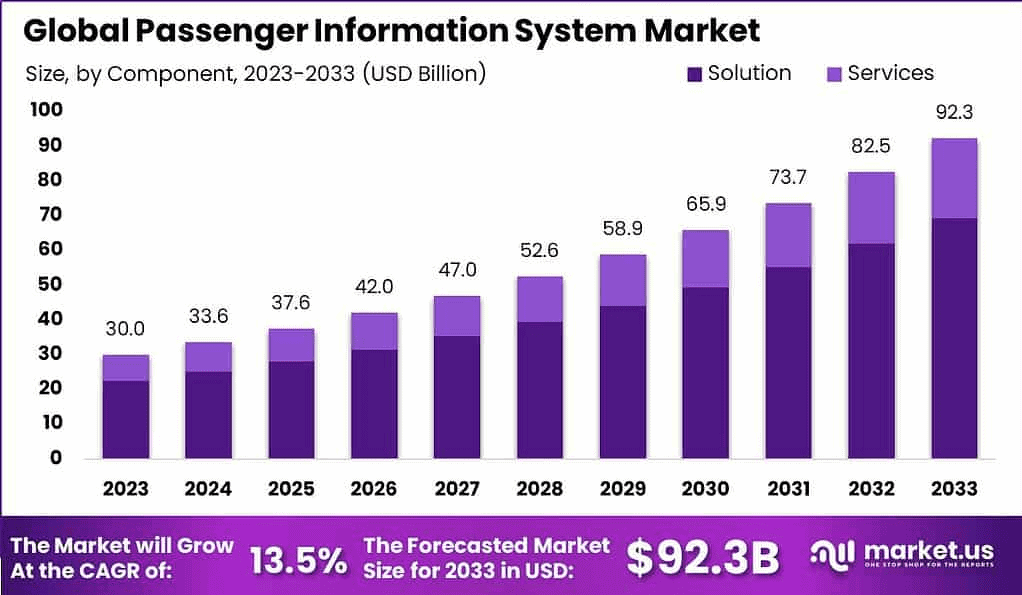
- According to market.us, the global Passenger Information System market is expected to account for around USD 37.6 billion in revenue by 2025, up from USD 33.6 billion in 2024.
- In 2025, the Passenger Information System market’s hardware segment will account for the highest revenue, reaching USD 28.20 billion.
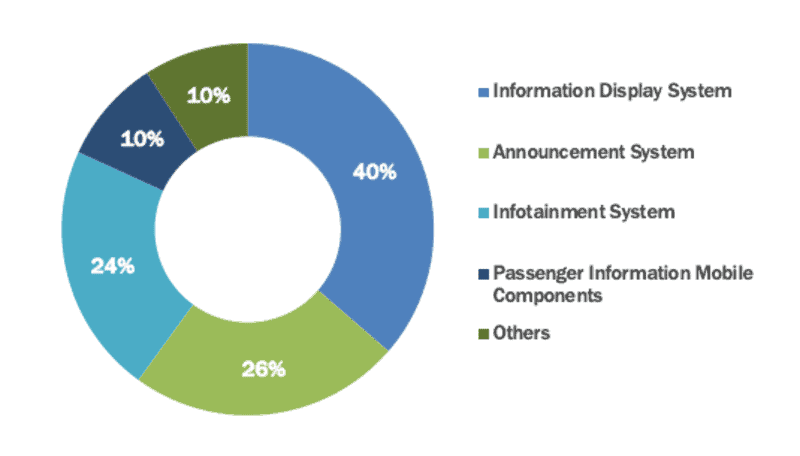
- Data Library Research stated that in the Passenger Information System market, Information Display Systems account for 40% of the total share.
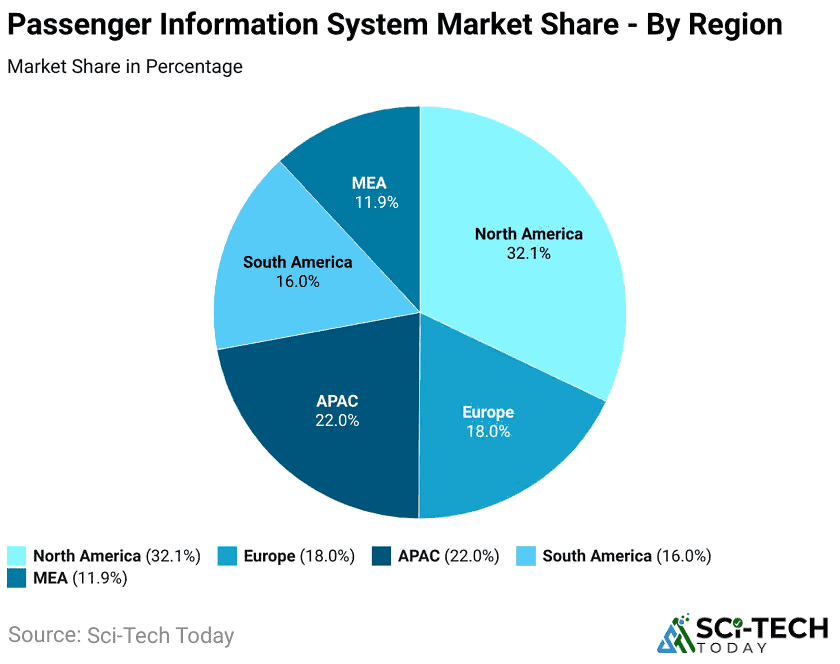
- As of 2024, the North American region accounted for the largest market share in the Passenger Information System, at 32.1%
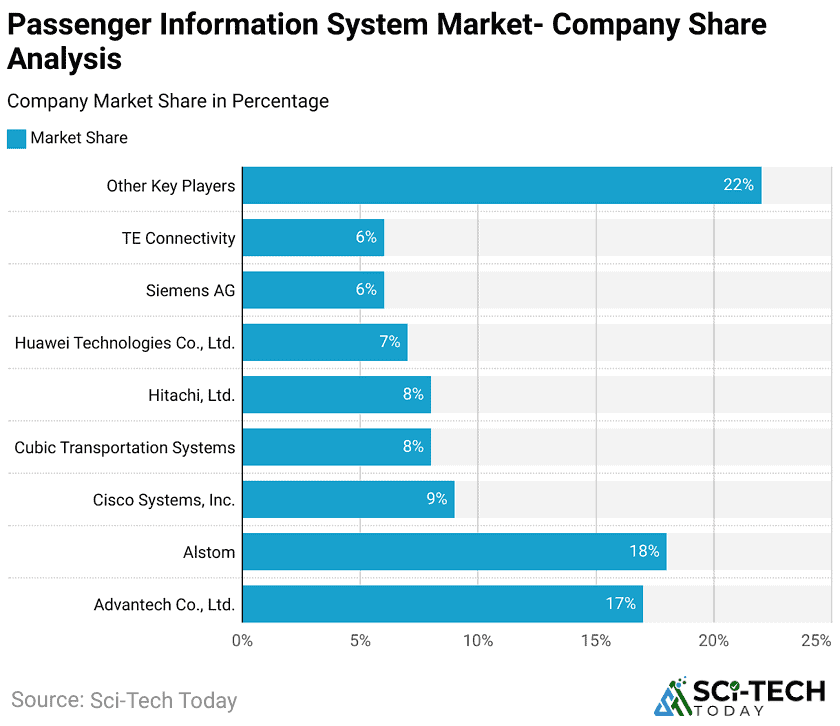
- The Passenger Information System (PIS) market is highly competitive, with Alstom holding 18% and Advantech Co., Ltd.
- According to datahorizonresearch.com, the global Railway Passenger Information System market was valued at about USD 8.2 billion in 2024.
- A report published by wiseguyreports.com states that the Airport Passenger Information System market was worth USD 1,864.7 million in 2024.
- The gminsights.com report shows that the global real-time Passenger Information Systems market is valued at USD 29.8 billion in 2024.
Passenger Information Market Size
(Source: market.us)
- The global Passenger Information System market is expected to account for around USD 37.6 billion in revenue by 2025, up from USD 33.6 billion in 2024.
- In the coming years, the market is estimated to reach around USD 42 billion by 2026, USD 47 billion by 2027, USD 52.6 billion by 2028, USD 58.9 billion by 2029, USD 65.9 billion by 2030, USD 73.7 billion by 2031, USD 82.5 billion by 2032, and USD 92.3 billion by 2033.
- Additionally, the market will grow at a CAGR of 13.5% from 2024 to 2032.
Segmental Analysis of Passenger Information System Statistics
| Category | Market Share (2024) |
Forecasted CAGR (2025 to 2030) |
|
Segments |
||
| Component | Hardware (47.1%) | Software (14.7%) |
| Solution | Information display systems (37.9%) | Mobile applications (16.7%) |
| Deployment location | Station and wayside installations (56.4%) | On-board systems (15.9%) |
| Mode of transportation | Roadway and bus networks (51.6%) | Airport projects (13.56%) |
| Geography | North America (34.1%) | Asia-Pacific (12.67%) |
(Source: datalibraryresearch.com)
- According to datalibraryresearch.com, in the Passenger Information System market, Information Display Systems account for 40% of the total share.
- Announcement Systems account for 26%, while Infotainment Systems account for 24%.
- Passenger Information Mobile Components hold 10%, and other solutions capture the remaining 10% of the market.
Passenger Information Revenue Statistics by Components
- In 2025, the Passenger Information System market’s hardware segment will account for the highest revenue, reaching USD 28.20 billion.
- Moreover, the services segment will account for USD 9.40 billion.
The estimated revenue of the market’s components is mentioned below:
| Year | Software | Services |
| Revenue (USD billion) | ||
| 2026 | 31.50 | 10.50 |
| 2027 | 35.25 | 11.75 |
| 2028 | 39.45 | 13.15 |
| 2029 | 44.18 | 14.73 |
| 2030 | 49.43 | 16.48 |
| 2031 | 55.28 | 18.43 |
| 2032 | 61.88 | 20.63 |
| 2033 | 69.23 | 23.08 |
Passenger Information System Market Share Statistics by Region
(Reference: scoop.market.us)
- In 2024, North America held the largest share of the Passenger Information System market at 32.1%.
- The remaining market was distributed across Asia Pacific (22%), Europe (18%), South America (16%), and MEA (11.9%).
Passenger Information Systems Statistics by Company Shares
(Reference: scoop.market.us)
- In 2024, Alstom accounted for the highest share of 18%, while Advantech Co., Ltd. secured 17%.
- Meanwhile, around 17% market share, followed by Cisco Systems, Inc. at 9%, Cubic Transportation Systems at 8%, Hitachi, Ltd. at 8%, Huawei Technologies Co., Ltd. at 7%, Siemens AG at 6%, and TE Connectivity at 6%.
- Besides, other top companies dominate, yet still many other important players collectively hold 22% of the market.
Railway Passenger Information System Market Statistics
- According to datahorizonresearch.com, the global Railway Passenger Information System market was valued at about USD 8.2 billion in 2024.
- By 2033, it is expected to reach around USD 15.8 billion, with a 7.6% CAGR overall from 2025 to 2033.
- In the North American region, the global Railway Passenger Information System market size was USD 1.8 billion in 2024 and is projected to reach USD 3.2 billion by 2033.
Furthermore, other regional market sizes are stated in the table below:
| Region | 2024 | 2033 |
| (USD billion) | ||
| Europe | 2.3 | 4.1 |
| Asia Pacific | 3.5 | 7.1 |
| Latin America | 0.4 | 0.9 |
| Middle East & Africa | 0.2 | 0.5 |
Passenger Information System Driven Rail Investments
- Through the Trans-European Transport Network (TEN-T) program, the European Union allocates over EUR 26 billion to railway projects until 2027.
- Asia likewise fuels demand: China spends more than USD 100 billion annually on high-speed rail, while India’s National Rail Plan commits USD 30 billion for railway modernisation by 2030.
- The United Nations expected that around 68% of the world’s population would live in urban areas by 2050.
- Meanwhile, the European Green Deal goal of a 90% reduction in transport emissions by 2050 both encourages rail digitalisation.
- The European Railway Agency estimates retrofitting stations with modern PIS at EUR 500,000 to 2 million per station, while China’s Ministry of Transport reports over 3.66 billion annual rail trips.
Buses Passenger Information System Market Statistics
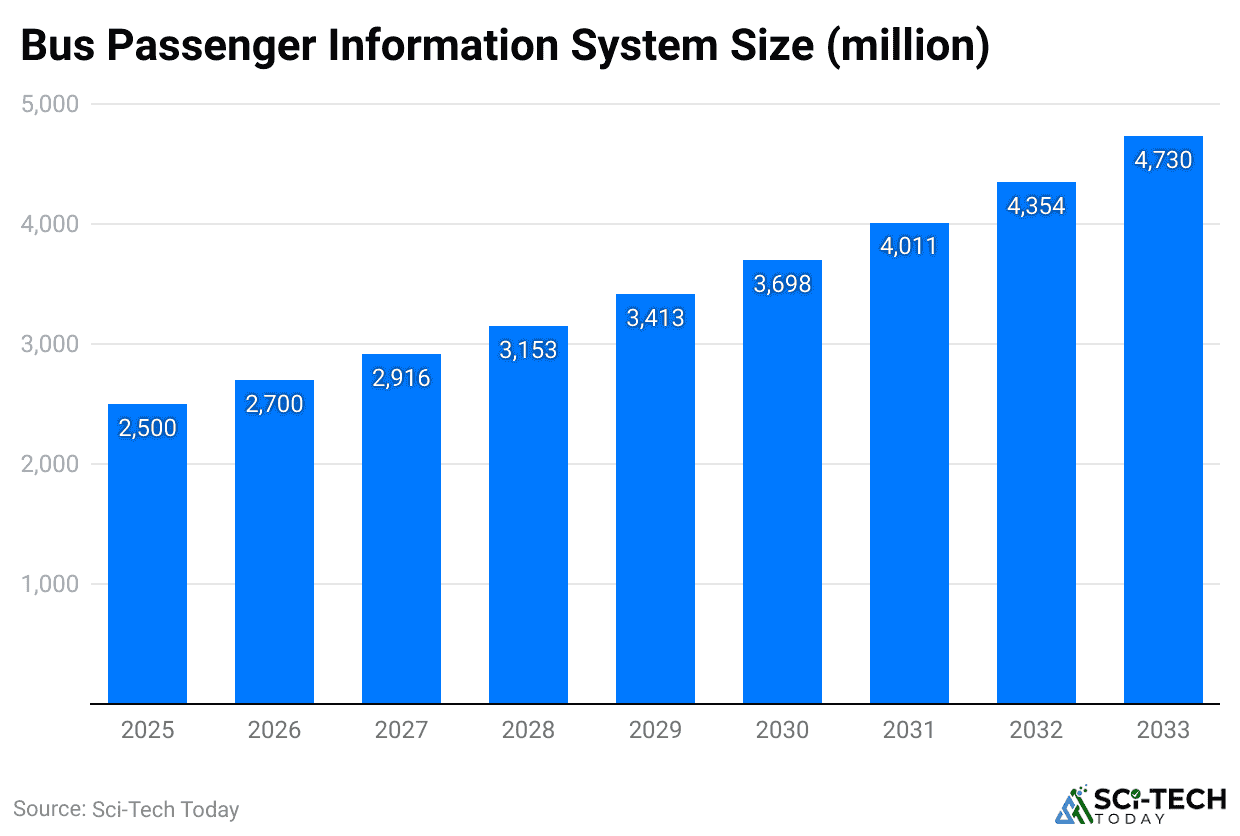
(Reference: amazonaws.com)
- The global Bus Passenger Information System market is estimated at USD 2,500 million by 2025.
- Followed by USD 2,700 million in 2026, USD 2,916 million in 2027, USD 3,153 million in 2028, USD 3,413 million in 2029, USD 3,698 million in 2030, USD 4,011 million in 2031, and USD 4,354 million in 2032.
- It is forecast to grow at an 8% CAGR from 2025 to 2033, reaching about USD 4,730 million by 2033.
- Bus Passenger Information System growth increases steadily, starting at 200% in 2025 to 2026 and then reaching 216% in 2026 to 2027, 237% in 2027 to 2028, 260% in 2028 to 2029, 285% in 2029 to 2030, 313% in 2030 to 2031, 343% in 2031 to 2032, and finally 376% in 2032 to 2033.
Airport Passenger Information System Market Statistics
- According to wiseguyreports.com, the Airport Passenger Information System market was worth USD 1,864.7 million in 2024.
- It is expected to increase from USD 1,974.7 million in 2025 to USD 3,500 million by 2035.
- This means the market is forecast to grow at about 5.9% per year between 2025 and 2035.
Passenger Air Ticket Yield Statistics are mentioned in the table below:
| Year | YoY Change Rate |
| 2025 | -4% (forecasted) |
| 2024 | -4.8% (estimated) |
| 2023 | +8.4% |
| 2022 | +9.7% |
| 2021 | +4.9% |
| 2020 | -9.1% |
Smartphones and Passenger Information Statistics
- By 2024, smartphone growth meant 70% of people, about 5.68 billion, used mobiles, reports We Are Social UK.
- A 2022 study in ScienceDirect reports that up to 80% of car and public-transport users sometimes rely on smartphones for travel information.
- Technavio stated that over 60% prefer mobile ticketing apps with journey planning, real-time digital tickets.
Real-Time Passenger Information Systems Market Statistics
- According to gminsights.com, the global real-time Passenger Information Systems market is valued at USD 29.8 billion in 2024.
- It is projected to reach USD 78.5 billion by 2034, growing at a CAGR of 12.1% from 2025 to 2034.
- By 2034, the hardware segment is expected to exceed USD 32 billion.
- Meanwhile, the cloud-based segment already holds a 66% market share in 2024.
- Regionally, North America is anticipated to record a market size of over USD 28 billion by 2034.
Conclusion
To sum up, the numbers on Passenger Information Systems (PIS) show that these tools are now widely used and very important in today’s transport. The data points to clear benefits, such as happier passengers, better timekeeping, and easier crowd management, when PIS works properly. Numbers on how accurate the information is, how quickly it is updated, and how often the system is working show that timely, live details help reduce stress and confusion for travellers.
Even though some transport systems still face financial and maintenance challenges, the findings suggest that investing in PIS can make daily travel easier and help develop better transport plans.

Sources