








Introduction
Space Mining Statistics: Space mining kind of moved from, you know, science fiction into a fast-moving part of the global space economy. Governments, big private aerospace firms, and venture-backed startups are putting serious money into systems meant to pull water, metals, rare earth elements, and other valuable stuff out of asteroids, the Moon, and other celestial bodies. Even if actual commercial extraction hasn’t really started yet, progress in robotics, more autonomous spacecraft, in-situ resource utilization (ISRU), and deep-space exploration is basically pushing the whole field forward.
By 2026, the sector is still mostly in the tech-demonstration phase, but people who track markets expect meaningful expansion during the following decade as the need for space-based resources keeps rising.
The article will present the following space mining statistics: market size, investment patterns, technical barriers impact of this emerging space mining world.
Featured Selection
- The global space mining market is expected to expand from USD 1.90 billion in 2024 to USD 5.02 billion by 2030, gaining over USD 3.1 billion in total value.
- A strong 17.9% CAGR keeps space mining near the top of the fastest-growing tracks in the emerging space economy.
- NASA’s Psyche spacecraft is traveling across about 2.2 billion miles, and it’s considered one of the more ambitious deep-space operations ever put into motion.
- The metal-rich asteroid Psyche measures roughly 173 miles (279 km) wide and is linked to a theoretical haul worth around USD 10,000 quadrillion.
- Near-Earth Asteroids, or NEAs, drive more than 50% of the exploration attention, mainly because they’re easier to reach from a commercial angle.
- C-Type asteroids held over 75% of the space-mining market revenue share in 2024.
- Scientific surveys have confirmed 17 hydrated C-Type asteroids, strengthening the case for water-based resource extraction.
- Around 50% of examined C-Type asteroids contain ammonium-bearing minerals, expanding their long-term economic potential.
- Carbonaceous asteroids contain an average 4.5% water by weight, supporting future orbital fuel production and life-support systems.
- Spacecraft design absorbs 42–47% of total industry spending, proving that engineering and infrastructure remain the dominant investment priorities.
Space Mining Market Size
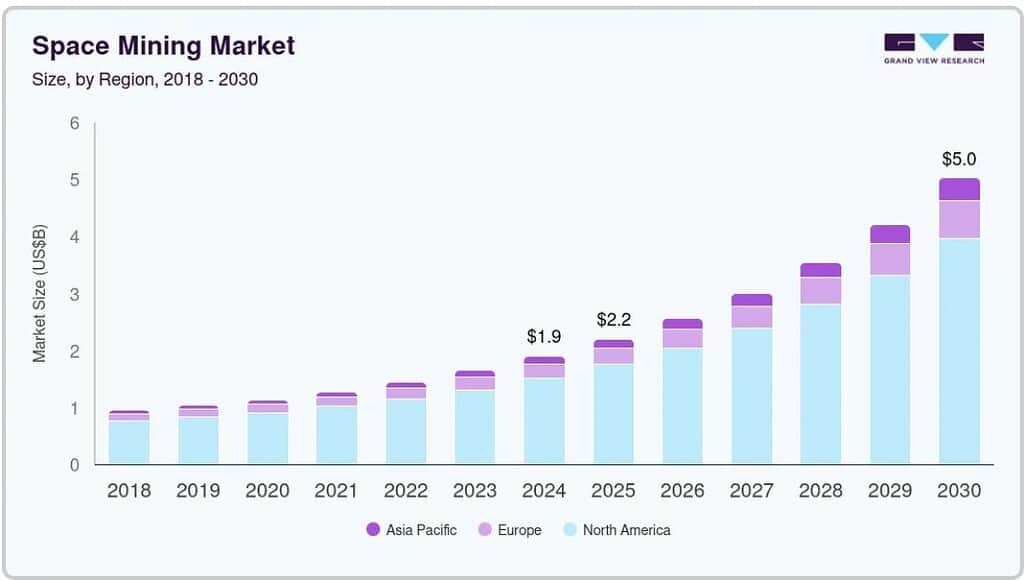
(Source: grandviewresearch.com)
- The market seems to be sliding into a powerful expansion phase, with its value expected to move from USD 1.90 billion in 2024 to USD 5.02 billion by 2030. That’s a pretty striking 17.9% compound annual growth rate (CAGR) across 2025 to 2030, showing strong momentum and a clear uptick in financing through the industry.
- In the six-year forecast window, the market is forecast to tack on more than USD 3.1 billion in incremental value, so it lands more than double the 2024 level.
- North America came out as the largest market in 2024. It fits with the region’s solid industrial base, advanced technical capabilities, and the clustering of major commercial plus government players.
- So the overall statistical outlook suggests the market is turning from a budding chance into something closer to a heavyweight economic segment.
- With a projected reach of USD 5.02 billion by 2030 and that 17.9% CAGR, the industry looks set for steady growth, broader commercial uptake, and a meaningful long-term investment story.
NASA Space Mining Psycho Mission
- According to Reuters and the NASA mission briefings, the Psyche mission is kind of one of those, currently running, super ambitious deep-space undertakings that a lot of people talk about.
- This mission was actually launched in October 2023, and the spacecraft is pushing through something like 2.2 billion miles just to get to the metallic asteroid Psyche.
- Mission timing indicates the craft should finally reach its destination in August 2029, which essentially points to a close to six-year interplanetary passage.
- One notable milestone happened around the spacecraft’s Mars flyby on May 15, 2026. On that day, Psyche reportedly skimmed to within about 2,864 miles (4,609 kilometers) of the Martian surface, moving at around 12,328 mph (19,840 km/h).
- The gravitational assist manoeuvre basically lets the mission conserve propellant, and it also tunes the path, so the trajectory stays optimized for the rest of the trip.
- Now the asteroid itself isn’t just interesting, it’s also striking when you look at the science and the numbers together.
- Psyche is estimated to be roughly 173 miles (279 kilometers) wide at its broadest point, making it the largest metallic asteroid that scientists know in its category.
- Researchers usually describe it as one of about nine metal-rich asteroids that have been detected so far, mostly through radar observations.
- Some researchers even talk about a theoretical worth near USD 10,000 quadrillion, which is why it’s often framed as one of the more economically significant objects ever analyzed out there in space.
- Once it reaches the asteroid, the spacecraft will do a detailed investigation for 27 months, looking into its gravity, magnetic field, and composition.
- The mission is currently planned to run right up until 2031, which means lots of years of scientific data, probably more than what many earlier plans ever managed.
- The Psyche mission shows this bigger and bigger scale of deep space exploration, where long-duration travel, advanced propulsion engineering, and the study of a strangely metal-rich world all come together.
- It could reveal insights into planetary formation more than 4 billion years after the solar system was born, kind of a long-horizon kind of science.
Near-Earth Asteroid (NEA) Prospecting Vs. Deep Space
- The commercial space mining industry is increasingly turning its focus toward Near Earth Asteroids, or NEAs, instead of far-off deep-space targets.
- Asteroids represent around 50% of overall space-mining activity attention, with NEAs leading the early push because they are easier to reach, and they also allow shorter mission schedules.
- As Grand View Research notes, C-Type asteroids took in more than 75% of the global space-mining market revenue share in 2024, making them the most financially appealing asteroid group.
- JAXA’s AKARI survey picked up hydrated mineral signals in 17 C-Type asteroids, which kinda points to water-carrying material, not just random dust stuff.
- Later work then reported ammonium-bearing minerals in roughly 50% of the C-Type targets, that is, the kind of mix that could let you pull out both water and ammonia from the same general sources.
- Carbonaceous asteroid material averages about 4.5% water by weight, which is a very solid number for something so far away.
- NASA’s in-space propellant architecture shows water can be broken into hydrogen and oxygen fuel, so suddenly you have a plausible route toward orbital refuelling networks.
- In turn, C-Type asteroids stop being only raw material providers and start looking more like future space fuel depot suppliers.
- Near-Earth Asteroids accounted for over 50% of the activity focus in 2025, and that feels like growing confidence that water-based resource extraction could feed recurring commercial income, through orbital fuel sales plus logistics services, and related support.
- So overall, the picture is pretty consistent that C-Type Near-Earth Asteroids are looking like the front runners for the first commercially workable phase of the space mining economy.
Technological Barriers and Spacecraft Design Investments
- Space mining, at least for now, is still kinda stuck in the construction phase more than the actual extraction phase.
- The global market was worth about USD 1.90 billion in 2024, and it’s projected to climb to USD 5.02 billion by 2030, with a strong 17.9% CAGR.
- Most of the money people are putting in today is going toward designing the spacecraft and the supporting technologies, the stuff that will later make commercial resource extraction possible.
- Grand View Research says spacecraft design brought in more than 47% of total market revenue in 2024. That finding matches several other industry studies.
- Mordor Intelligence, for example, estimated that spacecraft design and engineering made up 44.92% of market revenue in 2025.
- Meanwhile, Kings Research pointed to a 42.17% share in 2024.
- On top of that, Maximize Market Research reported the spacecraft segment reached 45.87% of the market in 2025, so it’s sitting as the biggest value-generating phase across the whole industry.
- Roughly, 42%–47% of today’s space mining spend is being funneled into engineering, mission architecture, autonomous systems, payload integration, and spacecraft development.
- Meanwhile, the real mining activities plus logistics are still smaller pieces, and they’re expected to grow later, once the technologies mature and become more dependable.
- Mordor Intelligence expects the industry to rise from around USD 3.07 billion in 2026 to about USD 7.39 billion by 2031, which is a 19.21% CAGR. The same report also lists spacecraft design as the top-revenue segment across the forecast horizon.
- Technology readiness remains one of the main reasons behind this investment clustering, a kind of baseline factor. NASA’s In-Situ Resource Utilization (ISRU) initiatives keep leaning into building systems that can extract, process, store, and move resources within harsh space conditions.
- Right now, these technologies are still in a kind of demonstration phase, so they still need a lot of research and engineering support before anything like a large-scale commercial rollout starts making sense.
- Some researchers suggest that mining systems might, eventually, have to work across an estimated population of as many as 150 million asteroids spread across the solar system.
- Taken together, the numbers indicate that the current space mining market is basically engineering-led.
- Almost half of all market revenue is connected to spacecraft design, and when the market is expected to top USD 5 billion by 2030, investors are mainly backing the infrastructure and the technical groundwork that could enable the next era of off-earth resource extraction.
Conclusion
Space mining is kinda moving along, from a “futuristic maybe” idea into something more commercial and real, backed by rising investment, stronger spacecraft innovations, and a broader understanding of what kinds of materials actually exist outside Earth. Even if large -scale extraction has not started yet, the market seems to be building momentum, mostly because of new research, mission building, autonomous robotics work, and in-situ resource utilization methods that are getting better every year.
Near Earth Asteroids, especially those water-bearing C-Type bodies, are turning into the front runners for the first early commercial efforts, mainly because they are more accessible and they bring big strategic advantages. As both governments and private organizations keep funding better spacecraft design and resource processing systems, space mining is quietly setting up the technical base for a future off-world economy.
FAQ
The global space mining market is projected to reach around USD 5.02 billion by 2030.
The industry is forecast to grow at a 17.9% CAGR from 2025 to 2030.
They hold water, carbon compounds, and ammonia, and they represent more than 75% of the overall interest plus revenue share.
The spacecraft is travelling approximately 2.2 billion miles to reach asteroid Psyche.
Spacecraft design and engineering receive the most investment today, making up roughly 42–47% of total market spending.

Sources