








Introduction
CubeSat Statistics: CubeSats kinda changed the global space industry, in the sense that satellite building became noticeably cheaper, faster, and well more reachable than older spacecraft designs. They started mainly for education and research, but these days CubeSats are used for a whole bunch of things like Earth observation, communications, defense intelligence, climate monitoring, IoT connections, and even deep-space probing.
A big part of that momentum is commercial space services arriving sooner than expected, rideshare launches making it easier to get lift-off, and miniaturized electronics that just keep getting better. So deployments across the world sped up, and by 2026, CubeSats are showing up as one of the fastest-growing niches in the satellite space. Governments, startups, universities, and defense agencies all seem to be putting money into them. In the New Space economy, CubeSats keep acting like that affordable, scaled mission “engine”.
This article will present the CubeSat statistics, including its growth, revolution, and applications.
Editor’s Choice
- The global CubeSat market is expected to jump from USD 426.6 million in 2024 to about USD 1.65 billion by 2033, adding nearly USD 1.22 billion in additional value.
- A projected 15.6% CAGR through 2033 puts CubeSats among the quicker-growing parts of the broader space economy.
- Total CubeSat launches grew from 225 in 2014 to 2,505 by 2024, which really signals adoption going a bit wild globally.
- Roughly 95% of CubeSats reached orbit successfully: 2,381 successful deployments out of 2,505 launches.
- The nanosatellite ecosystem now covers more than 4,800 tracked CubeSats and nanosatellites, pointing to a pretty unprecedented scale.
- CubeSat tech is evolving fast, including 222 propulsion-equipped satellites and 30 missions that launched beyond Low Earth Orbit.
- CubeSats are widening space access internationally, since 88 countries have managed to launch nanosatellites and keep them operating.
- Launch activity reached a record 390 nanosatellite launches in 2023, while 1,085 nanosatellites remain operational in orbit.
- Commercial demand is shifting toward larger platforms, with 6U–12U CubeSats emerging as the fastest-growing form factor segment through 2033.
- Earth Observation generates 44.2% of CubeSat application revenue, while space-based IoT is growing at an estimated 15–16.5% CAGR.
CubeSat Market
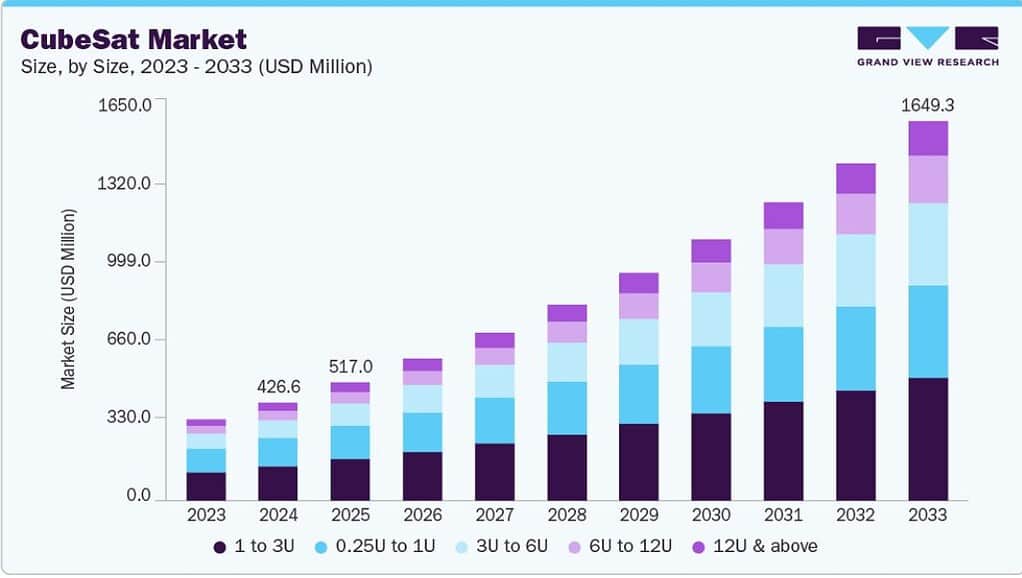
(Source: grandviewresearch.com)
- According to Grandview research, the CubeSat market is sliding into a strong growth phase, with figures pointing toward sustained expansion during the next decade or so.
- In 2024, the industry was valued at USD 426.6 million, and it is projected to climb to roughly USD 1.65 billion by 2033, which would mean an increase of nearly USD 1.22 billion across the whole forecast stretch.
- That climb is backed by a healthy compound annual growth rate (CAGR) of 15.6% over 2025 to 2033, so it kind of suggests the market will almost quadruple in value by 2033, which is a fairly notable trajectory.
- On the regional side, the performance looks pretty lopsided. North America held the largest market share in 2024, hinting at a heavy concentration of space companies, plus technological invention, commercial funding, and advanced infrastructure, all stacked together in that region.
- The above figures imply a market that’s shifting from an emerging opportunity into something more anchored as a commercial industry.
- Since revenue is expected to grow from USD 426.6 million up to USD 1.65 billion by 2033, the numbers signal rising investor confidence, broader commercial uptake, and longer-term momentum throughout the sector.
CubeSat Growth From Dozens To Thousands In Orbit
(Source: nanosats.eu)
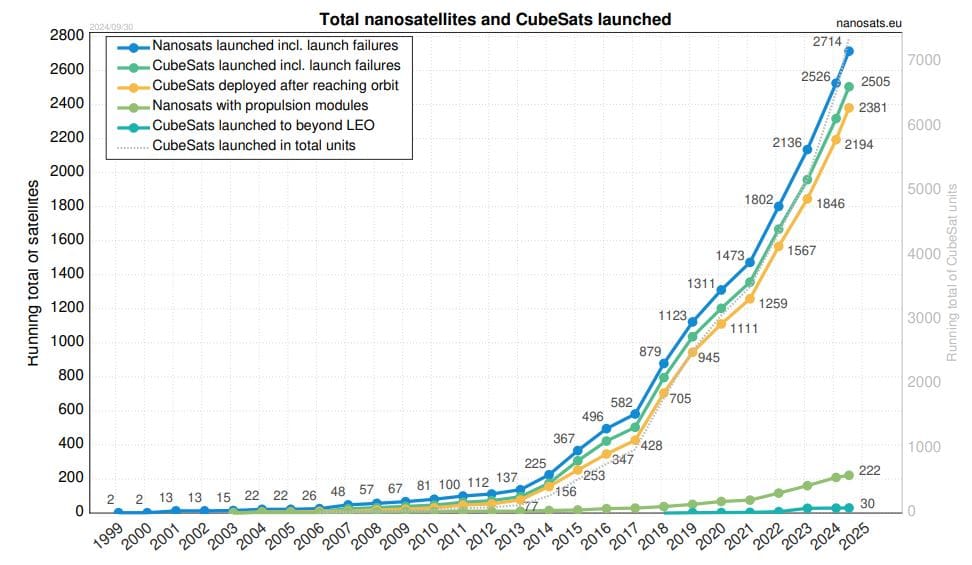
- The chart shows this crazy, steady, well, not steady rise of CubeSats over the past two decades.
- From 1999 to 2013, the cumulative CubeSat launches stayed under 140 spacecraft, so it looks like the tech was still in that early stage.
- The growth really started to kick up after 2014, when total CubeSat launches went from 225 in 2014 to 879 by 2018, which is a pretty big jump.
- Then the 2020s get even wilder. By 2021, the cumulative CubeSat launches had climbed to 1,473, and by 2022 it reached 1,802. In 2023, it was 2,136, and by September 2024, it hit 2,505.
- Out of those, 2,381 CubeSats managed to reach orbit, so mission success looks strong overall.
- CubeSats that had propulsion systems rose to 222 spacecraft, and 30 CubeSats were launched past Low Earth Orbit (LEO), helping support deep space exploration missions, not just near-orbit stuff.
- The Nanosats Database, it calls itself the world’s largest database of nanosatellites. As of January 1, 2026, it lists more than 4,800 nanosatellites and CubeSats worldwide.
- It also catalogs missions that range from single-unit university experiments to commercial constellations made up of dozens or even hundreds of spacecraft.
- Created and maintained by Erik Kulu, an Estonian space industry analyst, the site has been freely available to researchers, engineers, journalists, and policymakers since 2014.
- So, overall, the data pretty clearly points to a fast-growing CubeSat ecosystem, with cumulative nanosatellite launches reaching 2,714 by 2024.
- The numbers basically confirm CubeSats have moved from niche educational projects into a major driver of global space innovation, and wider access to orbit.
CubeSat Small-Satellite Revolution
- Out of 2,505 CubeSats that launched, 2,381 actually reached orbit, so the overall hit-rate lands at about 95%.
- Together, these CubeSats add up to 7,378.5 standardized CubeSat units (U) and around 11,068 kilograms of launch mass, and it really points to a higher level of complexity and capability for these little satellites.
- By 2024, 16 interplanetary CubeSats had already been sent out, which sort of signals that compact spacecraft are increasingly doing deep-space exploration work.
- At the same time, 88 countries have managed to launch nanosatellites, underscoring the “democratization” of space access and the wider involvement of newer space-faring nations.
- After an earlier high of 297 nanosatellites in 2017, the market bounced back, with 329 launches in 2021, 334 in 2022, and then a new top number of 390 launches in 2023.
- In the first nine months of 2024, 188 nanosatellites were launched, and that seemed to confirm the industry’s steady momentum, still going.
- From an operations point of view, 1,085 nanosatellites are still active in orbit.
- Meanwhile, the biggest rideshare mission so far bundled 120 nanosatellites inside a record-setting 143-spacecraft payload on SpaceX’s Transporter-1 mission.
- Even with this expansion, there are sticking points too, like 126 satellites lost due to launch failures, plus 26 cases tied to deployment problems or mission bans.
- Taken as a whole, the figures paint a CubeSat ecosystem that’s maturing quickly. It keeps pushing innovation, lowers the gates for getting into space, and expands global participation across the space economy.
CubeSat Form Factor Evolution – The Shift To 6U And 12U Platforms
- The CubeSat industry is going through a big change, and the figures really suggest that the age of very tiny, almost test-only satellites is starting to make room for bigger and more capable platforms.
- In NASA’s Evolution of CubeSat Spacecraft Platforms study, CubeSat standards have stretched a lot, from the original 1U setup (10×10×10 cm) to also cover 6U, 12U, 16U, 24U, and 27U designs.
- It looks like this is less about experiments for experiment’s sake, and more about what the market wants, meaning higher performance, not just showing that the idea works.
- SNS Insider market research says that even though the older 1U–3U CubeSats are still responsible for around one-third of the industry revenues, the 6U–12U category is expected to become the fastest-growing segment through 2033.
- NASA also cites data from Blue Canyon Technologies, and that part is kind of telling. A typical 3U CubeSat usually gives around 1.5U of payload volume, while a 6U unit offers roughly 4–4.5U, and a 12U platform can allocate 10U or more to mission hardware.
- That big jump in usable space allows operators to tuck in more advanced payloads without throwing away CubeSat economics completely.
- On top of that, a normal 3U spacecraft tends to handle a 1 kg payload with about 45 watts of peak power.
- Meanwhile, a 6U platform can carry around 7.5 kg and deliver about 75 watts, and a 12U system supports up to 16 kg of payload mass with up to 100 watts peak power.
- Communications keep improving too, from the simpler S/VHF/UHF links that are common on 3U platforms, to X-band support on 6U spacecraft, and then Ku-band connectivity for 12U systems.
- NASA is calling attention to Omnispace’s plan for a constellation made up of roughly 200 12U satellites, while SatRevolution has suggested a 1,024 6U CubeSats network aimed at more frequent Earth viewing.
- In practice, these numbers show that bigger CubeSat formats are basically winning out for real-world, operational constellations.
- Work by Reanin and Persistence Market Research also points to larger CubeSats tying directly into measurable performance improvements.
- New approaches like electric propulsion, software-defined radios, optical inter-satellite connections, and onboard AI could boost data downlink efficiency by over 30% and also cut the time from revisit to usable insight by more than 25%.
- Even so, 1U and 3U CubeSats still matter a lot for education, and for low-cost trials too. But the commercial “center of gravity” has moved toward 6U and 12U systems.
- Those platforms give more payload capacity, stronger power budgets, and expanded mission capability, all while keeping the cost benefits that come with the CubeSat ecosystem.
Dominant Applications – Earth Observation and Space-Based IoT
- The CubeSat market’s “strong growth story” seems to be pushed by two main applications, Earth Observation (EO) and space-based Internet of Things (IoT) connectivity.
- Market research suggests the global CubeSat industry will move from USD 426.6 million in 2024 to around USD 1.64 billion by 2033, which is a pretty healthy 15.6% compound annual growth rate (CAGR).
- A big part of this trajectory is linked to rising needs for low-cost Earth observation, remote sensing, communication services, and IoT connectivity offerings.
- Persistence Market Research’s 2026 results indicated that in 2026, EO should account for roughly 44.2% of total CubeSat application revenue.
- Earlier work also suggests that Earth observation and traffic-monitoring missions made up more than 53% of the CubeSat market in 2021, so the dominance is not exactly new; it’s been there a while.
- Modern CubeSat constellations offer repeated daily views of the same area, which helps with faster decisions compared with older satellite approaches.
- Parallel to EO, space-based IoT is showing up as the quickest growing commercial opportunity.
- Long-term growth in the range of 15–16.5% CAGR, and the support comes from needs like asset tracking, environmental surveillance, industrial telemetry, logistics oversight, and remote infrastructure connectivity.
- ESA’s 2024 announcement about seven Greek CubeSat missions gives a solid example, kind of concrete, really, including ERMIS, with three satellites (two 6U CubeSats and one 8U CubeSat) built for IoT connectivity and also hyperspectral imaging, while DUTHSat-2 is a 6U CubeSat aimed at environmental monitoring and precision agriculture.
- Agriculture leans into crop health monitoring, maritime operators lean on satellite vessel tracking, and climate researchers are making use of atmospheric data gathered from CubeSat networks.
- Earth observation is sitting around 44–53% of application revenue, and IoT communications is the fastest growing part, so CubeSats are turning into a kind of essential infrastructure for global monitoring connectivity and data-driven decisions.
Conclusion
CubeSats have kind of morphed from classroom-style spacecraft into this really important pillar of the global space industry. You can see solid market growth, more launches happening, and lots of expanding commercial uses, all pointing to the fact that these little satellites are remaking how “access to space” works. Deployment outcomes are getting better and better, adoption of advanced 6U plus 12U platforms keeps climbing, and the appetite for Earth observation, along with IoT connectivity, is still increasing, so the whole industry keeps moving forward.
Also, 88 countries are participating now, and operational constellations are spreading fast, which suggests this space tech is becoming more democratic. And as the New Space economy keeps growing, CubeSats are expected to stay the core tools for communications, scientific investigations, environmental tracking, plus even deep-space exploration, more or less.
FAQ
By 2033, the CubeSat market is expected to be around USD 1.65 billion.
It’s projected to grow at a 15.6% CAGR from 2025 to 2033.
By 2024, more than 2,505 CubeSats will have been launched worldwide.
Roughly 95% of CubeSats reached orbit successfully, with 2,381 successful deployments.
Earth observation is the biggest segment, while space-based IoT connectivity is the fastest-growing use area.

Sources