








Brief Overview
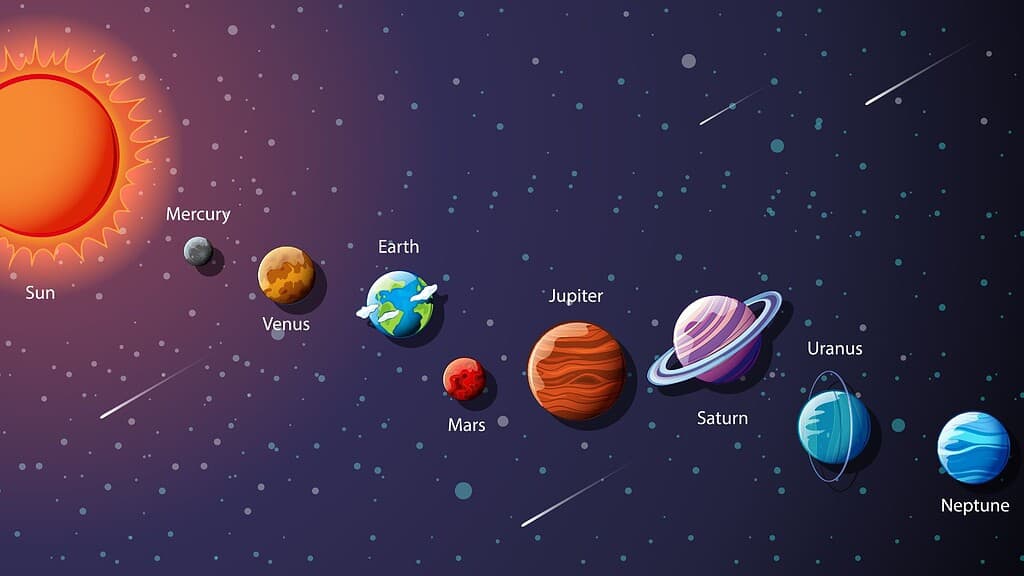
Solar System Statistics: The solar system is what most people quickly think about: planets like Earth, Mars, or maybe even Saturn with its big rings. But the truth is, the Solar System is much bigger, more complex, and more fascinating than just the planets we know from school textbooks. It’s built around one star, the Sun, and everything that moves around it. This includes the eight planets, their moons, dwarf planets like Pluto (maybe not an actual-sized planet), countless asteroids, icy comets, and even dust particles floating in the space between.
The story of the solar system began about 4.6 billion years ago, it is said, when a big cloud of gas and dust collapsed under its own gravity. At the center of that collapse, the Sun was born, and the leftover material spun into a disk that slowly came together to form planets and smaller objects. Today, this system stretches far beyond what we can easily see, from Mercury orbiting closest to the Sun to the Oort Cloud lying trillions of Kilometers away.
But what makes these solar system statistics truly exciting is not just its size, but the number that defines it. From the Sun holding more than 99% of all its mass, to Saturn having hundreds of moons, every number tells us something important about how this system works. In this article, I’ll break down these solar system statistics and let you know everything about our own family. Let’s get into it.
The Editor’s Ultimate Picks
- The solar system formed about 6 billion years ago from a collapsing cloud of gas and dust, giving birth to the Sun and all planets, moons, and small bodies.
- The Sun dominates everything with 86% of the total mass of the solar system. Its mean is about 1.988 x 10 to the power 30 kg, diameter 1,391,400 km, and surface temperature 5,770 K.
- There are 8 planets, split into 4 rocky inner planets (Mercury, Venus, Earth, Mars) and 4 gas/ice giants (Jupiter, Saturn, Uranus, Neptune).
- Dwarf planets officially recognized: 5: Ceres, Pluto, Haumea, Makemake, Eris.
- Mercury is the smallest planet, with a radius of 2,440 km, a mass of 0.055 Earth masses, an orbit of 0.39 AU, a year of 88 days, and has 0 moons.
- Venus: Radius 6,052 km, mass 0.815 Earth masses, orbit 0.72 AU, year 225 days, no moons.
- Earth: Radius 6,371 km, 1 Earth mass, orbit 1 AU, year 365.25 days, 1 moon.
- Mars: Radius 3,390 km, mass 0.107 Earth, orbit 1.52 AU, year 687 days, 2 moons.
- Jupiter: Radius 911 km, mass 317.8 times that of Earth, orbit 5.2 AU, year 11.86 years, 95+ moons, largest Ganymede.
- Saturn: Radius 58,232 km, mass 95 Earth, orbit 9.58 AU, year 29.5 years, 274 moons (recent count).
- Uranus: Radius 25,362 km, mass 14.5 times that of Earth, orbit 19.2 AU, year 84 years, 28 to 29 moons.
- Neptune: Radius 24,622 km, mass 17.1 times that of Earth, orbit 30.05 AU, year 165 years, 14 to 16 moons, the largest being Triton.
- The main asteroid belt has over 1 million asteroids larger than 1 km; Ceres is the largest at 940 km in diameter.
- The Kuiper Belt contains hundreds of thousands of icy bodies larger than 100 km.
- The Oort Cloud may contain trillions of icy bodies, stretching up to 50,000 to 100,000 AU.
- Total confirmed moons in the solar system: about 891; half orbit small bodies, half orbit planets.
- Orbital distances follow the AU scale: 1 AU is equal to 149,597,870.7 km. Mercury moves the fastest (47.9 km/s), and Neptune has the longest year (165 Earth years).
- Extreme surface temperatures: Mercury -173 °C to 427 °C, Venus 460 °C, Mars -60 °C avg, outer moons in tens of kelvin.
- Exploration: Over 100 interplanetary missions launched; iconic ones include Voyager 1 & 2, Cassini, Juno, New Horizons, and Mars rovers.
| Topic | Key Stats |
| Formation Age |
4.6 billion years |
|
Sun mass fraction | 99.86% |
| Sun mass |
1.988 x 10 to the power 30 kg |
|
Sun diameter | 1,391,400 km |
| Sun surface temp |
5,770 k |
|
Total planets | 8 |
| Dwarf planets |
5 (Ceres, Pluto, Haumea, Makemake, Eris) |
|
Mercury | Radius 2,440 km, Mass 0,055 Earth, Orbit 0.39 AU, Year 88 days, Moons 0 |
| Venus |
Radius 6,052 km, Mass 1 Earth, Orbit 0.72 AU, Year 225 days, Moons 0 |
|
Earth | Radius 6,371 km, Mass 1 Earth, Orbit 1 AU, Year 365.25 days, Moons 1 |
| Mars |
Radius 3,390 km, Mass 0.107 Earth, Orbit 1.52 AU, Year 687 days, Moons 2 |
|
Jupiter | Radius 69,911 km, Mass 317.8 Earth, Orbit 5.2 AU, Year 11.86 years, Moons 95+, Largest Ganymede |
| Saturn |
Radius 58,232 km, Mass 95 Earth, Orbit 9.58 AU, Year 29.5 years, Moons 274 |
|
Uranus | Radius 25,362 km, Mass 14.5 Earth, Orbit 19.2 AU, Year 84 years, Moons 28 to 29 |
| Neptune |
Radius 24,622 km, Mass 17.1 Earth, Orbit 30.05 AU, Year 165 years, Moons 14 to 16, largest Triton |
|
Main asteroid belt | 1.1 million greater than 1km, the largest Ceres is 940 km |
| Kuiper belt |
Hundreds of thousands greater than 100 km |
|
Oort Cloud | Trillions of icy bodies, 2,000 to 100,000 AU |
| Total moons |
891 |
|
Fastest orbital speed | Mercury 47.9 km/s |
| Longest orbital period |
Neptune 165 years |
|
Extreme temps | Mercury 173 °C to 427 °C, Venus 460 °C, Mars -60 °C, Outer bodies tens of k |
| Missions |
Greater than 100 interplanetary, including Voyager, Cassini, Juno, New Horizons, and Mars rovers |
Formation of the Solar System
(Source: wikipedia.org)
- The solar system formed from a collapsing cloud of gas and dust roughly 4.6 billion years ago.
- Gravity pulled the dense parts together to form the Sun at the center and a rotating disk of leftover material that later became planets and smaller bodies.
- The collapse likely started after a disturbance such as a nearby supernova or density wave, causing parts of a molecular cloud to fragment.
- The present w constraint values are roughly −1. In order to find out about time variations or tiny differences, it is necessary to have a percent-accurate measurement in several probes, and this is exactly what Euclid, Roman, Rubin, and DESI want to provide in the upcoming decade.
- The leftovers established the first angular momentum and temperature distribution that decided what bodies would be rocky and what bodies would become gas giants.
- The inner disk lost its gas and built up solid particles that eventually transformed into planets through processes lasting tens of millions of years and turned into the eight planets we observe today.
- The rest is still present in the form of asteroids, comets, and trans-Neptunian objects. A lot of current satellites and moons were captured in those turbulent times.
| Topic | Fact |
| Formation age | 4.6 billion years |
| Formation process | Collapse of the solar nebula, followed by accretion and migration |
| Timescale for planet formation | Tens of hundreds of millions of years |
| Leftover reservoirs | Asteroid belt, Kuiper belt, Oort cloud |
#1. The Sun
(Source: lightcolourvision.org)
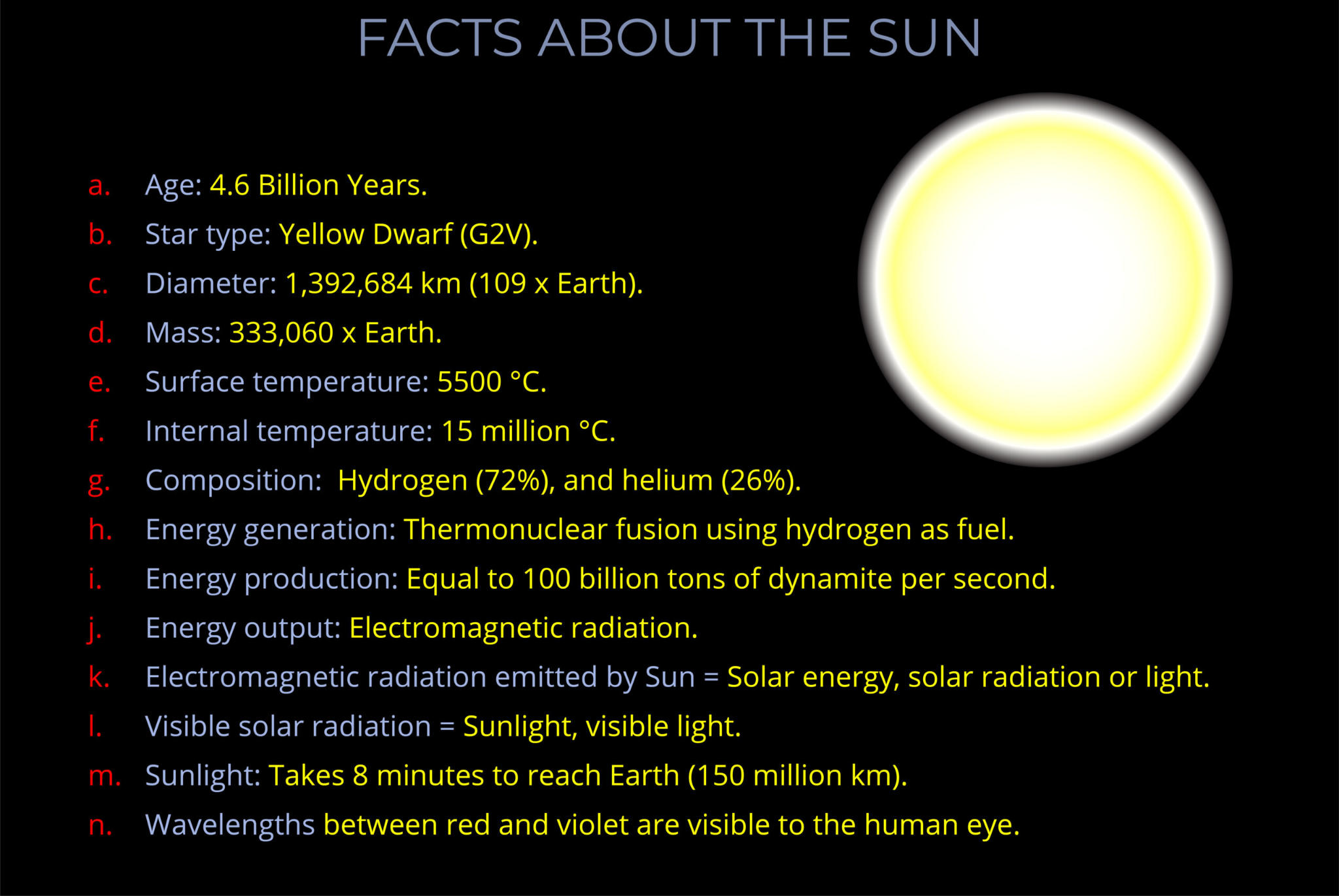
- The Sun accounts for almost all the mass in the solar system. The mass of the Sun is close to 99.86% of the total mass of the solar system; therefore, the Sun regulates almost all the orbits and angular momentum.
- While the mass of the Sun in SI units is about 1.988 x 10 to the power 30 kilograms, its mean diameter is close to 1,391,400 kilometers, or 109 times Earth’s diameter. Surface temperature in the visible photosphere is about 5,770 K.
- Luminosity of the sun is about 3.828 x 10 to the power of 26 watts. The Sun’s energy defines habitable zones, evaporation of volatile materials, and the rate of atmospheric loss throughout the solar system.
- The Sun is a G-type main-sequence star that has been around for about 4.6 billion years out of a main-sequence lifetime of about 10 billion years. Therefore, we have used half of the fuel of the Sun’s lifetime.
| Property | Statistics |
| Mass fraction of the solar system | 99.86% |
| Mass | 1.988 x 10 to the power 30 kg |
| Diameter | 1,391,400 km |
| Photosphere temperature | 5,770 k |
| Luminosity | 3,828 x 10 to the power of 26 W |
#2. The Planets
(Source: jpl.nasa.gov)
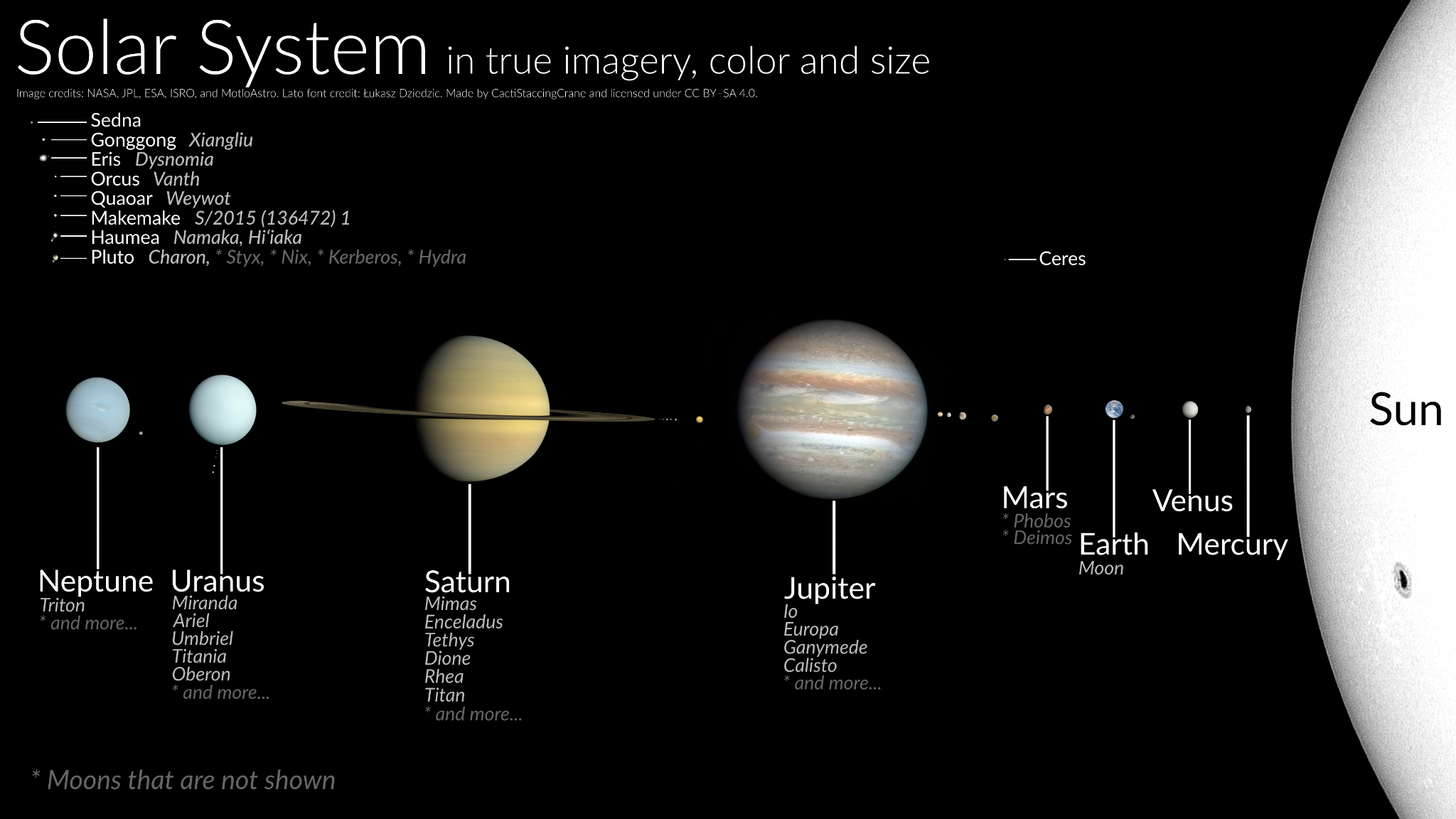
- The solar system has eight planets: Mercury, Venus, Earth, Mars, Jupiter, Saturn, Uranus, and Neptune.
- These eight are split into two broad classes: four rocky inner planets and four giant outer planets.
- There are also five officially recognized dwarf planets: Ceres, Pluto, Haumea, Makemake, and Eris. These live mostly in the asteroid belt and trans-Neptunian space and are round but have not cleared their orbits.
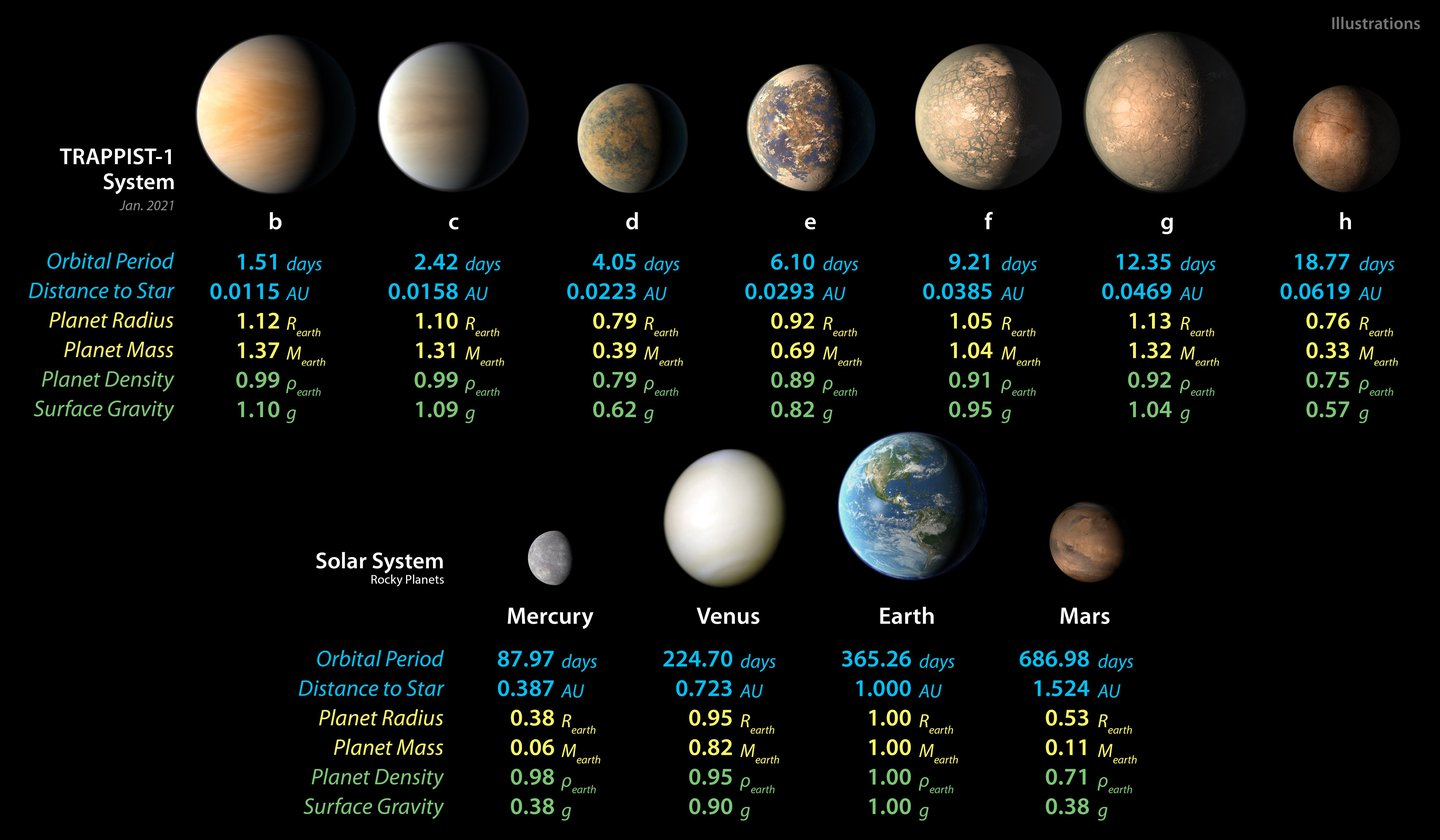
- Below, I give concise, statistic-focused notes about each planet, size, mass (relative to Earth), mean distance from the Sun (astronomical units, AU), orbital period, and major moon counts where relevant.
Mercury
- Smallest planet, radius 2,440 km, and mass about 0.055 Earth masses. Surface gravity is about 0.38 g.
- Orbit is at an average of 0.39 AU, and it completes one orbit in 88 Earth days.
- No atmosphere to speak of (very thin exosphere), extreme temperature swings, roughly -173 °C to 427 °C. Mercury has no natural satellites.
Venus
- Radius 6,052 km and mass 0.815 Earth masses. Mean distance is 0.72 AU with an orbital period of 225 Earth days.
- Thick CO2 atmosphere, surface pressure 92 times Earth’s, surface temperatures around 460 °C, rotates slowly and in retrograde relative to most planets.
Earth
- Radius 6,371 km, mass 1 Earth by definition. Distance 1 AU, orbital period 365.25 days.
- One large moon (the Moon), global ocean coverage of 71% of the surface, and average surface temperature suitable for liquid water. The only known world with life.
Mars
- Radius is 3,390 km and has 0.107 Earth masses. Orbit 1.52 AU, year 687 Earth days.
- Thin CO2 atmosphere, polar ice caps, two small moons, Phobos and Deimos.
Jupiter
- Largest planet: Radius 69,911 km at the equator, mass 317,8 Earth masses (about 1/1000 of the Sun). Orbit 5.2 AU, year 11.86 Earth years.
- Gas giant, strong magnetic field, dozens of moons; major Galilean moons are Io, Europa, Ganymede, and Callisto. (See moons section for totals).
Saturn
- Radius 58,232 km, mass 95 Earth masses. Orbit 9.58 AU, orbital period 29.5 Earth years.
- Iconic rings, many moons; recent surveys pushed Saturn’s confirmed moon count much higher (see moons section).
Uranus
- Radius 25, 362 km, mass 14.5 Earth masses. Orbit 19.2 AU, year 84 Earth years.
- An ice giant with a strong axial tilt that makes seasons extreme, many small moons, and faint rings.
Neptune
- Radius 24,622 km, mass 17.1 Earth masses. Orbit 30.05 AU, year 165 Earth years.
- An ice giant, strong winds, a major moon, Triton, which is geologically active and likely captured.
| Planet | Radius (km) | Mass (Earth 1) | Avg distance (AU) | Orbital period (Earth days/years) | Notable moons |
| Mercury | 2,440 | 0.055 | 0.39 | 88 days | 0 |
| Venus | 6,052 | 0.815 | 0.72 | 225 days | 0 |
| Earth | 6,371 | 1 | 1 | 365.25 days | 1 (Moon) |
| Mars | 3,390 | 0.107 | 1.52 | 687 days | 2 (Phobos, Deimos) |
| Jupiter | 69,911 | 317.8 | 5.20 | 11.86 years | 95+ (major: Io, Europa, Ganymede, Callisto) |
| Saturn | 58,232 | 95.2 | 9.58 | 29.5 years | 274 (recently updated) |
| Uranus | 25,362 | 14.5 | 19.2 | 84 years | 28 to 29 |
| Neptune | 24,622 | 17.1 | 30.05 | 165 years | 14 to 16 |
Dwarf Planets, Asteroids, and Comets
(Source: creation.com)
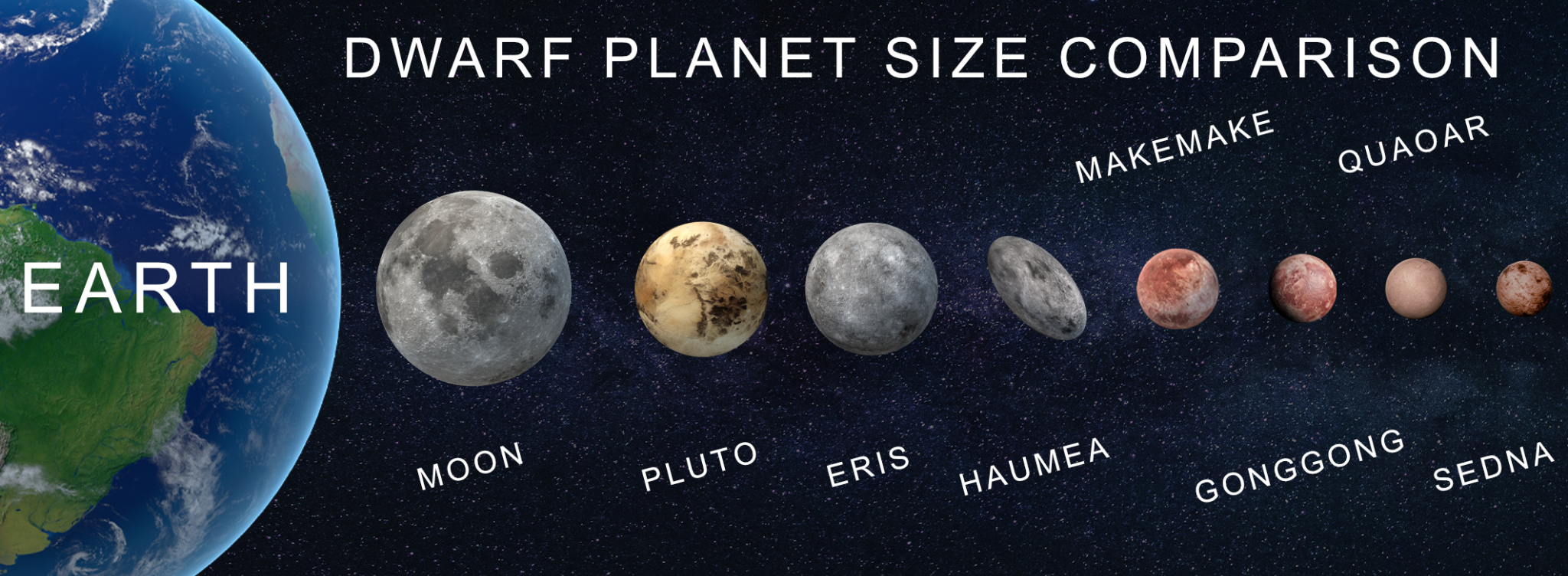
- Five dwarf planets are officially accepted: Ceres, which is located in the asteroid belt, and Pluto, Haumea, Makemake, and Eris, which are in the trans-Neptunian zone. There are many other candidate dwarf planets yet to be confirmed.
- The main belt of asteroids between Mars and Jupiter is believed to have over 1.1 million asteroids above 1 km in size and millions of smaller fragments. Ceres is the biggest one of those, with a mean diameter of 940 km.
- The Kuiper belt outside Neptune has hundreds of thousands of bodies of ice bigger than 100 km in size, along with millions of smaller ones.
- The Oort cloud is a hypothesized spherical shell extending tens of thousands of AU out; estimates place its inner edge near 2,000 AU and outer boundary up to 50,000 to 100,000 AU. The Oort cloud likely holds trillions of icy bodies that occasionally fall inward as long-period comets.
| Reservoir | Rough Counts |
| Dwarf planets (official) | 5 recognized (Ceres, Pluto, Haumea, Makemake, Eris) |
| Asteroids greater than 1km | 1.1 million in the main belt (est.) |
| Kuiper belt objects | Hundreds of thousands greater than 100 km, many smaller |
| Oort cloud bodies | Potentially trillions (hypothetical, distant) |
| Comets known | Thousands cataloged; many new ones found annually |
#3. Moons
(Source: wikipedia.org)
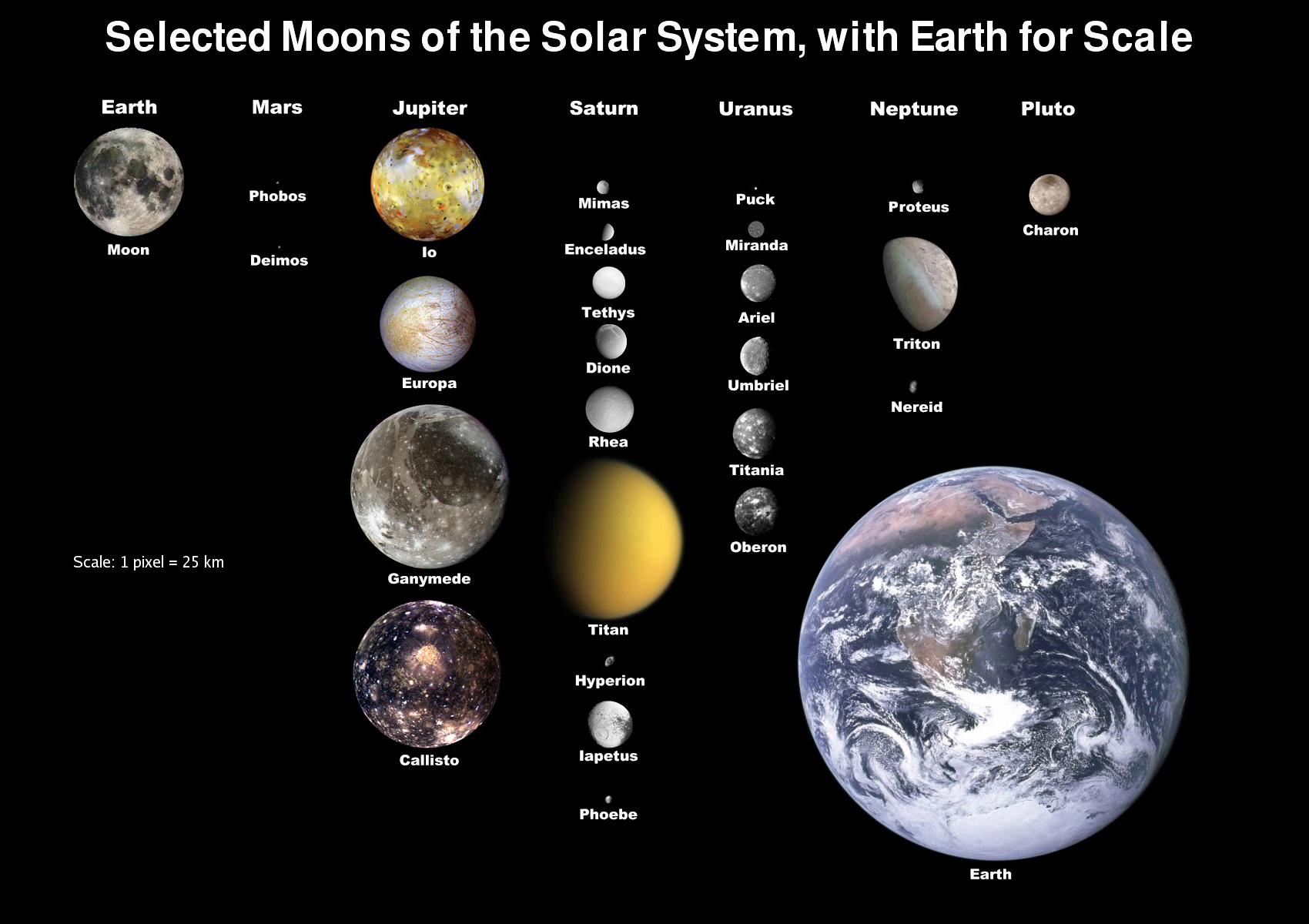
- Moons are a growing tally as surveys and better analysis reveal faint satellites. As of March 25, 2025, there were about 891 confirmed moons in the solar system, with ongoing discoveries likely to change that number. That total mixes planetary moons and small bodies’ satellites.
- Of those moons, around 421 orbit recognized planets (counting Pluto among dwarf planets in some tallies) while 470+ orbit dwarf planets, asteroids, and other small bodies.
- This means almost half the known moons are orbiting smaller objects and not a planet.
- Saturn saw a major increase from dedicated surveys that announced a batch of new, faint moons and pushed its confirmed total to around 274, making it the planet with the most known satellites at that time.
- Many of these added moons are tiny irregularities only a few kilometers across.
- The Jupiter system has the biggest moons, like Ganymede, which is larger than Mercury, and the Galileans. The Galileans and Jupiter-Saturn account for the most numerous and massive systems of moons.
- Moon size varies greatly, ranging from small moonlets in rings, only a meter wide, to Ganymede, which has a radius of 2,634 kilometers. Some of the moons have indications of liquid oceans under their surfaces.
| Metric | Value |
| Confirmed moons (system-wide) | 891 as of March 25, 2025. |
| Planet-orbiting moons | 421 |
| Moons around small bodies | 470+ |
| Largest moon | Ganymede (radius 2,634 km) |
| Most moons (planet) | Saturn 274 (updated in 2025) |
Distances, Scales, and Orbital
(Source: wikimedia.org)
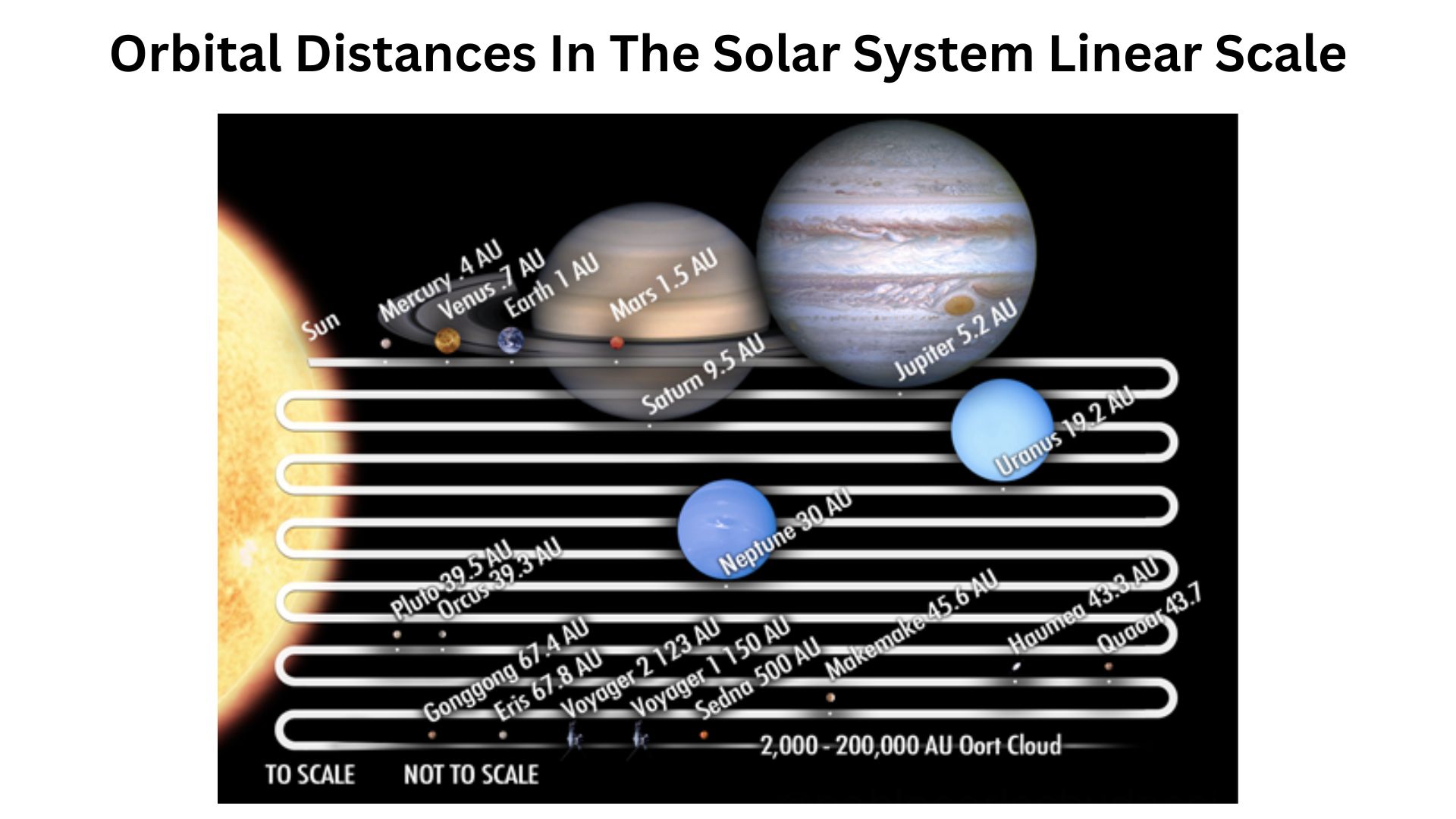
- The basic distance unit is the astronomical unit (AU), which is the mean Earth-Sun distance: 149,597,870.7 km.
- That single number helps compress large distances into simple ratios: Mars at 52 AU, Jupiter at 5.2 AU, Neptune at 30 AU.
- Orbital periods scale roughly with distance following Kepler’s third law, so outer planets have very long years: Neptune’s orbital period is about 165 Earth years.
- The shortest orbital period in the solar system is Mercury’s 88 Earth days.
- Planetary orbital eccentricities and inclinations vary; Mercury and Pluto have relatively high eccentricities compared with the circular orbits of Venus and Neptune.
- Axial tilts produce seasons. Earth’s tilt of 23.4 degrees gives familiar seasons; Uranus’ tilt of 98 degrees gives extreme seasonal extremes.
| Item | Value |
| 1 AU | 149,597,870.7 km |
| Mercury orbit | 0.39 AU (88 days) |
| Earth orbit | 1 AU (365.25 days) |
| Jupiter orbit | 5.20 AU (11.86 years) |
| Neptune orbit | 30.05 AU (165 years) |
Mass, Density, and Composition
(Source: planetary.org)
- The Sun dominates mass at 99.86%. Planets make up nearly all the rest, with Jupiter and Saturn together containing most of the non-solar mass.
- Jupiter alone is about 0.1% of the total solar system mass, but is more than three times Saturn’s mass.
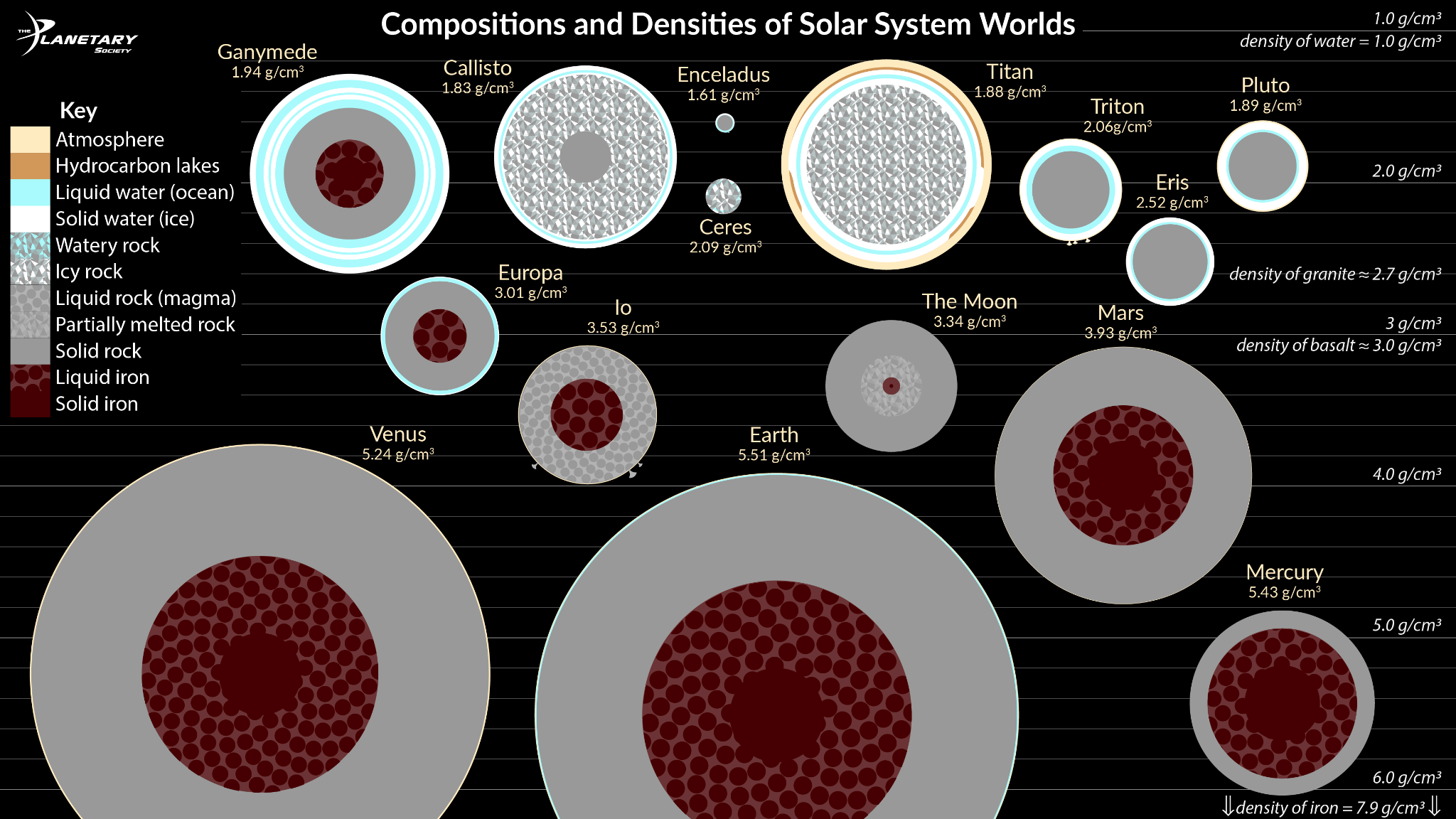
- Terrestrial planets (Mercury to Mars) are composed of rock and are dense; the total mass of all these bodies is a tiny fraction compared to the giants.
- The mass of the Earth is taken as a standard, but the total mass of Mercury, Venus, Earth, and Mars combined is far less than Jupiter’s mass.
- The ice giants (Uranus and Neptune) have higher amounts of ices and volatiles compared to Jupiter and Saturn.
- Small bodies like asteroids and comets contribute negligible mass but are numerous and hold clues about primordial composition.
| Component | Mass Fraction |
| Sun | 99.86% of system mass |
| Jupiter | 0.10% of system mass; the largest planet by mass |
| Saturn | 0.03% approx; second giant |
| Terrestrial planets combined | A very small fraction compared to the giants |
| Small bodies (asteroids/comets) | Negligible mass but large numbers |
Temperature Ranges and Environments Across the Solar System
(Source: science.nasa.gov)
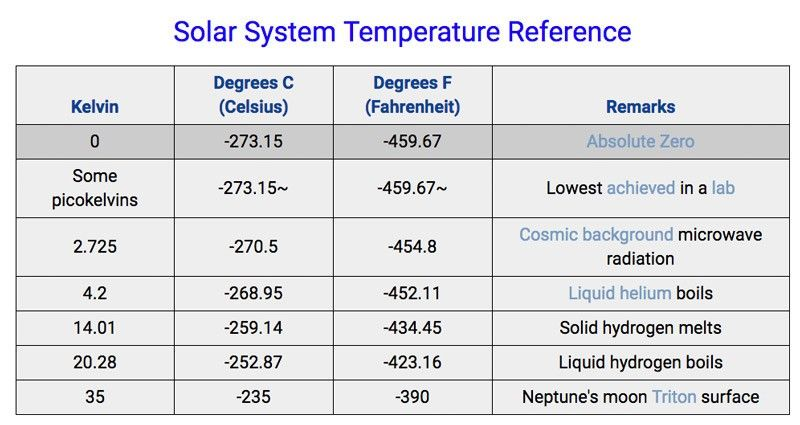
- Temperatures vary from thousands of Kelvin in the solar corona to a few kelvin in the far Oort cloud.
- At planetary surfaces, Mercury and Venus’ hot extremes contrast with frigid outer worlds.
- Example surface temps: Mercury Day 427 °C, night down to 173 °C; Venus’s average 460 °C due to runaway greenhouse; Mars average -60 °C, but local extremes from 20 °C daytime in equator to -125 °C at poles.
- Outer moons and bodies have surface temperatures in the tens of kelvin; internal heat and tidal heating create localized warm environments (eg, Io volcanism, subsurface oceans on Europa and Enceladus).
| Body/Region | Representative Temps |
| Mercury (day) | Up to 427 °C |
| Venus (surface) | 460 C |
| Earth (global avg) | 14 C |
| Mars (avg) | 60 C |
| Outer moons / Kuiper region | Tens of kelvin |
Exploration Statistics
(Source: nature.com)
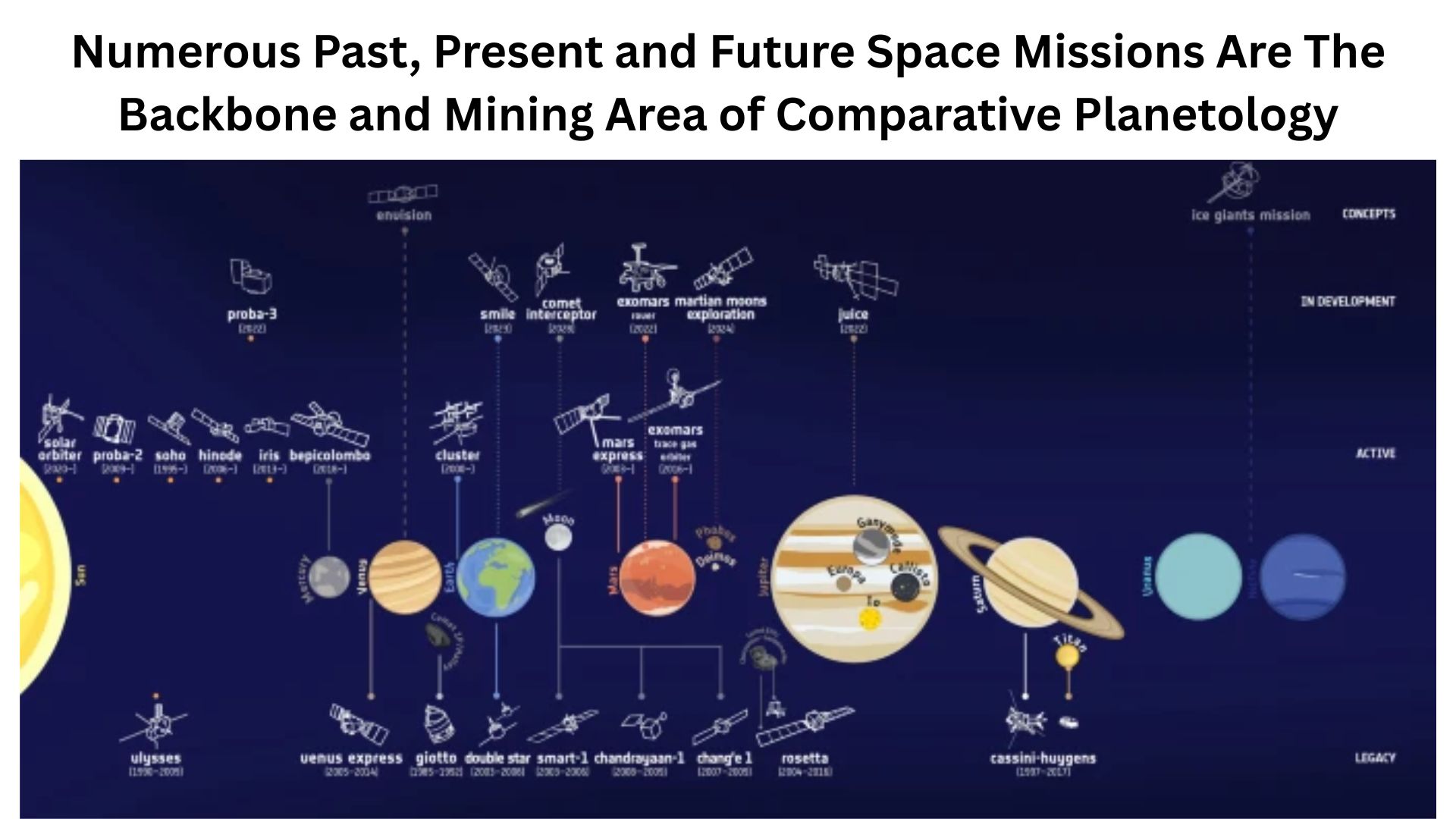
- So far, human efforts are restricted to low Earth orbit and the Moon. Robotic spacecraft have been sent to all planets and numerous small objects, with flybys, orbiters, landing craft, and rovers providing most information.
- Milestone mission numbers: More than 100 interplanetary missions have been launched in history; there are tens of active spacecraft (the exact number of active spacecraft varies with spacecraft lifetime and mission losses).
- Important missions include Voyager 1 & 2, which exited into interstellar space, the Cassini mission around Saturn, the Juno mission around Jupiter, the New Horizons mission to Pluto, and many sample return missions and remote sensing missions.
- Planetary science missions generate huge amounts of data and have driven discovery rates, leading to new counts of moons, asteroids, and information about atmospheres, surfaces, and interiors.
| Category | Stats |
| Notable missions | Voyager 1 & 2, Cassini, Juno, New Horizons, Perseverance |
| Interplanetary missions launched | Over 100 historically |
| Sample-return missions | A few (Apollo lunar samples, OSIRIS-REx, Hayabusa2) |
Records and “Top” Numbers in the Solar System
(Source: wikipedia.org)
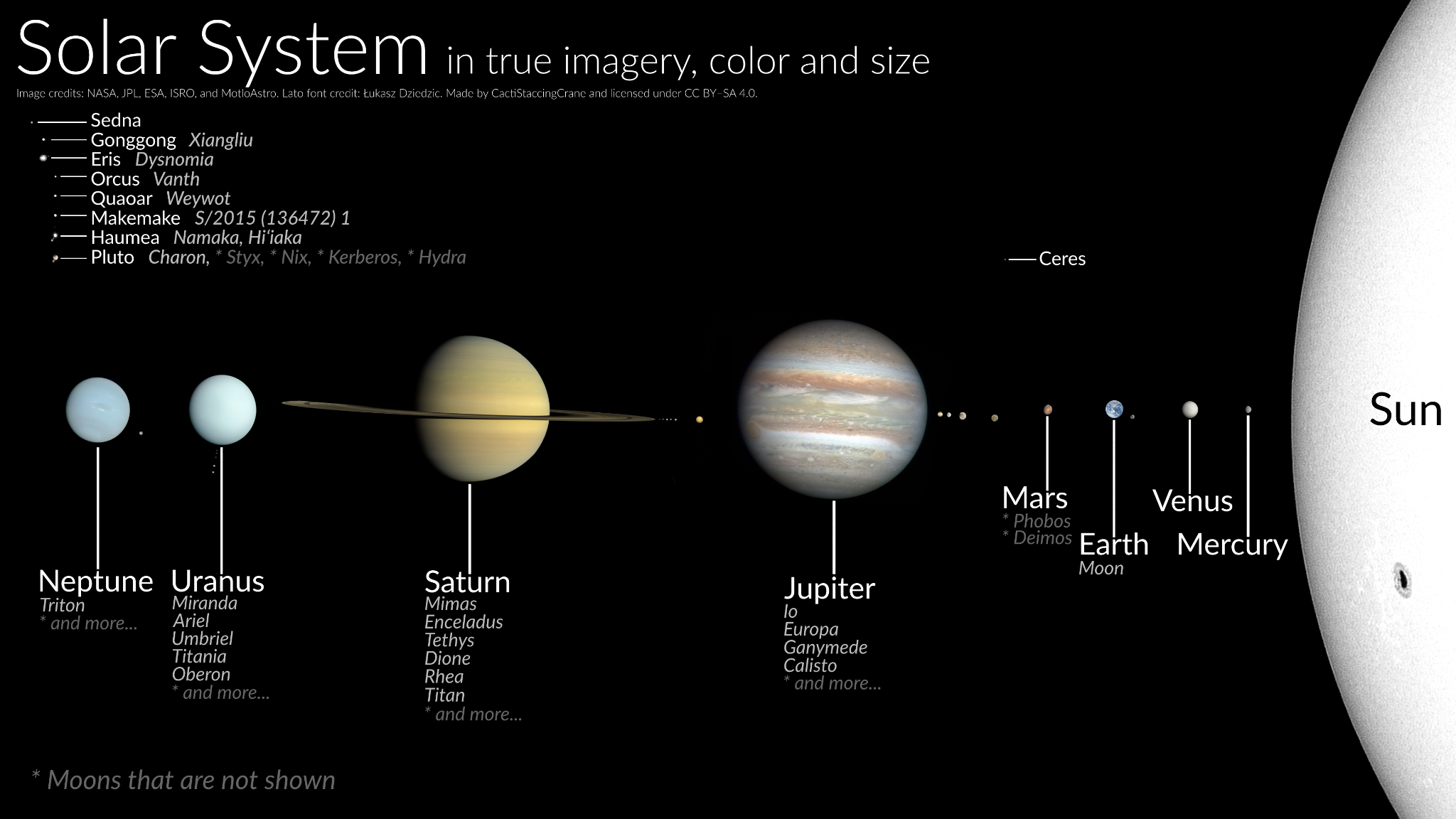
- Largest planet by mass: Jupiter.
- The most massive satellite: Ganymede, larger than Mercury by volume.
- Most moons (single planet): Saturn (recent tally showed 274).
- Most distant known small-body reservoirs: Oort cloud (theoretical reach up to tens of thousands of AU).
- Fastest orbital speed (planet): Mercury (47.87 km/s at perihelion).
- Longest planetary year: Neptune (165 Earth years).
| Record | Value |
| The most massive body | Sun (99.86% of system mass) |
| Planet with the most moons | Saturn (274) |
| Largest moon | Ganymede |
| Fastest orbital speed | Mercury (47.9 km/s) |
| Longest orbital period | Neptune (165 years) |
How Do These Numbers Change?
- The number of counts in the solar system is not static. Counts of moons, small bodies, and potential dwarf planets keep increasing due to telescopic observations through JWST, Rubin Observatory, and other surveys. More counts should be expected.
- The estimates of the number of small bodies rely on modeling. The number of Kuiper belt objects will be based on the sensitivity of the survey and albedo assumption, hence always changing.
- The distances and masses are fixed, while the numbers are fluid in counts and classification.
Final Thoughts
So, overall, the solar system is more than just a collection of planets orbiting the Sun. It is a vast, dynamic system full of numbers that tell the origins of its past and its structure. From the Sun holding almost all of the system’s mass to Saturn’s hundreds of moons and the trillions of small icy bodies in the Oort cloud, every figure helps us understand how this incredible neighborhood works.
Exploring these stats not only gives us perspective on our place in space, but it also inspires curiosity for me, especially about the worlds beyond Earth. If you enjoyed learning about the solar system, please get deeper into each planet, moon, and small body. There is still so much to discover. Keep exploring, keep questioning, and see these numbers come alive as you study our own home. If you have any questions, kindly let me know in the comments section.
FAQ
Venus is Earth’s sister planet. Often referred to as our “twin”, it earned this nickname because it is the closest in size, mass, and rocky composition to Earth in our solar system.
In planetary astronomy, Uranus is widely considered the most unloved and neglected planet. Often the butt of juvenile jokes, it was previously thought to be a featureless blue sphere. It was only briefly visited once by humanity when Voyager 2 made a flyby in 1986.
The largest known star in the universe is Stephenson 2-18. It is a red supergiant located roughly 19,000 light-years away from Earth in the constellation Scutum.

Sources