








Briefing
Comet Browser Statistics: Comet Browser is changing the way people use the internet by putting AI directly into the browsing experience. Unlike traditional browsers that mainly help users open websites and search for information, Comet can understand what users need and help complete tasks along the way. It can summarize web pages, find useful information, answer questions, and assist with everyday online tasks. As AI becomes a bigger part of how people work and search online, browsers are also becoming smarter. Comet aims to make browsing faster, simpler, and more productive by reducing the need to switch between different tools. This article explores Comet Browser, its key features, growth, and what makes it different from traditional browsers.
Top Recommendation
- Perplexity AI’s Comet is an AI-powered, Blink-based proprietary browser, launched on Windows/macOS on July 9, 2025, Android on November 20, 2025, and iOS on March 18, 2026.
- It supports Windows 10+, macOS Big Sur+, Android 12+, iOS 18+, and visionOS 2.0+.
- Its key advantage is conversational research: AI chat, multi-source comparisons, visible citations, summaries, memory, workspaces, split-screen, sync, reader mode, tracker blocking, and password management.
- Comet scores 5/5 for AI, 4/5 for speed and ease of use, and 3/5 for privacy, customization, and extensions.
- Global browser share reportedly reached 1.9%, versus Chrome’s 63.1% and Safari’s 18.4%.
- MAU rose from 2.4 million in Q1 2025 to 9.1 million in Q3 2025 and 18 million in Q1 2026; Pro subscribers reached 2.1 million.
- Address-bar AI searches hit 298 million in Q1 2026; agentic tasks grew 860% YoY to 14 million.
- The U.S. represents 38% of MAU; India contributes 8% and is the fastest-growing market.
- 74% of users engage with Comet AI; summaries appear in 41% of sessions and reduce session time by 31%.
- Comet is strongest for research and education, but limited privacy tools, ad blocking, VPN/Tor, and extension support constrain its role as an all-purpose browser.
Comet Browser Overview
| Category | Details |
| Developer | Perplexity AI developed Comet as an AI-powered web browser. |
| Browser engine | Comet uses the Blink browser engine. |
| Windows and macOS release | The browser launched on July 9, 2025. |
| Android release | The Android version launched on November 20, 2025. |
| iOS release | The iOS version launched on March 18, 2026. |
| Device support | Comet supports Windows 10 or later, macOS Big Sur or later, Android 12 or later, iOS 18 or later, and visionOS 2.0 or later. |
| License | Comet is proprietary software built on an open-source software project. |
| Website | The official Comet website is perplexity.ai/comet. |
Key Benefits of Comet Browser
- Users can ask questions and continue the conversation with follow-up queries.
- Comet allows users to compare information from different sources.
- Citations are clearly displayed, making research easier to verify.
- The browser can reduce the need to manage many tabs during complex research.
- It is particularly useful for students, researchers, and people who frequently learn online.
- However, it may not fully replace traditional browsers for everyday activities such as banking and shopping.
Top Features
- AI chat: Supported, making conversational research a core feature.
- Private search engine: Not supported as the default.
- Tracker blocking: Supported, helping limit third-party tracking.
- Targeted ads: Not supported.
- Cookie consent pop-up blocking: Not supported.
- YouTube targeted ad blocking: Not supported.
- Password manager: Supported.
- Email spy-pixel blocking: Not supported.
- History clearing: Supported with one tap.
- Workspaces and tab groups: Supported.
- Split-screen view: Supported.
- Sync across devices: Supported.
- Reader mode: Supported for distraction-free reading.
- VPN, Tor integration, anti-fingerprinting, and native ad blocking: Not supported.
- Chrome and Firefox extensions: Not supported.
Key Strengths and Limitations
- Comet’s biggest strength is its 5/5 AI rating, with conversational search, source comparisons, and citations built into the experience, according to a report from browsers.to.
- Speed and ease of use both receive 4/5, suggesting that Comet also delivers a smooth browsing experience.
- Privacy, customizability, and extensions each score 3/5, highlighting important limitations.
- Overall, Comet seems better suited for AI-based research than for replacing a traditional everyday browser.
Comet Browser Market Position
- SEO Sandwitch report further noted that Comet has reached a 1.9% global market share, up from 0.4%.
- Established browsers remain dominant, with Chrome at 63.1% and Safari at 18.4% of global usage.
- Comet ranks second among AI-native browsers, while AI-focused browsers collectively represent 4.3% of worldwide browser usage.
- Adoption is also growing in San Francisco and New York, where Comet ranks as the third-most popular desktop download and runs on 12% of university lab machines across 23 universities.
- Among creators, 19% use Comet for generating summaries, while 7.8% of Stack Overflow threads reference it.
- However, only 4% of privacy-focused users prefer Comet over Brave.
- Overall, Comet is emerging as a strong AI-browser competitor, with higher user engagement than Brave.
Comet User and Subscriber Growth
- Comet recorded 2.4 million monthly active users (MAU) and 0.18 million Comet Pro subscribers in Q1 2025, according to presenc.ai.
- By Q3 2025, MAU increased to 9.1 million, while Pro subscribers reached 0.8 million, representing 95% QoQ growth in MAU.
- In Q1 2026, MAU doubled to 18 million, and Pro subscribers reached 2.1 million, although quarterly MAU growth slowed to 41%.
User Demographics and Usage Insights
- Comet attracts digitally skilled users, with 35% aged 18-24. Students and academics account for 27% of total usage.
- Desktop devices account for 61% of access among U.S. users, while 18% rely solely on mobile devices, indicating varied device preferences.
- Users view an average of 11.7 pages per session, while 14% spend more than 5 hours online each week.
- Users complete 48% of their activity during office hours, while weekend usage falls by 2.6%.
- Users from non-English-speaking regions account for 39% of sessions. Additionally, 45% rate Comet’s interface as highly intuitive.
- Neurodiverse users report 31% higher satisfaction, suggesting that Comet’s research-focused environment can support different cognitive needs
Comet Browser Usage Statistics by Surface
- Address-bar AI search generated 298 million queries in Q1 2026, up 340% YoY.
- Inline page summaries reached 92 million, up 520% YoY.
- Agentic tasks totaled 14 million, recording the fastest growth at 860% YoY.
- Comet Memory recall reached 76 million sessions, increasing 410% YoY.
By Geographic Distribution
- The United States accounted for 38% of Comet MAU, supported by strong desktop adoption.
- Western Europe represented 23%, led by the UK, Germany, and France.
- East Asia contributed 11%, while India accounted for 8% and remained the fastest-growing region.
- Latin America represented 5%, with Brazil and Mexico as key markets, while 15% came from other regions.
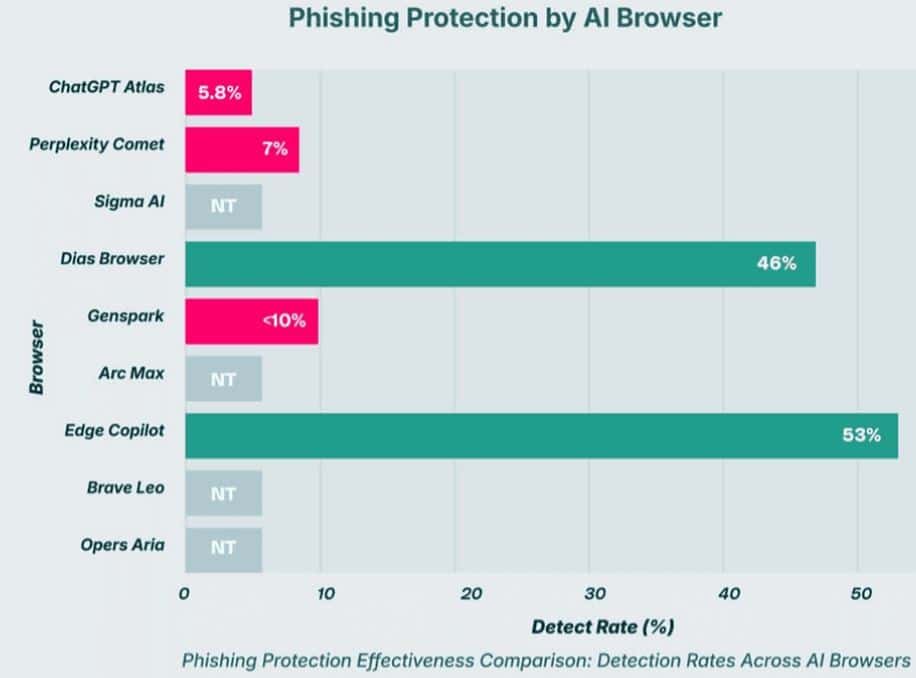
AI Browser Phishing Protection Rates
(Source: layerxsecurity.com)
- Edge Copilot showed the strongest phishing protection, detecting 53% of threats.
- Dias Browser ranked second, with a 46% detection rate.
- Genspark detected less than 10% of phishing attempts.
- Perplexity Comet detected 7%, while ChatGPT Atlas detected 5.8%.
- Sigma AI, Arc Max, Brave Leo, and Opera Aria were marked as not tested (NT).
Comet AI Engagement Snapshot
- The usage metrics show that Comet browser functions as an AI-first browsing platform, which has reached advanced development stages and attracts daily users who rely on it.
- Daily usage data shows that 74% of users interact with Comet AI, which results in more than 1 million chat sessions and 32 million AI interactions during the month of September 2025.
- The measurement shows that AI summaries reduce session time by 31% because they appear in 41% of all sessio, ns while users request information through Ask Comet at an average rate of 3.8 times.
- The preference data shows that 65% of users choose Comet for factual queries, while Google receives a 4.7 out of 5 satisfaction rating for AI chat.
- Knowledge work dominates adoption, with 58% of responses aiding citations and 83% usage in educational contexts.
- The power users create additional value through their use ofthe multi-tab AI feature, which they use 21% of the time, and they use pinned side panels through 65% of their browsing sessions.
Comet Browser Adoption Momentum
- The Comet browser achieves rapid growth because its growth metrics show it to be the fastest expanding AI-native browser during 2025.
- The platform reached 10 million active users per month in Q3 2025 while its daily user base increased by 320% to 2.94 million.
- Users show strong engagement because they spend an average of 13.4 minutes per session, which results in 48% of users returning after 30 days, a retention rate that exceeds industry standards.
- The platform sees adoption through youth participation since 60% of users belong to the 35 and younger age group, while 28% of users are students who drive academic usage upward by 75% each quarter.
- The platform shows product-led switching behavior because 43% of users who join the platform do so because they want to use AI summarization, while 72% of early users make it their main browsing tool.
- The Comet browser controls 1.9% of the global browser market, while its growth rate exceeds Firefox’s 11.5% monthly expansion.
- The Comet browser shows increasing enterprise adoption, which enables its use in both professional and institutional environments,s according to a 200% increase in enterprise deployments during H1 2025.
Comet Browser Speed and Performance Analysis
- According to datanorth.ai, Comet recorded a 29.3 Speedometer 3.1 score, indicating responsive performance for web applications.
- However, Chrome 138 scored 34.3, making Comet 5.0 points or 14.6% slower in the reported test.
- Comet outperformed ChatGPT Atlas, which scored 18.0, by 11.3 points or 62.8%.
- Safari 19 scored 31.5, placing Comet 2.2 points or 7.0% behind Safari.
- Its Chromium foundation supports standard features, including bookmarks, translation, and most Chrome extensions.
- Perplexity’s Computer agent averaged 26 minutes of machine execution versus 33 seconds for Search, representing 48× more work.
- Computer-plus-human review reduced task time by 87%, from 269 minutes to 36 minutes, according to research on perplexity.ai.
Comet Download Page Traffic Trend

(Source: facebook.com)
- Interest in the Comet download page increased after its announcement in June 2025.
- Web visits peaked at about 65% of Perplexity browser users during broad availability in late September 2025.
- Indexed Comet panelists also peaked at approximately 3,700 during this period.
- Traffic declined sharply after October 2025, despite smaller spikes in November 2025.
- By January 2026, Comet’s share of Perplexity browser users had fallen to about 3%.
Comet’s Growing Role in Academic Research
- Comet has gained strong adoption among educational institutions and research organizations, with use across more than 420 universities and 100 academic conferences.
- Student usage highlights Comet’s research value: 65% use it to summarize academic papers, and 20% have switched from Google to Comet for research.
- AI-powered outlines have improved productivity, contributing to a 22% increase in draft submissions and helping groups complete projects 29% faster.
- Educators also benefit, completing grading 32% faster by using AI-generated summaries.
- Research engagement remains strong, with 79% of PhD students at selected institutions regularly using the research method.
- More than 78% of educational accounts offer citation support, while over 190,000 students use Comet’s Zotero integration.
- Overall, Comet is becoming a useful academic tool, supported by a 94% satisfaction rate for lecture summaries and 400% annual growth in academic repository usage.
Comet Browser Pricing Statistics, 2026
| Plan | Price | Comet-related access and usage limits |
| Free | USD 0 | Includes basic access; Comet Assistant queries are not available. |
| Education Pro | USD 10/month | Available to verified students and educators; includes Pro-level features. |
| Pro | Price not specified in the official 2026 plan article | Includes Comet Assistant with monthly limits for average use. |
| Max | Price not specified in the official 2026 plan article | Includes Comet Assistant with higher monthly limits and priority access to new products. |
| Enterprise Pro | Starts at USD 40/seat/month or USD 400/seat/year | Includes up to 80 Comet Assistant queries per month, enterprise controls, and protected organizational data. |
| Enterprise Max | USD 325/seat/month or USD 3,250/seat/year | Includes up to 800 Comet Assistant queries per month, equal to 10 times Enterprise Pro capacity. |
| Eligible education and nonprofit Enterprise Pro | USD 30/seat/month or USD 300/seat/year | Provides a USD 10 monthly discount, or 25%, off standard Enterprise Pro pricing. |
Comet Browser Accessibility Analysis
- Comet makes accessibility a key part of its product experience, rather than treating it as a basic compliance requirement.
- The browser achieves a 92% accessibility score and meets WCAG 2.1 AA standards across its main tools.
- User preferences indicate strong demand for accessibility features, with 69% choosing dark mode, 11% using colorblind mode, and 6% relying solely on keyboard navigation.
- AI accessibility features are also gaining attention, with text-to-speech summaries used in 8% of cases and AI-generated captions available for 5% of video content.
- Neurodivergent users show 15% better page understanding, while the simplified interface reduces cognitive requirements by 17%.
- Comet supports 37 languages, while its low-bandwidth mode reduces feature requirements by 42%.
- Accessibility plugin installations have grown 117% annually.
Comet Browser Tutorial
- Beginners can download, install, and set up Perplexity’s Comet Browser.
- Users can select preferences such as theme settings and connect their account during the initial setup.
- Comet’s built-in AI Assistant can answer questions, summarize information, manage tabs, and complete browser-based tasks.
- Users can type natural-language questions or commands into the search bar instead of entering only website addresses.
- The Assistant provides conversational answers with cited sources.
- Comet can search for hotels within a chosen budget and can support booking actions after the user logs in.
- Voice commands can also be used for tasks such as opening a new browser tab.
- Overall, the tutorial positions Comet as an AI-driven browser designed to simplify online research and routine web tasks.
Summary
Comet Browser shows how AI is changing the way people browse the internet. It combines regular browsing with AI tools that can help users search, research, summarize information, and complete tasks more easily. As users seek faster, smarter ways to work online, Comet has strong potential to stand out. However, its long-term success will depend on user adoption, performance, privacy, and its ability to compete with other AI-powered browsers.
FAQ
Comet Browser was developed by Perplexity AI, an AI-powered search company.
Comet integrates AI assistance directly into browsing, search, research, and everyday tasks.
Yes, Comet has an integrated AI assistant that helps users browse, research, summarize, and automate tasks.