









Introduction
Data Visualization Adoption Statistics: Data visualization has quietly become one of the most essential parts of modern business intelligence, turning tangled datasets into useful signals so teams can decide more quickly and with a bit more confidence. In 2026, organizations in finance, healthcare, retail, manufacturing, government, and technology are leaning harder on interactive dashboards, AI-powered analytics, and real-time reporting, because staying competitive kind of depends on it.
At the same time, the steady uptake of cloud computing, artificial intelligence, and self-service business intelligence tools has really pushed demand for better data visualization platforms. Businesses that invest in visualization technology often see tangible wins in operational efficiency, deeper customer understanding, higher revenue generation, and steadier strategic planning.
The data visualisation adoption statistics below present the global market share, data growth, and integration of AI.
Editor’s Choice
- The global data visualization tools market is expected to rise from USD 9.04 billion in 2026 to USD 23.76 billion by 2033, with an estimated 14.8% CAGR.
- Cloud-based platforms will represent 57.2% of the market in 2026, basically confirming that the industry is moving toward elastic analytics solutions.
- North America is forecast to take 39.6% of the global market, and it looks set to keep leading in data visualization adoption.
- The digital data surge keeps going too, with Google handling more than 99,000 searches per second and roughly 3.12 trillion searches every year.
- Global communication is also speeding up, as 392.5 billion emails are expected to be sent each day by 2026, which will create a demand for visualization tools on an almost unprecedented scale.
- Articles with images or video usually get about 94% more views, and 82% of businesses say their website traffic improves thanks to video marketing.
- Organizations are moving fast toward analytics, where 52% keep proper digital analytics teams, and 44% also use specialized data science teams, sort of more focused.
- About 60% of business leaders mention a data literacy gap, even though 88% agree that data literacy is essential for everyday work, you know.
- Data scientist roles are projected to grow 34% from 2024 to 2034, which works out to roughly 23,400 job openings every single year.
- Global digital data is estimated at 4.4 zettabytes, and that basically reinforces visualization as a mission-critical business capability.
Data Visualization Tools Market Statistics
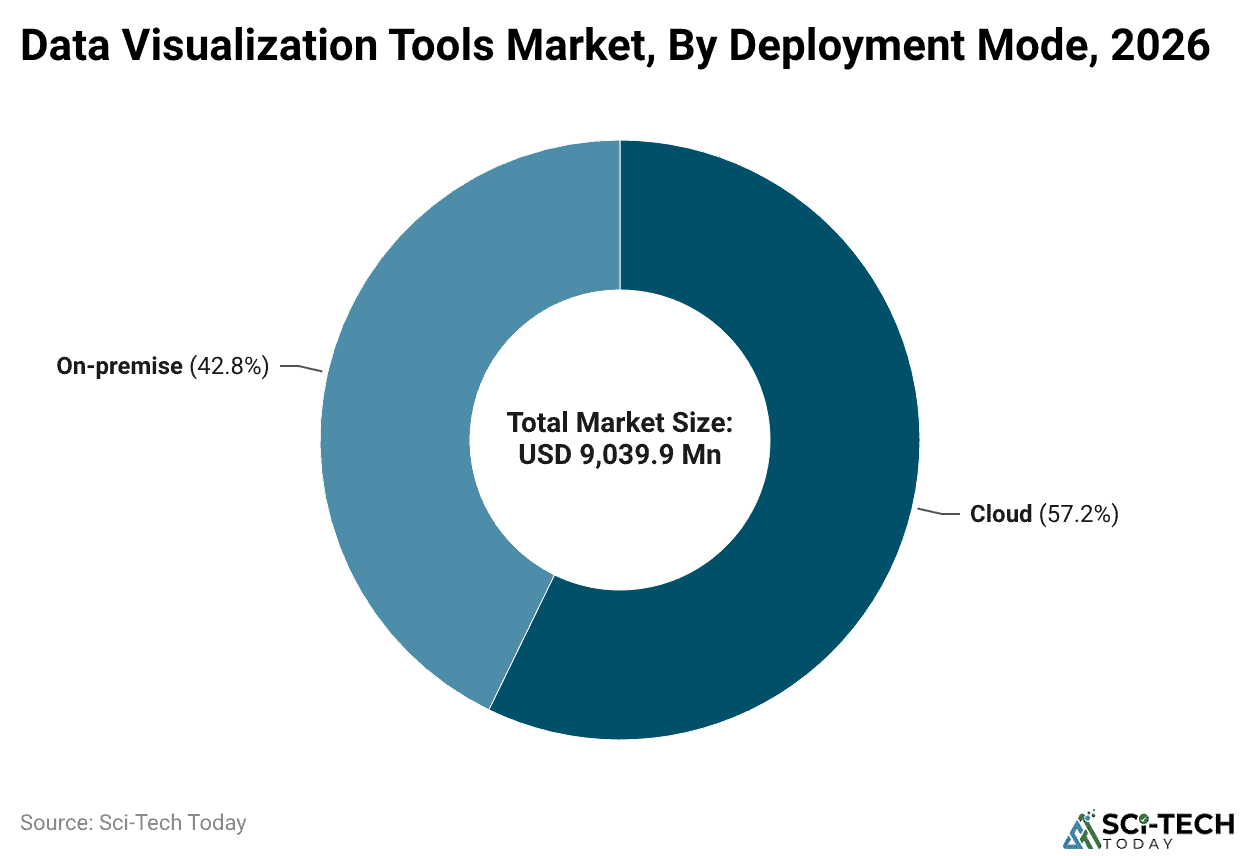
(Reference: coherentmarketinsights.com)
- The global data visualization tools market looks like it is going into a high-growth period, mostly because more companies want business intelligence and cloud analytics- you know that kind of demand that just keeps rising.
- By 2026, it is projected to land at USD 9.04 billion (USD 9,039.9 million) and then by 2033 to reach USD 23.76 billion (USD 23,755.2 million). That implies a healthy compound annual growth rate (CAGR) of 14.8% from 2026 to 2033.
- When it comes to deployment, cloud-based solutions are expected to take 57.2% of the global market in 2026, which makes sense because companies keep leaning toward scalable, flexible, and cost-efficient analytics platforms.
- On the regional side, North America should hold 39.6% of the market share in 2026, staying on top thanks to solid enterprise uptake and stronger digital infrastructure overall.
- Meanwhile, IT and telecommunications are expected to stay as the biggest industry users of these data visualization tools.
The Explosive Growth Of Digital Data Is Driving The Need For Data Visualization
- The digital landscape is creating data at this really unprecedented speed, so data visualization has become more important than ever because it helps turn huge datasets into something usable, you know, like real business insights.
- DemandSage says Google handles 99,000+ searches each second, which comes out to roughly 8.5 billion searches per day, and then about 3.12 trillion searches annually, but that’s just one piece.
- On top of that, total internet traffic is already around 1 petabyte per second, so every moment there’s this massive torrent of information moving around global networks.
- Then YouTube Statistics mentions that users upload more than 500 hours of video every minute, which equals 30,000 hours per hour and something like 720,000 hours per day.
- At the same time, Instagram sees about 95 million photos and videos shared daily, while WhatsApp users swap over 100 billion messages, showing how fast user-driven content is climbing.
- Meanwhile, Science Focus reports that Google, Amazon, Microsoft and Facebook collectively store around 1,200 petabytes of data, and Google by itself manages nearly 10 exabytes on its servers.
- Digital information keeps expanding, and businesses that can visualize and interpret large datasets effectively tend to walk away with a clearer competitive edge in data-driven decision-making.
Data Visualization In Marketing Statistics
- Data visualization has basically become one of the main engines in modern marketing, letting companies take huge piles of customer details and campaign metrics and turn them into things you can actually use.
- 94% more views than content that is only text, which points pretty clearly to how much visuals matter for keeping people interested.
- 82% of businesses say video marketing has boosted their website traffic, and 93% of video marketers think video is an essential part of their broader marketing approach.
- For instance, FinancesOnline reports that 36% of marketers use online design or graphic-making tools to generate visual content.
- Other studies mention that when you add charts, graphs, images, and different visuals, content readership can jump by 80%, so the complicated stuff becomes more digestible for audiences.
- With online competition getting tighter, those figures really underline that data visualization can improve how effective content is and how well information sticks after people read it.
The Integration Of AI and Augmented Analytics In Data Visualization
- Organizations are also investing a lot in analytics powers to sharpen the way they deal with customers and how they feel along the journey.
- Based on Contentsquare’s “Defining Digital Experience” survey, 52% of brands have teams that are dedicated to digital analytics and insights, and 44% keep specialized data science teams too.
- Then again, 67% of organizations rely on digital experience strategies to create a shared customer experience vision, while 74% are putting money into digital experiences to help cement long-term customer loyalty.
- On the behavioral analytics side, 42% of brands are already using heatmaps to understand what users do on websites and mobile, and 21% want to adopt behavioral analytics platforms in the next two years.
- Augmented analytics is becoming the new normal for enterprise business intelligence because companies are embedding AI, machine learning, and natural language processing into their analytics environments.
- As IBM says, and Gartner (via Tableau) and SAP also point out, these tools now automate data cleanup, insight surfacing, visualization, and even report creation. That means both technical folks and non-technical users can explore data more quickly and often with higher accuracy.
- Instead of swapping out analysts completely, AI is pushing decision-making ahead by cutting down manual workload and widening who can reach advanced analytics across entire organizations.
- Microsoft points out that Power BI Copilot lets people create dashboards, reports, DAX calculations, and narrative summaries just from simple text prompts, instead of doing all the manual coding by hand.
- Tableau AI, Tableau Pulse, Qlik, SAP Analytics Cloud, and ThoughtSpot are pushing AI- based recommendations, automated visualizations, and natural language queries right inside existing business intelligence workflows.
- Trigyn Technologies also notes that these options can help automate anomaly detection, pattern recognition, visualization recommendations, and plain-language explanations, which makes analytics feel more approachable for a wider set of workers.
- The investment pattern seems to confirm that augmented analytics is becoming a true enterprise core, not some extra optional add-on.
- IBM, SAP, and Tableau argue that AI-powered analytics can democratize forecasting, segmentation, driver analysis, and predictive insights because business users can do what used to require specialized data science teams.
- Meanwhile, Microsoft keeps expanding Copilot, and Tableau keeps moving with an AI-first strategy, and together, that shows how big BI vendors are folding generative AI into basically every stage of the analytics lifecycle.
- The future of data visualization is more and more about AI-assisted conversations, automated insights, and intelligent decision support that helps organizations turn complicated data into quicker, smarter business moves.
Key Barriers To Adoption – The Data Literacy Gap
- Even with the fast, somewhat dazzling progress in AI-driven analytics and data visualization, organizations still keep running into big human and organizational friction.
- As DataCamp (2026) says, about 60% of business leaders admit there’s a data skills gap, and 88% also agree that data literacy matters for everyday work, not just theory or special projects.
- Gartner, mentioned by Kirey Group (2026), takes it a step further and points out that weak data literacy is the second biggest obstacle for successful data and analytics efforts, which kind of suggests that technology alone will not translate into business value unless the users are properly skilled.
- The U.S. Bureau of Labor Statistics projects that employment for data scientists will rise 34% from 2024 to 2034, and that there will be roughly 23,400 job openings each year, so demand is still moving faster than the talent pipeline can handle.
- 365 Data Science (2024–2026) observes that employers increasingly want one person to cover analytics, machine learning, cloud infrastructure, data engineering, and architecture altogether, like a stitched-together role.
- Stitch’s State of Data Science basically reinforces the mismatch, estimating that only about 11,400 professionals worldwide actually match its criteria for data scientists.
- Meanwhile, the World Economic Forum keeps listing big data and AI among the fastest-growing job areas up through 2030.
- RudderStack and Tealium point out that when data sits in disconnected silos, it turns into inconsistent measurements, conflicting summaries, and, honestly, kind of shaky dashboards, so teams end up leaning on manual spreadsheets instead of trusted, real insights.
- The digital information keeps exploding, with industry estimates saying global digital data is around 4.4 zettabytes, or 4.4 trillion gigabytes.
- Meanwhile, Gartner and Kirey Group mention that organizations put only about 2–5% of payroll toward employee training and skills growth, which is way under what’s required if the goal is a truly data-driven culture.
- The win in AI-powered visualization probably won’t come mainly from “getting smarter tools”; it’ll depend much more on data literacy, shrinking the talent gap, stitching together enterprise data, and putting real effort into workforce readiness.
Conclusion
Data visualization has sort of become a strategic pillar inside modern business intelligence, helping companies turn fast-growing data volumes into usable actions, somehow. The blend of cloud computing, artificial intelligence, augmented analytics, and interactive dashboards is changing how businesses decide things, improve customer journeys, and tighten up the day-to-day operations.
Even if tech adoption is still speeding up, the whole industry has a real snag: closing the data literacy and analytics skills gap. Companies that put money into advanced visualization platforms and also into workforce capabilities are the ones that will likely unlock the most value from their own data. In the AI era, effective data visualization is not something you can easily skip anymore; it’s a true competitive advantage.
FAQ
The global market is projected to reach USD 23.76 billion by 2033, growing at a 14.8% CAGR.
It helps organizations convert complex datasets into actionable insights, which improves decision-making, operational efficiency, and overall business performance.
North America is expected to lead with 39.6% of the global market share in 2026.
The primary challenge is the data literacy gap, with 60% of business leaders saying employees have insufficient data skills.
AI helps by automating data preparation, dashboard creation, anomaly detection, predictive analytics, and natural-language insights, so advanced analytics can be faster and more accessible.