









Preamble
Neural Network Statistics: Neural networks are changing the way computers learn, think, and solve problems. They are a powerful part of artificial intelligence that can learn from large amounts of data and spot patterns with impressive accuracy. From voice assistants and face recognition to self-driving cars and generative AI, neural networks are already part of everyday technology. As AI adoption grows, these systems are helping businesses automate tasks, improve decisions, and create smarter products and services. But how do neural networks actually work?
This article explains their basic concepts, major types, real-world applications, benefits, challenges, and future potential in simple terms.
Highly Recommended
- The global neural-network software market is projected to reach USD 45.63 billion in 2026.
- The market could reach USD 177.55 billion by 2031, growing at a 31.25% CAGR.
- BFSI accounted for 23.05% of neural-network software revenue in 2025.
- Global AI spending is projected at USD 2.59 trillion in 2026, up 47% YoY.
- AI infrastructure spending is expected to reach USD 497 billion in 2026.
- U.S. private AI investment reached USD 285.9 billion in 2025, representing 23.1 times China’s investment.
- AI in healthcare is valued at USD 50.7 billion in 2026, with a 38.9% CAGR.
- MLPerf Training v6.0 recorded 95 systems, using 13 accelerators and 19 processors.
- DeepSeek V3 contains 671 billion parameters, with 37 billion activated per token.
- MLPerf Tiny achieved 22.2 µJ per inference, highlighting the efficiency of edge neural networks.
- The artificial neural network’s performance improved as the number of hidden-layer neurons increased from 2 to 20.
Key Market Indicators of Neural Networks
- According to lightcast.io, AI skills appeared in 2.5% of U.S. job postings, increasing 55% year over year and nearly 300% over the past decade.
- Agentic-AI skills rose from 0.06% in 2024 to 0.23% in 2025, a growth of over 280%, and reached nearly 90,000 job postings.
- A report published by Stanford Study reported that the United States’ private AI investment reached USD 285.9 billion in 2025, more than 23 times China’s investment.
- New neural networks can contain 1 trillion parameters while activating only 32 billion parameters per token, improving computing efficiency.
Artificial Neural Network Market Size
- Coherent Market Insights reported that the global artificial neural network market is valued at USD 179.40 billion in 2026.
- It is projected to reach USD 613.40 billion by 2033, growing at a 19.2% CAGR from 2026 to 2033.
Segmental Analysis
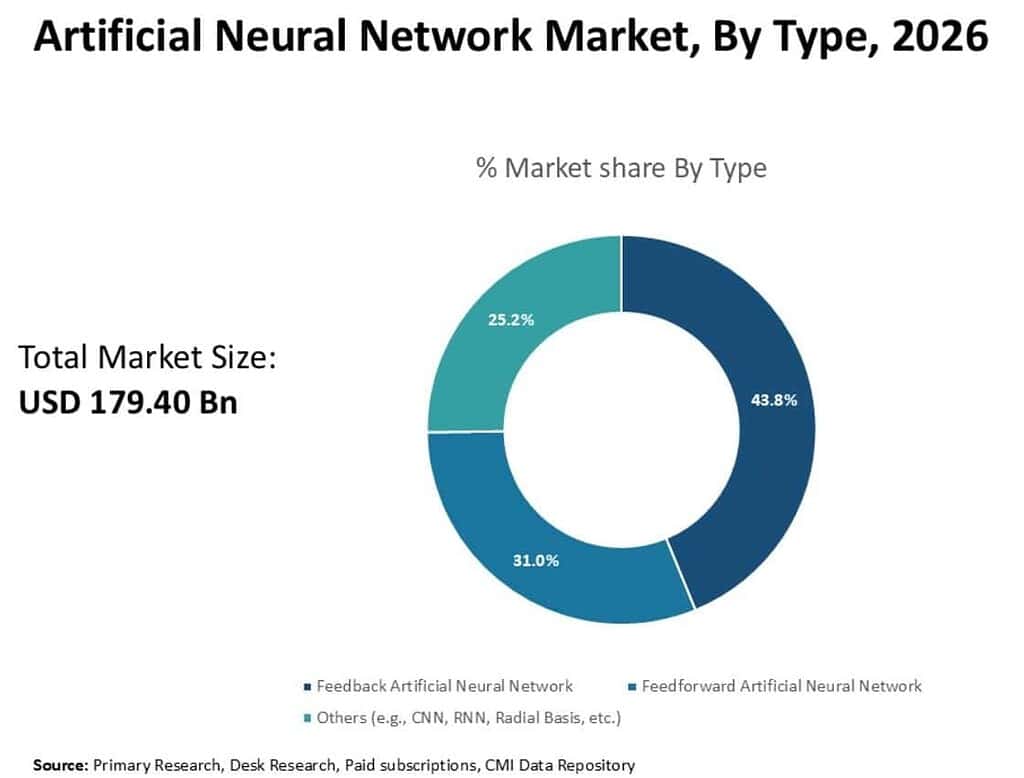
(Source: coherentmarketinsights.com)
- As of 2026, Feedforward artificial neural networks lead with a 43.8% market share among all types.
- Feedback networks account for 31.0%, while others, such as CNNs and RNNs, account for 25.2%.
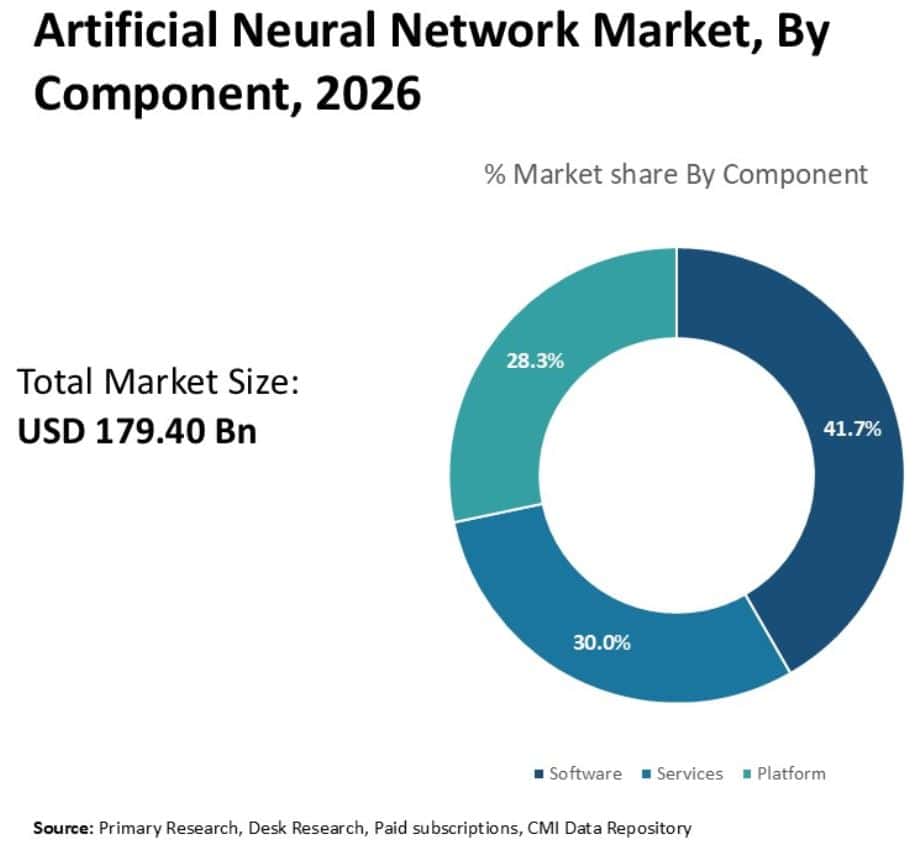
(Source: coherentmarketinsights.com)
- Software leads the component segment with a 41.7% market share, making it the top contributor.
- Services account for 30%, while the platform accounts for the remaining 28.3%.
- The clinical diagnosis and prognostics segment holds the largest application share at 34.8% in 2026.
- North America dominates the market with a 39.3% share, while Asia Pacific is growing the fastest and holds a 26.7% share.
Neural Network Investment and Market Indicators in 2026
- According to Gartner, global AI spending is USD 2.59 trillion, up 47% YoY, compared with an earlier estimate of USD 2.52 trillion, up 44%.
- AI infrastructure spending reaches USD 497 billion, including USD 89.7 billion in Q1 2026, and may reach USD 1.21 trillion by 2030.
- AI-optimized IaaS spending is USD 42 billion, growing 96%.
- AI platforms and models reach USD 64 billion, up 63.4% from USD 39 billion.
- Neural-network software is valued at USD 45.63 billion and is projected to rise to USD 177.55 billion by 2031, at a 31.25% CAGR.
- ANN estimates vary from USD 287.45 million to about USD 203 billion.
- Generative AI reaches USD 161 billion, while the U.S. AI market reaches USD 234.62 billion.
- AI data centers reach USD 142.50 billion, and agentic AI reaches USD 19.33 billion.
- Deep learning reaches USD 8.2 billion, while AI-driven economic value could reach USD 22.5 trillion by 2031.
Neural Network Adoption Trends
- According to StatCan, 2.3% of Canadian businesses reported using neural networks in the previous 12 months, compared with 2.5% in Q2 2025.
- Among businesses, deep learning adoption stood at 13.1%, while 24.8% used large language models, indicating broader adoption of advanced AI capabilities.
- AI-powered speech recognition reached 20.6% usage, whereas image or pattern-recognition technologies were used by 14.0% of businesses.
By Business Age
- Businesses operating for 3-10 years reported the highest neural-network use, at 4.2%, in Q2 2026.
- Neural-network adoption stood at 2.4% among businesses aged 11-20 years, while businesses operating for 2 years or less and those operating for more than 20 years reported 0.3% and 0.4%, respectively.
By Age Group
| AI Chatbot Used | All U.S. adults | 18-29 | 30-49 | 50-64 | 65+ |
| ChatGPT | 44% | 61% | 55% | 37% | 17% |
| Google Gemini | 24% | 30% | 34% | 20% | 10% |
| Microsoft Copilot | 17% | 17% | 22% | 19% | 8% |
| Meta AI | 14% | 14% | 17% | 13% | 5% |
| Grok | 8% | 9% | 10% | 7% | 3% |
| Claude | 6% | 10% | 9% | 4% | 1% |
| Character.AI | 3% | 7% | 3% | 1% | 0% |
Key AI and Deep-Learning Market Trends
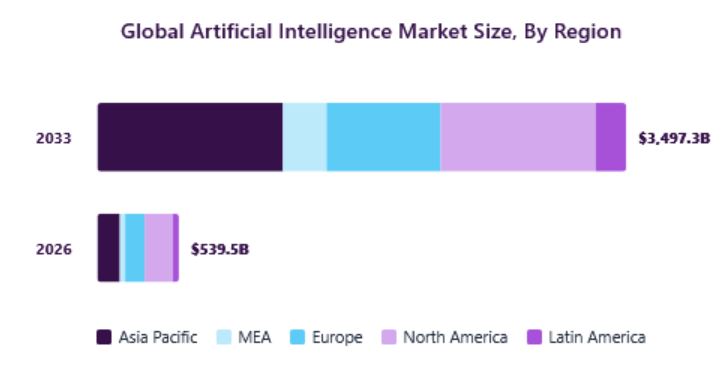
(Source: grandviewresearch.com)
- The global AI market is projected to reach USD 539.5 billion in 2026, up from USD 390.9 billion in 2025.
- According to IDC, AI infrastructure spending is expected to reach USD 497 billion, growing about 56% year over year.
- AI infrastructure spending reached nearly USD 90 billion in Q1 2026 and is projected to reach USD 1.08 trillion by 2029 and USD 1.21 trillion by 2030
Investment and Model Scaling
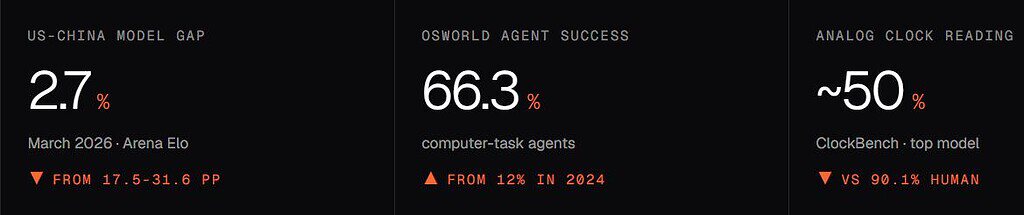
(Source: digitalapplied.com)
- Global corporate AI investment reached USD 581.7 billion in 2025, while private AI investment totaled USD 344.7 billion, up 127.5% year-over-year.
- The United States private AI investment reached USD 285.9 billion in 2025, 23.1 times China’s USD 12.4 billion, underscoring strong U.S. AI investment.
- According to c3.unu.edu, more than 90% of notable AI models in 2025 came from industry, while frontier-model training compute has grown 4 to 5 times annually and language-model compute about 5× annually since 2020.
Enterprise Adoption and Energy
- According to Masterofcode, about 40% of enterprise applications are expected to include task-specific AI agents by the end of 2026.
- A report published by aibusinessweekly.net shows that 88% of organizations use AI and 72% use generative AI.
- AI-focused data-center electricity use grew 50% in 2025, compared with 17% overall data-center growth; electricity demand is forecast to rise from 485 TWh in 2025 to 950 TWh in 2030.
(Source: mordorintelligence.com)
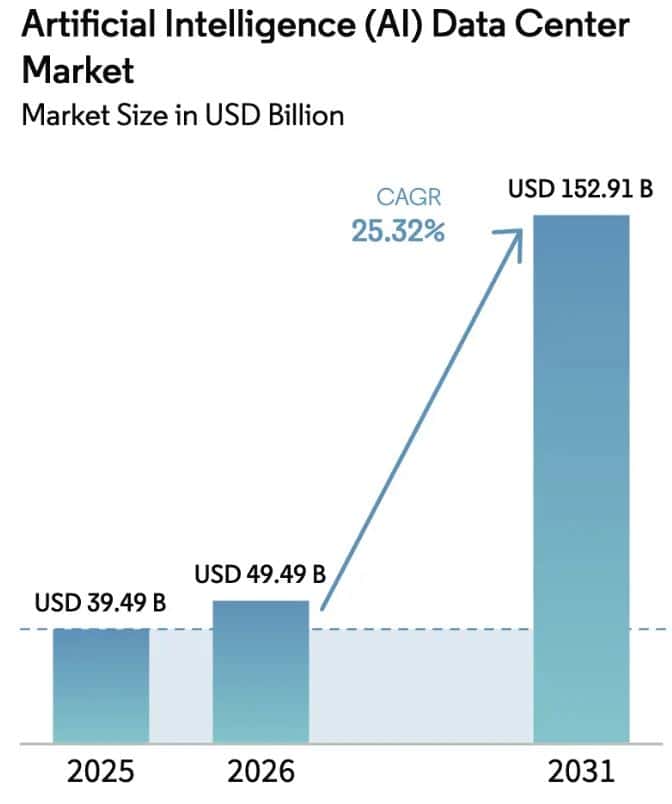
- AI data center market estimates vary significantly, ranging from USD 49.49 billion in 2026 to USD 179.34 billion.
Key Neural Network Applications by Industry
- Neural networks support fraud detection, credit scoring, risk analysis, and customer-service NLP. BFSI accounted for 23.05% of neural-network software revenue in 2025, according to a report from Mordor Intelligence.
- Neural-network manufacturing is forecast to grow at a 33.4% CAGR from 2025 to 2031.
- Grand View Research stated that AI in healthcare is valued at USD 50.7 billion in 2026, with a 38.9% CAGR, and supports imaging, diagnosis, and patient risk prediction.
- Healthcare generative AI is worth USD 3.8 billion in 2026 and is projected to grow at a 33.3% CAGR.
- Fortune Business Insights reported that AI in manufacturing is projected to reach USD 9.85 billion in 2026, growing at a 37.9% CAGR.
- The smart manufacturing market will reach USD 446.45 billion in 2026.
- IT and telecom sector accounts for 27.14% of the generative AI market in 2026.
- Automotive AI applications are forecast to grow at a 33.2% CAGR from 2026 to 2033, driven by ADAS and autonomous driving.
- Machine learning in retail is valued at USD 2.95 billion in 2026 and could reach USD 4.99 billion by 2035, growing at a 5.9% CAGR.
- According to Roots Analysis, the deep learning in drug discovery segment of the pharmaceutical sector is projected to reach USD 8.2 billion in 2026, growing at a 17.3% CAGR.
- R&D AI could create about USD 500 billion annually, with biopharma and automotive accounting for 27% and 29% of the related R&D value creation, respectively, as per Neural Concept.
Neural Network Performance Statistics in 2026
(Source: mlcommons.org)
- MLPerf Inference v6.0 included 24 organizations, indicating broad adoption of standardized neural network performance testing.
- Multi-node inference submissions increased by 30% from v5.1, while 10% of systems used more than 10 nodes, up from 2%.
- The largest inference system used 72 nodes and 288 accelerators, highlighting the growth of distributed AI infrastructure.
- 5 of 11 datacenter tests were new or updated to cover modern AI workloads.
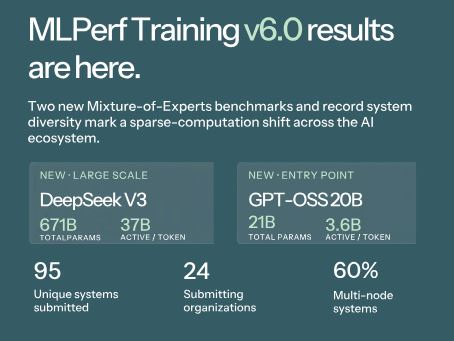
- MLPerf Training v6.0 recorded 95 systems using 13 accelerators and 19 host processors.
- 60% of training systems were multi-node, while cloud submissions more than doubled from v5.1.
- DeepSeek V3 used 671 billion parameters, with 37 billion activated per token.
- GPT-OSS 20B used 21 billion parameters, with 3.6 billion activated per token.
- MLPerf Tiny v1.4 included 9 organizations and 25 configurations, with 5 first-time submitters.
- TinyML models typically contain fewer than 2 million weights and operate within kilobytes of memory.
- Edge results reached 22.2 µJ per inference, while some workloads achieved latency below 0.30 ms.
- STM32U3 reduced inference time by 76.0% and power by 23.3%, while STM32H7P improved inference time by 96.0%.
- University of Leeds achieved 1,849.7 inferences/second at 313 MHz.
By Hidden-Layer Neurons
(Source: researchgate.net)
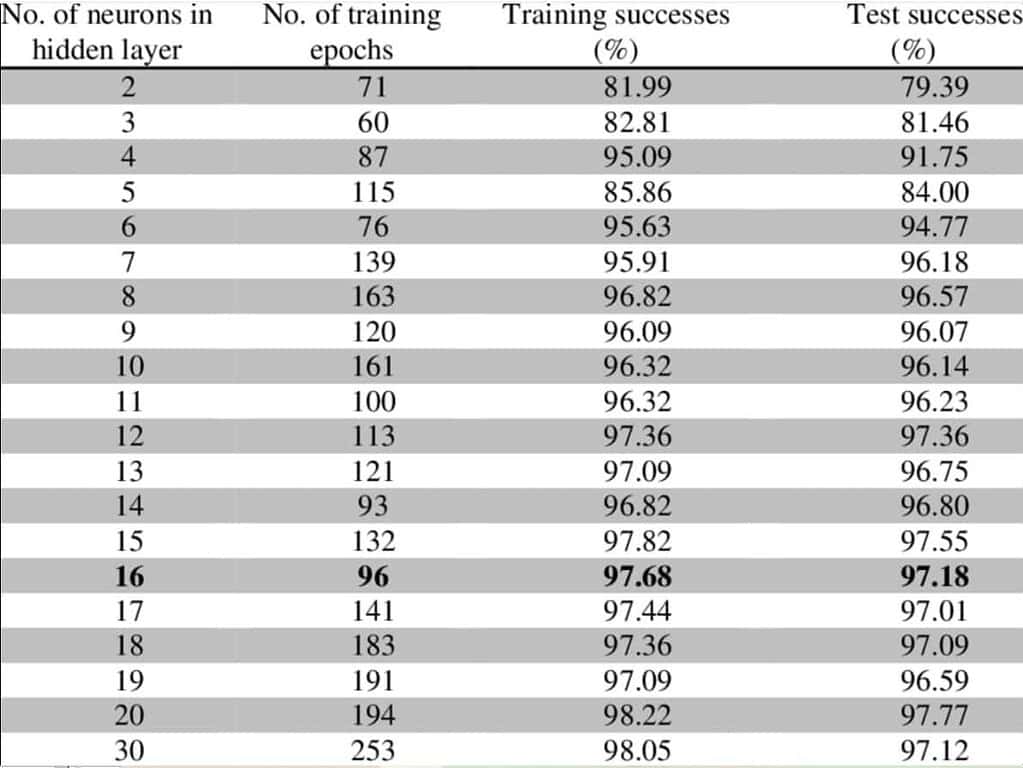
- The artificial neural network’s performance improved as the number of hidden-layer neurons increased from 2 to 20.
- With 2 neurons, the model required 71 training epochs and achieved 81.99% training success and 79.39% test success.
- Test success increased to 91.75% with 4 neurons and 94.77% with 6 neurons.
- The network achieved more than 96% test success when the hidden layer had 7 or more neurons, with only minor variations across configurations.
- The best overall configuration used 16 hidden-layer neurons and required 96 training epochs. It recorded a training success of 97.68% and the highest test success of 97.18%.
- The configuration with 20 neurons required the most training epochs (194) and achieved 98.22% training success and 97.77% test success.
- Using 30 neurons required 253 epochs, with 98.05% training success and 97.12% test success.
Neural Network Software Market Growth
(Source: mordorintelligence.com)
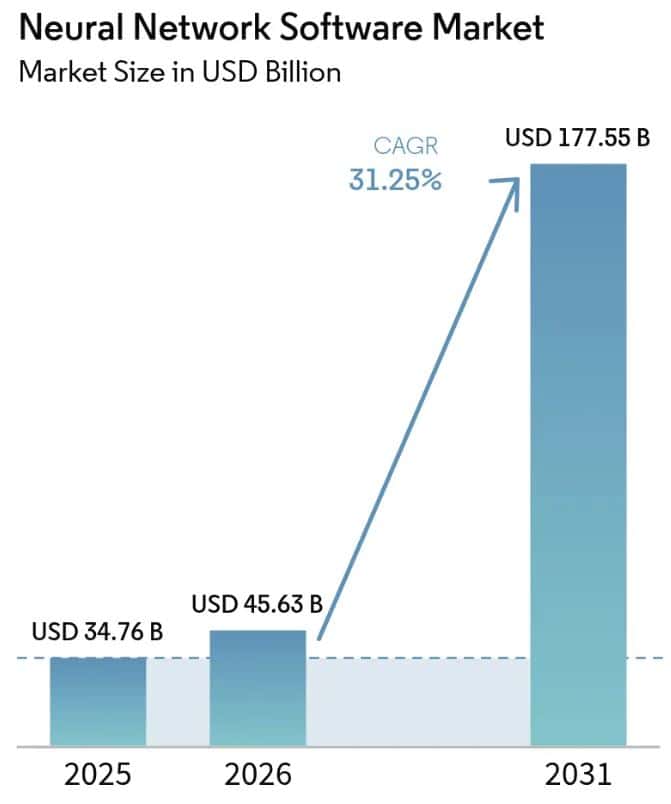
- The global neural network software market was valued at USD 34.76 billion in 2025 and is projected to reach USD 45.63 billion in 2026.
- By 2031, the market is expected to grow to USD 177.55 billion.
- The market is anticipated to expand at a compound annual growth rate of 31.25% between 2026 and 2031.
Wrap-Up
Neural networks are changing how computers learn and solve problems using data. They help power many AI applications, from image recognition and healthcare to finance, robotics, and automation. As technology improves, neural networks will become faster, smarter, and more useful across industries.
However, challenges such as high costs, data quality, privacy, and complex decision-making still need attention. Overall, neural networks will remain an important part of AI and future digital innovation.
FAQ
The main types include feedforward, convolutional, recurrent, and transformer neural networks.
Neural networks are used in healthcare, finance, robotics, image recognition, speech processing, cybersecurity, and automation.
Neural networks process complex data, recognize patterns, automate tasks, and improve predictions across many industries.

Sources