









Opening
Taxi Apps Statistics: Taxi apps have changed how people move around cities. With one phone app, riders can book a ride, see the price and route, track the driver, and pay online, which has largely replaced waving down a cab or calling a booking office. Many apps now also offer shared rides, scheduled trips, delivery, and links to public transport. Uber alone recorded 3.9 billion trips in Q2 2026, and it had 208 million monthly active platform consumers.
One useful insight is where growth comes from. Uber’s monthly users grew 16% year on year, while monthly trips per user grew only 2%, so growth is coming mainly from new riders rather than from people riding more. At the same time, the industry faces strict rules, safety concerns, and pressure for fair driver pay. Companies are responding with smarter pricing, faster driver matching, and electric cars, while testing self-driving vehicles. In the end, apps that are convenient, safe, and trusted will do best.
Key Choices by the Editor
- Global ride-hailing revenue is expected to reach about USD 188.6 billion in 2026 and about USD 230.0 billion by 2030, growing at a 5.08% CAGR.
- China is projected to lead ride-hailing revenue worldwide with about USD 65.5 billion in 2026.
- Ride-hailing user penetration is projected to rise from 24.6% in 2026 to 28.7% by 2030.
- Uber generated approximately USD 27.39 billion in first-half 2026 revenue, with Q2 at USD 14.19 billion, up about 12% year over year.
- Across 30 markets, 74% of 7,923 respondents aged 18–29 used a ride-hailing app.
- In the UK, 49% of surveyed consumers used ride-hailing services, and 37% of heavy users concentrated their trips in the morning for commuting.
- Waymo served over 14 million trips in 2025, passed 20 million lifetime rides, and targets 1 million weekly rides by the end of 2026.
- A basic taxi app MVP is estimated to cost USD 30,000–60,000 and take 3–5 months to build, according to Creole Studios.
Recent Taxi Apps Stats
- On September 30, 2026, Lyft launched European app access in 2 cities, Barcelona and Hamburg, with wider rollout planned throughout October.
- In September 2026, Bolt partnered with Lucid, targeting at least 25,000 Level 4 robotaxis toward its broader 100,000-vehicle ambition for 2035.
- In September 2026, Grab announced a 10-to-50-vehicle expansion within 6 months, reporting over 110,000 autonomous kilometres, over 12,000 riders, and 99% recommendation.
- On September 3, 2026, Uber launched supervised Wayve rides in London, reporting over 140,000 opt-ins, 64-language screens, and expansion plans covering 12 markets.
- By July 25, 2026, India’s Bharat Taxi reported nearly 800,000 registered drivers and around 4.1 million customers, operating a 0% commission model.
- In April 2026, Lyft agreed to acquire Gett UK, covering 75% of London’s registered black-cab drivers; over 50% of Gett-registered cabs were zero-emission-capable.
- In March 2026, Uber announced a milestone-dependent investment of up to USD 1.25 billion in Rivian, targeting up to 50,000 robotaxis across 25 cities.
- In January 2026, Grab partnered with GAC to introduce an initial 20,000 electric vehicles across 6 Southeast Asian countries, covering 3 vehicle models.
- Lyft’s July 2025 Freenow acquisition added 9 countries and over 180 cities; the finalized purchase consideration reached USD 236.8 million in 2026.
Global Taxi Aggregator Apps Market Outlook
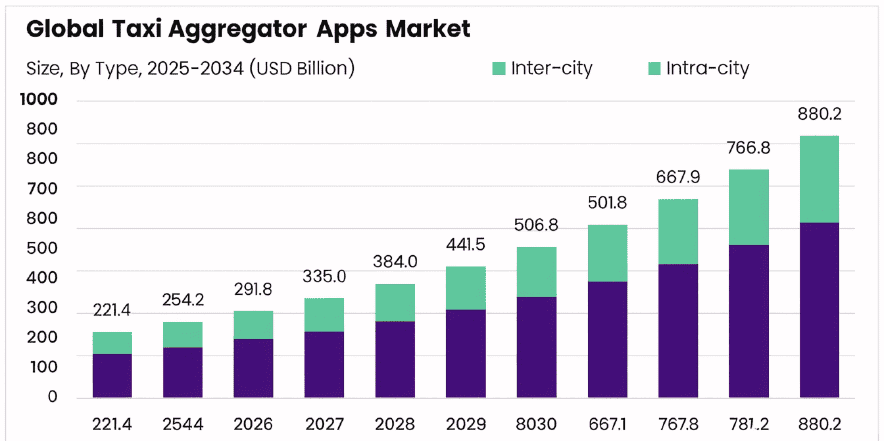
- The global taxi aggregator apps market, covering inter-city and intra-city services, was valued at USD 221.4 billion in 2024 and is projected to reach USD 254.2 billion in 2025, USD 291.8 billion in 2026, and USD 335.0 billion in 2027.
- The market is expected to grow steadily to USD 384.5 billion in 2028, USD 441.5 billion in 2029, USD 506.8 billion in 2030, and USD 581.8 billion in 2031.
- The market is forecast to reach USD 667.9 billion in 2032, USD 766.8 billion in 2033, and USD 880.2 billion in 2034, reflecting a compound annual growth rate (CAGR) of 14.8% during 2025–2034.
Global Ride-Hailing Market Revenue
- The ride-hailing market is expected to grow substantially worldwide, driven by rising demand and expanding user adoption.
- Revenue in this market is projected to reach USD 188,595,987,709.73 by 2026.
- The market is expected to grow at an annual growth rate (CAGR) of 5.08% between 2026 and 2030, reaching a projected market value of USD 229,978,303,357.75 by 2030.
- The number of ride-hailing users worldwide is expected to see a significant increase, reaching 2,335,432,235.53 users by 2030.
- The user penetration rate is projected to be 24.6% in 2026, rising to 28.7% by 2030.
- The average revenue per user (ARPU) is estimated to be around USD 96.95.
- The ride-hailing market operates primarily as an online-only service.
- China is expected to generate the most revenue in the ride-hailing market, with a projected revenue of USD 65,521,973,175 in 2026, making it the leading country globally.
- In the United States, ride-hailing companies have faced increased scrutiny and regulation from local governments, leading to market consolidation and higher prices.
UK Ride-Hailing Users Insights
- Ride-hailing usage reached 49% among surveyed UK consumers, according to TGM Research’s United Kingdom Ride-Hailing Insights 2026 report, released in March 2026.
- Among heavy ride-hailing users, 37% concentrated their usage in the morning for commuting, while overall demand was strongest during daytime and afternoon periods.
- The UK survey included 489 respondents, covering the age groups 18–29, 30–44, 45–54, 55–65, and 66–75, with the sample reflecting the British adult population’s age and gender distribution.
Taxi Apps Market Leaders by Revenue
| Company | Q1 2026 revenue | Q2 2026 revenue | First-half 2026 revenue |
| Uber | USD 13.203 billion, up approximately 14% year over year. | USD 14.19 billion, up approximately 12% year over year. | Approximately USD 27.39 billion, calculated by adding the reported quarterly figures. |
| DiDi Global | – | CNY 62.522 billion, compared with CNY 56.404 billion in Q2 2025. | – |
| Lyft | USD 1.6505 billion, up 14% year over year. | USD 1.8435 billion, up 16% year over year. | USD 3.4940 billion. |
| CaoCao | – | – | CNY 10.3 billion, up 9.0% year over year, according to its company-issued announcement. |
| Grab | USD 955 million, up 24% year over year. | USD 997 million, up approximately 22% year over year. | USD 1.952 billion, calculated by adding the reported quarterly figures. |
Taxi App Development Cost Breakdown
- Creole Studios estimates that a basic minimum viable product (MVP) costs USD 30,000–60,000 and takes 3–5 months to develop, while a growth-ready taxi platform costs USD 70,000–140,000 and requires 5–8 months.
- A multi-city ride-hailing platform costs an estimated USD 150,000–300,000+ and takes 8–14 months, according to Creole Studios, while AppVerticals estimates USD 180,000–280,000 and 8–12 months for its multi-market platform.
- AppVerticals places full-scale taxi app development at USD 280,000–450,000+, with a delivery period of 12–18 months. These figures are providers’ planning estimates for different project scopes, not fixed industry prices or costs that should be added together.
- In its illustrative MVP budget, Creole Studios allocates USD 4,000 to requirements and product planning, USD 7,000 to user research and interface design, and USD 18,000 to the backend system and administration dashboard.
- The same budget allocates USD 10,000 each to the passenger and driver applications, USD 8,000 to quality assurance and security testing, and USD 3,000 to deployment and release support, bringing the total to USD 60,000.
- Maintenance and cloud infrastructure: Published vendor estimates suggest annual maintenance costs of 15%–20% of the initial development budget, while cloud hosting and infrastructure may cost USD 500–5,000+ monthly, depending on usage and scale.
- Google’s Compute Routes Essentials includes 10,000 free monthly events, followed by USD 5 per 1,000 events in the first paid tier. Twilio Verify lists USD 0.05 per successful verification plus USD 0.0083 per US SMS, with rates varying by destination country.
- Stripe’s standard US domestic card processing fee is 2.9% plus USD 0.30 per successful transaction, while Apple developer membership costs USD 99 annually and Google Play registration costs USD 25 once.
Impact of AI in Taxi Apps Worldwide
- AI-powered dispatch improved Uber’s Q2 2026 performance, with 3.9 billion trips, 208 million users, and 18% trip growth.
- Uber uses data from more than 72 billion trips to improve AI-based pickup locations, routing, arrival estimates, and weather-risk management.
- Uber plans deployment of up to 50,000 fully autonomous robotaxis with Rivian, including an initial 10,000 vehicles.
- Baidu Apollo Go completed over 17 million rides, operated across 22 cities, and surpassed 250,000 weekly autonomous rides.
- Apollo Go logged over 240 million autonomous kilometers, including more than 140 million fully driverless kilometers, strengthening taxi-app automation capabilities.
- Waymo served over 14 million trips during 2025, surpassed 20 million lifetime rides, and targets 1 million weekly rides by the end of 2026.
- Waymo’s safety analysis covered over 270 million autonomous miles through June 2026, equivalent to driving Route 66 over 110,000 times.
- McKinsey reports over 60% of consumers would consider robotaxis, while roughly 50% expect autonomous taxi fares to decline.
Taxi Apps Usage Rate Among Gen Z
| Market | Gen Z usage metric | Numeric finding |
| Global, 30 markets | Ride-hailing app usage among ages 18–29 | 74% of 7,923 respondents aged 18–29 used a ride-hailing app. |
| United States and United Kingdom | Weekly or more ride-hailing use | 16% of Gen Z respondents used ride-hailing services at least weekly. |
| United States and United Kingdom | Weekly private-car use | 66% of Gen Z respondents used a private vehicle weekly or more in 2025, compared with 62% in 2024. |
| India | Bike-taxi or scooter ride-hailing use | 46% of Gen Z respondents used bike or scooter ride-hailing services. |
| India | Overall cab booking | 61% of Indian respondents booked a cab through Uber, Ola, Rapido, or similar platforms during the previous 12 months. |
| Indonesia | Increased ride-hailing usage versus pre-COVID-19 | 37% of Gen Z respondents used online ride-hailing more often than before COVID-19. |
| United Kingdom | Total consumer ride-hailing usage | 49% of consumers used ride-hailing services, while 37% of heavy users concentrated trips in the morning. |
| United States | Historical past-year ride-hailing or taxi usage | 36% of Gen Z adults aged 18–21 used a ride-hailing app, taxi, or both during the previous year. |
Taxi Apps Market Outlook
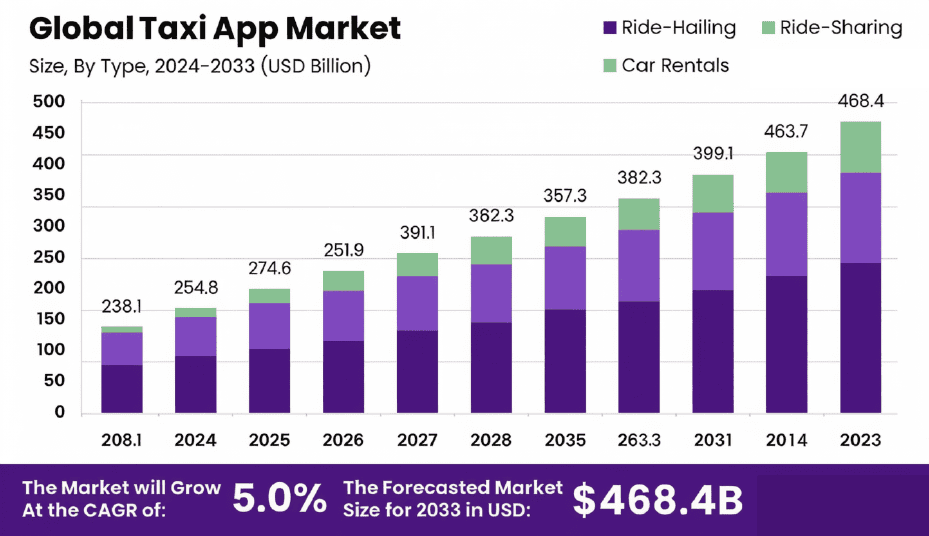
- Market.us projects the global taxi app market will grow at a compound annual rate of 7.0% during 2024–2033.
- The market estimates start at USD 238.1 billion in 2023 and rise to USD 254.8 billion in 2024.
- The forecast reaches USD 272.6 billion in 2025 and USD 291.7 billion in 2026.
- By 2033, the global taxi app market is expected to reach USD 468.4 billion.
- Ride-hailing represents the largest segment throughout the forecast, followed by ride-sharing and car rentals.
Summary
Taxi apps are no longer just a handy way to get a ride. They are becoming a key part of how cities move. The market keeps growing, and many young people use these apps often. Top companies are earning good revenue, while AI, electric cars, and self-driving taxis are changing how rides are matched and delivered.
Rules, safety, and fair pay for drivers are still big questions. The apps that mix new technology with trust and fair prices are most likely to lead.
FAQ
Taxi apps are mobile platforms that connect riders with nearby drivers for on-demand rides. They use GPS, digital payments, and real-time matching to handle booking, pricing, and tracking in one place.
A rider enters a pickup and drop-off location, and the app shows the estimated fare and arrival time. It then matches the rider with a nearby driver, tracks the trip live, and processes payment automatically at the end.
They offer convenience, price transparency, cashless payment, and shorter waiting times. Features like live tracking, ride sharing, and driver ratings also make trips feel safer and more predictable than street hailing.
Most earn a commission on each ride. Other revenue sources include surge or dynamic pricing, subscription plans, advertising, delivery services, and partnerships with businesses and public transport providers.
They give people an alternative to owning a car, support shared and multi-modal travel, and help drivers find flexible work. They also raise issues around congestion, regulation, and the effect on traditional taxi services.
Key challenges include strict and changing regulations, driver pay and working conditions, rider safety, intense competition, and rising operating costs. Keeping prices fair while staying profitable is an ongoing balance.


