









Opening Remarks
AI Everywhere Statistics: AI is quickly becoming part of everyday life. We see it in the apps we use, the content we watch, the products we buy, and the tools we use at work. Businesses are also turning to AI to save time, understand data, improve services, and make better decisions. This growing use of AI is changing the way people interact with technology.
The idea of AI Everywhere goes beyond chatbots and AI assistants. It means bringing AI into the products, services, and systems people already use. As this trend grows, AI is becoming less visible but more useful, quietly working in the background to make everyday tasks faster, smarter, and easier.
Preferred Choice
- The global Artificial Intelligence market is projected to reach USD 617.62 billion in 2026.
- AI software spending could rise from USD 282.8 billion in 2025 to USD 453.2 billion in 2026.
- In Q1 2026, 50% of U.S. employees used AI at work, while 13% used it daily.
- AI use reached 48.9% among U.S. retail companies, while adoption in manufacturing could exceed 50% by 2026.
- AI adoption has reached 88% across organizations.
- ChatGPT has 900 million weekly active users, while 48% of Google searches show an AI Overview.
- Overall, 64% of organizations are actively using AI, while 28% are assessing its potential use.
- North America leads regional AI adoption, with 70% of organizations actively using AI.
- Large companies with more than 1,000 employees lead adoption, with 76% actively using AI.
- 94% of workers understand AI and its role in their jobs.
- 80% of AI and automation users say these tools make work faster and more accurate.
- AI could create 170 million jobs and displace 92 million by 2030.
- Multimodal AI is expanding rapidly, with more than 50% of new AI models expected to combine text, image, and audio data by 2026.
Global Artificial Intelligence Market Size
- Statista reported that the global Artificial Intelligence market is projected to reach USD 617.62 billion in 2026.
- Analysts expect the market to grow at a 14.82% CAGR from 2026 to 2032, reaching USD 1.42 trillion by 2032.
- The United States is expected to lead globally, generating USD 414.89 billion in 2026.
Key Insights
- Based on Thunderbit, Generative AI attracted USD 170.9 billion in private investment in 2025, up 404%.
- Meanwhile, AI software spending could rise from USD 282.8 billion in 2025 to USD 453.2 billion in 2026.
- AI adoption reached 88% of organizations in 2025, while regular generative AI use rose to 65% in 2024, from 33% in 2023.
- AI improved software development productivity by 26%, although one METR study found experienced developers were 19% slower.
- AI could add USD 15.7 trillion to global GDP by 2030, create 170 million jobs, and displace 92 million jobs.
- In Q1 2026, 50% of U.S. employees used AI at work, while 13% used it daily.
- Financial services recorded 85% adoption, compared with 60%-70% in data-rich industries.
- ChatGPT’s weekly users reached 900 million by February 2026.
- Private AI investment reached USD 344.7 billion in 2025, up 127.5%, with the US accounting for USD 285.9 billion.
- Healthcare AI could grow from USD 25.88bn in 2025 to USD 194.79bn by 2031, at a 39.7% CAGR.
- AI use reached 48.9% among U.S. retail companies, while adoption in manufacturing could exceed 50% by 2026.
- AI could potentially reduce global emissions by 3.2-5.4 gigatons of CO2 annually by 2035.
AI Funding and Investment Trends
- Global corporate AI investment reached USD 581.7 billion in 2025, up 130%, while private AI investment rose 127.5% to USD 344.7 billion.
- The U.S. attracted USD 285.9 billion, more than 23 times China’s USD 12.4 billion.
- In Q1 2026, global venture funding hit USD 300 billion across about 6,000 startups.
- AI companies received USD 242 billion (80%), with four companies securing USD 188 billion (63%).
- Generative AI attracted about USD 170.9 billion in 2025, nearly half of private AI investment and up more than 200%.
- France announced a €109 billion AI plan, while Saudi Arabia committed USD 100 billion to AI infrastructure through HUMAIN.
Major AI Funding Rounds and Valuations, Q1 2026
| Company | Funding Round Size | Valuation | Lead Investors |
| OpenAI | USD 122 billion | USD 852 billion post-money | Amazon, Nvidia, SoftBank |
| Anthropic | USD 30 billion (Series G) | USD 380 billion post-money | Coatue, GIC |
| xAI | USD 20 billion (Series E) | – | Andreessen Horowitz |
| Waymo | USD 16 billion (Series D) | USD 126 billion post-money | Dragoneer, DST Global, Sequoia |
Key AI Adoption and Impact Statistics
- According to Unico Connect, AI adoption has reached 88% across organizations.
- However, only 6% are achieving significant business value
- 95% of generative-AI deployments show no measurable P&L impact, while 80%+ of enterprise AI projects fail to deliver value.
- Only 28% of infrastructure and operations AI use cases fully meet ROI expectations, and 23% of organizations are scaling agentic AI systems
- 84% of developers use or plan to use AI coding tools, with 46% of GitHub files built with Copilot assistance.
- ChatGPT has 900 million weekly active users, while 48% of Google searches show an AI Overview.
- Global AI spending is forecast at USD 2.59 trillion in 2026, while AI could create 170 million jobs and eliminate 92 million by 2030.
- Generative AI adoption could reach 53% of the population within 3 years.
AI Adoption Trends by Industry
(Reference: blogs.nvidia.com)
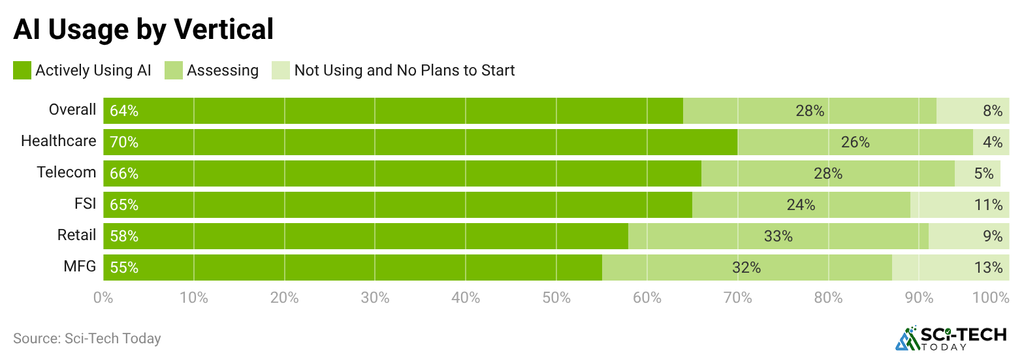
- Overall, 64% of organizations are actively using AI, while 28% are assessing its potential use. Only 8% are not using AI and have no plans to begin.
- Healthcare has the highest AI adoption rate, with 70% of organizations actively using AI. A further 26% are assessing AI, while 4% have no plans to adopt it.
- The telecom sector follows, with 66% actively using AI, 28% assessing AI, and 5% reporting no plans to adopt it.
- Financial services and insurance show 65% active use of AI. Around 24% are assessing AI, while 11% have no plans to start.
- Retail records 58% active AI adoption, with 33% still assessing AI solutions and 9% reporting no plans.
- Manufacturing has the lowest adoption among the listed sectors, although 55% are already using AI. Another 32% are assessing AI, while 13% have no plans to adopt it.
By Region
- According to NVIDIA, North America leads regional AI adoption, with 70% of organizations actively using AI.
- EMEA reports 65% active adoption, followed by APAC at 63%.
- The rest of the world has the lowest active adoption at 57%, but 36% of organizations are assessing AI.
By Company Size
- Large companies with more than 1,000 employees lead adoption, with 76% actively using AI.
- Organizations with fewer than 100 employees report 57% active adoption.
- Meanwhile, companies with 100-1,000 employees report 56%.
AI Workload Adoption by Region
| Region | Data Analytics | Generative AI and LLMs | Agentic AI |
| Overall | 62% | 61% | 44% |
| North America | 66% | 69% | 52% |
| EMEA | 62% | 68% | 44% |
| APAC | 60% | 45% | 32% |
| Rest of the World | 60% | 66% | 52% |
AI in the Workplace and Employee Use
- 94% of workers understand AI and its role in their jobs.
- About 62% believe AI can improve workplace efficiency and productivity.
- More than 63% say AI makes their work more enjoyable and less stressful.
- Around 55% report that AI reduces routine tasks and supports better mental well-being.
- Nearly 48% believe formal AI training would improve their workplace skills.
- However, 52% are hesitant to admit to using AI for important tasks.
(Source: wearetenet.com)
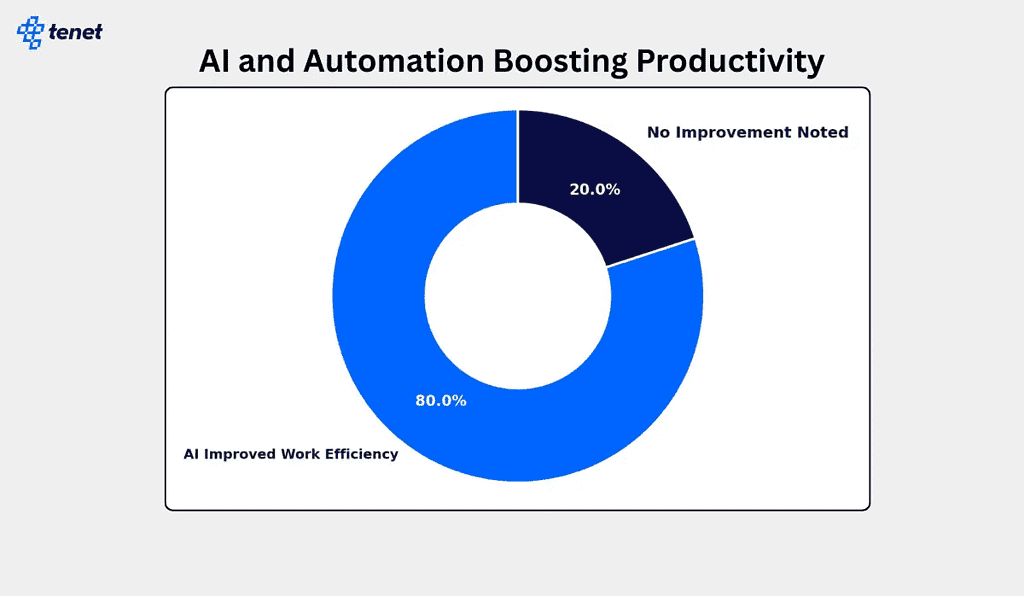
- 80% of AI and automation users say these tools make work faster and more accurate.
- AI helped workers finish tasks 25% faster.
- They also produced 12% more output and achieved results that were 40% higher quality.
- Less-experienced workers saw a 35% improvement in performance after using AI.
AI Impact on Jobs and Workforce
- According to UpMetrics, AI could create 170 million jobs and displace 92 million by 2030.
- Overall, this would add 78 million jobs and affect about 22% of today’s workforce.
- The IMF estimates AI could affect 40% of jobs globally, including 60% in advanced economies and 26% in low-income countries.
- AI specialist roles grew 176% in India and 151% in the UK.
- Productivity gains reached 14%-15% in customer support, 26% in software development, and up to 50% in marketing.
- In 2025, AI was linked to about 55,000 US job cuts out of 1.17 million layoffs
Business Adoption and Leadership Insights on AI
- Around 79% of business leaders say AI adoption is essential to remain competitive.
- About 78% plan to increase AI budgets, while 86% of technical professionals and 59% of C-suite leaders show strong interest in generative AI.
- CEOs oversee AI governance in 28% of organizations, and 29% train at least one-quarter of their workforce in AI.
(Source: wearetenet.com)
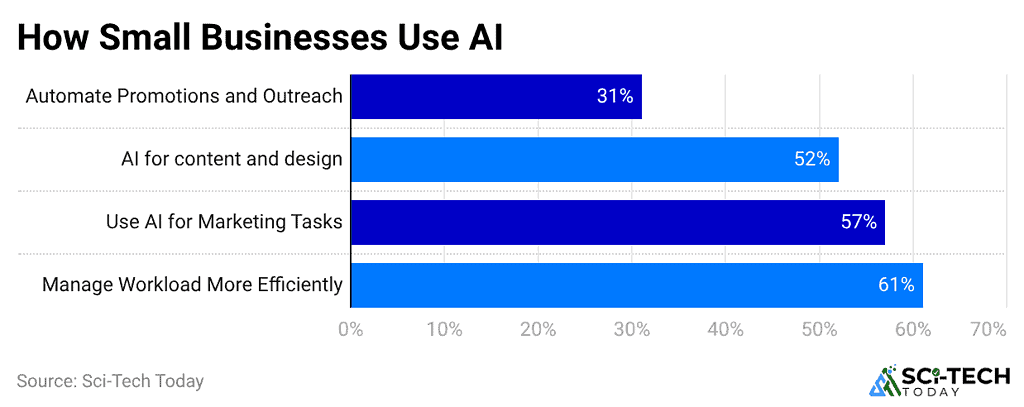
- 57% of small businesses use AI for marketing, and 61% say it helps them save time and manage workloads more efficiently.
- Creative adoption is also growing, with 52% using AI for content and design, and 31% automating promotions and outreach.
- Overall, 44% report higher productivity, while 83% use AI to improve customer experiences.
Leading AI Tools and User Base, Early 2026
| AI Tool | Users and Adoption Metrics |
| ChatGPT | Approximately 900 million weekly active users.More than 50 million paying consumer subscribers; 9 million paying business users. |
| Gemini | 750 million monthly active users. |
| Microsoft Copilot | Almost 33 million standalone active users.15 million paid Microsoft 365 Copilot seats. |
| Claude | 18.9 million monthly active users. |
| Perplexity | Around 100 million users across all products. |
| GitHub Copilot | Approximately 20 million total users.4.7 million paid subscribers.Deployed by 90% of Fortune 100 companies. |
Agentic AI Market and Enterprise Adoption
(Reference: static-web.upmetrics.co)
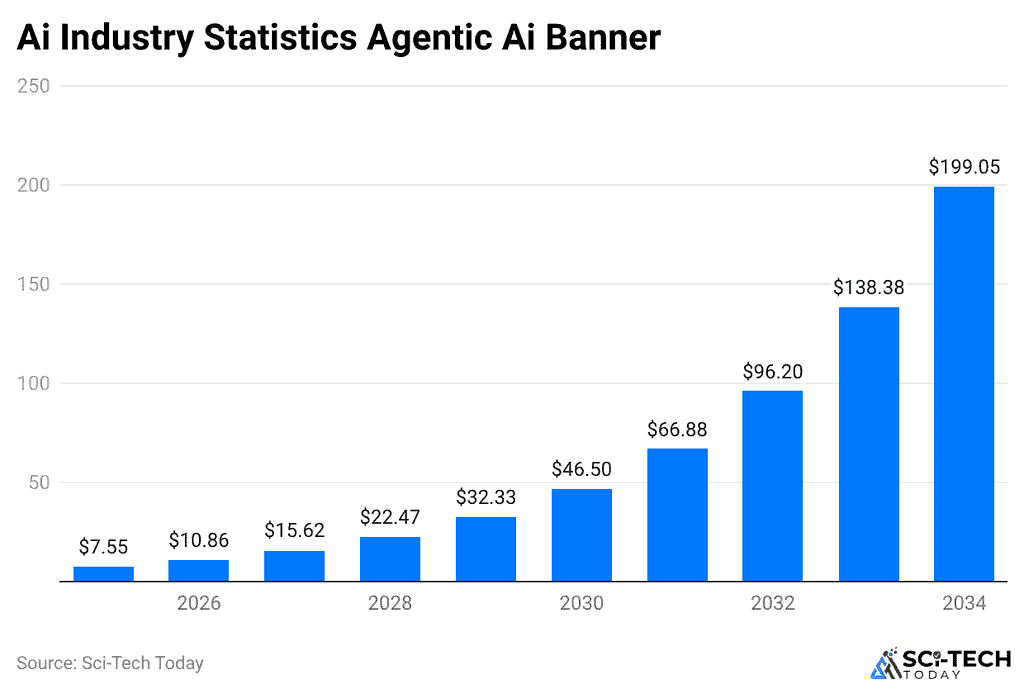
- The global agentic AI market is expected to grow from USD 7.55 billion in 2025 to USD 10.86 billion in 2026.
- By the end of 2026, about 40% of enterprise applications could include task-specific AI agents, up from less than 5% in 2025.
- Around 62% of organizations are experimenting with AI agents, but fewer than 10% have scaled them in any business function.
- Agentic AI is also expected to support global AI spending of USD 1.3tn by 2029, growing at an annual rate of 31.9%.
Consumer AI Adoption Trends
- Microsoft’s data report further stated that global generative AI adoption reached 16.3% in the second half of 2025, up from 15.1% in the first half.
- According to the Pew Research Center, about 50% of U.S. adults used AI chatbots in 2026. That is, roughly 25% use them daily, and 12% use them several times a day.
- 31% of Americans interacted with AI several times daily in 2025, compared with 22% in 2024.
- In 2025, 56% of U.S. adults had used AI tools, while 28% used them weekly.
- Among teens aged 13-17, 64% had used an AI chatbot by fall 2025.
- 21% of U.S. workers used AI for some work in 2025, up from 16% in 2024.
- federalreserve.gov reported that work-related AI adoption reached 41%, compared with 50% for personal use.
- Only 9% used AI chatbots for news, while 75% never did.
- 47% of consumers were likely to use generative AI for purchase research, up 6% year over year.
Consumer Attitudes Toward AI
(Source: wearetenet.com)
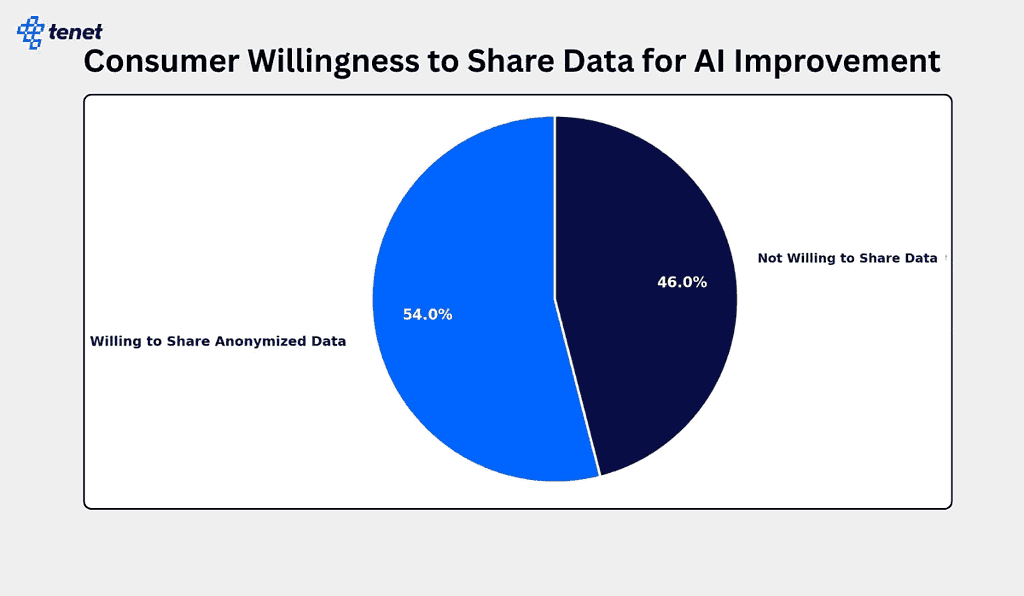
- 54% of respondents are willing to share anonymized data, while 46% are not.
- Only 38% of Americans view AI positively and believe its benefits outweigh its risks.
- Privacy remains a concern, with 52% worried about how AI handles personal information.
- Misinformation is a major issue, as 76% fear AI-generated false or misleading content.
- About 70% of Americans have little or no trust in companies to use AI responsibly.
- 62% also lack confidence in government AI regulation.
- Still, 58% expect AI to personalize customer experiences, while 65% trust it to improve customer service.
- 48% expect AI to simplify complex information, while 65% of AI users are Millennials or Gen Z.
- Among Gen Z, 52% trust AI to support better decisions, and 48% do not.
Emerging AI Technology and Sustainability Trends
(Source: strapi.thunderbit.com)
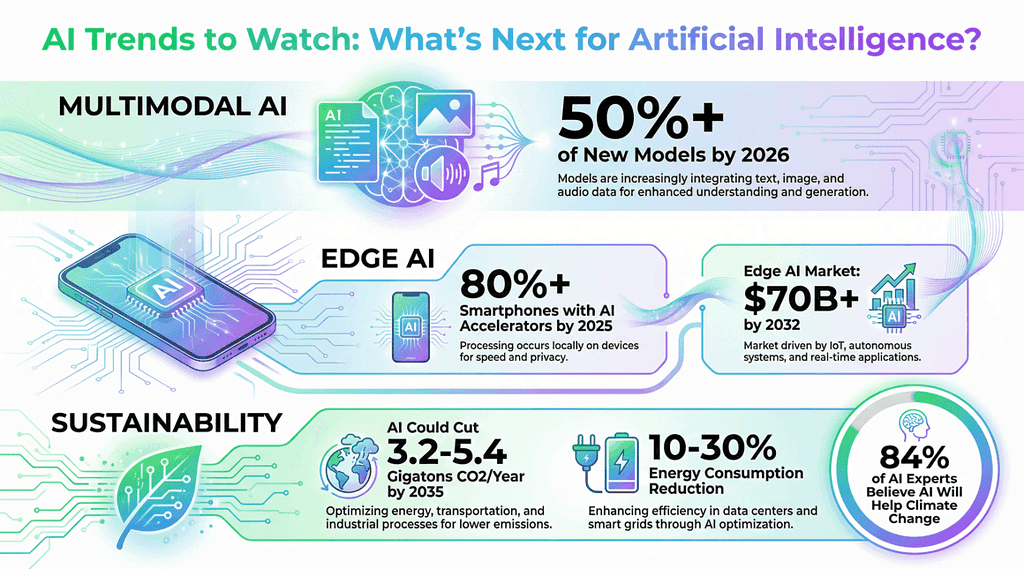
- Multimodal AI is expanding rapidly, with more than 50% of new AI models expected to combine text, image, and audio data by 2026.
- More than 80% of smartphones were expected to feature AI accelerators in 2025. The edge AI market is expected to exceed USD 70 billion by 2032.
- AI can help cut carbon emissions by 3.5-4 gigatons annually by 2035.
- AI-based efficiency solutions could reduce energy consumption by 10%-30%.
- Meanwhile, 84% of AI experts believe AI will help address climate change.
Overall View
AI is quickly becoming part of how we live and work. From healthcare and education to business and entertainment, it is helping people complete tasks faster and find better solutions. This growth will continue as AI tools become more useful and easier to access. At the same time, privacy, security, and responsible use cannot be ignored. The real value of AI will come from using it wisely while keeping people at the heart of every decision.
FAQ
AI helps with recommendations, voice assistants, navigation, smart devices, online shopping, and personalized entertainment.
AI improves business operations by automating tasks, reducing costs, and enabling faster, smarter decisions.
AI may replace some jobs, but humans will remain essential for creativity, judgment, and empathy.

Sources