









Opening statement
Printed Electronics Statistics: Printed electronics is bringing a new approach to electronic manufacturing. Instead of relying solely on traditional production methods, it uses printing technologies to fabricate circuits, sensors, displays, and other components on substrates such as plastic, paper, and fabric. This makes it possible to create electronics that are thinner, lighter, flexible, and often more cost-effective.
In addition, the technology can reduce material waste and make production more efficient. Its applications are expanding across smart packaging, wearables, healthcare, automotive systems, and consumer electronics. As demand for flexible and connected products continues to grow, printed electronics is becoming an important part of the future of manufacturing.
Featured Choice
- The global printed electronics market was valued at USD 18.7 billion in 2025 and is projected to reach USD 21.34 billion by the end of 2026.
- By material, inks account for 57.5% of the market, while substrates make up the remaining 42.5%.
- As of 2026, screen printing leads with a 34% share, followed by inkjet printing at 26%.
- Asia Pacific reached USD 6.11 billion in 2025, accounting for 34.41% of the global market. It is projected to reach USD 7.43 billion in 2026.
- South Korea-based Samsung leads in OLED and flexible displays. It reported KRW 333.606 trillion (USD 234.6 billion) in revenue in 2025.
- The battery-free sensor market is expected to reach USD 80 million in 2026 and grow at a 21.8% CAGR through 2032.
- Inkjet printing offers a throughput of about 100 m²/h and a resolution of 50 μm.
- The U.S. tariffs included a 50% rate on semiconductors in 2025. Besides, the new 2026 Section 301 actions included 12.5% tariffs for certain economies.
- The global 3D-printed electronics market is estimated to be USD 13.95 billion in 2026.
Printed Electronics Market Size
(Source: market.us)
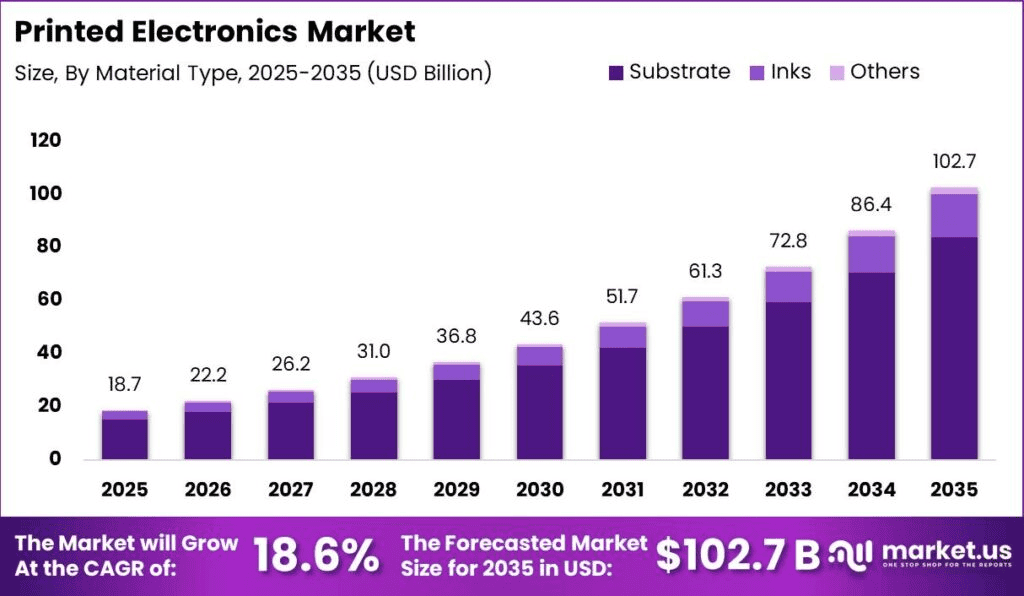
- The global printed electronics market was valued at USD 18.7 billion in 2025. It is projected to reach USD 21.34 billion by the end of 2026.
- The market is expected to grow at an 18.6% CAGR from 2025 to 2035, reaching USD 102.7 billion by 2035.
Market Segment Overview
(Source: coherentmarketinsights.com)
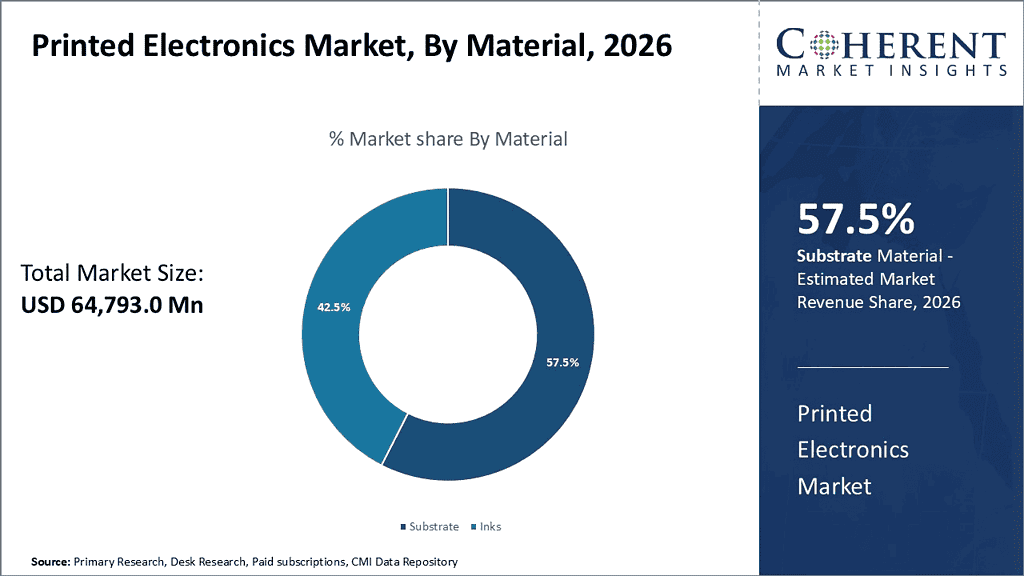
- By material, inks account for 57.5% of the market, while substrates make up the remaining 42.5%.
(Source: coherentmarketinsights.com)
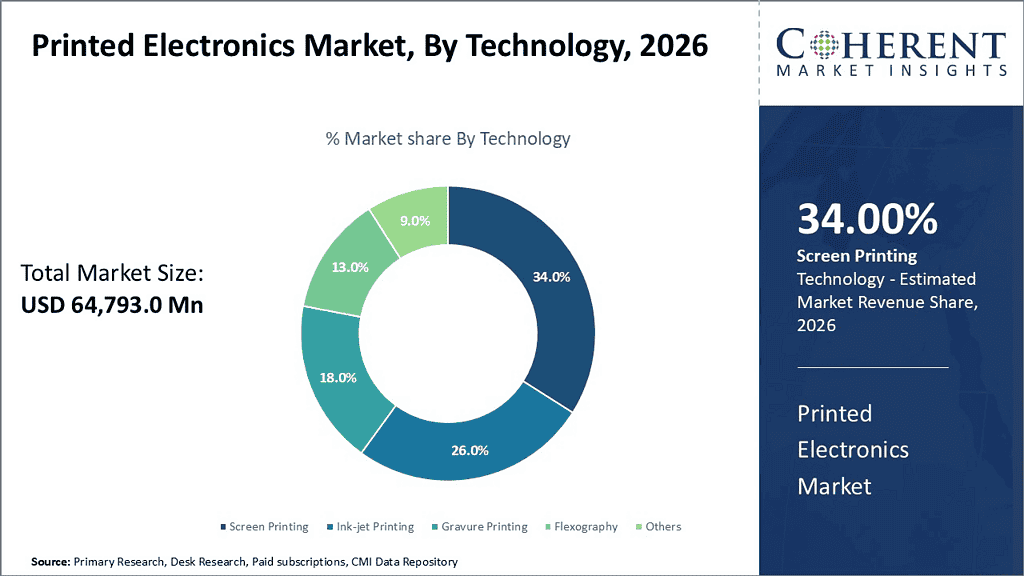
- As of 2026, screen printing leads with a 34% share, followed by inkjet printing at 26%.
- Gravure printing accounts for 18%, flexography for 13%, and other methods for 9%.
- Asia Pacific leads the market with a 41.8% share in 2026, and China holds the second-largest position within the region at 11%.
Printed Electronics Market Regional Analysis: Asia Pacific
- Fortune Business Insights reported that Asia Pacific reached USD 6.11 billion in 2025, accounting for 34.41% of the global market. It is projected to reach USD 7.43 billion in 2026.
- Japan is expected to reach USD 1.6 billion, China USD 2.23 billion, and India USD 1.05 billion by 2026.
- China’s semiconductor industry invested USD 24.73 billion in chip-making equipment during H1 2024.
Europe
- The European market stood at USD 3.98 billion in 2025, with a 22.40% share, and may reach USD 4.79 billion in 2026.
- The UK and Germany markets are forecast to reach USD 1.14 billion and USD 1.26 billion, respectively, by 2026.
North America
- North America generated USD 4.35 billion in 2025, accounting for 24.47% of the global market, and is projected to reach USD 5.17 billion by 2026.
- The U.S. semiconductor investments reached nearly USD 450 billion across 25 states.
- U.S. semiconductor manufacturing capacity is expected to triple by 2032.
- Additionally, the U.S. printed electronics market is on pace to hit USD 3.24 billion in 2026.
Middle East and Africa
- Middle East & Africa accounted for 11.53% of the global printed electronics market in 2025, valued at USD 2.05 billion. It is projected to reach USD 2.43 billion in 2026.
- Saudi Arabia is investing in local semiconductor manufacturing under its Vision 2030 program.
- Taiwan holds 46% of global semiconductor foundry capacity, followed by China, South Korea, the U.S., and Japan.
Latin America
- The Latin American market reached USD 1.28 billion in 2025 and held 7.20% of global revenue.
- Meanwhile, it is estimated to reach USD 1.51 billion by 2026.
Top Printed Electronics Companies
- According to images.samsung.com, South Korea-based Samsung leads in OLED and flexible displays. It reported KRW 333.606 trillion (USD 234.6 billion) in revenue in 2025. Meanwhile, Samsung Display generated KRW 76.710 trillion in 2025, and the overall market valuation was about USD 1.315 trillion in September 2026.
- A report published by LG Display stated that the company focuses on OLED and flexible displays and recorded KRW 26.6 trillion in revenue in 2024. Its Q1 2026 revenue reached KRW 5.534 trillion. Its market valuation is about USD 3.30 billion as of September 2026.
- BASF Report stated that the German materials company generated €59.7 billion in 2025 sales and supplies chemicals, coatings, and functional materials. Its market valuation was about USD 53.16 billion.
- According to investors.dupont.com, DuPont, the U.S. company, reported USD 6.8 billion in net sales in 2025. It also provides conductive pastes, inks, films, and electronic materials. Its market valuation was about USD 17.77 billion.
- E Ink Holding’s report indicated that the Taiwan-based company recorded NTD 36.116 billion in revenue in 2025, up 12.3%. Its market valuation was about USD 5.39 billion.
- Japan-based Nissha generated JPY 194.898 billion in sales in 2025 and develops printed functional materials and touch sensors. Its market valuation was about USD 369 million.
- Agfa-Gevaert, the Belgian company, reported €467 million in revenue in 2025, a 6.5% increase, supported by functional inks and printed-electronics materials. Its market valuation was about USD 75.62 million.
- Canatu, a Finland-based company, generated €15.6 million in revenue in 2025 and develops carbon nanotube components for advanced electronics. Its market valuation was about USD 238 million based on its September 2026 market cap of €203.6 million.
Industrial Applications of Printed Electronics
- Markets and Markets reported that the battery-free sensor market is expected to reach USD 80 million in 2026 and grow at a 21.8% CAGR through 2032.
- The global RFID market reached USD 14.58 billion in 2025 and is projected to be USD 30.47 billion by 2034.
- In Smart packaging, the label-identification market is expected to reach USD 2.04 billion in 2026 and grow at a 7% CAGR through 2031.
(Source: grandviewresearch.com)
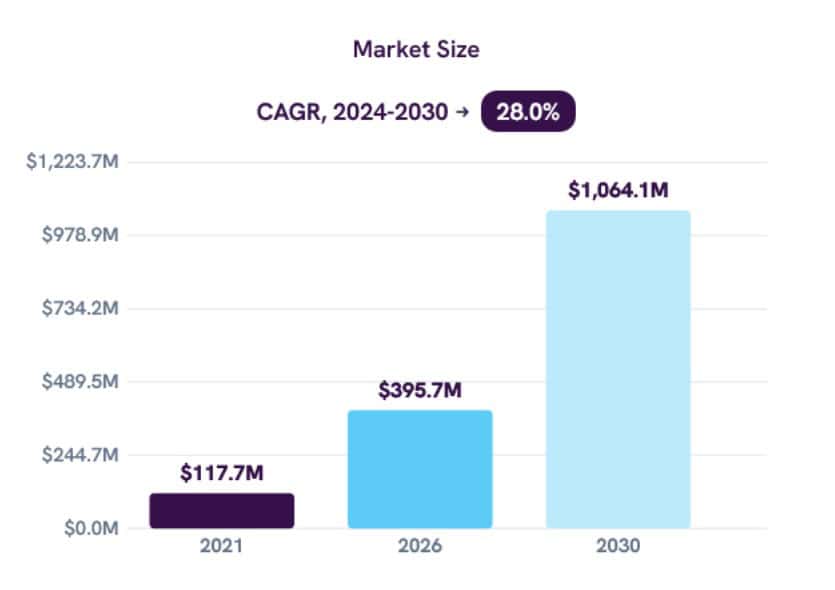
- Printed and thin-film batteries are projected to reach USD 395.7 million in 2026.
- The flexible-electronics market is estimated to reach USD 40.7 billion in 2026, creating opportunities in printed sensors, heating, lighting, and controls.
- According to Idtechex, flexible hybrid electronics could reach about USD 1.8 billion by 2034.
Printing Technologies Used in Printed Electronics
- Printed electronics use simple, cost-effective methods to create thin, flexible electronic layers.
- Inkjet printing offers a throughput of about 100 m²/h and a resolution of 50 μm.
- Screen printing achieves about 50 m²/h with a 100 μm resolution and is well-suited for thick conductive and insulating layers.
- The aerosol jet printing method creates features as small as 10 μm, uses droplets of 1-2 μm, and operates at about 50 m/s. It can print on 3D surfaces.
- Evaporation printing can produce features as small as 5 μm, using precision masks with registration better than 1 μm.
- High-volume printing methods such as gravure, offset, and flexographic printing support large-scale production, with speeds reaching 10,000 m²/h for applications such as solar cells.
Geopolitical Impact on Printed Electronics
- According to ustr.gov, the U.S. tariffs included a 50% rate on semiconductors in 2025. Besides, the new 2026 Section 301 actions included 12.5% tariffs for certain economies.
- McKinsey reported that more than USD 165 billion in trade shifted away from the United States-China corridor by the end of 2025. The bilateral trade fell by about 30%, supporting China+1 supply-chain strategies.
- Based on Deloitte data, semiconductor sales grew 22% in 2025 and are projected to rise 26% in 2026 to USD 975 billion.
- By May 2025, Suez Canal tonnage had fallen to 70% of 2023 levels, as per unctad.org.
- World Bank further stated that Red Sea shipping disruptions increased cargo distances by 48% and travel times by up to 45%.
Key Challenges and Opportunities
| Category | Metrics | Estimated CAGR Impact (2025-2035) |
| Challenge | Lab-to-fab scale-up yield losses. | -2.4% |
| Ink and substrate compatibility gaps. | -1.9% | |
| Shortage of multidisciplinary talent. | -1.6% | |
| Durability under repeated bending and flexing. | -1.3% | |
| Fragmented serialization and recycling standards. | -1.0% | |
| Opportunity | Printed diagnostics and health-monitoring patches. | +3.5% |
| Organic photovoltaics through printed deposition. | +2.6% | |
| Smart packaging sensors. | +2.2% | |
| India and Southeast Asia manufacturing expansion. | +1.8% | |
| Flexible hybrid electronics for aerospace and defense. | +1.5% | |
| E-textiles and printed batteries for smart apparel. | +1.2% |
3D Printed Electronics Market Outlook
(Source: precedenceresearch.com)
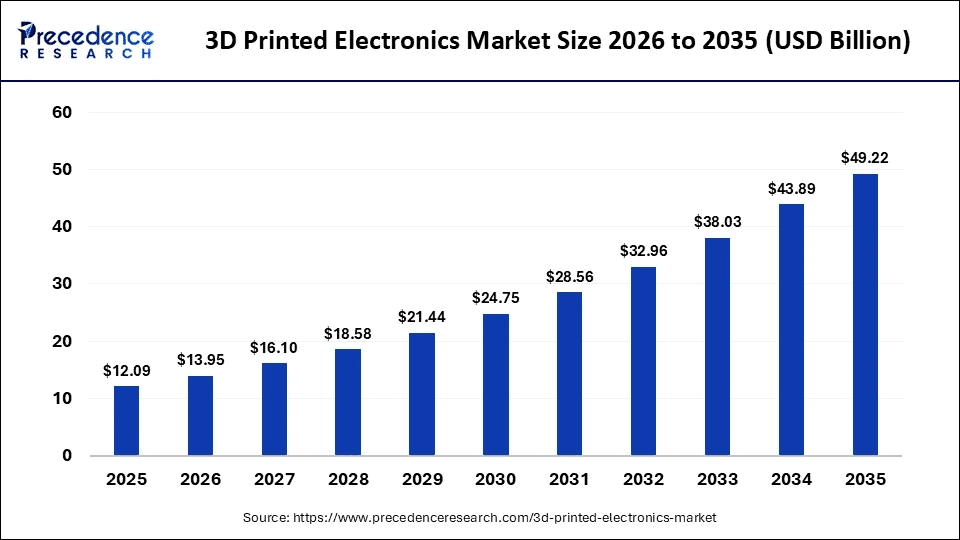
- The global 3D printed electronics market was valued at USD 12.09 billion in 2025 and is expected to reach USD 13.95 billion by 2026.
- The market is expected to grow steadily, reaching USD 49.22 billion by 2035.
Segment Highlights
| Segment | Dominant Category | Market Share in 2025 | Market Share in 2035 | Fastest-Growing Category | Market Share in 2025 | Market Share in 2035 |
| By Printing Technology | Screen Printing | 36.30% | 30.70% | Inkjet Printing | 33.60% | 38.40% |
| By Material | Inks | 77% | 69% | Polymers | 13.00% | 21% |
| By Application | Displays | 29.60% | 26.40% | Photovoltaic Cells | 5.50% | 9.50% |
| By End-Use Industry | Automotive & Transportation | 22.20% | 24% | Consumer Electronics | 16.20% | 18% |
Printed Electronics Industry Developments
- May 2026: Henkel advanced its conductive ink and printed electronics technologies to support flexible sensors, wearable devices, smart healthcare, and smart connectivity applications.
- February 2026: DuPont continued developing conductive materials and printed electronics solutions for automotive, healthcare, and consumer electronics.
- October 2025: NovaCentrix strengthened its photonic curing technology, enabling faster processing of printed electronic materials and supporting high-throughput manufacturing of flexible electronics.
- June 2025: Agfa continued expanding its conductive-material solutions for printed electronics. It also includes applications such as RFID, displays, sensors, and other connected electronic devices.
Closing Statement
Printed electronics is opening up new possibilities for designing and manufacturing electronic products. With benefits such as flexibility, lightweight materials, and lower production costs, the technology is finding applications in healthcare, automotive, displays, sensors, and smart packaging.
As innovation continues, its use is likely to expand across more industries, driving the development of thinner, smarter, and more flexible electronic devices.
FAQ
The commonly used materials are conductive inks, semiconductors, dielectric materials, and flexible substrates.
The main applications include sensors, displays, smart packaging, wearable devices, RFID tags, and flexible circuits.
Consumer electronics, healthcare, automotive, retail, packaging, and energy industries use this technology.

Sources