









Starter
AI In Gaming Statistics: AI made a real mark on the gaming world in 2025. Nearly 90% of game developers used some form of AI in their work. In addition, Steam alone saw around 20% of new game releases built with generative AI tools. In 2026, things are only speeding up. More studios are experimenting with AI-powered NPCs, smarter game engines, and even AI-generated worlds. This is making 2026 a turning point for the industry. AI is changing how games are made and played, from personalized storylines to faster development times. With more than 95% of developers believing AI is transforming gaming, it is clear this technology is not just a trend. Instead, it’s becoming the new normal.
In this article, you will learn how AI in gaming grew in 2025, what to expect in 2026, and why this shift matters for gamers and developers alike.
Handpicked Choices by the Editor
- About 90% of game developers used some form of AI in 2025, and 97% believe it is changing the industry for good.
- The AI in gaming market could grow from USD 3 billion in 2024 to USD 28 billion by 2033.
- Around 1 in 5 new games released on Steam in 2025 were built using generative AI tools.
- AI-driven characters can now keep players engaged 15–25% longer than old-style scripted characters.
- Most gamers still feel unsure or negative about AI, especially when it replaces human art, writing, or voice acting.
Global AI in Gaming Market Statistics
- The market size of the Global AI in Gaming Market is projected to reach around USD 28.0 Billion by 2033, from USD 3 Billion in 2024. The market is expected to grow at a CAGR of 28.40% between 2024 and 2033.
- Action and Adventure category had the largest market share of over 64% of the AI in gaming market in 2025.
- The mobile category was the largest revenue-generating category in the AI in gaming market in 2025. It accounted for more than 50% of market share.
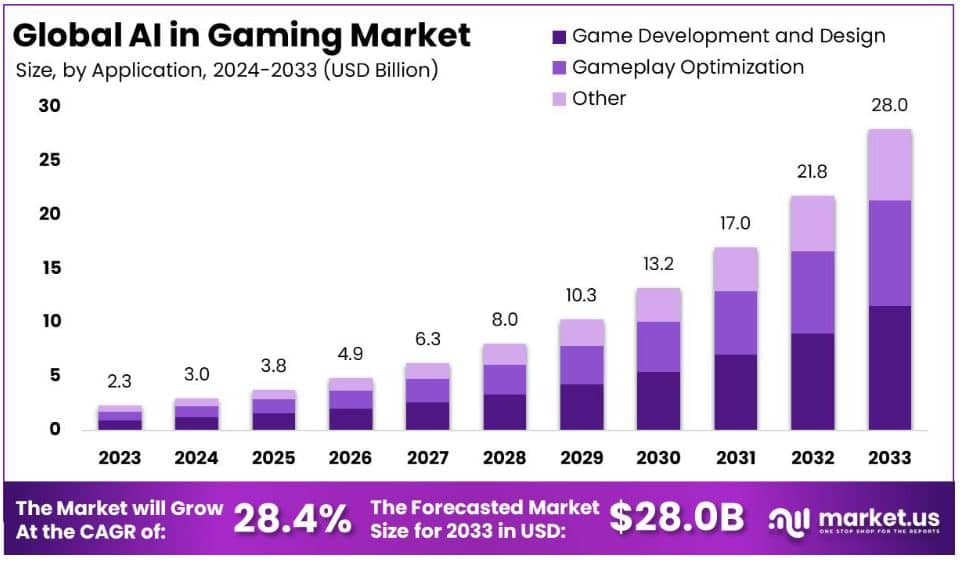
(Source: market.us)
AI use in Video Game Development
- Google Cloud’s 2025 survey of 615 game-development professionals across five countries found that 90% had integrated generative AI into their workflows.
- GDC’s industry survey found that 36% personally used generative AI tools and 52% worked at companies that had implemented them.
- Google Cloud’s 2025 research found that 97% of surveyed game developers believed generative AI was reshaping the industry.
- 95% of developers in Google Cloud’s survey said they use AI to automate repetitive tasks, including portions of asset processing, testing support, workflow coordination, and documentation.
- Code generation and scripting support represent another significant practical application. In fact, 44% of developers surveyed by Google Cloud reported using generative AI for these tasks.
- GDC found that 35% of respondents using generative AI applied it to prototyping activities.
- Creative production remains more restrained than productivity use. Furthermore, only 19% of surveyed industry professionals use generative AI for asset generation and 10% use it for procedural-content generation.
- Internal governance is expanding as studios confront these risks. According to GDC’s 2025 survey, 64% of developers worked at companies with an internal generative-AI policy, up from 51% in 2024.
- GDC reported that only 13% of respondents believed generative AI was having a positive effect on the games industry in early 2025.
AI Adoption in Gaming
- A study conducted by Aream & Co. in 2025 found that 84% of gaming executives are currently using or experimenting with AI tools. Moreover, 68% of gaming executives are already implementing AI technology in their studios.
- Smaller studios are taking advantage of AI in order to compete against bigger companies, although numbers are not given.
- In fact, according to Tom’s Hardware, 7,818 games on Steam use generative AI as of July 2025. This is 20% of all games released in 2025.
- AI technology is being used to produce images, dialogues, sounds, and even code for games.
Specific Applications of AI in Gaming
- Playtesting and gameplay balancing have emerged as the single area where AI delivers the most immediate workflow acceleration. This was stated by 47% of developers as a primary use case, closely followed by localization and translation work at 45%.
- Non-player character behavior modeling stands out as the dominant application segment within the broader market. It commands a 25.1% revenue share in 2024, according to Grand View Research.
- The 2025 Game Developers Conference AI Summit found that AI-driven NPC behavior increases average player session length by 15 to 25%. This is in comparison to traditional scripted systems.
- Chinese gaming enterprises are achieving an 86.36% AI technology application rate in quality assurance. This substantially outpaces the global average that sits between 50 and 55%.
- Within specific AI testing scenarios, functional testing has reached the highest maturity level industry-wide at 78% penetration. Meanwhile, more nuanced applications like balance testing and content verification remain in earlier exploratory phases at just 43% and 38% penetration, respectively.
- Player-facing expectations have shifted in tandem with these backend advances. In fact, 89% of surveyed developers report observing changing player expectations, with 34% specifically noting that gamers now expect smarter, more emotionally responsive non-player characters.
| Application Metrics | 2025 Value |
| NPC behavior modeling market share | 25.1% |
| Player session length increase (adaptive NPCs) | 15–25% |
| China’s AI testing application rate | 86.36% |
AI in Gaming Examples
- MIR5’s ACE-powered bosses adapt in real time, learning a player’s combat style to counter static, repetitive strategies.
- Dead Meat uses generative AI to enable freeform dialogue, letting players interrogate AI-driven murder suspects.
- At GDC 2025, Dead Meat’s suspects were shown running fully on-device using NVIDIA’s Minitron small language model instead of the cloud.
- Shadow of Mordor’s Nemesis System remains a landmark example, letting enemies remember past encounters and evolve personalized rivalries.
- Red Dead Redemption 2 uses AI to give NPCs believable routines and reactions, enhancing its living-world feel.
- Cyberpunk 2077 applies city-scale AI to simulate thousands of NPCs living independent daily routines.
- Ubisoft’s La Forge division-built Ghostwriter with NVIDIA to automate first-draft NPC dialogue for writers.
- Activision Blizzard uses AI mainly for matchmaking, weapon balancing, and anti-cheat systems.
- AI Dungeon showcases AI as a real-time storytelling partner, generating narrative based on player choices.
- Convai’s AI engine enables real-time conversations across thousands of NPCs simultaneously, unlike scripted systems.
- EA’s SEED lab and EASE engine explore emergent AI behavior and simulation tech across EA’s game portfolio.
- Call of Duty: Black Ops 7 faced backlash for AI-generated cosmetics resembling Studio Ghibli’s art style.
Recent Developments in AI in Gaming
- NetEase posted record Q2 2025 revenue thanks to titles like MARVEL Mystic Mayhem and FragPunk. These titles were built using its own LLM, Confucius, for development and ad optimization.
- Steam disclosed that about 20% of its 2025 game releases used generative AI for content or character creation.
- At Devcom in 2025, Google revealed that 90% of game developers now use some form of AI, and 97% believe it is transforming the gaming industry.
- Globant’s report, released on November 18, 2025, noted that global gaming revenue was set to hit USD 189 billion for the year. This surge is driven partly by AI-powered tools.
- Elon Musk’s xAI began hiring Nvidia AI experts in 2025 and announced plans to release a fully AI-generated game before the end of 2026.
- A report on January 14, 2026, revealed that games on Steam using generative AI passed 7,900 games with official AI disclosures in 2025. This marks a huge jump from previous years.
- The GDC State of the Game Industry survey (early 2026) found that 36% of over 2,300 surveyed game industry professionals now use generative AI tools as part of their daily job.
The Bottom Line
Almost every major studio touched AI in some way in 2025, whether to speed up testing, write code, or build smarter, more lifelike characters. Games like Cyberpunk 2077 and Shadow of Mordor already show what’s possible when AI powers how NPCs think and react. But the movement isn’t all smooth.
Many developers still worry about job losses and rising costs. Most players remain cautious about AI replacing human creativity. As 2026 comes to an end, the industry’s biggest challenge won’t be building better AI. Instead, it will be earning player trust while using it responsibly.
FAQ
Artificial intelligence is used in modern video games to power non-player character (NPC) behavior, generate procedural worlds, optimize graphics, and accelerate developer workflows.
Artificial intelligence has changed the gaming world by speeding up development, creating smarter non-player characters, and personalizing player experiences, while also raising serious concerns about job losses and rising production costs.
Gamers feel mostly negative about generative artificial intelligence in video games, especially when it replaces human art, writing, and voice acting.
Artificial intelligence (AI) has been used in gaming for over 80 years, with its roots dating back to academic computer programs and digital games developed in the early 1950s.
The first computerized game with artificial intelligence was a mechanical Nim machine built in 1941 and published in 1942, which could regularly beat human players.