








Opening statement
Predictive Analytics Statistics: Predictive analytics is helping businesses make better plans by looking beyond what has already happened. It combines data, AI, and modern technologies to identify patterns and estimate what could happen next. Businesses can use these insights to understand customers, manage risks, improve operations, and make quicker decisions. From healthcare and finance to retail, manufacturing, and technology, predictive analytics is becoming an important part of business strategy. As data volumes continue to rise, accurate forecasting is becoming even more valuable.
This article covers the latest trends, major applications, benefits, market growth, and future opportunities in predictive analytics.
Top Pick
- The predictive analytics market generated USD 17.3 billion in 2025 and is on track to reach an estimated USD 21.4 billion by the end of 2026.
- By component, the total predictive analytics market is projected to reach USD 13 billion from solutions and USD 8 billion from services in 2026.
- Cloud deployment leads the market with a 79.11% share in 2026.
- The North American predictive analytics market reached an estimated USD 10.66 billion in 2026
- In 2026, the U.S. predictive analytics market reached USD 6.84 billion.
- SAP Analytics Cloud offers more than 100 prebuilt business-content packages.
- IBM Corporation’s official report stated that Q2 2026 revenue was USD 17.162 billion, while H1 revenue was USD 33.079 billion.
- The healthcare predictive analytics market is expected to reach USD 19.7 billion in 2026.
- As of 2026, 27% of companies now use AI for predictive planning and forecasting, up from 11% last year.
- AI adoption in the U.S. reached 18% among firms, while larger companies recorded a higher adoption rate of 32%.
- 42% of respondents identified it as the top AI spending priority for 2026.
Predictive Analytics Market Revenue
(Source: market.us)
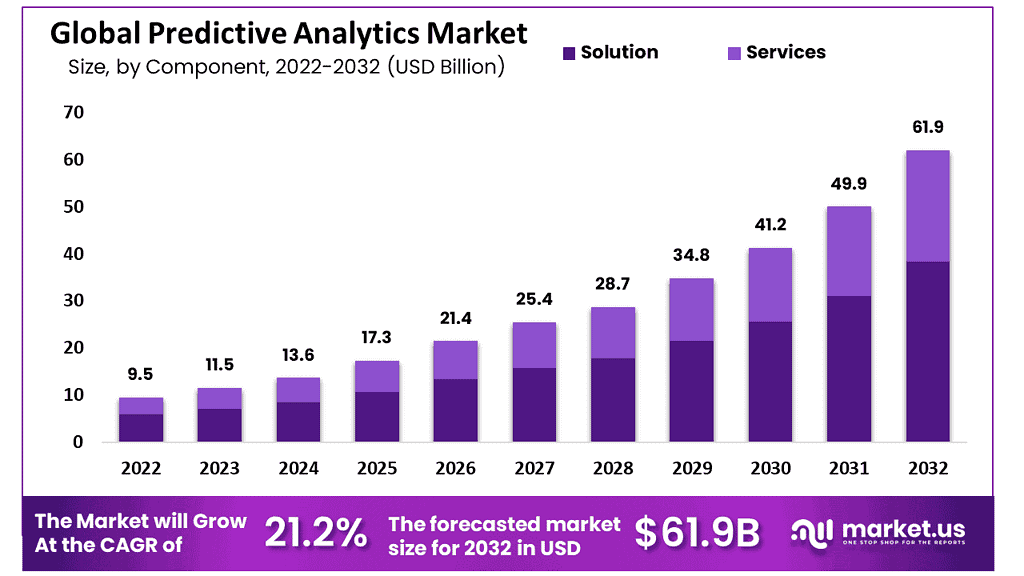
- The predictive analytics market generated USD 17.3 billion in 2025.
- Revenue is projected to reach USD 21.4 billion in 2026, reflecting a 23.7% growth rate.
- The market is forecast to expand to USD 61.9 billion by 2032.
By Component
- Market.us Scoop also mentioned that the total predictive analytics market is projected to reach USD 13 billion from solutions and USD 8 billion from services in 2026.
- By 2032, solutions are expected to contribute USD 38 billion, while services are forecast to generate USD 24 billion.
Deployment Mode Market Share
- According to Fortune Business Insights, cloud deployment leads the market with a 79.11% share in 2026.
- On-premises deployment accounts for 20.89% of the global market.
Regional Market Outlook: North America
- Fortune Business Insights further stated that the North American Predictive Analytics market reached USD 8.61 billion in 2025, holding a 38.70% share.
- Meanwhile, the market is expected to reach USD 10.66 billion in 2026.
(Source: precedenceresearch.com)
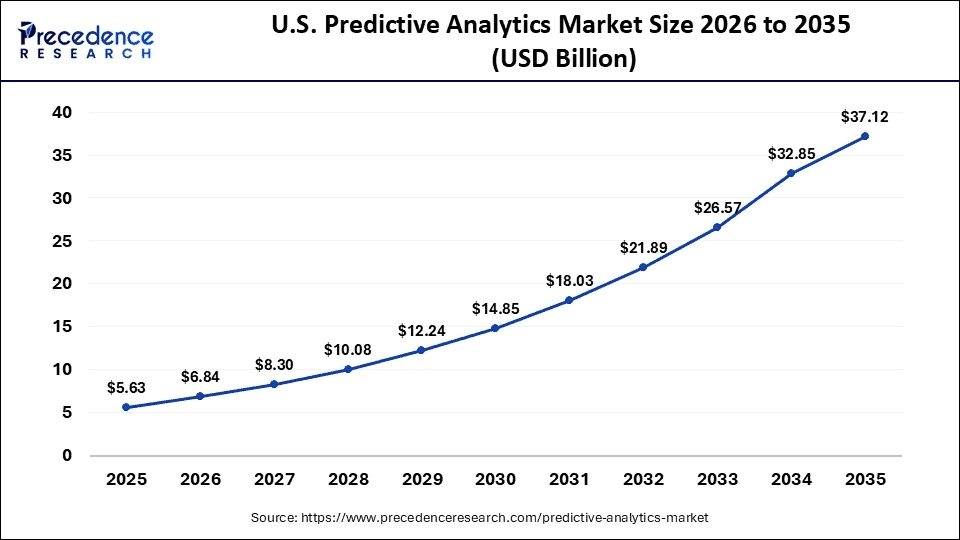
- In 2026, the U.S. predictive analytics market reached USD 6.84 billion.
- By 2035, it could reach USD 37.12 billion, expanding at a 20.76% CAGR from 2026 to 2035.
Asia Pacific
- The market was valued at USD 4.73 billion in 2025, representing 21.30% of the global market. It is also expected to reach USD 5.91 billion in 2026.
- Japan, China, and India are expected to reach USD 1.31 billion, USD 2.16 billion, and USD 1.21 billion, respectively, by 2026.
Europe
- The European market generated USD 6.85 billion in 2025, accounting for 30.80%. It is projected to reach USD 8.52 billion in 2026.
- The UK and German markets are expected to reach USD 1.80 billion and USD 1.68 billion, respectively.
Rest of the World
- Latin America accounted for 5.30% of the Predictive Analytics market, valued at USD 1.17 billion in 2025.
- The market will reach USD 1.42 billion in 2026.
Predictive Analytics Tool Market Statistics: SAP Analytics Cloud
- Eweek reported that SAP Analytics Cloud offers more than 100 prebuilt business-content packages.
- As per the SAP Community Update, it supports tables with more than 1 million cells.
- The wider SAP data and AI ecosystem includes 7.3 million data fields with semantic relationships.
RapidMiner
- RapidMiner AI Studio 2026.1.1 was released on April 1, 2026.
- RapidMiner has historically been associated with more than 400,000 users and millions of downloads, according to Wikipedia.
Alteryx

(Source: alteryx.com)
- Alteryx surpassed USD 1 billion in annual recurring revenue and executes more than 380 million workflows annually.
- Workflow volume increased by more than 120 million, from 260 million in 2023 to 380 million in 2025, representing at least 46.2% growth.
- 96% of analysts use AI tools, 85% say AI insights influence critical decisions, and 65% prefer business-managed AI logic.
- The platform processed 774 trillion records and 258 petabytes of data.
Other Leading Platforms
- IBM SPSS Statistics starts at USD 109 per authorized user and references Versions 31 and 32.
- According to support.tibco.com, Spotfire 14.8 added 23 no-code algorithms, while support for Statistica Version 14.2.X ends August 1, 2026.
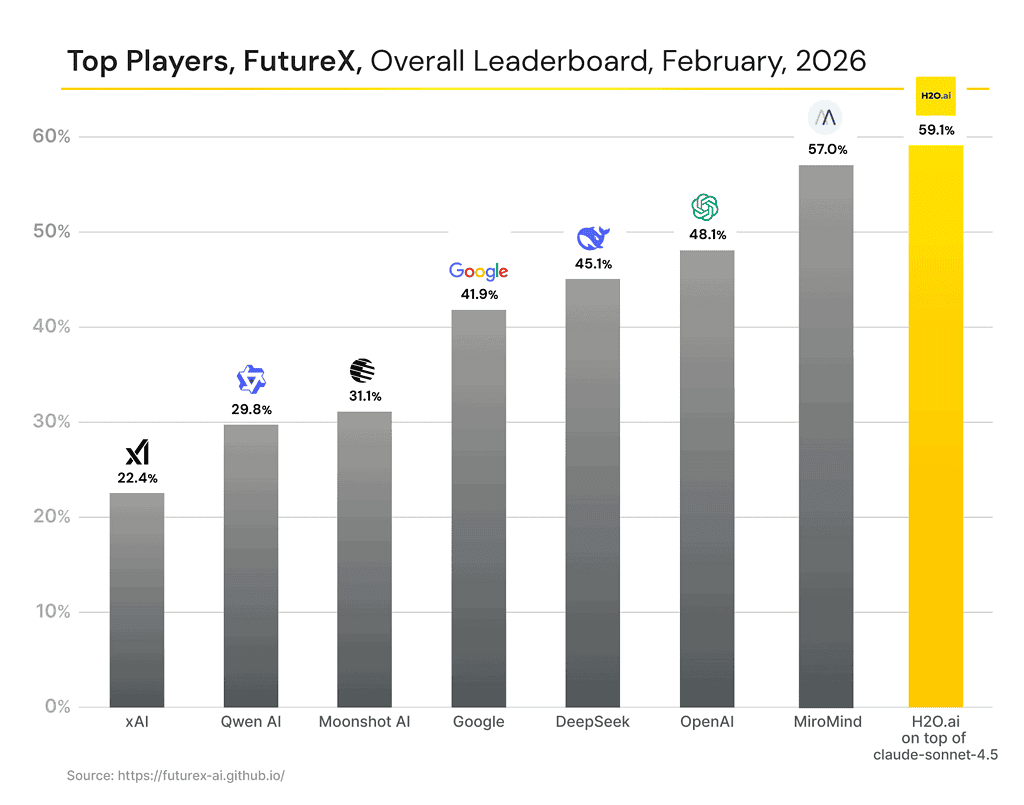
- H2O.ai serves more than 20,000 organizations and reaches more than half of the Fortune 500.
(Source: businesswire.com)
- It also recorded more than 1 million monthly downloads. Its FutureX performance in February 2026 was 59.1%.
Key Predictive Analytics Companies
- IBM Corporation’s official report stated that Q2 2026 revenue was USD 17.162 billion, while H1 revenue was USD 33.079 billion. Software revenue was USD 7.8 billion, up 5%. IBM projected a 4% to 5% constant-currency revenue growth for 2026.
- According to SAP News Center, in Q2 2026, revenue reached EUR 9.878 billion, up 9% reported and 11% constant currency. By the end of 2026, cloud revenue is expected to be EUR 25.8-26.2 billion.
- Microsoft reported USD 331.8 billion in 2026 revenue, up 18%, while operating income rose 21% to USD 155.2 billion. The net income climbed 31% to USD 133.7 billion on a GAAP basis, while non-GAAP income increased 22%.
- According to press.siemens.com, Siemens AG’s Q3 2026 revenue was EUR 20.8 billion, up 7%. On the other hand, its digital business grew 18% during the first nine months.
- GE Vernova’s Q2 2026 revenue was USD 11.1 billion, up 22%, and overall 2026 guidance increased to USD 45.5-46.5 billion.
- In the first half of 2026, Schneider Electric SE revenue reached EUR 21.226 billion, up 9.8% reported and 14% organically.
- NTT DATA Business Solutions reported EUR 1.850 billion in revenue and EUR 138.3 million EBITA, with revenue up 14.7% as of June 30, 2026.
- Oracle Corporation’s revenue in 2026 is expected to reach USD 67.4 billion, up 17%, while cloud revenue is expected to grow 39% to USD 34 billion.
- SAS Institute Inc. reported more than USD 3 billion in annual sales, while a third-party estimate for 2026 puts revenue at USD 4.2 billion.
Predictive Analytics Statistics by Industry
(Source: grandviewresearch.com)
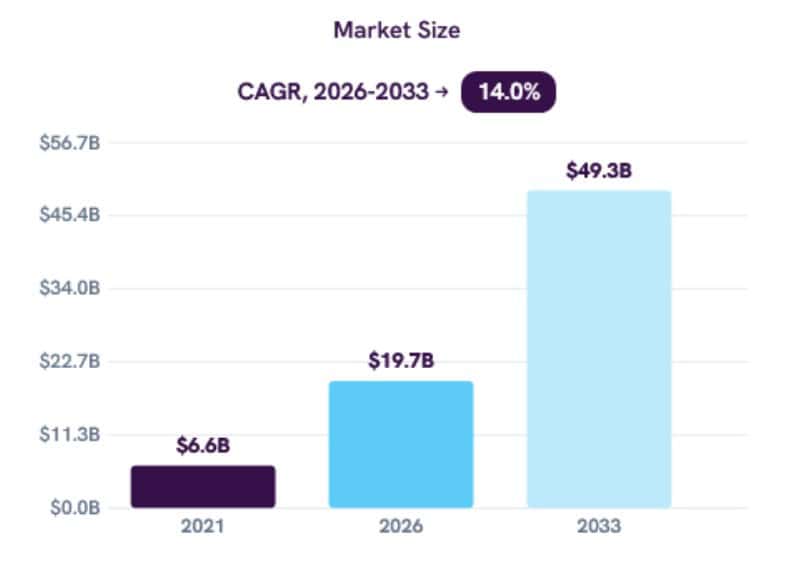
- The healthcare predictive analytics market is expected to reach USD 19.7 billion in 2026.
- Research and Markets estimates the manufacturing market at USD 2.31 billion in 2026 and projects an 18.5% CAGR through 2034.
- According to 360i Research, retail predictive analytics is expected to reach USD 2.04 billion in 2026, with an 18.49% CAGR forecast through 2032.
(Source: marketsandmarkets.com)
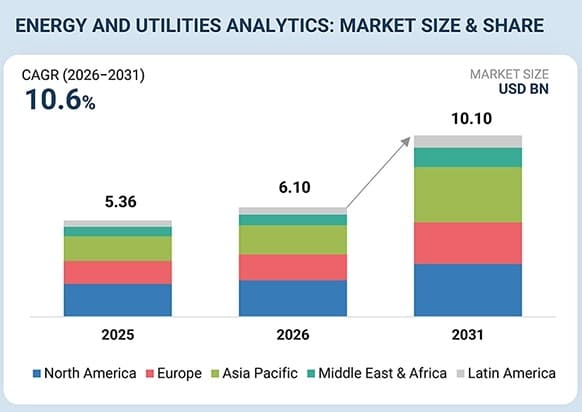
- The energy and utilities analytics market is projected to reach USD 6.10 billion in 2026, growing at a 10.6% CAGR through 2031.
- Predictive modeling is used by 46% of financial-services companies, followed by retail companies (46%), manufacturers (40%), and healthcare companies (39%).
Predictive Analytics and AI Adoption Trends
- As of 2026, 27% of companies now use AI for predictive planning and forecasting, up from 11% last year.
- According to a BARC survey of 804 participants, 66% plan to integrate AI, ML, generative AI, or agentic AI into their planning processes.
- 97% of organizations surveyed by Dun & Bradstreet had active AI initiatives in 2026.
- However, only 5% considered their data ready, while 56% planned to increase AI investment over the next 12 months.
- 64% of organizations in NVIDIA’s 2026 research were actively using AI. Meanwhile, 28% were assessing projects, and 8% had no current AI use or plans.
- According to Aon, in India, 43% of organizations had deployed AI, while another 20% were running pilot programs in 2026.
- Deloitte reported at-scale AI adoption of 62% in product development, followed by strategy and operations (56%), marketing and sales (55%), and supply chain (48%).
- Google’s TimesFM-3 forecasting model has 330 million parameters and was trained on more than 1 trillion time points.
- A 2026 agricultural study tested 17 forecasting approaches across 4 model classes. Time-MoE reduced MAE by 45% overall and by more than 50% for corn and soybeans versus USDA benchmarks.
User Adoption
- According to census.gov, AI adoption in the U.S. reached 18% among firms, while larger companies recorded a higher adoption rate of 32%.
- U.S. adoption is expected to rise to 22%, marking a 4% increase from the current level.
- Focused AI use remains common, with 57% of businesses using AI across 3 or fewer functions.
- The McKinsey report found that nearly 9 in 10 respondents worldwide use AI regularly. Meanwhile, 44% of organizations have scaled AI across their enterprise.
- Cross-functional AI use reached 56%, up from 51%.
- Workplace AI use stands at 25% among workers in one survey, while another reports 45% regular use and an 18% decline in confidence.
- Small-business adoption rose from 6.3% to 8.8%.
- CapsuleCRM reported that 63% of AI-using small businesses now use AI daily. Data analysis is a major SMB use case, with 62% using AI for this purpose.
Predictive Analytics Use Cases
| Predictive Analytics Use Cases | 2026 Numeric Information |
| Sales forecasting and lead scoring | 87% of sales organizations use AI. |
| AI agent used by sellers | 54% of sellers use AI agents. |
| Customer understanding and account intelligence | 89% of AI-using sellers say AI improves customer understanding. |
| Research-work automation | Expected 34% reduction in research time. |
| Content-work automation | Expected 36% reduction in email-drafting time. |
| Marketing AI use | 76% of marketing respondents use at least one form of AI. |
| AI as a sales growth tactic | Ranked #1 by surveyed sales teams. |
| AI use in operations | 64% of respondents actively use AI in operations. |
| Data analytics as an AI workload | 62% of respondents identify data analytics as a major AI workload. |
| Workflow and production-cycle optimization | 42% of respondents identified it as the top AI spending priority for 2026. |
| Customer-support AI use | 56% of surveyed organizations use AI in customer support. |
| Marketing data barriers | 98% of AI-using marketing teams reported at least one data-related obstacle. |
| Marketing-data integration | Marketing organizations integrate an average of 7 data sources for agentic marketing. |
| AI adoption across U.S. business functions | 18% of U.S. firms used AI in at least one business function; 32% on an employment-weighted basis. |
| Expected near-term U.S. AI adoption | 22% of firms are expected to use AI within six months. |
| Limited functional deployment | 57% of AI-adopting firms use AI in 3 or fewer business functions. |
| Data-quality dependence | 84% of data and analytics leaders agree that AI-output quality depends on data-input quality. |
| AI initiatives meeting ROI targets | Only 33% of AI initiatives met ROI targets. |
Closing Statement
Printed electronics is enabling a new breed of products, from the design and manufacturing perspective. The advantages, such as flexibility, reduced weight, and lower cost of production, have driven the usage of the technology in healthcare, automotive, display, sensors, and smart packaging.
As more research happens around the technology, we can expect to see increased applications in other industries as well, heralding a thinner, smarter, and more flexible future for electronics.
FAQ
It is used in finance, healthcare, retail, manufacturing, marketing, and supply chain management.
Machine learning, artificial intelligence, data mining, statistics, and big data tools support predictive analytics.
Descriptive analytics explains what happened, while predictive analytics uses data to forecast what may happen next.

Sources