








Beginning
AI In Advertising Statistics: AI in advertising uses machine learning to automatically decide who sees an ad, how much it costs, how it’s made, and how well it performs, often with much less work from humans at each step. In the past, a human designer might make a few versions of a banner ad. Now, AI can create many different versions on its own, like different headlines, images, and videos, and test them quickly to see which ones work best for different groups of people. Buying ads has also changed.
Instead of just placing ads automatically, AI now handles bigger decisions too, like setting prices, moving money between campaigns, and refreshing ad creative while a campaign is still running, often without a person stepping in. New systems are even letting AI on the buying side and AI on the selling side make deals with each other directly. All of this speed is raising new concerns about safety, since so much AI-made content is flooding ad spaces faster than anyone can check it. Companies in this space are now working to build safety checks alongside all this automation.
Key Stats Highlighted by the Editor
- Media executives rating AI “very important” for coding and development rose from 28% to 44% in a year.
- 54% of organizations use AI for creative generation, editing, or customization.
- 85% of surveyed companies already use AI-based tools for marketing activities.
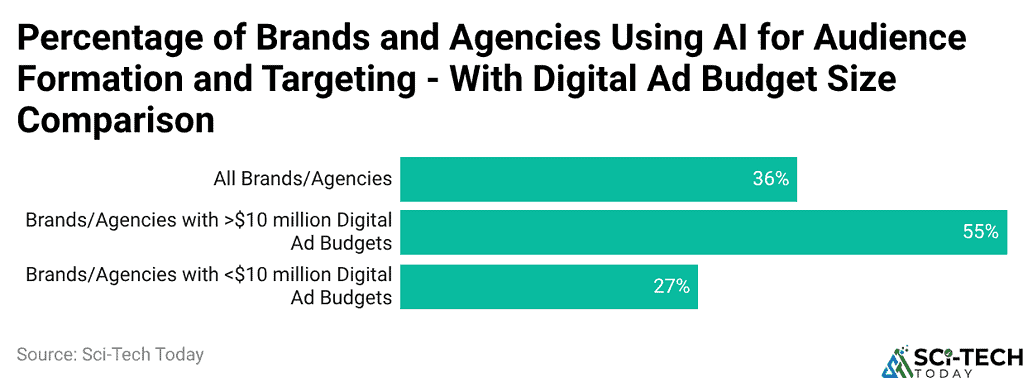
- Brands spending over USD 10 million on digital ads show 55% AI adoption for targeting, versus 27% for smaller budgets.
- 83% of advertising executives deployed AI in the creative process in 2026, up from 60% in 2024.
- Global social-media ad spending is forecast to reach USD 394.6 billion in 2026.
- AI-ready organizations allocate 21.3% of marketing budgets to AI, per Gartner’s 2026 survey.
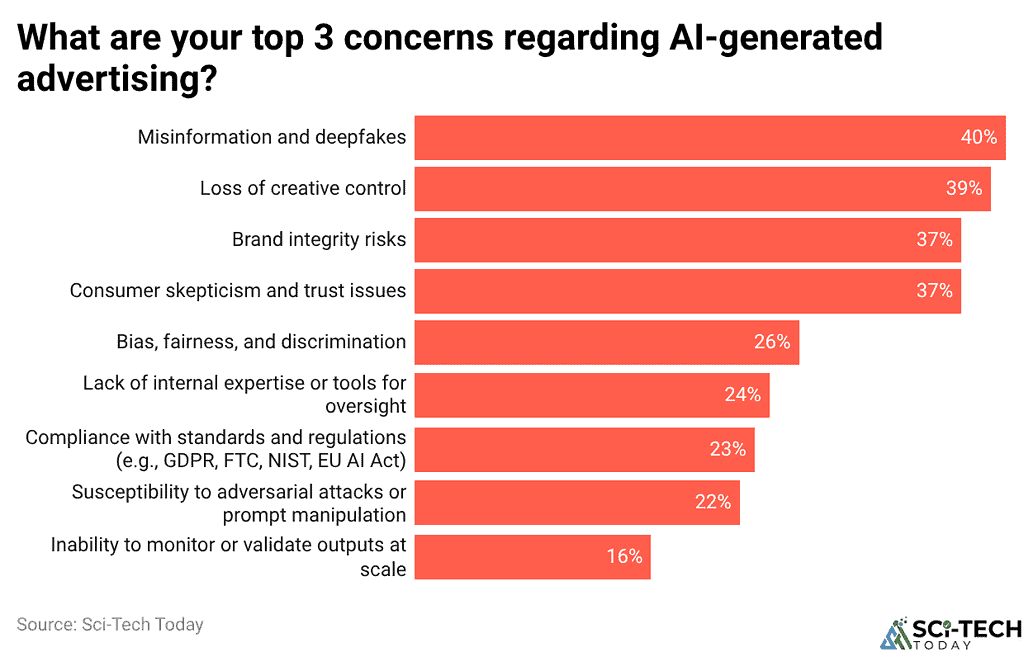
- 40% of respondents identified misinformation and deepfakes as a leading AI advertising risk.
Recent AI in Advertising Stats
- In May 2025, Google launched AI Max globally, reporting 14% more conversions or value, rising to 27% for exact-and-phrase-heavy campaigns.
- In May 2025, Meta reported Advantage+ generated USD 4.52 per USD 1 spent, delivering 22% higher ROAS than conventional campaigns.
- In June 2025, Adobe expanded GenStudio; Lumen reduced campaign launches from 25 to 9 days and 4-ad variation production by 65%.
- IAB’s July 2025 report found 86% of buyers use or plan to use generative AI for video creative, projected across 40% of 2026 ads.
- At unBoxed 2025, Amazon introduced unified Campaign Manager, Creative Agent and Ads Agent, citing AI-powered search enabling 67% faster campaign launches.
- In November 2025, Amazon enhanced Performance+ and Brand+; dynamic creative optimization lifted paid units 8.4%, conversions 7.9%, ROAS 7.2%, and CTR 6.5%.
- In October 2026, OpenAI announced visual ChatGPT ads; tests showed 15.3% lower CPA, 67% net-new incremental purchases, and 93% new visitors.
- In October 2026, TikTok launched AI advertising updates; TTAN reached nearly 400,000 apps, while MCP advertiser adoption increased over 200%.
Global AI in Advertising Market Outlook
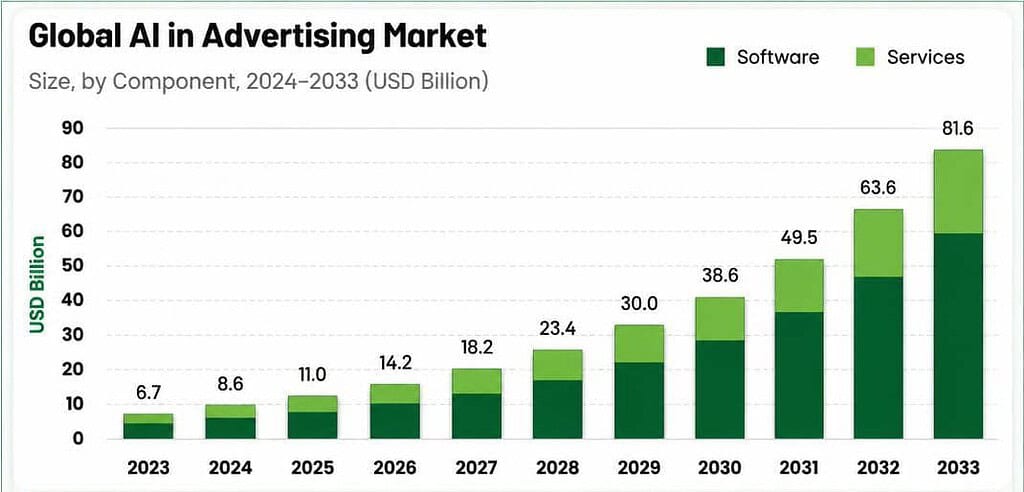
- The global AI in advertising market is forecast to grow from USD 6.7 billion in 2023 to USD 8.6 billion in 2024, USD 11.0 billion in 2025, and USD 14.2 billion in 2026.
- Growth is projected to continue, with the market reaching USD 38.6 billion in 2030, USD 49.5 billion in 2031, USD 63.6 billion in 2032, and USD 81.6 billion in 2033.
- The market is forecast to expand at a compound annual growth rate (CAGR) of 28.4% from 2024 to 2033.
How AI is Transforming Media Publishing
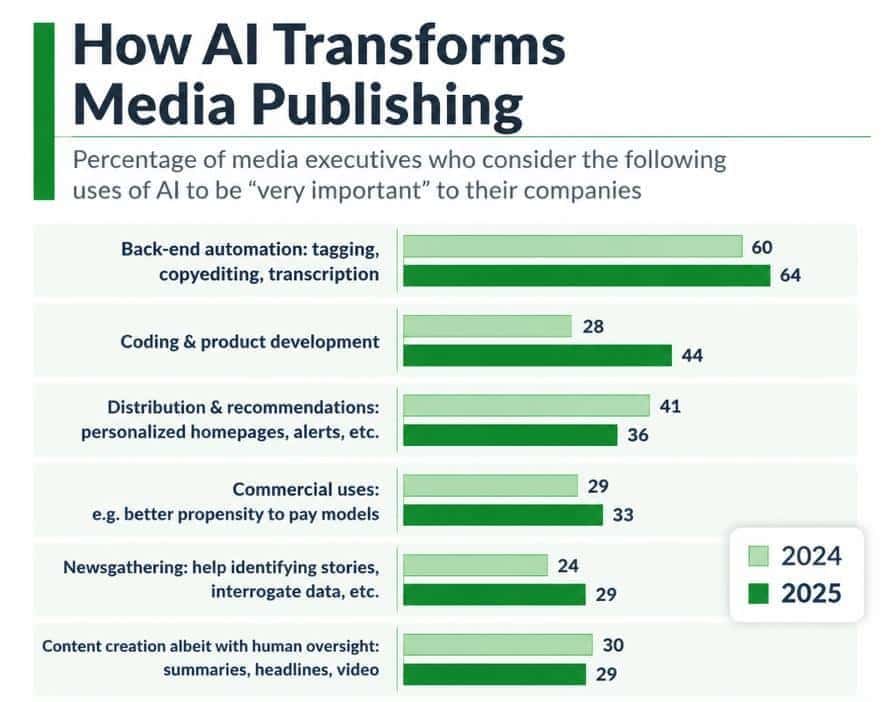
- In back-end automation, including tagging, copyediting, and transcription, the share of media executives who considered AI “very important” increased from 60% in 2024 to 64% in 2025.
- In coding and product development, the share increased significantly from 28% in 2024 to 44% in 2025.
- In distribution and recommendations, including personalized homepages and alerts, the share decreased from 41% in 2024 to 36% in 2025.
- In commercial applications, such as improving customers’ propensity-to-pay models, the share rose from 29% in 2024 to 33% in 2025.
- In newsgathering, including identifying stories and examining data, the share increased from 24% in 2024 to 29% in 2025.
- In content creation with human oversight, including summaries, headlines, and videos, the share declined slightly from 30% in 2024 to 29% in 2025.
- Overall, media executives placed the greatest importance on AI for back-end automation in both years. Coding and product development recorded the largest increase, rising by 16 percentage points between 2024 and 2025.
Current Uses of AI in Advertising and Marketing
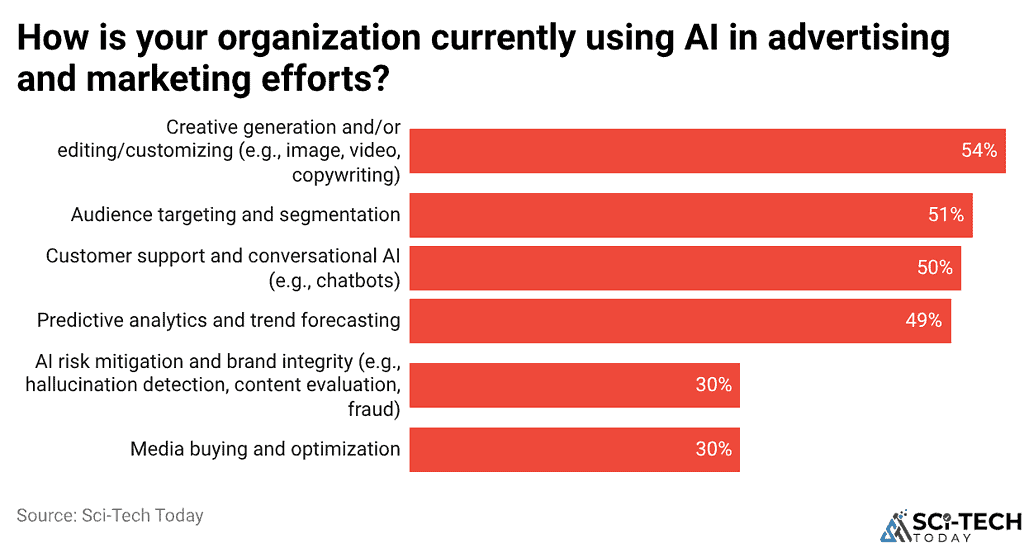
- 54% of organizations use AI for creative generation, editing, or customization, including image creation, video production, and copywriting.
- 51% of organizations use AI for audience targeting and segmentation. This helps marketers identify and reach customer groups more effectively.
- 50% of organizations use AI for customer support and conversational AI, such as chatbots. These tools can provide faster responses and improve customer interactions.
- 49% of organizations use AI for predictive analytics and trend forecasting.
- 30% of organizations use AI for risk mitigation and brand integrity, including hallucination detection, content evaluation, and fraud prevention.
- 30% of organizations use AI for media buying and campaign optimization. This can help companies improve advertising placement, spending efficiency, and campaign performance.
AI Adoption and Governance in Digital Advertising
- 85% of surveyed companies already use AI-based tools for marketing activities. Nearly three-quarters also confirmed that AI supports at least one part of their advertising campaigns.
- 68% of companies have general internal AI guidelines, but only 43% have specific policies for marketing and advertising. Only around one-third provide employees with basic guidance on AI use.
- 60% of advertising technology companies and 48% of advertising agencies reported improvements in key performance indicators from using AI. Publishers, however, experienced fewer direct benefits.
- More than 80% of respondents expressed interest in buying or selling advertising space on consumer-facing AI platforms, including chatbots powered by large language models.
AI Usage for Audience Targeting by Advertising Budget
- 36% of all surveyed brands and agencies use AI for audience formation and targeting in digital advertising.
- Brands and agencies with digital advertising budgets above USD 10 million show the highest adoption, with 55% using AI for audience formation and targeting.
- Among brands and agencies with digital advertising budgets below USD 10 million, only 27% use AI for these activities.
- The adoption rate among organizations spending more than USD 10 million is 28 percentage points higher than among those spending less than USD 10 million.
AI Content and Creative Advertising Statistics
- 83% of advertising executives said their organizations had deployed AI in the creative process in 2026. This increased from 60% in 2024.
- Advertisers are most likely to use AI for social-media advertising, with 85% reporting use in this channel. AI use is also reported in display advertising by 73% of advertisers, television advertising by 56%, and audio advertising by 42%.
- Nearly two-thirds, or about 62%, of digital-video advertising buyers use generative AI to create video advertising content in 2026. This is an increase from about 50% in 2025.
- Buyers expect generative AI to be used in approximately one-third of their digital-video advertising assets in 2026. This is higher than one-quarter in 2025, and the share is expected to reach 43% by 2027.
- 86% of buyers either use or plan to use generative AI to develop video advertising creative.
- Cost efficiency is the leading reported benefit of AI-generated advertising content, cited by 64% of respondents.
- Creative innovation is the second most important perceived benefit, cited by 61% of respondents in 2026. This is slightly lower than the 64% recorded in 2024.
- 56% of advertising professionals use AI for idea generation and creative concept development. Around 50% use it to create visual assets, while about 40% use it for copywriting, audience targeting, and media planning.
AI in Social Media Advertising
| Area | 2026 Statistic | Research Analyst Interpretation |
| Global social-media ad spends | USD 394.6 billion | Global social-media advertising spending is forecast to reach USD 394.6 billion in 2026. |
| Social-media ad-spend growth | 21.3% | Social-media advertising is forecast to grow by 21.3% in 2026, making it the fastest-growing major advertising channel. |
| Share of global ad spend | 29.4% | Social media is expected to account for 29.4% of total global advertising spending in 2026. |
| Social-media spend outlook | More than USD 500 billion by 2028 | Social-media advertising spending is projected to exceed USD 500 billion by 2028, supported by short-form video, creator content, AI-based targeting, and campaign automation. |
| Major digital channels | 66.4% | Social media, search, and retail media are expected to represent 66.4% of total worldwide advertising expenditure in 2026. |
| Global ad-spend increase | USD 143 billion | Global advertising spending is expected to increase by approximately USD 143 billion in 2026. |
| Contribution of key channels | USD 131 billion | Social media, search, and retail media are expected to contribute about USD 131 billion of the total USD 143 billion increase in global advertising spending. |
| Contribution of key channels | Nearly 92% | These three channels are expected to generate nearly 92% of the increase in worldwide advertising spending during 2026. |
| AI use in social ads | 85% | 85% of advertisers use AI in social-media advertising, representing the highest AI adoption rate across advertising formats. |
| AI use in display ads | 73% | 73% of advertisers use AI in display advertising. |
Cost of AI in Advertising Statistics
- Gartner’s 2026 survey found companies allocate 15.3% of marketing budgets to AI; AI-ready organizations allocate 21.3%.
- Gartner reports marketing budgets reached 7.8% of company revenue in 2026, versus 7.7% in 2025, contextualizing AI investment.
- AI-ready organizations reported marketing budgets averaging 8.9% of revenue, compared with Gartner’s 2026 overall average of 7.8%.
- Klarna reported approximately $10 million in annualized AI-driven marketing savings, representing 37% of savings reported in Q1 2024.
- McKinsey estimates generative AI could unlock marketing productivity worth 5%–15% of total marketing spending, approximately $463 billion annually.
Risks of AI-Generated Advertising
- According to IAB’s report, around 40% of respondents identified misinformation and deepfakes as a leading concern.
- 39% of respondents were concerned about losing creative control. Organizations may find it difficult to ensure that AI-generated content fully reflects their intended message, tone, and brand style.
- 37% of respondents cited brand-integrity risks as a major concern. AI-generated advertising could harm a brand if the output is inaccurate, inappropriate, or inconsistent with brand values.
- 37% of respondents were concerned about consumer skepticism and trust issues. Customers may be less willing to trust advertising if they believe it has been created entirely by AI.
- 26% of respondents identified bias, fairness, and discrimination as concerns. AI systems may produce content or targeting decisions that unintentionally exclude, stereotype, or disadvantage certain groups.
- 24% of respondents cited a lack of internal expertise or oversight tools.
- 23% of respondents were concerned about compliance with standards and regulations, including the GDPR, FTC rules, NIST guidance, and the EU AI Act.
- 22% of respondents highlighted vulnerability to adversarial attacks or prompt manipulation. These risks can affect the reliability and safety of AI-generated advertising content.
- 16% of respondents were concerned about their ability to monitor and validate AI outputs at scale.
The Closing Observation
AI now touches almost every stage of advertising, from targeting and bidding to creative generation and measurement, with adoption highest among social media advertisers and large-budget brands. Market value keeps climbing fast, and most organizations expect generative AI to dominate video creative within a few years.
Yet governance lags: few companies have marketing-specific AI policies, and misinformation, lost creative control, and brand-integrity risks remain top concerns as automation outpaces oversight.
FAQ
AI adoption in advertising is growing rapidly, with more brands and agencies integrating AI tools into their marketing strategies to stay competitive, improve efficiency, and meet changing consumer expectations in a digital-first world.
AI powers programmatic advertising by automatically buying and placing ads in real-time, using data analysis to determine the best placement, timing, and audience for each ad, maximizing return on investment.
AI tools track and analyze campaign performance metrics in real-time, helping marketers understand what’s working, predict future outcomes, and make quick adjustments to improve overall ad effectiveness.
Yes, AI can significantly reduce advertising costs by optimizing ad spend, eliminating wasted impressions, automating repetitive tasks, and ensuring ads reach the most relevant audiences without unnecessary expenditure.
AI tools can generate ad copy, design visuals, create video content, and even suggest creative variations based on data insights, helping marketers produce content faster while maintaining relevance and quality.
AI enhances customer engagement through personalized recommendations, interactive chatbots, dynamic content delivery, and real-time responses, creating more meaningful interactions between brands and consumers.
Small businesses are increasingly using AI-powered tools for affordable ad targeting, automated social media campaigns, performance tracking, and content creation, allowing them to compete more effectively with larger companies despite limited budgets.