








Opening
Conversational AI Statistics: You’ve probably talked to an AI today without even realizing it. Maybe you checked a delivery status online, asked your phone to set a timer, or chatted with “support” before you noticed it wasn’t a real person. That’s conversational AI. It’s a type of technology that understands what people say or type, and then answers back naturally. It uses things called natural language processing and machine learning to do this. It powers chatbots, voice assistants, and virtual helpers on websites, apps, and customer service phone lines. It used to be simple bots that could only follow a set script.
Now it has grown into smarter AI that can have real conversations, understand what you mean, and even finish tasks for you. Companies use conversational AI in customer service, sales, healthcare, and banking to answer common questions. This frees up human workers to focus on harder problems. As the AI behind these tools keeps getting better, it’s moving from just reacting to what you say toward guessing what you need before you even ask.
Here’s a look at the newest facts about conversational AI.
Key Takeaways Marked by the Editor
- Global conversational AI market valued at USD 15.3 billion in 2025, projected to reach USD 34.8 billion by 2029.
- 69% of businesses reported stronger customer service capabilities after adopting conversational AI.
- 82% of companies added voice-assistant technology, including speech recognition and transcription.
- 40% of organizations experienced an AI-related privacy breach in recent surveys.
- Retail chatbot spending could reach USD 72 billion globally by 2028.
- AI-powered retail sales have already reached USD 112 billion worldwide.
- Real-time voice AI costs fell 68%, from USD 100 to USD 32 per million tokens.
- ElevenLabs’ annual recurring revenue grew over 6 times in 2 years, reaching USD 500 million.
- 75% of organizations are expected to use LLMs for customer service by 2026.
Recent Developments in Conversational AI
- On October 6, 2026, ElevenLabs announced plans to invest hundreds of millions of USD in India after reaching a USD 22 billion valuation.
- On October 1, 2026, Forrester published findings from 27 conversational-AI practitioners, with some customer applications operating across 15 to 30 languages.
- On September 30, 2026, ElevenLabs completed a USD 300 million employee tender offer, doubling its valuation from USD 11 billion to USD 22 billion.
- On September 10, 2026, Salesforce reported 7 billion Agentic Work Units, including 3.2 billion during the second quarter alone.
- On September 3, 2026, Google introduced Gemini 3.5 Live conversational voice functions across 3 applications: Gmail, Docs, and Keep.
- On August 17, 2026, Wispr raised USD 280 million at a USD 2 billion valuation; its voice software served over 10,000 enterprises.
- On July 8, 2026, Gartner reported customers were approximately 3 times more likely to use third-party generative-AI tools than company-provided chatbots.
- On May 19, 2026, Google reported 900 million monthly Gemini users and more than 7 times growth in daily requests within one year.
- On April 23, 2026, Amazon acquired conversational-AI company NLX, enabling Amazon Connect customers to deploy no-code AI experiences within weeks instead of months.
Global Conversational AI Market Growth
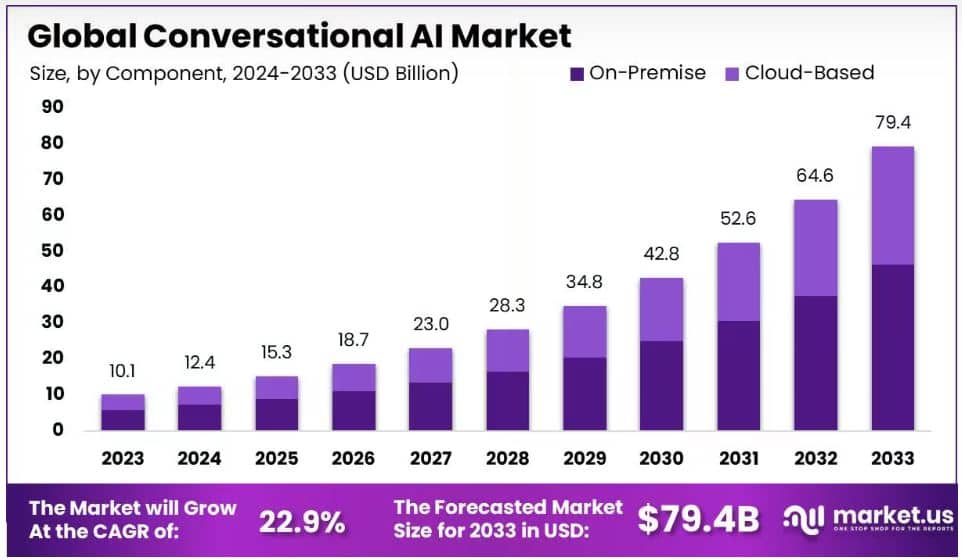
- The global conversational AI market was valued at USD 12.4 billion in 2024 and USD 15.3 billion in 2025.
- Market value is forecast to increase to USD 18.7 billion in 2026 and USD 23.0 billion in 2027.
- The conversational AI market is expected to reach USD 28.3 billion in 2028 and USD 34.8 billion in 2029.
- The market is projected to grow at a compound annual growth rate of 22.9% during the forecast period.
- On-premise solutions are expected to remain the larger market component, while cloud-based solutions will also contribute to overall growth.
(Source: market.us)
Benefits of Conversational AI in Client Care
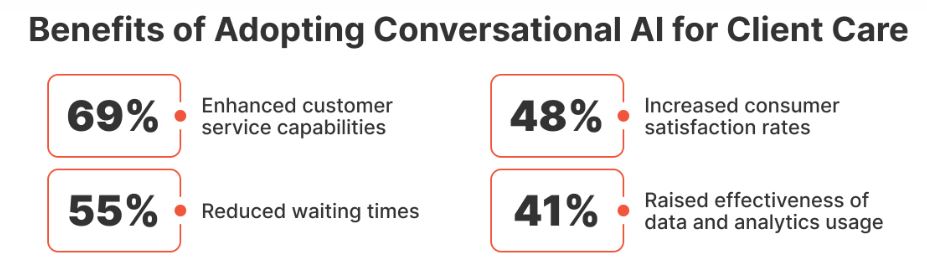
- 69% reported stronger customer service capabilities.
- 55% experienced shorter customer waiting times.
- 48% recorded higher customer satisfaction rates.
- 41% improved how effectively they used customer data and analytics.
(Source: masterofcode.com)
Voice Assistant Adoption and Value
- 82% of companies have added voice-assistant technology to their operations, including speech recognition, transcription, and machine translation.
- Nearly 67% of consumers want more voice-based interactions with AI chatbots.
- 70% of customers expect companies to use AI for personalized conversations and offers.
- 74% of respondents reported better speech-to-text accuracy, while 68% cited improved conversational intelligence.
- 64% recognized the cost-saving benefits of voice AI.
- 85% of decision-makers expect wider voice-AI adoption within the next five years.
Challenges in Conversational AI Adoption
- 40% of organizations experienced an AI-related privacy breach, while over 50% of consumers consider personal-data use a major privacy concern.
- About 63% of clients worry about bias and discrimination in AI decision-making, increasing the need for fairness checks and transparent policies.
- 22% of IT decision-makers have data trapped in systems that cannot be migrated, and 79% struggle with undocumented data pipelines.
- 57% of global consumers see AI as a privacy threat, while 61% remain distrustful of AI systems.
- Strong data governance, clear user communication, and reliable system integration are essential for wider conversational AI adoption.
Conversational AI Adoption Insights
- North America holds over 60% of global conversational AI patents, supporting its leadership in innovation.
- 71% of business and technology professionals report chatbot investment, while 64% of CX leaders plan higher bot budgets in 2026.
- Retail chatbot spending could reach USD 72 billion by 2028; 66% of U.S. consumers show interest in generative AI shopping tools.
- Banking represents 23% of the chatbot market, with 48% of U.S. banks planning customer-facing AI integration.
- Healthcare chatbot adoption may grow at a 33.7% CAGR through 2028; 81% of consumers have used bots or voice agents.
Conversational AI in Retail
- 17% of U.S. shoppers use chatbots to research products before purchasing.
- Retail chatbots could save businesses USD 439 million annually.
- AI-powered retail sales have reached USD 112 billion.
- 40% of U.S. consumers have already interacted with retail chatbots.
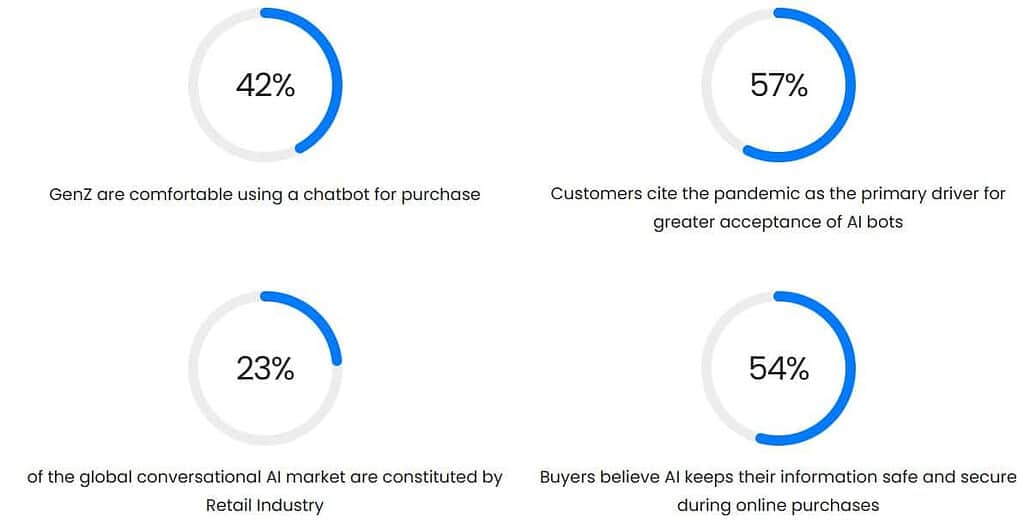
- 42% of Gen Z consumers feel comfortable purchasing through chatbots.
- 57% of customers say the pandemic increased their acceptance of AI bots.
- Retail represents 23.3% of the global conversational AI market.
- 54% of buyers believe AI protects their information during online purchases.
(Source: acuvate.com)
Voice AI Costs and Funding
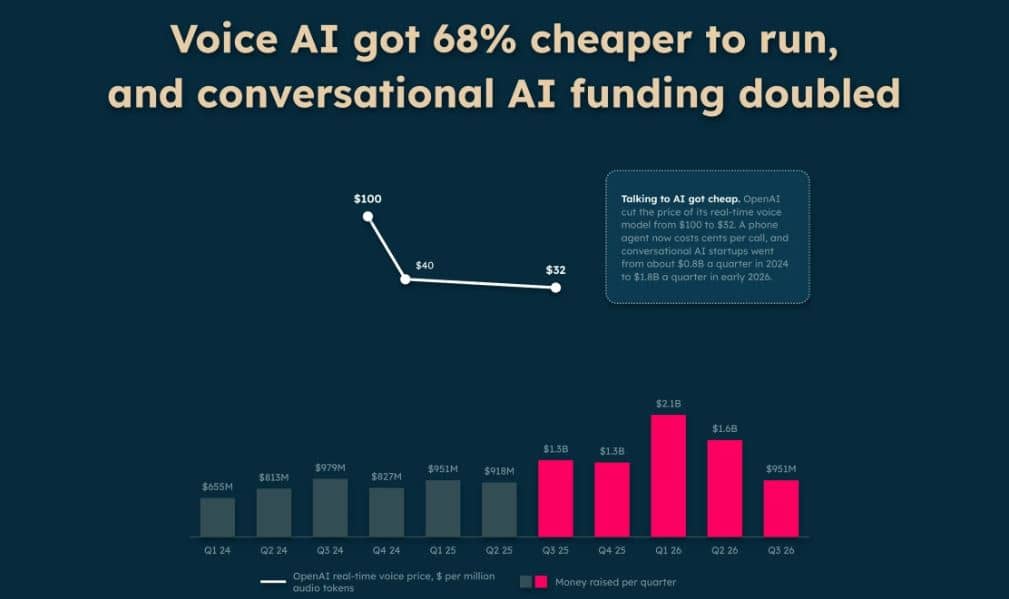
- Real-time voice AI costs fell from USD 100 to USD 32 per million audio tokens, a 68% reduction.
- Conversational AI startups raised about USD 0.8 billion per quarter in 2024, increasing to USD 1.8 billion in early 2026.
- Quarterly funding peaked at USD 2.1 billion in Q1 2026 before declining to USD 951 million in Q3 2026.
- Lower voice-AI costs can improve the economics of phone-based AI agents and support wider business adoption.
(Source: newmarketpitch.com)
ElevenLabs Revenue and Voice AI Funding
- ElevenLabs’ annual recurring revenue increased over 6 times in 2 years, rising from USD 80 million to USD 500 million.
- Revenue grew through reported levels of USD 80 million, USD 200 million, USD 330 million, and USD 500 million.
- Quarterly funding reached USD 655 million, USD 813 million, USD 979 million, and USD 827 million across Q1–Q4 2024.
- Funding totaled USD 951 million, USD 918 million, USD 1.3 billion, and USD 1.3 billion across Q1–Q4 2025.
- Funding rose from about USD 0.8 billion quarterly in 2024 to USD 1.8 billion on average in early 2026.
- Funding reached USD 2.1 billion in Q1 2026, USD 1.6 billion in Q2, and USD 951 million in Q3.
LLM Adoption in Customer Service
- By 2026, 75% of organizations are expected to use LLMs for customer service, compared with 10% in 2023.
- The AI customer-service market is projected to grow from USD 9.53 billion in 2023 to USD 47.82 billion by 2030.
- 87% of companies are deploying or testing generative AI, while 80% of customer-service organizations are expected to use it by 2025.
- LLM-based customer-support tools deliver an average 10% efficiency improvement across large volumes of customer interactions.
- Negative generative-AI outcomes rose from 44% of organizations in 2024 to 51% in 2025.
- 35% of LLM users identify unreliable or inaccurate outputs as their main concern.
Conversational AI Impact on Contact Centers
- Contact-center and conversational-AI spending was projected to increase 24% in 2024, as companies invested in AI-powered customer support and virtual assistants.
- AI chatbots can provide 24/7 support, helping organizations answer routine customer questions faster and improve service convenience.
- Nearly 90% of contact centers reported faster complaint resolution and improved capacity to manage customer call volumes through AI.
- Executives reported an 80% improvement in customer satisfaction, service delivery, and overall contact-center performance from AI adoption.
- Chatbot-led customer interactions can cost 30% less than agent-led interactions, creating meaningful operational savings.
- Chatbots were projected to save more than 2.5 billion customer-service hours by 2023.
- Conversational AI can reduce average customer-query handling time by 77% and lower overall customer-service costs by up to 30%.
Closing
Conversational AI has moved well beyond scripted chatbots, now powering voice assistants, customer service, retail shopping, and contact centers at scale. Businesses report real gains in satisfaction, speed, and cost savings, while voice AI costs keep falling and funding keeps flowing to companies like ElevenLabs.
Even so, trust remains fragile: privacy concerns, bias worries, and unreliable outputs continue to hold back adoption for many organizations. As LLM-powered tools replace rule-based bots across banking, healthcare, and retail, conversational AI is becoming a standard layer of customer interaction rather than a novelty.
FAQ
Unlike rule-based chatbots that follow scripted responses, Conversational AI uses natural language processing (NLP) and machine learning to understand context, intent, and nuances, allowing for more dynamic and human-like interactions.
Conversational AI is widely used in customer service, healthcare, banking, retail, and e-commerce to handle inquiries, provide support, automate tasks, and improve overall customer experience.
Conversational AI offers benefits such as 24/7 customer support, faster response times, reduced operational costs, improved customer satisfaction, and the ability to handle multiple queries simultaneously.
By providing instant responses, personalized interactions, and round-the-clock availability, Conversational AI helps businesses resolve customer issues quickly while reducing the workload on human support teams.
Conversational AI relies on technologies like natural language processing (NLP), natural language understanding (NLU), machine learning, and speech recognition to interpret and respond to user inputs effectively.
Many users are increasingly comfortable with Conversational AI, especially for simple tasks like answering FAQs, booking appointments, or tracking orders, though complex issues often still require human assistance.
Challenges include understanding complex or ambiguous language, maintaining context in long conversations, ensuring data privacy, and avoiding miscommunication that can frustrate users.