









Introduction
AI in Robotics Statistics: In recent years, robots have become increasingly intelligent, as AI enables them to interpret data collected from the world. With information from cameras, LiDAR, and touch sensors, a robot can determine what to do next, move with greater control, and operate without constant human intervention. Even with unclear sensor readings and a small amount of data, AI can still spot useful patterns.
It also helps robots behave more safely when working near people by signalling the robot’s confidence in its decisions. To achieve robust and consistent results, methods such as Bayesian filtering, SLAM, deep learning, and reinforcement learning must rely on high-quality data and be rigorously and fairly evaluated. As robots are increasingly used in settings such as factories, hospitals, and homes, statistics become particularly important.
It helps us assess how well a robot performs, identify unfair outcomes, measure trustworthiness, and identify potential problems before they lead to failures. This article elaborates on the role of AI in robotics through a simple, clear statistical perspective.
Editor’s Choice
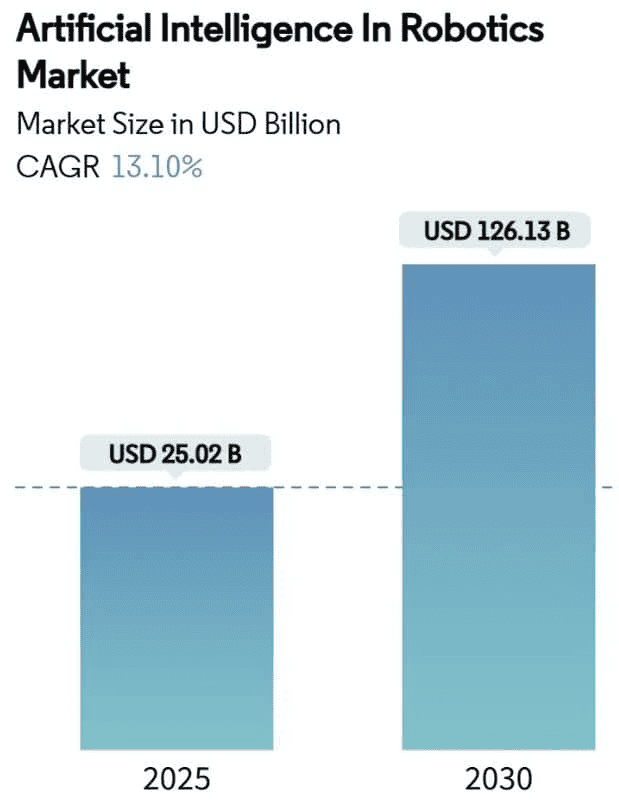
- The artificial intelligence in robotics market is projected to increase from USD 25.02 billion in 2025 to USD 126.134 billion by 2030.
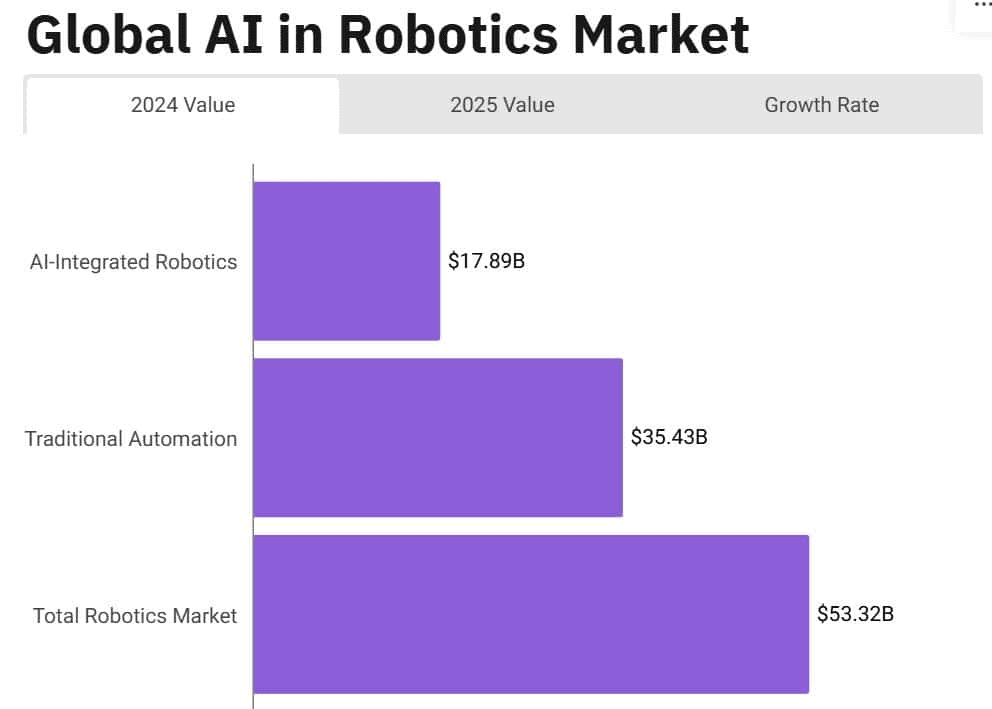
- In 2025, AI-integrated robotics accounted for USD 23.01 billion, whereas traditional automation made up USD 38.90 billion.
- Around 42% of all robots are used in the automotive industry.
- A report from allaboutai.com stated that manufacturing and assembly account for 42%, with automotive accounting for 15% due to the high-precision work required.
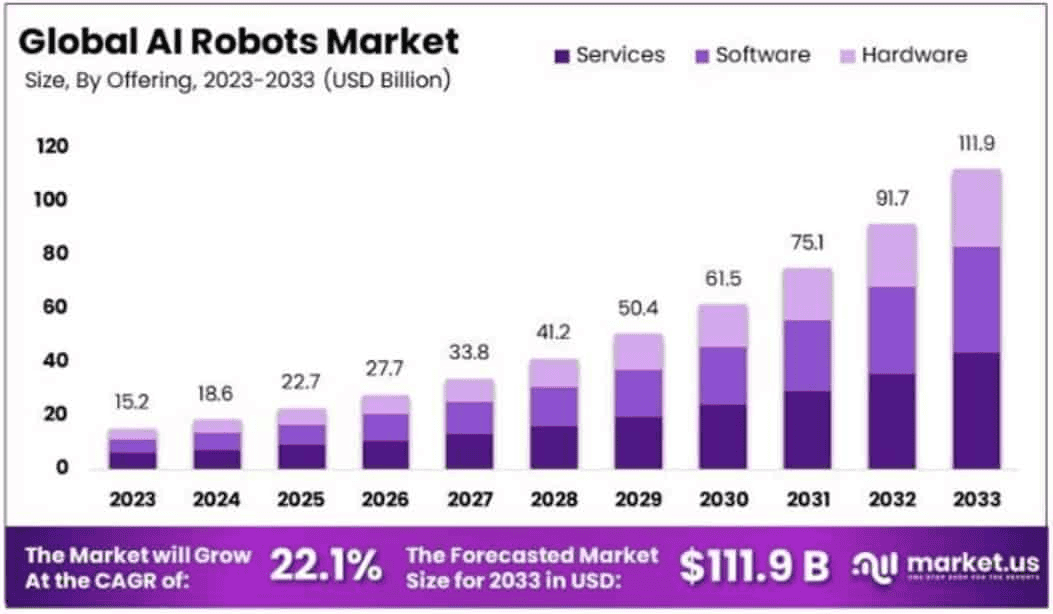
- The global market size of AI Robots is expected to reach approximately USD 22.7 billion by 2025, up from USD 18.6 billion in 2024.
- In 2024, North America’s AI robot market was valued at USD 5.76 billion, accounting for the largest share (34.40%).
- The industrial robots shipped 542,000 units globally in 2024, according to Allaboutai, with a market value of USD 13.9 billion.
- In the United States, the AI robotics market is valued at USD 6.79 billion, with an 18.2% unit share and 98,700 units.
- In 2025, China leads the global AI robotics leaderboard with 1,501,535 operational robots and a robot density of 392.
- More than 16 million service robots are operated worldwide, and AI-enabled models accounted for 57% of the fleet.
- The global use of Autonomous Mobile Robots (AMRs) had risen to 2.9 million units, representing 22% year-on-year growth.
- By the end of 2024, Boston Dynamics had invested USD 400 million and partnered with the Toyota Research Institute to advance robotics research.
- By 2024, the automotive industry had 1,472 robots for every 10,000 workers, and AI robotics was used on 87% of production lines.
General Statistics of AI In Robotics
- Allaboutai.com estimates that the AI-robotics market will be approximately USD 20.51 billion in 2025, with 68% of use in industrial applications.
- In many factories, AI robots can increase efficiency by up to 40% compared with conventional automation.
- Collaborative robots also jumped ahead in 2025: shipments grew 31%, adding 73,000 new cobots. In terms of innovation, China accounts for over 70% of AI-robotics patents, while the United States leads in private AI funding, with USD 471 billion invested since 2013.
- In 2025, activity included more than 150 patent filings and 310 grants. By 2035, AI robotics may add USD 15.7 trillion to GDP, create 97 million jobs, and replace 85 million roles.
- Nearly 79% of robots use computer vision and machine learning, and AI-based control systems grew 58% year over year.
- Generative AI is used by 46% of product teams for design and simulation, cutting costs by 40% to 60% and boosting productivity up to 40%.
- By 2030, the market may reach USD 124.26 billion, and 85% of new robots will ship with embedded AI.
AI In Robotics Market Analysis
(Source: mordorintelligence.com)
- The artificial intelligence in robotics market is projected to increase from USD 25.02 billion in 2025 to USD 126.134 billion by 2030.
- The market is projected to grow at a CAGR of approximately 13.10% from 2025 to 2030.
- According to a 2025 report by StartUs Insights, more than 69,000 people work in AI robotics, and about 8,000 new professionals joined the field last year.
- The United States, India, the United Kingdom, Japan, and China are among the leading countries driving innovation and progress in AI and robotics.
- Boston Dynamics, Oisix Ra Daichi Inc., BDC Capital, and others invested USD 750 million.
- The AI and robotics market generates more than 13,300 publications.
- In the last year, global searches for AI robotics rose by 64.4%.
- The United States’ AI robotics market is projected to reach approximately USD 7.24 billion by 2025.
(Source: infogram.com)
- In 2025, AI-integrated robotics accounted for USD 23.01 billion, whereas traditional automation made up USD 38.90 billion.
- Together, these segments amounted to a robotics market value of USD 61.91 billion in 2025.
By Segments
| Metrics | Market Share (2024) |
CAGR (From 2025 to 2030) |
| Geography | Asia (47%) | Asia (18%) |
| Component | Hardware (62%) | Machine Learning & Deep Learning software (24%) |
| Robot Type | Industrial robots (68%) | Medical & healthcare robots (26%) |
| Application | Manufacturing & assembly (41%) | Logistics & warehousing (25%) |
| End-user | Automotive (28%) | Healthcare (26%) |
| Vendor concentration | Fanuc + ABB + KUKA + Yaskawa (57%) | – |
Facts About Artificial Intelligence And Robotics
(Source: thrivemyway.com)
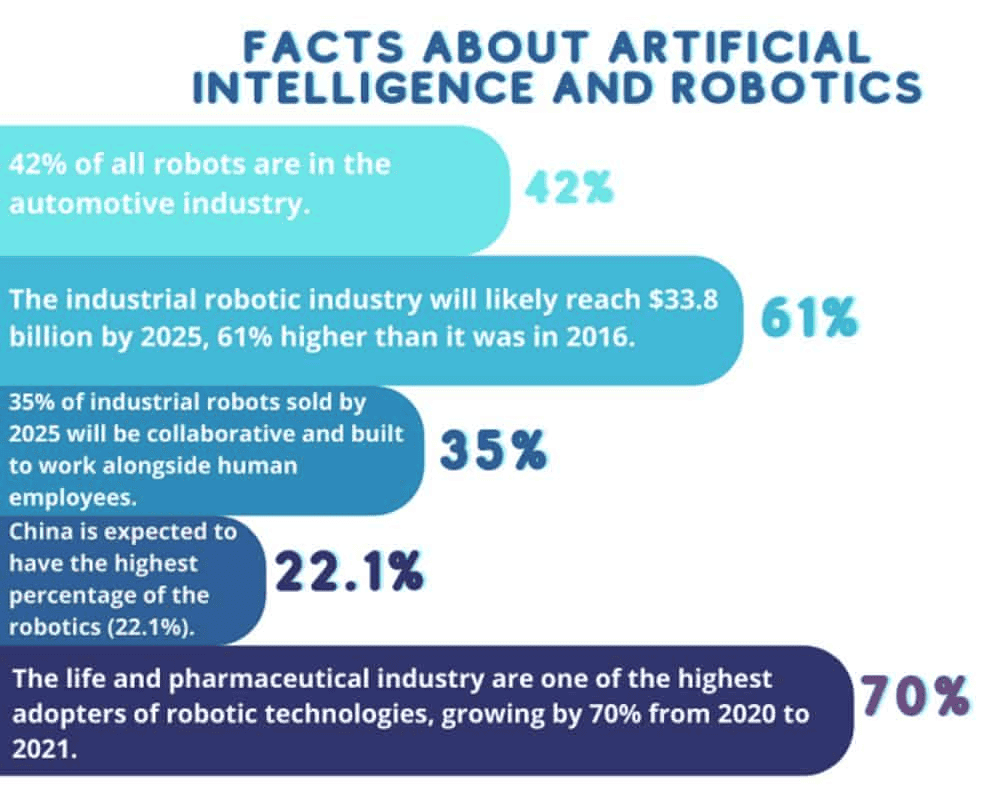
- Around 42% of all robots are used in the automotive industry.
- The industrial robotics sector is projected to reach USD 33.8 billion by 2025, 61% higher than in 2016.
- By 2025, about 35% of industrial robots sold are expected to be collaborative robots designed to work alongside people.
- China is projected to have the largest share of robotics at 22.1%.
- The life sciences and pharmaceutical industries are also major adopters of robotics, with adoption rising by 70% from 2020 to 2021.
Industries Driving The AI Robotics Market
- A report from allaboutai.com stated that manufacturing and assembly account for 42%, with automotive accounting for 15% due to the high-precision work required.
Furthermore, other sector shares are stated in the table below:
| Sector | Market Share | Key Drivers |
| Logistics & Warehousing | 23% | E-commerce uses autonomous sorting and fulfilment. |
| Agriculture | 8% | AI-guided drones and smart harvesters. |
AI Robots Market Statistics
(Source: roboticstomorrow.com)
- The global market size of AI Robots is expected to reach approximately USD 22.7 billion by 2025, up from USD 18.6 billion in 2024.
- The market is projected to reach approximately USD 27.7 billion by 2026, USD 33.8 billion by 2027, USD 41.2 billion by 2028, USD 50.4 billion by 2029, USD 61.5 billion by 2030, USD 75.1 billion by 2031, USD 91.7 billion by 2032, and USD 111.9 billion by 2033.
- The compound annual growth rate of the market is expected to grow by 22.1% from 2025 to 2033.
By Region
(Reference: cervicornconsulting.com)
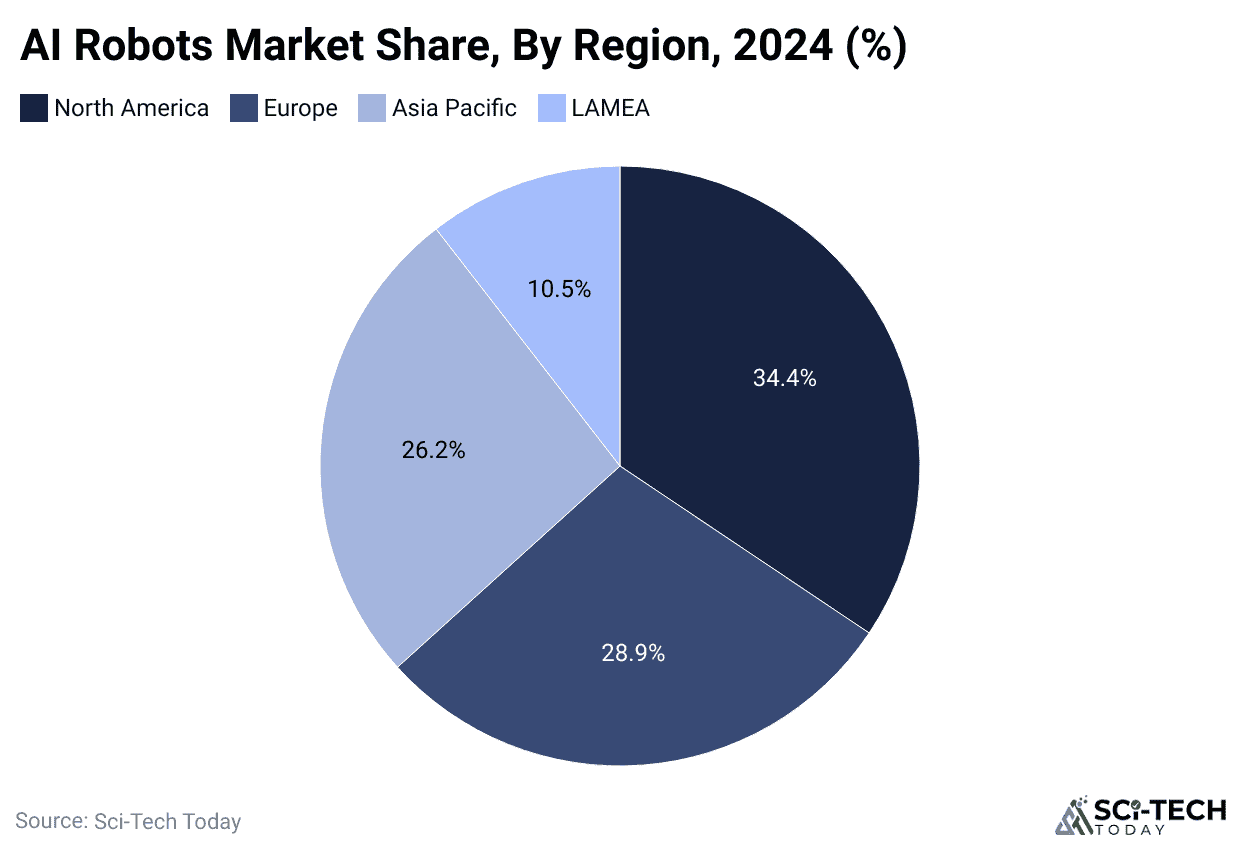
- In 2024, North America’s AI robot market was valued at USD 5.76 billion, accounting for the largest share (34.40%).
- It is projected to reach approximately USD 40.68 billion by 2034.
Furthermore, other regional analyses of the AI Robotics market are mentioned below:
|
Region
|
Market Valuation (USD billion) |
Market Share | |
| 2024 | 2034 | ||
| Europe | 4.84 | 34.18 | 28.9% |
| Asia Pacific | 4.39 | 30.99 | 26.2% |
| LAMEA | 1.76 | 12.42 | 10.5% |
By Segmental Analysis
- According to Precedence Research, North America was the leading region in the AI robot market in 2024, accounting for 33.14% of the global total.
- Meanwhile, the Asia-Pacific region should post the fastest growth, at a 21.9% CAGR from 2025 to 2034.
- In terms of offerings, services accounted for 37.14% of 2024 results, while hardware is projected to expand at a 22.69% CAGR from 2025 to 2034.
- Industrial robots accounted for the largest share in 2024 at 60.48%.
- Service robots are projected to grow at an annual rate of 22.3%.
- Machine learning was the primary contributor in 2024, accounting for 35.06%.
- Cloud deployment was also the largest that year at 53.88%, but on-premises installations may advance at a 21.1% CAGR through 2034.
- Stock management was the primary application in 2024, accounting for 14.13%.
Overview of AI And Robotics Trends
| Area | Growth Rate | Number of Companies | Number of Employees | New Hires (Last Year) |
| Human-Robot Interaction | 14.48% | 126 | 972 | 972 |
| Swarm Robotics | 6.36% | 53 | 800 | 105 |
| Teleportation | 34.45% | 100 | 4000 | 730 |
AI In Robotics Statistics By Robot Type
- The industrial robots shipped 542,000 units globally in 2024, according to Allaboutai, with a market value of USD 13.9 billion.
- AI-enabled models accounted for 79% (428,180 units) in that year.
Other Types of analyses are mentioned in the table below:
| Robot type | Units (2024) |
Revenue (USD) |
CAGR to 2030 | 2030 Expected (units) | 2030 Expected valuation (USD billion) |
| Autonomous Mobile Robots (AMRs) | 145,000 | 4.2 billion | 24.8% | 485,000 | 14.8 |
| Collaborative Robots (Cobots) | 73,000 | 1.42 billion | 18.9% | 198,000 | 3.38 |
| Humanoid Robots | 8,200 | 890 million | 52.3% | 112,000 | 9.2 |
By Regional Analysis
- In the United States, the AI robotics market is valued at USD 6.79 billion, with an 18.2% unit share and 98,700 units.
- It is forecast to grow at a 20.8% CAGR through 2030, reaching an estimated USD 19.4 billion by that year.
Other regional analyses are mentioned below:
| Region | Market Value (USD billion) | Unit Share | Units | CAGR (From 2025 to 2030) |
Expected Valuation, 2030 (USD billion) |
| European Union | 3.81 | 16.4% | 88,900 | 19.3% | 10.8 |
| Asia Pacific | 7.23 | 35.1% | 190,300 | 21.9% | 21.6 |
| Rest of World | 2.68 | 30.3% | 164,100 | 23.4% | 8.9 |
Global AI Robotics Leaderboard Statistics By Country, 2025
- In 2025, China leads the global AI robotics leaderboard with 1,501,535 operational robots and a robot density of 392.
- It also ranks #1 in the AI R&D Bank category.
| Country | Operational Robots | Robot Density | AI R&D Bank |
| Japan | 414,281 | 399 | #2 |
| United States of America | 365,002 | 255 | #3 |
| South Korea | 374,737 | 1,012 | #4 |
| Germany | 245,000 | 371 | #5 |
AI Integration In Service Robotics
- According to a report in SQ Magazine, in 2025, more than 16 million service robots operated worldwide, and AI-enabled models accounted for 57% of the fleet.
- Hospitals increased AI robot deployments for diagnostics and logistics by 38% compared with 2024.
- Retail robots, which use AI for shelf scanning and customer interaction, now generate USD 3.6 billion in global revenue.
- Hospitality experienced a 24% increase in AI concierges and room-service bots in 2025.
- AI eldercare robots reached a total of 4.3 million units.
- By mid-2025, sanitation robots were adopted in 58% of major U.S. airports.
- Predictive maintenance algorithms embedded in service robots reduced operational downtime by 22% in 2025.
AI In Autonomous Mobile Robots (AMRs) And Drones
- By 2025, global use of Autonomous Mobile Robots (AMRs) will reach 2.9 million units, representing 22% year-on-year growth.
- In North America, AMR-based warehouse systems are active in 61% of logistics hubs.
- AI robotic drones for crop monitoring reached 420,000 units globally.
- In building projects, the use of AI-enabled drones for 3D mapping and safety applications increased by 31%.
- In logistics, AMRs with live path planning cut human intervention by 47% as of 2025.
- Facial-recognition surveillance drones hit 620,000 units by mid-2025.
- Drone fleet coordination software supports multi-agent synchronisation in 72% of large deployments, and disaster-response drones equipped with AI thermal imaging are used in 48 countries.
In the Investors of AI in Robotics Statistics
(Reference: startus-insights.com)
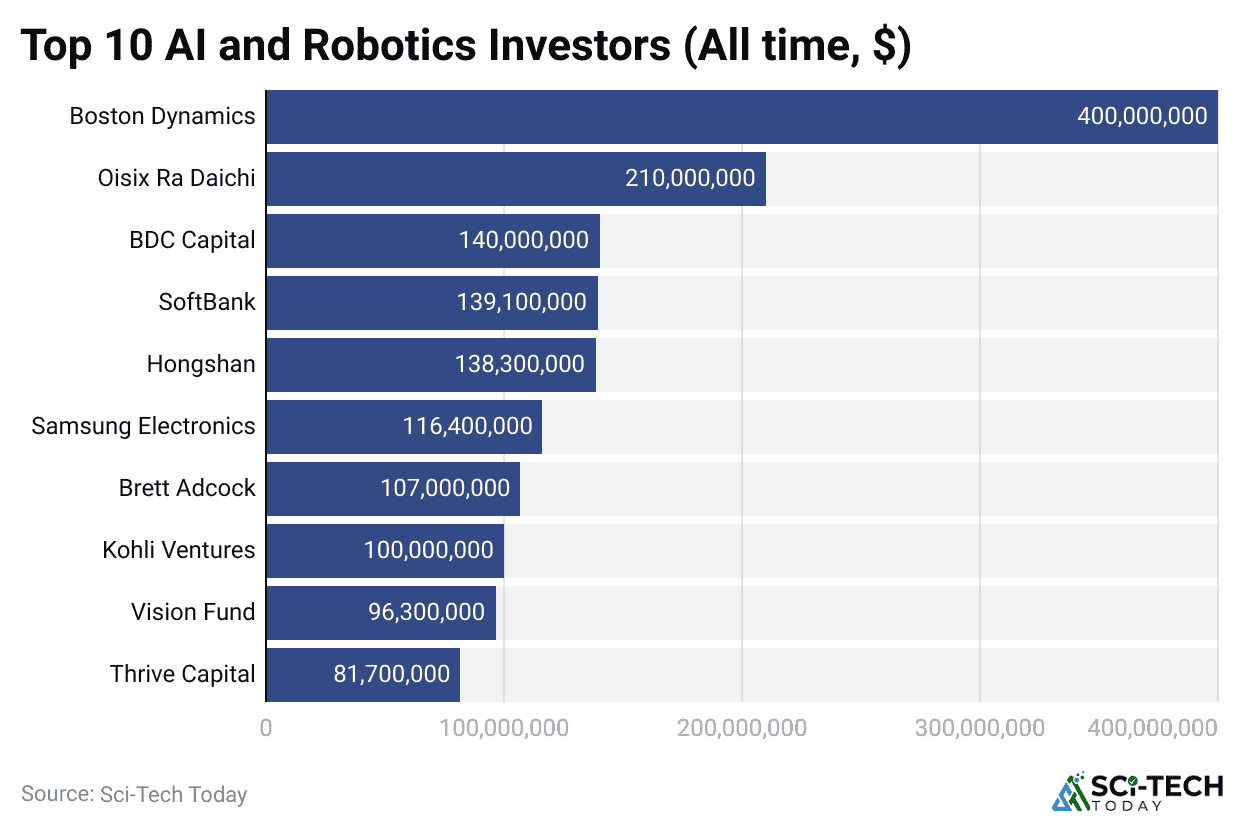
- By the end of 2024, Boston Dynamics had invested USD 400 million and partnered with the Toyota Research Institute to advance robotics research.
- Furthermore, other investors’ investing amounts are followed as Oisix Ra Daichi Inc. (USD 210 million), BDC Capital (USD 140 million), SoftBank Group Corp. (USD 139.1 million), Hongshan (USD 138.3 million), Samsung (USD 116.4 million), Brett Adcock (USD 107 million), Kohli Ventures (USD 100 million), SoftBank Vision (USD 96.3 million), and Thrive Capital (USD 81.7 million).
AI Robotics Adoption, Density, And Performance Gains
- By 2024, the automotive industry had 1,472 robots for every 10,000 workers, and AI robotics was used on 87% of production lines.
- After implementing AI, median OEE increased by 18.4%, whereas throughput typically increased by 23%-28%.
- As a standout example, BMW’s Regensburg plant reports 99.2% quality accuracy using AI vision systems.
|
Industry |
Robot density (per 10,000 workers) | Adoption rate | Median OEE improvement |
Median throughput improvement |
|
Electronics |
1,089 | 72% of assembly operations | +22.1% | 31% to 35% |
| FMCG (Consumer Goods) | 287 | 54% of packaging lines | +15.7% |
19% to 24% |
AI Algorithm Use in Robotics, 2025
| Metrics | Numeric Data |
| Computer vision embedded in robots | 79% |
| Reinforcement learning in control systems | 58% |
| Visual SLAM geographic spread | 91 countries |
| Object detection average accuracy | 94.6% |
| NLP is included in consumer AI robots | 23% |
| Multi-sensor fusion is used in navigation systems | 67% |
| Motion cycle time reduction via trajectory planning | 15% |
| More object types handled with adaptive control AI | 22% |
Conclusion
Ultimately, statistics play a key role in making AI robots more intelligent. With data, robots can learn what is happening around them rather than following only strict rules. They can recognise objects, travel to the appropriate place, and handle objects with greater care. Statistics also help a robot assess its confidence before it acts, thereby improving safety in situations involving confusion, noise, or sudden changes.
Simple trials and results reveal where a robot struggles and what needs fixing. As robots train on larger datasets and continue learning, Willingness, Hong Kong valuation, and clear standards will matter just as much as powerful hardware.

Sources