









Introduction
AI Microcontroller Statistics: Artificial intelligence microcontrollers are changing how devices collect, handle, and use data close to where it is created. Unlike older MCUs, these small chips include built-in machine learning hardware. This enables them to run AI models directly on devices such as fitness bands, drones, and factory sensors. In this article, we look at important numbers that show how quickly AI-MCUs are growing. For example, we explore how many are shipped, how much energy they save, and how fast and accurate their models are.
By comparing use across industries, we can see where edge AI already adds value. We also highlight where new opportunities remain. These statistics help engineers and decision-makers plan and build the next wave of smart, low-power embedded systems.
Editor’s Choice
- The global AI microcontroller market is expected to account for around USD 7.3 billion in revenue by 2025, up from USD 6.1 billion in 2024.
- AI microcontroller growth rates are expected to increase by 625% between 2025 and 2026.
- China’s AI microcontroller market size reached USD 1.01 billion in 2024 and is estimated to account for USD 1.14 billion by 2025.
- According to Market.us, in 2024, Asia-Pacific (APAC) accounted for the largest share of the AI microcontroller market, accounting for more than 34.7% and about USD 2.1 billion in revenue.
- A report by media.berginsight.com stated that on-device AI for IoT earned USD 10.1 billion in 2024 from AI SoCs/SoMs, AI accelerators, AI MCUs, and software/platforms.
- Dual-core MCUs run AI tasks 6 times faster, letting tiny networks respond in 0.20 ms.
- The AI industrial microcontroller market is experiencing strong growth, with revenues projected to reach USD 2,304 million by 2025.
- The Edge AI microcontrollers market is expected to reach about USD 7,500 million by 2025.
- IoT Analytics reports that the IoT microcontroller market reached USD 5.1 billion in 2024.
AI Microcontroller Market Size
(Source: sp-ao.shortpixel.ai)
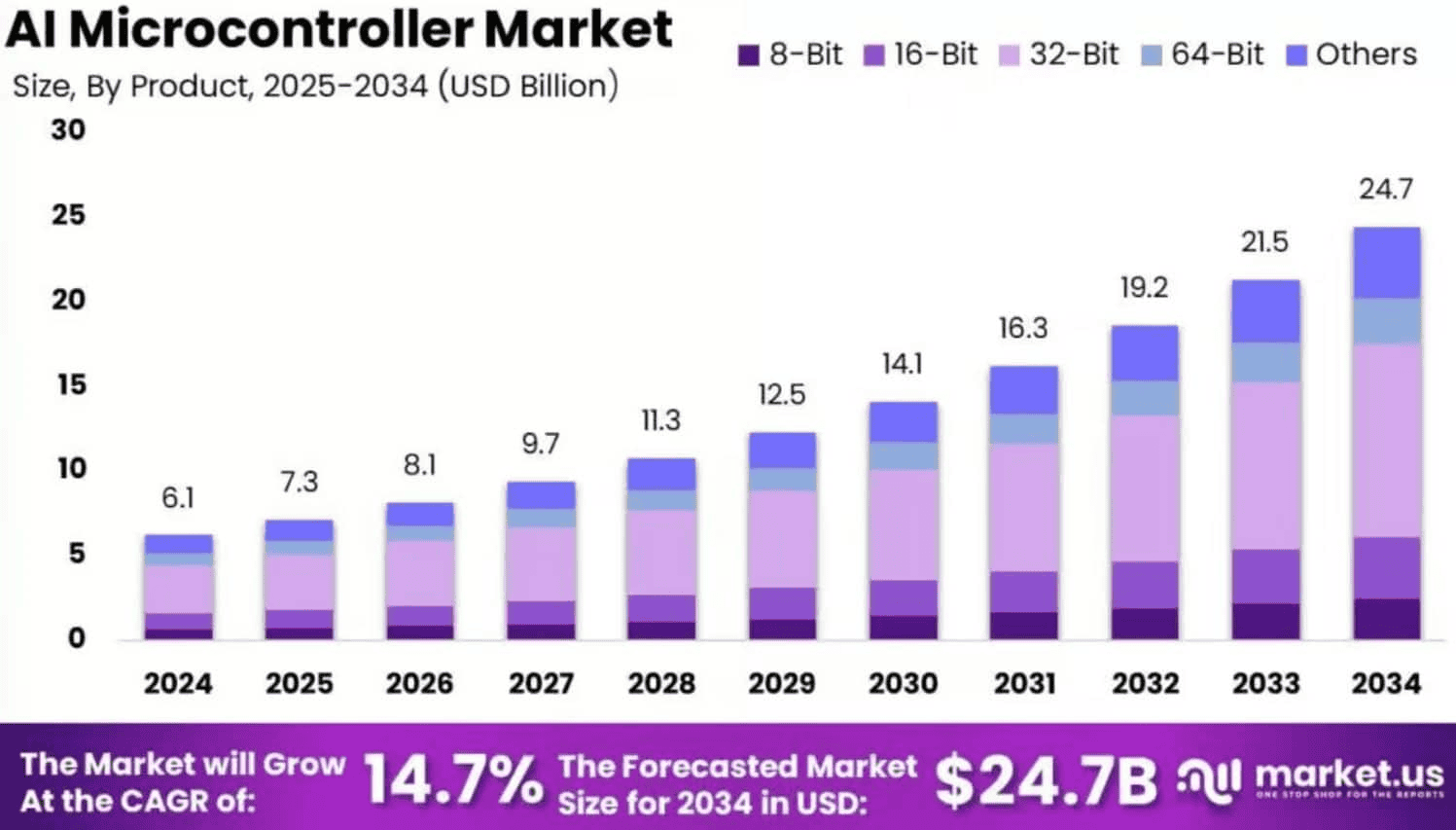
- The global AI microcontroller market is expected to account for around USD 7.3 billion in revenue by 2025, up from USD 6.1 billion in 2024.
- In the coming years, the market is estimated to reach around USD 8.1 billion by 2026, USD 9.7 billion by 2027, USD 11.3 billion by 2028, USD 12.5 billion by 2029, USD 14.1 billion by 2030, USD 16.3 billion by 2031, USD 19.2 billion by 2032, USD 21.5 billion by 2033, and USD 24.7 billion by 2034.
- Additionally, the market will grow at a CAGR of 14.7% from 2025 to 2034.
AI Microcontroller Growth Statistics
(Source: multisite-public.s3.ap-south-1.amazonaws.com)
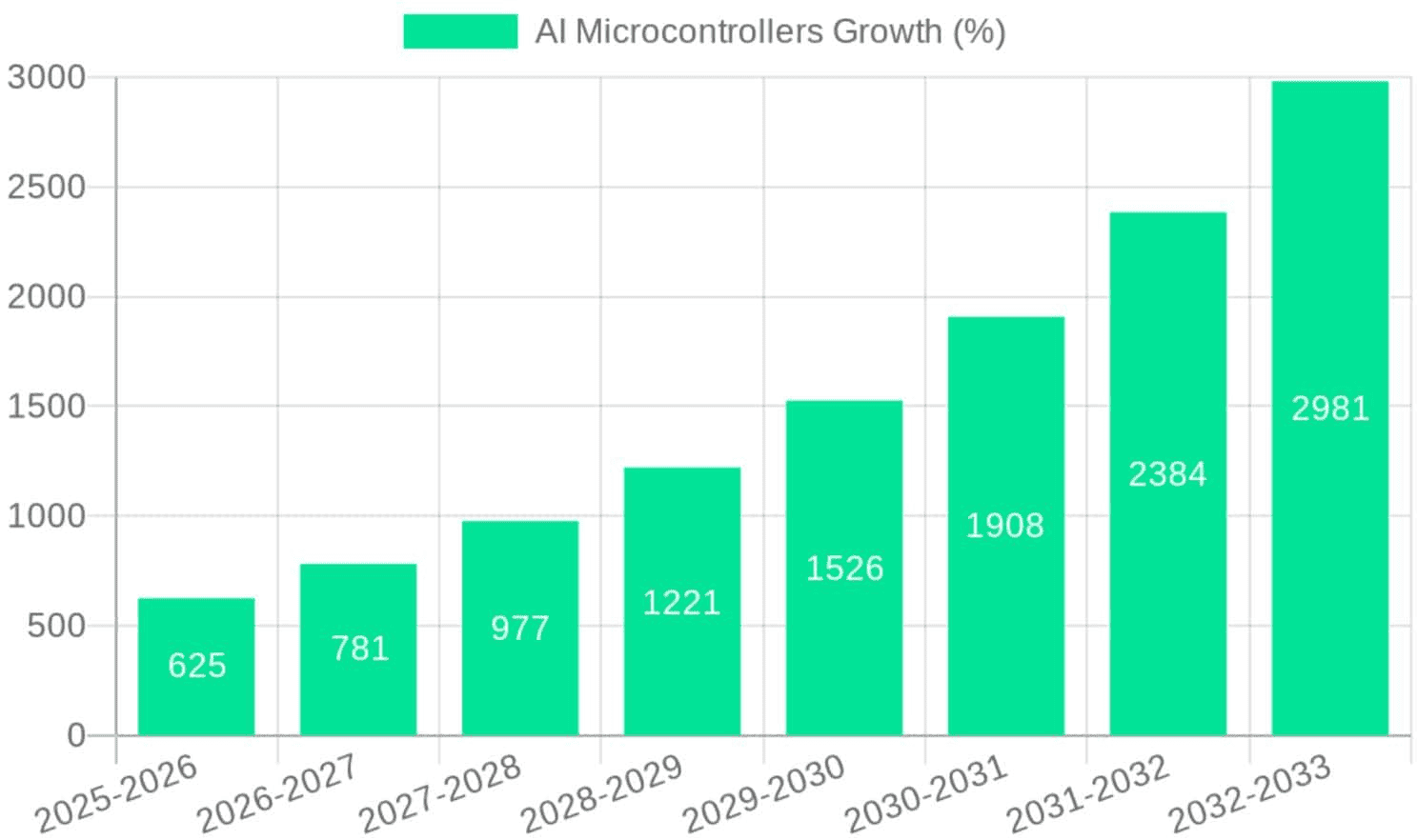
- The above graph shows that AI microcontroller growth rates are expected to increase by 625% between 2025 and 2026.
- Furthermore, followed by 781% in 2026-2027, 977% in 2027-2028, 1221% in 2028-2029, and 1526% in 2029-2030, 1908% in 2030-2031, 2384% in 2031-2032, and finally reaches 2981% in 2032-2033.
Segmental Analysis of The AI Microcontroller Market
- According to Market.us, in 2024, Asia-Pacific (APAC) accounted for the largest share of the AI microcontroller market, accounting for more than 34.7% and about USD 2.1 billion in revenue.
- Within this region, China’s AI microcontroller market alone reached USD 1.01 billion in 2024, growing at a CAGR of 12.4% from 2025 to 2034.
- By type, 32-bit chips were the most popular, accounting for over 46.7% of the market.
- Meanwhile, Natural Language Processing (NLP) led with more than 38.4% market share, and Consumer electronics accounted for 36.5%.
- Direct sales channels were also the strongest, with a share above 54.5%.
- At the same time, consumer electronics was the top end-use industry, with 36.5% of global AI microcontroller sales during the year.
AI Microcontroller Market Statistics In China
(Source: sp-ao.shortpixel.ai)
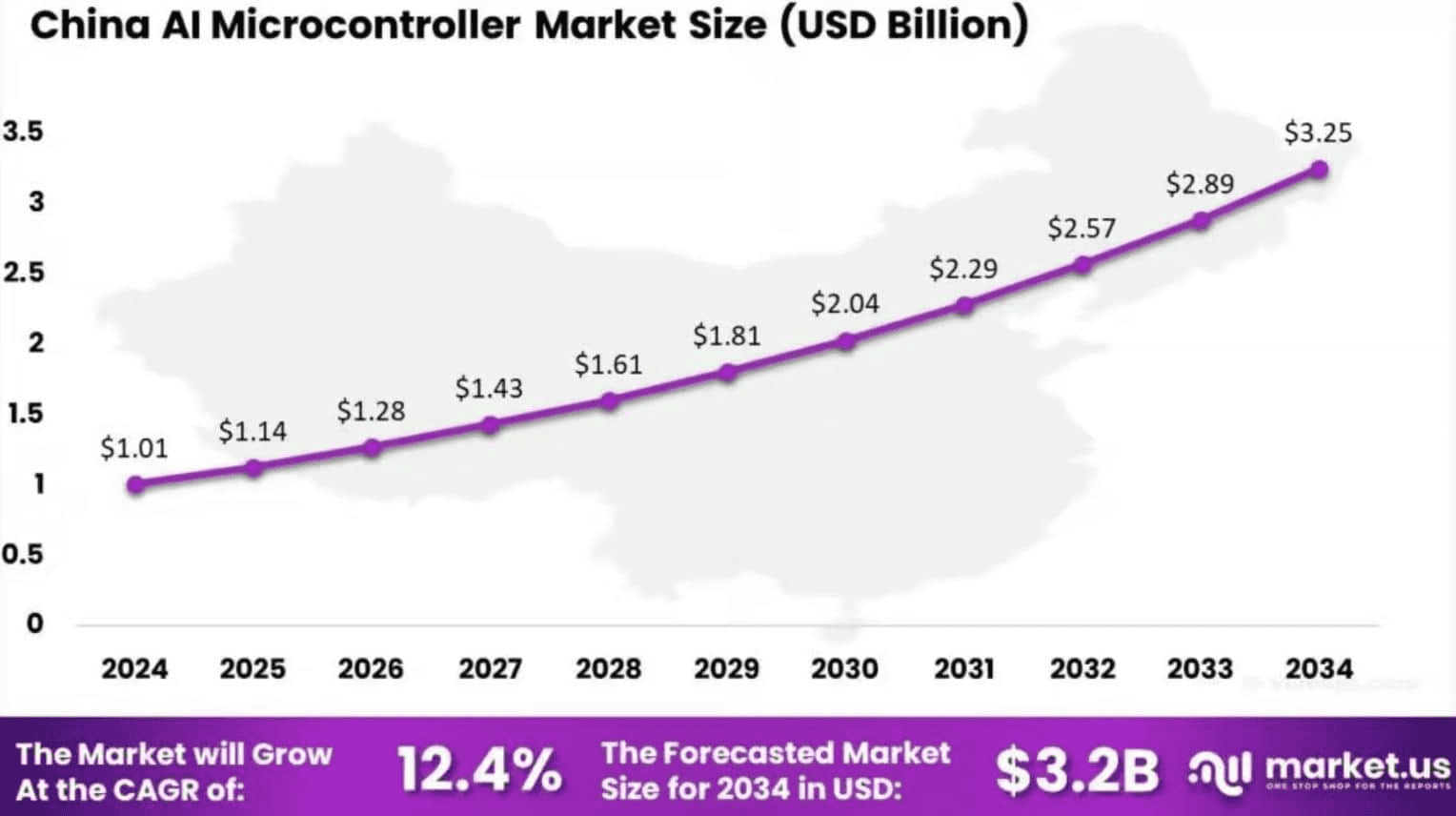
- China’s AI microcontroller market size reached USD 1.01 billion in 2024 and is estimated to account for USD 1.14 billion by 2025.
- The market is growing at a CAGR of 12.4% from 2025 to 2034.
- The market valuation is expected to reach USD 1.28 billion (2026), followed by USD 1.43 billion (2027), USD 1.61 billion (2028), USD 1.81 billion (2029), USD 2.04 billion (2030), USD 2.29 billion (2031), USD 2.57 billion (2032), USD 2.89 billion (2033) and USD 3.25 billion (2034).
On-Device AI Market Statistics
- According to media.berginsight.com, on-device AI for IoT earned USD 10.1 billion in 2024 from AI SoCs/SoMs, AI accelerators, AI MCUs, and software/platforms.
- This market growth was 22% more than in 2023.
- Analysts expect the market to reach USD 30.6 billion by 2029, with a 25% CAGR from 2024 to 2029.
- AI MCUs power low-energy sensors, wearables, and IoT endpoints.
AI Microcontroller Performance Statistics
- On-device AI systems can spot machine faults with about 93% accuracy from vibration signals.
- Image classifiers on microcontrollers, built with NNoM or TensorFlow Lite, achieved 91%-98% accuracy.
- Dual-core MCUs run AI tasks 6 times faster, letting tiny networks respond in 0.20 ms.
- Moreover, optimised speech enhancement runs at about 8 mA, providing over 10 hours of battery life in earbuds.
- Smart thermostats save around 21% to 28% more energy overall.
AI Industrial Microcontroller Statistics
- A report published on datainsightsmarket.com shows that the AI industrial microcontroller market is experiencing strong growth, with revenues projected to reach USD 2,304 million by 2025.
- From 2025 to 2033, it is expected to expand at a compound annual growth rate (CAGR) of 12.3%.
- By 2033, AI industrial microcontroller shipments will surge to exceed 30 million units per year worldwide.
- The North American region accounted for 35%, followed by Europe (30%), Asia Pacific (25%), the Middle East & Africa (5%), and South America (5%).
Edge AI Microcontrollers Statistics
- According to marketreportanalytics.com, the Edge AI microcontrollers market is expected to reach about USD 7,500 million by 2025.
- From 2025 to 2033, it is forecast to grow at a 22% compound annual growth rate (CAGR).
- The Edge AI microcontroller market is dominated by major chipmakers, with STMicroelectronics leading at 18% to 22%.
- The ten leading suppliers, including STMicroelectronics, Analog Devices, Infineon, and others, control over 80% of the edge AI microcontroller market.
- In 2023, roughly 150 million such chips were shipped worldwide.
- Analogue Devices follows with approximately 14% to 18%, while Infineon holds around 12% to 16%; Renesas, NXP, and Microchip each control nearly 10% to 15%.
- Texas Instruments holds about 8% to 12% share across industrial, automotive, consumer, and global IoT markets today.
AI Microcontroller Developer and Maker Community
- Arduino’s developer and maker ecosystem now includes over 33 million active users worldwide, according to Qualcomm’s acquisition announcement and related coverage.
- These users, hobbyists, students, educators, startups, robotics labs, entrepreneurs, and tech professionals build many AI-on-MCU projects on Arduino boards.
- IoT Analytics reports that the IoT microcontroller market reached USD 5.1 billion in 2024, about a 9% decline versus 2023, but is projected to grow at a 6.3% CAGR to USD 7.32 billion by 2030.
- The same report notes total MCU spending (IoT + non-IoT) at USD 23.2 billion in 2024, expected to reach USD 29.4 billion by 2030 with a 3.9% CAGR.
- Meanwhile, globally connected IoT devices are forecast to exceed 40 billion by 2030, many of which run TinyML or AI workloads.
Conclusion
AI microcontroller numbers show that this field is growing rapidly, and more “smart” features are moving to smaller edge devices. Tiny chips now have more power, lower cost, and better energy use so that they can run useful machine-learning tasks on their own.
Many areas, such as cars, hospitals, and home gadgets, are increasingly using these AI chips for faster decision-making and automation. As software tools and common standards improve, AI microcontrollers will become easier to use. Therefore, they will appear in many everyday products.

Sources