








Introduction
Deep Space Exploration Statistics: Deep space exploration kind of slipped into a new phase in 2026, because governments and private organizations started pushing harder to grow humanity’s footprint past Earth orbit. The year was basically defined by big handholds, so to speak, including NASA’s successful Artemis II crewed lunar flyby. At the same time, there was more money going into lunar infrastructure, Mars-oriented research programs were expanding, and private-sector funding climbed to levels that looked almost unreal. Robotics progress, artificial intelligence, deep space communications, plus reusable launch approaches have already lowered mission expenses in a meaningful way while also widening what scientists can actually do.
Meanwhile, as countries chase leadership across the Moon-to-Mars economy, deep space exploration feels like it’s shifting from being only a research mission into a strategic economic engine, one expected to produce hundreds of billions of dollars in long-term value. The following deep space exploration statistics will present the global market, budget, and global space investment.
Editor’s Choice
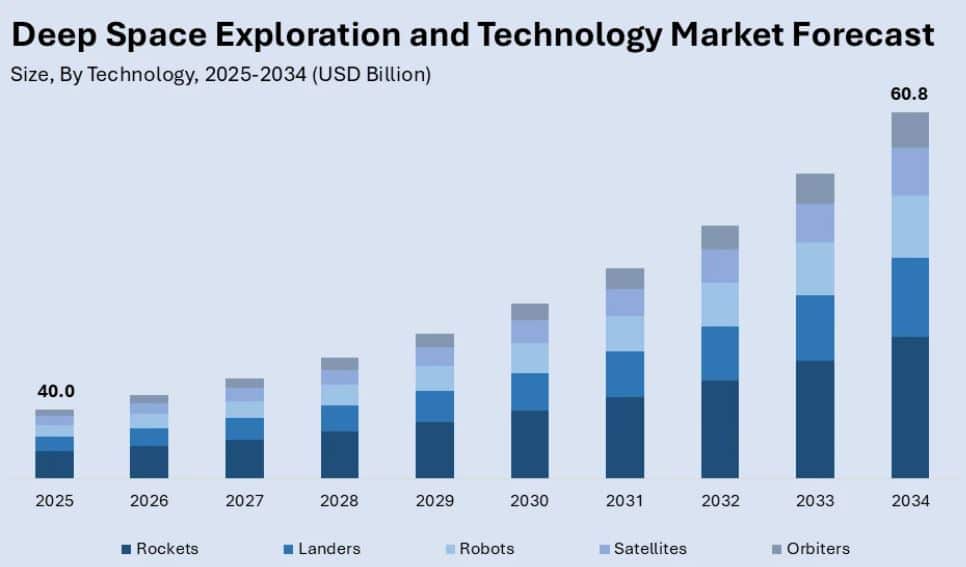
- The global deep space exploration market hit USD 40.0 billion in 2025, and it’s projected to reach USD 60.8 billion by 2034.
- A consistent 4.63% CAGR through 2034 points to durable growth across lunar, Mars, and deep-space technologies.
- NASA’s Deep Space Exploration Systems budget is expected to rise from USD 7.45 billion in FY2023 to USD 8.28 billion by FY2029, showing a sustained investment drive.
- The Moon to Mars Transportation System received USD 4.21 billion, and that’s more than half of NASA’s exploration budget.
- NASA set aside USD 1.90 billion for the Human Landing System (HLS), turning lunar landing capabilities into the main funding focus.
- Global space investment landed at a record USD 7.95 billion in Q1 2026, up over 102% from the prior quarter’s USD 3.93 billion.
- In the same quarter, the industry logged 159 space-sector deals. The average deal size jumped nearly twice, from USD 35.1 million to USD 68 million.
- China’s International Lunar Research Station (ILRS) had already attracted 17 countries and international organizations, plus 50+ research institutions by 2025.
- The European Space Agency increased its 2026 budget to a record €8.26 billion and secured €22.1 billion for programs running through 2028.
- Starship potentially reducing launch costs from USD 1,500–USD 2,000 per kilogram to as little as USD 100–USD 200 per kilogram, and eventually below USD 20 per kilogram under high-reuse scenarios.
(Source: imarcgroup.com)
- The worldwide deep space exploration plus technology market size touched USD 40.0 billion in 2025.
- Looking ahead, IMARC Group estimates the market will grow to USD 60.8 billion by 2034, showing a CAGR of 4.63% across 2026-2034.
- There are quite a few drivers, like how 3D printing and additive manufacturing (AM) are flexible, a rising tally of space expeditions, more space budgets, and also the many green lights provided by government bodies from multiple nations.
Deep Space Exploration Systems Budget
(Source: nasa.gov)
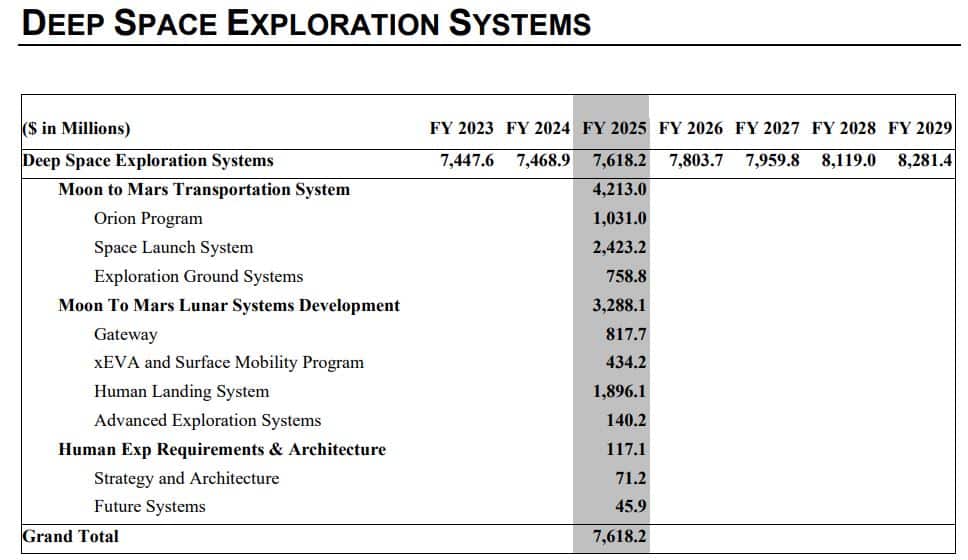
- NASA’s Deep Space Exploration Systems budget really shows the scale of money NASA is pushing toward the next era of human spaceflight.
- In FY 2023, funding was USD 7.45 billion, then it moved up to USD 7.62 billion by FY 2025.
- For FY 2026, the budget sits at USD 7.80 billion, and it’s expected to climb to USD 7.96 billion in FY 2027, scaling again to USD 8.28 billion by FY 2029.
- Honestly, that kind of climb tends to signal a deep, longer-term commitment to the groundwork needed for sustained lunar exploring, and later on missions aimed at Mars.
- Looking closer at FY 2025, the biggest portion goes straight to the Moon to Mars Transportation System, with USD 4.21 billion. That’s over half of the overall exploration budget.
- In that same slice, the Space Launch System (SLS) takes USD 2.42 billion, which makes it the top-funded program on its own.
- The Orion Program is next with USD 1.03 billion, while Exploration Ground Systems receives USD 758.8 million.
- After that, another USD 3.29 billion is earmarked for Moon to Mars Lunar Systems Development, mainly so the infrastructure can handle longer-duration human missions.
- The Human Landing System (HLS) gets the largest chunk here at USD 1.90 billion, underscoring how crucial it is for bringing astronauts back down to the lunar surface.
- The Gateway lunar station receives USD 817.7 million, and the xEVA, along with the Surface Mobility Program, is funded at USD 434.2 million.
- Then, Advanced Exploration Systems adds USD 140.2 million to support future technology progress, sort of like a quiet but important backup plan for what comes next.
- NASA also puts USD 117.1 million into Human Exploration Requirements and Architecture, with USD 71.2 million for Strategy and Architecture and USD 45.9 million for Future Systems.
- If you look at it like an analyst would, the dollars kinda say the quiet part out loud: transportation systems, lunar landing capability, and orbital infrastructure all show up again and again as the heavy hitters.
- The gradual climb from USD 7.45 billion to USD 8.28 billion by FY 2029 feels like the whole effort is shifting from talk, planning, and testing into something more steady, like a consistent operational presence on and around the Moon, and yeah, that sets up the money trail for the later crewed push toward Mars.
Space Investment Reaches Escape Velocity In 2026
(Source: reuters.com)
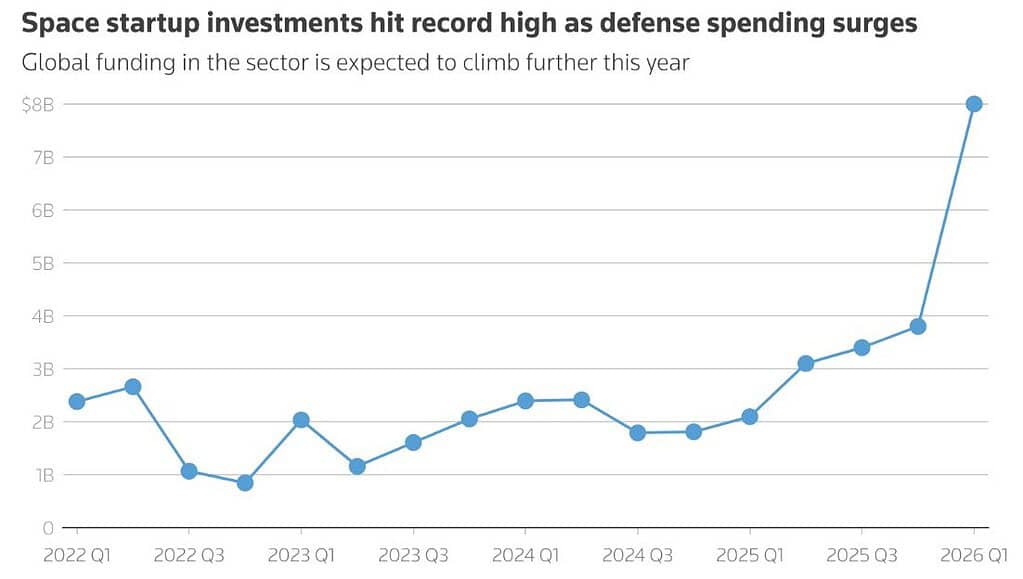
- Globally, the space industry kicked off 2026 with an almost weird level of momentum, because funding hit a record USD 7.95 billion in the first quarter, compared with USD 3.93 billion in the prior quarter.
- So that’s more than a 102% jump quarter over quarter, which reads like investors being genuinely confident across the space economy, not just hopeful.
- Meanwhile, trailing twelve-month investment climbed to an all-time high of USD 18.8 billion, meaning capital inflows into the sector are accelerating, not easing off.
- Deal activity was just as loud. During Q1 2026, the sector logged 159 transactions, pushing an annualized total to a record 654 deals. But the standout story wasn’t really the count, it was the scale.
- Average deal value rose fast from USD 35.1 million in Q4 2025 to USD 68 million in Q1 2026, almost doubling. That pattern implies investors are leaning into established companies with bigger funding rounds, rather than spreading capital thinly across a wider pile of younger startups.
- One of the standout transactions really was the USD 1.75 billion funding round Saronic pulled in, which makes it one of the biggest private space – related financings on record. Stuff like this, big and very visible, is kind of reworking how money moves through the industry, and it’s also pushing broader market growth along with it.
- Regionally, North America came in at around 70% of the total funding, so it stays the main place where space ventures tend to get backed.
- Meanwhile, Europe showed its best investment results since 2022, and Asia added more than USD 1.2 billion in fresh capital, which points to a wider global involvement that’s getting harder to ignore.
- Overall, the figures suggest the market is moving past the “only satellite communications” idea. Investment is increasingly targeting in-space infrastructure, think commercial space stations, orbital data centers, and other services that live off-world.
- When you layer in the chatter around a possible SpaceX public offering, plus recent deals like the proposed USD 11.6 billion acquisition of Globalstar, the sector seems to be sliding into a new phase with bigger capital commitments, more room for market opportunities, and, honestly, record – level enthusiasm from investors.
Global Competitors – China’s ILRS and International Space Agencies
- Global Deep Space Exploration Market Studies for 2026 show this kind of big change across the wider space world. If you look at it from an analyst’s viewpoint, the space sector just isn’t being pulled by one dominant country anymore.
- Instead, China and Europe are showing up as major players in what comes next for lunar and far beyond infrastructure.
- On top of that, global market assessments suggest the deep space exploration and technology field was roughly USD 38–40 billion in 2024, and it may climb to about USD 58–61 billion by the start of the 2030s, which really underlines how much economic weight lunar exploration, planetary science, and deep-space technologies are getting.
- Official guidance from the China National Space Administration (CNSA), along with the China Manned Space Agency (CMSA), keeps pointing to the aim of reaching a crewed Moon landing by 2030.
- The whole mission setup involves the new Mengzhou spacecraft, the Lanyue lunar lander, and the Long March 10 heavy-lift rocket system.
- Between 2025 and 2029, China is expected to run a lot of tests, plus mission simulations, so its lunar timeline stays on track.
- After that first landing, China is putting a lot of money into the International Lunar Research Station (ILRS), like it’s not really a “one-off” thing.
- The whole program works along a long schedule that goes past 2035, with three stages—reconnaissance, construction, and utilization.
- Then there are the robotic efforts, Chang’e-7 (2026) and Chang’e-8 (2028, they’re meant to lay down the groundwork for some kind of lasting lunar footprint.
- Chinese officials say there should be a basic lunar research station by 2035, and then a broader version close to 2040, backed by a better communications backbone and orbital support.
- Also, the ILRS already pulled in 17 countries, plus international organizations, and more than 50 research entities as collaboration partners by 2025.
- Meanwhile, Europe is also pushing harder into deep space, with extra public spending that’s pretty visible.
- The European Space Agency (ESA) said it would raise its budget by 7.6% so the 2026 total becomes €8.26 billion, which ESA calls the highest level it’s ever had.
- On top of that, member states okayed a €22.1 billion funding package for 2026–2028. That’s more than €5 billion higher than the earlier funding cycle.
- These funds are supposed to support lunar activities, Mars robotics, deep space links, plus improvements to the Estrack tracking network.
- Put together, the figures really show a shift toward a multipolar space age; deep space exploration is going to be shaped more by several big global actors, not just one power pulling everything.
Next-Generation Launch Vehicles – Slashing The Cost To Orbit
- The big deal deep-space statistic for 2026 isn’t really the count of missions people are launching; it is more like the noticeable dip in launch costs thanks to reusable heavy-lift rockets.
- Mordor Intelligence says the worldwide reusable launch vehicle market was around USD 6.15 billion in 2025, and it is expected to rise from USD 6.43 billion in 2026 to almost USD 9.45 billion by 2031, which works out to a CAGR of 7.99%.
- Already, reusable booster fleets are driving average launch costs under about USD 2,500 per kilogram, and that quietly flips the whole economic setup for lunar and Mars exploration.
- By May 2026, Starship had managed at least nine integrated test flights, with the major milestones landing around Flight 8 in March 2026 and Flight 9 on May 27, 2026.
- Flight 9 included a successful return and recovery of the 33-engine Super Heavy booster, and it got grabbed by the Mechazilla tower roughly 7 minutes and 12 seconds after liftoff, which was the second straight time they caught a booster, too.
- The upper-stage craft then also followed its planned mission profile, basically showing momentum toward a higher cadence reusable launch framework.
- The commercial potential is becoming almost equally significant, or at least that’s how it looks now. In its first completely commercial mission in May 2026, Starship apparently managed to deliver a 22-tonne communications satellite into orbit, and this showed it can move past testing into operations that actually earn money.
- More importantly, analysts think Starship might one day cut launch costs down to something like USD 100–USD 200 per kilogram, rather than the roughly USD 1,500–USD 2,000 per kilogram numbers you typically see with Falcon 9, and definitely far below the about USD 10,000–USD 30,000 per kilogram for the traditional expendable heavy-lift rockets.
- Starship may reach launch costs of around USD 93.66 per kilogram after six fully reusable flights, then drop to USD 32.50 per kilogram after twenty flights. After about seventy flights, they go even further, estimating maybe USD 16.43 per kilogram.
- Taken together, these results are close to a 100x decrease compared with today’s heavy-lift yardsticks of roughly USD 1,400 per kilogram.
- At the same time, Blue Origin’s New Glenn is showing up as sort of a second major actor in reusable heavy-lift transport.
- After a solid third mission (NG-3) in April 2026, the company demonstrated improved launch reliability and also mentioned plans for at least four more launches.
- Even though New Glenn is built on a partially reusable design, analysts expect it could still help pull down launch prices for large commercial payloads and government payloads, perhaps a lot.
- The statistics suggest launch costs are rapidly becoming more like a smaller part of total mission budgets.
- As transportation expenses drop, more money can be steered toward lunar habitats, robotics, scientific devices, resource-utilization methods, and deep-space backbone infrastructure.
Conclusion
Deep space exploration is changing fast into a strategic global industry, powered by bigger government allocations, record private investment, and breakthrough launch technologies. NASA, China, Europe, and commercial operators are putting billions into lunar infrastructure, transit systems, and what comes next for Mars.
Also, reusable rockets are cutting the cost of reaching space, which makes ambitious missions more practical than before. With more countries joining in, lunar research programs growing, and record capital inflows, deep space activity seems to be moving away from one-off scientific missions and more toward long-term economic expansion. These patterns place deep space exploration as one of the main technology and investment frontiers for the next few decades.
FAQ
The global deep space exploration market is valued at about USD 40.0 billion.
NASA’s exploration budget is expected to rise to USD 8.28 billion by FY2029.
The sector attracted a record USD 7.95 billion in funding during the first quarter of 2026.
The program has attracted 17 countries and organizations and more than 50 research institutions.
Analysts estimate costs could fall to USD 100–USD 200 per kilogram, with some projections dropping below USD 20 per kilogram under extensive reusability.

Sources


