









Introduction
Human Spaceflight Statistics: Human spaceflight kind of entered a transformative era in 2026, as government agencies and private companies started pushing harder for a sustained human presence beyond Earth. After the commercial crew transportation success, the whole industry saw more money going into lunar exploration, private astronaut missions, space tourism, and also more capable spacecraft development. NASA’s Artemis program hit a historic moment with the crewed Artemis II lunar flyby, and then commercial operators like SpaceX, Axiom Space, and Virgin Galactic kept widening their human-spaceflight plans.
With billions of dollars moving into lunar infrastructure, spacecraft systems, and commercial low-Earth-orbit programs, human spaceflight has shifted from a mainly government-led effort into a rapidly expanding worldwide economic segment. The statistics below point out the main numerical currents shaping human spaceflight in 2026.
Featured Selection
- The global space tourism market is accelerating at a striking 36.6% CAGR, so it’s among the quickest-growing parts in the space economy.
- Space tourism revenue is expected to top USD 4.16 billion by 2027, and then climb to USD 17.74 billion by 2032.
- Commercial operators pretty much lead the sector, holding around 57% of the global space tourism market.
- NASA has awarded 11 Commercial Lunar Payload Services (CLPS) task orders, while four lunar landers have already launched.
- CLPS missions ran into an average 14-month schedule slip, with schedules growing from 30 months to 44 months, on average.
- NASA’s Human Landing System program has committed nearly USD 7 billion since 2019, and it is projected to pass USD 18 billion by FY2030.
- Artemis III will send a four-member crew on an approximately two-week lunar mission architecture demonstration.
- NASA has selected 370 astronauts since 1959, including 67 women, while its 2025 astronaut class emerged from more than 8,000 applicants.
- Long-duration human spaceflight continues to advance, with Frank Rubio’s U.S. record of 371 consecutive days in orbit.
- NASA currently spends USD 3–4 billion annually on ISS operations, but aims to reduce future low-Earth-orbit costs to approximately USD 1 billion per year through commercial space stations.
Global Space Tourism Market
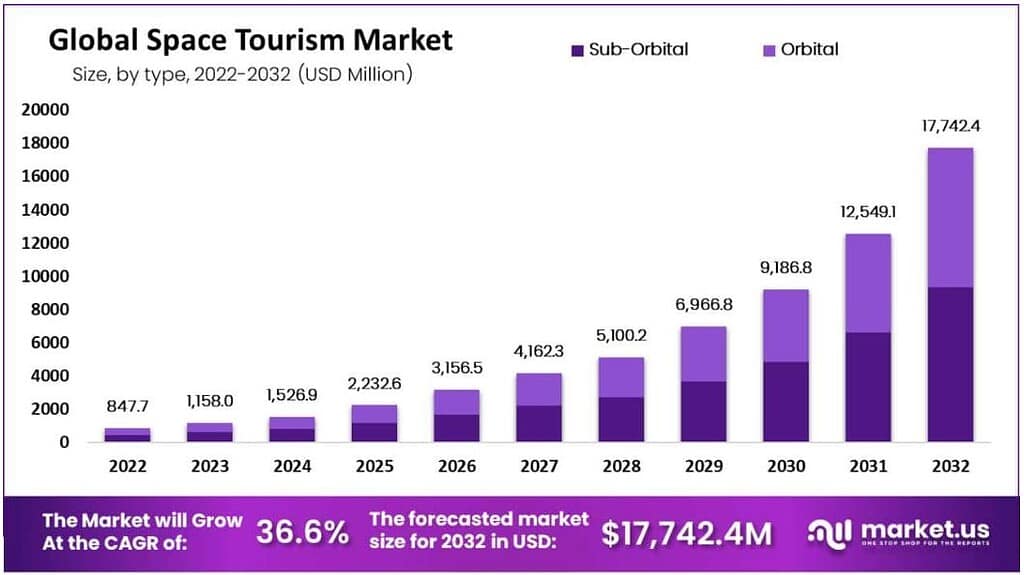
(Source: market.us)
- Space tourism has been growing pretty remarkably lately, with a CAGR of 36.6% and revenue basically climbing up, higher and higher, like it never stops.
- By 2027, the market is projected to jump beyond USD 4,162.3 million, and the same upward momentum should keep moving through the next years, landing at an eye-catching USD 17.74 billion by 2032.
- Within this fast-paced, quite competitive field, commercial players take the lead, holding about 57% of the market share.
Human Spaceflight’s Lunar Leap Moon Missions Accelerating
- The next chapter of human spaceflight is being shaped by unprecedented investment in lunar transportation systems and commercial partnerships.
- Statistical indicators suggest that NASA’s lunar ambitions are ramping up, fast, with the agency handing out 11 Commercial Lunar Payload Services (CLPS) task orders to five commercial vendors, while four lunar landers have already launched.
- Still, building out a true lunar economy has been challenging. NASA’s Inspector General pointed to a cumulative USD 208.2 million increase in CLPS mission costs and an average schedule delay of 14 months per task order.
- Early planning aimed for departures within 30 months after contract award, but the real average stretch widened to 44 months, showing just how complicated lunar mission development can get.
- For example, NASA’s VIPER rover, weighing about 1,000 pounds, came with a mission price tag around USD 433.5 million, and it sort of shows the growing sophistication of moon surface operations, plus how pricey they’re getting over time.
- The above figures suggest a shift from early experimental sorties toward more capable and strategically important lunar infrastructure.
- Since the HLS program started in 2019, NASA has put nearly USD 7 billion into lander development, and it’s expected to exceed USD 18 billion by FY2030.
- NASA auditors reported that SpaceX contract costs went up only about 6%, while Blue Origin’s costs rose by less than 1%, which points to strong cost discipline compared with a lot of past aerospace projects.
- Altogether, these numbers point to a human spaceflight area moving from an idea phase into actual execution.
- The mix of multibillion-dollar investments, rising launch activity, and controlled contract growth implies that NASA and its commercial partners are steadily assembling the groundwork for continuing lunar operations and, later on, crewed missions beyond the Moon.
Artemis III Mission – Building Human Spaceflight’s Return To Deep Space
- Human spaceflight is kind of stepping into a new era, and Artemis III really brings home the size of what’s being put in, like investment, tech, and also international teamwork that’s pushing a return to deep space exploration.
- NASA notes Artemis III is slated for 2027, and it’s basically a make-or-break test run before Artemis IV in 2028, planned as the first crewed trip down to the Moon’s South Pole.
- For Artemis III, there will be a four-person crew, plus one reserve astronaut, and they will carry out high-level rendezvous and docking tasks with commercial lunar landers that are being built by SpaceX and Blue Origin.
- Artemis III will require several heavy lift launches, and the astronauts will spend about two weeks in space.
- During that timeline, Orion is expected to stay tied in with Blue Origin’s lunar lander for around two days, and then later spend about one additional day connected with SpaceX’s Starship test craft.
- Commander Randy Bresnik is going for his third space mission, and he brings background from more than 7,000 flight hours across 95 aircraft types.
- ESA astronaut Luca Parmitano, also on his third flight, will add over 2,000 flight hours across 40 aircraft types, and he will become the first European Space Agency astronaut assigned to an Artemis mission.
- Frank Rubio, on his second flight, previously set the U.S. record for the longest single- duration astronaut stay with 371 straight days in orbit. Andre Douglas will represent the next generation of explorers on his first spaceflight.
- Artemis III is, sort of, less about pushing through to the Moon right away and more about demonstrating a scalable human spaceflight setup.
- The mission blends four astronauts with multiple spacecraft, plus two commercial lunar landers, and it runs a two-week orbital campaign, basically all of it stitched into one integrated demo.
- The sheer size, the schedule rhythm, and the technical difficulty they’re carrying around hint that human spaceflight is moving toward a very ambitious expansion, a kind of thing that feels close to the Apollo era.
Human Spaceflight By The Numbers
- Human spaceflight has kinda evolved from this small experimental effort into one of the more advanced, exploration-pushing ventures in history.
- NASA’s astronaut records show that ever since the first astronaut selection happened in 1959, the agency has picked 370 astronaut candidates overall, with 303 men and 67 women. In that group, 226 came from military backgrounds, while 144 were civilians.
- NASA also adds that 203 astronauts were pilots, and 167 were non-pilots, which in practice underscores how much science, engineering, and medical specialties matter for human exploration today.
- NASA’s latest astronaut class, the one selected in September 2025, came from a pool of more than 8,000 applicants. Right now, these folks are in training that’s almost two years long, before they’re considered eligible for missions tied to low Earth orbit work, lunar exploration, and later Mars goals.
- As of February 2026, NASA says it has 37 active astronauts, 9 management astronauts, and 10 astronaut candidates.
- Meanwhile, 342 former astronauts and payload specialists are still part of the agency’s broader human spaceflight legacy, even if they’re not currently in the same active rotation.
- For example, active astronaut Mike Fincke has logged 549 days in space, plus 9 spacewalks, totalling 48 hours and 37 minutes.
- For NASA SpaceX Crew-8 in late 2024, Michael Barratt’s total accumulated time in space is 446 days. Put together, this kind of record suggests the growing attention toward long-duration space travel, something that’s basically a must for future missions beyond the Moon.
- Astronaut Frank Rubio put a U.S. record on the board with 371 consecutive days in space, beating the prior American benchmark of 355 days. Long-duration missions like these end up delivering useful data for figuring out how the human body copes with extended periods in orbit, and that becomes an essential rung on the ladder toward crewed Mars expeditions.
- Over six decades, with 370 astronauts selected, and thousands of applicants chasing a small handful of slots, plus missions that are now lasting more than a year each.
- NASA is steadily assembling the workforce, lived experience, and day-to-day operational know-how required for persistent exploration of the Moon, Mars, and beyond.
- The numbers seem to point to the next era of human spaceflight, being bigger, lengthier, and more audacious than before.
Human Spaceflight, Commercial Space Stations, and The LEO Economy
- Human spaceflight is currently in the middle of one of its biggest structural changes since the launch of the International Space Station (ISS).
- With the ISS expected to retire around 2030, NASA is moving away from a government- owned arrangement toward a commercially led orbital economy.
- The agency now spends roughly USD 3–4 billion every year on ISS operations, transportation, and support services.
- Through its Commercial LEO Destinations (CLD) strategy, NASA wants to bring down long-term operating expenses while still preserving a human presence in low Earth orbit.
- Looking at future planning scenarios, NASA might even act as an anchor tenant, putting about USD 1 billion per year into commercial station services, rather than running an entire station by itself.
- Since the CLD program launched in 2021, NASA has funded multiple commercial station concepts, including Axiom Station, Starlab, and Orbital Reef.
- The objective is kinda to ensure that at least one operational commercial station is available before the ISS hits retirement in 2030, so human activity in orbit keeps going without any break.
- Because continuous human presence in low Earth orbit has been going on for more than two decades, it still sits right at the center of future exploration strategies.
- NASA is planning to launch its first dedicated module, the Payload Power Thermal Module (PPTM), by 2028.
- NASA has also already locked in more than USD 450 million in private capital.
- On top of that, NASA approved a fifth Private Astronaut Mission, aimed for January 2027, which shows commercial demand for crewed missions is climbing.
- By 2025, the project had completed five big development milestones, including preliminary design and safety reviews.
- The station is expected to shift from conceptual planning into full-scale hardware development, with operational deployment targeted for the late 2020s. Finishing those milestones basically indicates that commercial human-spaceflight infrastructure is moving past design studies and toward actual construction, finally.
- Orbital Reef is showing up as another pretty ambitious idea for human spaceflight. Sort of a mixed-use orbital destination, it should be able to host up to 10 people, and it might start operating between 2027 and 2030.
- The plan is meant to back research, manufacturing, tourism, plus other commercial work. In other words, it’s meant to show that spaceflight for humans is not only a government thing anymore. It is also moving toward broader economic uses and more everyday activities in orbit.
Conclusion
Human spaceflight in 2026 is kinda shifting, moving away from being led mostly by government, and into a more varied commercial ecosystem. That change is being pushed by lunar exploration, private astronaut missions, space tourism, and commercial space stations. Big investments in lunar landers, Artemis missions, and orbital infrastructure show long-term intent for keeping humans around beyond Earth.
At the same time, more involvement from private companies is changing how astronauts go, live, and work in space. You can also see it in record-setting mission times, in tougher competition among astronauts, and in the growing number of commercial stations being built. Taken together, these signals suggest human spaceflight is now entering its most ambitious growth moment since Apollo. That sets the stage for future missions to the Moon, Mars, and beyond.
FAQ
The space tourism industry is projected to grow at a 36.6% CAGR.
NASA has committed nearly USD 7 billion since 2019 and expects spending to top USD 18 billion by FY2030.
NASA has selected 370 astronauts since 1959.
Frank Rubio’s 371-day mission holds the U.S. record for continuous time in space.
The ISS is currently expected to retire around 2030, with commercial stations planned to succeed it.