








Overview
Rocket Launch Statistics: An annual event for the year-long 2025 in the international space industry will be set, as the industry continues to raise new records for the frequency of rocket launches, success rates, and economic impacts. Commercial satellite launches and then heralding space-exploration missions, data were marked to stress the growing role that space technologies will play in the future.
The article provides an in-depth analysis of the most critical rocket launch statistics and business trends in 2025.
Editor’s Choice
- In 2025, SpaceX executed 165 Falcon 9 launches, setting a new single‑year record for any launch vehicle family and lifting an estimated 2,400 tonnes to orbit, making the company the biggest player in the game. It was followed by the Chinese contractor CASC, which conducted 45 launches.
- By 2025, commercially operated rockets accounted for around 215 of 329 global orbital launch attempts, about 65–70% of total activity, with U.S. providers led by SpaceX delivering the majority of these missions.
- By 2021-09, Starlink had more than 6,300 satellites in orbit and hopes to deploy up to 40,000 satellites in total.
- Rocket launch statistics reveal that Kuiper is Amazon’s program to send off more than 3,200 satellites before 2025. In 2021, Roscosmos made 25 launches, nine of which were commercial. The launch sites were mostly located at Kazakhstan’s Baikonur Cosmodrome.
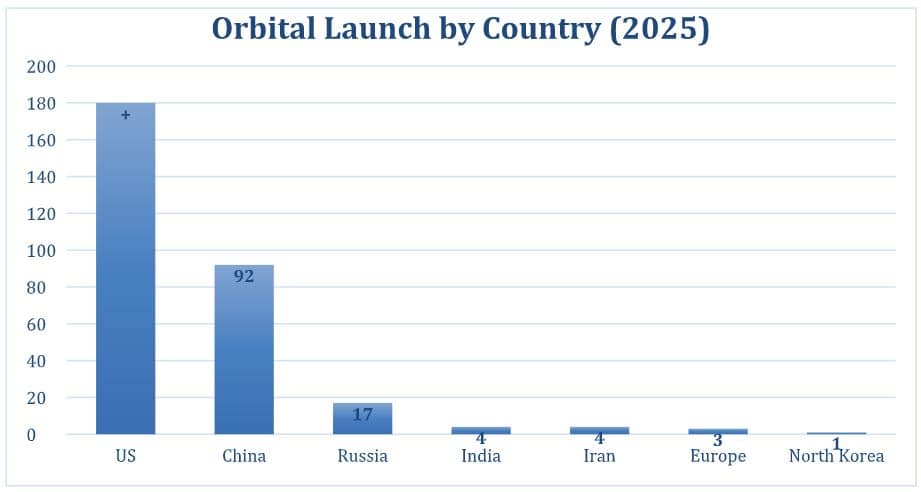
- The U.S. led the world in orbital launches, with over 180, followed by China (92) and Russia (17). Other countries, such as Japan, India, and Iran, had smaller numbers than their predecessors.
- Rocket launch statistics show that in 2023, the Falcon-9 was the most frequently used rocket family, with 126 launches, followed by other vehicles such as Starship, Firefly-Alpha, and China’s CZ-2, CZ-3, and CZ-4 families.
- New commercial rockets in 2024 will number 14, nearly half of which will come from start-ups, some in Australia and Argentina. Japan’s ambitious space program aims to double its space market from the current US$27 billion to US$54 billion by the 2030s.
- Signs were emerging of a slowing economy in space from Q4 2023, with few mergers and acquisitions and a 9%drop in the S-Network Space Index.
Rocket Launch Statistics by Country

(Source: statista.com)
- Launching rockets into orbit is an incredibly costly endeavor that has historically been restricted to government space agencies that have sent astronauts and satellites into orbit.
- However, this trend has been changing amid the tremendous growth of the private space industry in recent years.
- Increasingly, governments are entrusting their launches to contractors, while private ventures like those of Richard Branson’s Virgin Galactic, Jeff Bezos’ Blue Origin, and Elon Musk’s SpaceX are actively pursuing new ventures, such as a combination of suborbital and orbital space travel and transportation.
- I
- n 2025 SpaceX executed 165 Falcon 9 launches, setting a new single‑year record for any launch vehicle family and lifting an estimated 2,400 tonnes to orbit, making the company the biggest player in the game. It was followed by the Chinese contractor CASC, which conducted 45 launches.
- CASC publicly reported 73 space launch missions in 2025, including 69 Long March launches and 4 Jielong‑3 flights, sending more than 300 spacecraft.
- Of these, Russia’s Roscosmos was the most active, accomplishing 18, placing it third overall. India’s ISRO ranked fifth with just seven launches.
Commercial Space Launches

(Reference: statista.com)
- By 2025, commercially operated rockets accounted for around 215 of 329 global orbital launch attempts, about 65–70% of total activity, with U.S. providers led by SpaceX delivering the majority of these missions.
- While the activity by U.S. companies this year marks such a jump in launches, it also suggests a vast increase over the decade.
- Such changes occur when most successful companies, such as SpaceX, Blue Origin, and Rocket Lab, reduce prices to provide greater access and more frequent launches to space.
Major Satellite Projects Around the World

(Source: statista.com)
- Rocket launch statistics show that Starlink began operations in 2019 and, by the first week of September 2021, had more than 6,300 satellites in orbit.
- As of June 2026, Starlink consists of approximately 10,413 satellites in orbit, of which 10,397 are operational, according to Wikipedia and Jonathan McDowell’s tracking.
- Independent live trackers put the active satellite count in a very similar range: around 10,700+ active Starlink satellites, with more than 12,000 launched in total and the remainder deorbited.
- Starlink currently has regulatory approval and technical plans for up to about 42,000 satellites in its extended “Gen2” mega constellation.
- Another player in the international satellite market is Amazon, with a project called Kuiper that will have over 3,200 satellites. After successfully launching two prototypes this year, Amazon is set to deploy its commercial satellites by 2025.
- Turkey has announced its large-scale internet satellite projects.
- In August, state-owned Shanghai Spacecom Satellite Technologies announced the launch of the first 18 satellites of its Qianfan constellation, intending to reach over 15,000 satellites by 2030.
- Geespace, a subsidiary of Chinese carmaker Geely, scouted for nearly 6,000 satellites was planning to have 30 satellites in orbit by early September 2025.
- Among the European satellite operators, entirely new to the fixed and mobile broadband game in 2019, was the French satellite operator Eutelsat.
- Eutelsat OneWeb’s first‑generation LEO constellation reached roughly 650 satellites by 2025, exceeding its initial target of 648 satellites, and Eutelsat has since ordered up to 440 second‑generation satellites to further expand the fleet from late 2026 onward.
- Meanwhile, the European Union is advancing the Iris2 project, a sovereign 300-satellite broadband constellation presented to the European Commission on September 2.
- The rapid proliferation of satellite constellations across nations has raised many serious issues, including a possible increase in collisions and debris, as well as light pollution that interferes with astronomical research.
Number Of Carriers Rockets Launched By Roscosmos

(Reference: statista.com)
- Roscosmos initially planned “more than 20 orbital launch attempts in 2025” to reverse the downward trend.
- Roscosmos carried out only 17 launches in both 2024 and 2025, dominated by state missions such as ISS logistics and national communications and remote‑sensing satellites, and early data suggest that the 2026 total will remain in the same mid‑teens range.
- On commercial launches, they accounted for nine of the above figures. More than half of the rockets were launched from the Baikonur Cosmodrome in Kazakhstan.
Orbital Launch by Country
(Reference: scitech.com)
- Global orbital launch attempts in 2026 are on track for another high‑activity year, with 160 orbital attempts recorded so far and 154 actual launches to orbit, according to McDowell’s running statistics.
- Rocket launch statistics reveal that as of June 2026, the United States backed up its word, firing more than 99 orbital rocket missions, well ahead of the rest of the world.
- China is targeting around 44 launches in 2026, rebuilding on its 92‑launch record in 2025, though the final realized number will only be clear at year‑end. Russia, which has completed 9 launches, maintains a significant footprint in this industry.
- Others are still small for Japan, four each for India and Iran, 3 for Europe, and a single shot by North Korea.
- All these figures show the participation of nations in space exploration and satellite deployment, with the US leading and China right close behind.
Orbital Launches by Launch Vehicle Family

(Reference: space.skyrocket.de)
- Recent statistics on rocket launches indicate that different launch vehicle families are currently used for orbital launches, actively contributing to space exploration and satellite deployment.
- Falcon-9 tops the list with 126 launches; Starship, however, had 4. Firefly-Alpha is next with one launch, while Vulcan completed 2. China’s CZ-2, 3, 4 family had 30 launches, supplemented by other vehicles such as CZ-5 and CZ-6, 7, 8, which had 2 and 13 launches, respectively.
- Vehicles with fewer launches include CZ-12, Hyperbola, Kuaizhou-1, and Kuaizhou-11.
- There were about 1 to 4 launches by those Chinese vehicles. Like many more rocket families of other nations, the Russian R-7, with 14 launches; Angara, with 2; Delta-, with 4; and Atlas-5, with 1 and 2, respectively, have their share of activity.
- The PSLV/GSLV had three launches from India, whereas SSLV accounted for 1. Vega and Ariane-6 saw 2 and 1 launches from Europe, respectively.
- Mikado by Rocket Lab coincided with the CZ-6, 7, and 8 family, as both achieved 13 launches.
- Further contributions were the H-2 and H-3 rockets in Japan, which launched 2 and 3 times, respectively, while the DPRK’s Chollima has counted 1 lift-off. Both Iran’s Qaem and Simorgh vehicles achieved two launches apiece.
- Lastly, newer systems such as KAIROS, Lijian-1/Jielong-Yinli-1, and Zhuque-2, each with 1 launch, showcase new aspects of global launch capabilities.
Countries With Homegrown Capabilities of Launching Orbital Rockets

(Source: statista.com)
- Just last month, South Korea became one of the very few nations to launch a space rocket using its homegrown technology.
- On June 21, the much-anticipated Nuri rocket, or Korea Space Launch Vehicle-II, zoomed off from Goheung, southern South Korea, carrying a mix of smaller satellites and a dummy payload weighing 1.3 tons, proving its capability to launch satellites over 1 ton.
- As for the Korea Herald, only seven nations worldwide have achieved this technological progress.
- 13 countries and the European Space Agency (ESA) have developed rockets capable of launching into space.
- However, only 11 programs currently remain active, including the Russian and Ukrainian programs, offshoots of the earlier Soviet space program that pioneered launching a rocket into Earth’s orbit.
- Active but no longer productive European programs in the UK and France have now merged under the ESA program since its commencement in 1979.
- Asia boasts some of the oldest and still-active space programs, including those of China and Japan, established in 1970, and India, which joined the ranks in 1980.
- Today, South Korea finds itself among countries that aspire to “re” set foot on the Moon – including the USA, Russia, India, Japan, China, the UAE, and Turkey.
Growth And Challenges in the Commercial Space Sector
- As interest in commercial space development boosts the demand for new launch vehicles, 14 new rockets are expected to make their maiden flights in 2024.
- Some of these new launch vehicles are from such industrial behemoths as United Launch Alliance and Arianespace, while the great majority are from a growing number of smaller companies, including those developing Australia and Argentina’s first orbital launchers.
- The fourth quarter of 2023 highlighted Japan’s ambitious push into space. This exciting opportunity is enhanced by increased government budgets and industry investments in the public and private sectors, both promising to deliver strong returns.
- With this funding, Japan aims to double its domestic space market from about USD 27 billion to USD 54 billion by the early 2030s.
- Yet there is also the question of how to prevent Japan from losing independent access to space amid recent launch vehicle failures and delays. Although records will be broken in 2023, some signs point to a slight slowdown in the space economy.
- According to rocket launch statistics on mergers and acquisitions in the space industry, activity slowed in Q4 of 2023.
- The S-Network Space Index, which tracks a global portfolio of publicly traded space companies, underperformed all other benchmark indices over the year, declining by 2.9%.
- However, it was in the fourth quarter that equity financing deals intensified, thereby providing crucial support to capital-intensive startups in the space industry.
- Q4 also reports on workforce and technology trends, including the growing number of universities’ satellite programs.
- More schools around the world are giving students opportunities to participate in satellite projects.
- Most of these programs have education as a primary purpose, while some research is also significant because, for some countries, university satellites are all they have in terms of space activity.
Summary
The year 2025 is marked by rocket launches and rocket launch figures. It is a year of transformation, and its remarkable achievements have been observed as a stepping stone for a new phase in the life of mankind. Whether in terms of economic growth or technological advancement, the sky is not the limit; it is just the beginning.
FAQ
During a rocket launch, massive engines burn propellant to generate downward exhaust. According to Newton’s third law of motion, this creates an equal and opposite upward force, or thrust. As thrust overcomes gravity, the rocket lifts off, accelerates to speeds up to 17,800 mph, and tilts horizontally to enter orbit.
A powered rocket launch takes about 8 to 12 minutes to reach orbital velocity and enter Low Earth Orbit (LEO). The initial flight across the Earth’s atmosphere typically occurs within the first 2 to 3 minutes, after which the rocket’s upper stages push the payload to speeds around 17,500 mph.
Reusable rockets, like the SpaceX Falcon 9, land back on Earth by executing a series of precise engine burns. After detaching from the upper stage, the rocket fires its engines to reverse direction, deploys aerodynamic “grid fins” to steer through the atmosphere, and ignites its engines again to gently touch down.

Sources


