









Introduction
Social Selling Statistics: Social selling is about way more than just adding more people to your connections. Newer studies show that a lot of what goes into strong sales performance is warm introductions, personalized outreach, and building relationships throughout an entire buying group, and not just sending more messages. Big data on LinkedIn social selling shows that Connection Requests Accepted, Replied, and Meeting Booked should all be tracked differently.
In this article, we are going to share some important insights and trends, along with a strategy on what it looks like to social sell in 2026.
Top Picks
- A surprising 71% of salespeople use some sort of social selling tools, but it is prioritized by only 28% of companies.
- Social selling really works! Social sellers see their performance metrics jump to 178% of the average salesperson’s performance.
- 67% of buyers want to skip interacting with a salesperson entirely.
- Social media for sales means almost entirely LinkedIn, as 80% of sales leads originate there.
- LinkedIn also reported that high levels of social selling can mean as much as 151% of revenue compared to 100% of revenue.
- A research study from Forrester, sponsored by LinkedIn, found that Sales Navigator offers 312% ROI.
- Social media marketing has a response rate of 42%.
- Personalized captions increased link clicks to an average of 10.3 per caption from 1.6 per caption.
- Analysis of over 500,000 LinkedIn posts determined that social posts made by individual employees achieved 9.2 times more engagement than curated social posts.
- Using AI helped over 80% of sales teams grow revenue, as compared with just 66% for teams that did not use AI.
What Is Social Selling?
- Social selling is the process of using social networks to research and understand prospective customers to help start a relationship and establish trust.
- When done properly, it can also lead to more direct opportunities for interaction, like creating content. Do not confuse social selling with social commerce.
- Social commerce is the actual direct selling of a product to a consumer using a social network.
- The focus of the statistics used throughout this section will be relationship-based selling within a B2B context.
Social Selling Statistics: Adoption, Performance, and Training Gaps
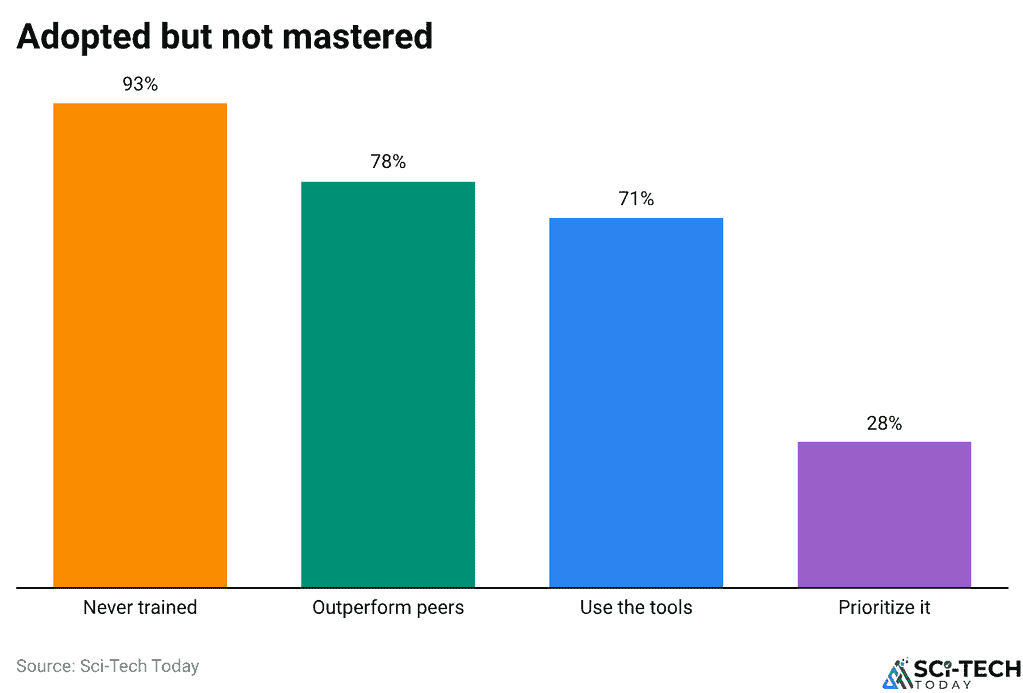
- In today’s B2B sales environment, many organizations have integrated social selling. Most people do it without formal social selling training. It takes an intentional social selling strategy.
- There are statistics that help us understand social selling’s value. 71% of social sellers said they use Sales Navigator, a B2B prospecting social selling tool.
- As social selling gains traction, digital platforms help B2B relationship building.
- 78% of the people who social sell on average perform better than the competition.
- Younger millennials account for 78% of the people who social sell, as many millennials also social sell to meet real sales quotas.
- A good social selling adoption percentage depends on whether you have a strategy in place.
- Wisernotify surveyed the world’s leading B2B organizations. 93% of the executives who responded do not offer social selling training to employees.
- In fact, most organizations surveyed, 72%, do not include social selling as part of their strategy.
- Beyond providing social media accounts to sales, social selling needs support.
- Organisations can support social selling with better training, clearly documented sales workflows, and measuring social selling results.
Buyer Behavior and Decision-Making Statistics 2026
- With control of the research and evaluation processes in their hands, B2B buyers have new, different expectations and needs.
- Gartner (2026) suggests that 67% of B2B buyers like an automated, no-salesperson experience, and 45% of them used AI in the recent past.
- B2B buyers will likely try to investigate the solution space before interacting with any company, so being known early and having credible information and trust is what you will need in order for them to consider your company.
- According to Harvard Business Review (2022), 80-90% of buyers create a vendor shortlist before their first outreach.
- The reason behind this is likely because prospects may reach out to you after they have already completed their research and review process.
- The human element remains critical in this digital world. Gartner (2026) states that 69% of B2B buyers consult a sales representative to confirm insights generated by an AI.
- Each B2B buyer reviews, on average, 7 information sources during a buying process.
- Buyers require consistency and reliability in your information across the channels you use.
- LinkedIn reports that 75% of B2B buyers use social media for supplier discovery.
- Furthermore, a study by Gartner (2024) reveals that 77% of B2B buyers perceived their most recent purchase as very complicated.
- Effective B2B selling involves more than just a direct outreach approach calls for an active and informative online presence, consistent creation and dissemination of educational material, and building strong and long-lasting relationships.
- Prospective buyers navigate their way through complicated purchasing decisions involving several stakeholders.
Which Platforms Drive B2B Social Selling?
- For social selling, LinkedIn is the go-to platform. LinkedIn dominates all B2B social selling and marketing statistics.
- LinkedIn accounts for 86% of all B2B marketing, versus Facebook at 79%. There is a reason for this difference.
- LinkedIn is for professionals and helps with decision-maker outreach, networking, and buyer research.
- LinkedIn also generates 80% of B2B social media leads, further proving the power of LinkedIn to attract new customers. LinkedIn has significant buying power.
- LinkedIn is the preferred social platform for 75% of B2B buyers in their purchasing decision-making process; thus, LinkedIn offers B2B vendors the best opportunity to show customers they are worthy of trust before contacting a salesperson.
- Being visible on social media is just the beginning of the B2B social selling lifecycle. 54% of B2B social marketers have used social media to generate new leads, while 39% of businesses state they have actually made sales as a result of their social media strategy.
- It seems like a lot of businesses have cracked the social media code. Like most business strategies, there is execution that is required.
- The results of the B2B social media strategies really come down to the targeted audience and how well a business has built its network and nurtured its leads.
- For instance, in the staffing and recruiting sectors, connection acceptance rates on LinkedIn are 36.5%.
- Professional social networks are much more effective in these sectors due to the high volume of connection building.
- Target audiences and objectives drive platform choices. Most firms should focus on social media platforms that complement a LinkedIn-centered social media strategy.
Social Selling Statistics: Revenue Growth and Sales Performance
- Most sales leaders now understand that social selling provides a distinct edge in generating additional revenue and establishing a competitive edge online.
- In fact, results of LinkedIn’s 2025 State of Sales Report found social selling adoption correlates with a 51% improvement in the rate at which teams meet their revenue targets.
- The benefits social selling brings to individual sales representatives are also significant.
- Reps who use social selling tools are able to sell 78% more than reps who do not social sell, in part, due to the shorter average sales cycles and the 35% larger deals they are able to close.
- The effects social selling brings are even felt by executives at the buying table, as 84% of C-level executives cite social media as part of their buying decision process, and for most, this starts with LinkedIn. Thus, it pays to develop credibility and start providing insights on LinkedIn well before you initiate your outreach.
- It is possible to amplify your sales impact by merging your social selling activities with account-based marketing efforts.
- For example, organizations combining account-based marketing with social selling achieve 67% higher close rates on targeted accounts compared to more conventional outreach approaches.
- Furthermore, teams that social sell regularly achieve 64% higher quota attainment.
- Sales teams must quantify social selling’s effectiveness and contribution to the bottom line by measuring their results.
Social Selling Statistics by Platform
Different channels within social selling change, giving companies new methods for reaching shoppers, influencing buyer behavior and creating sales. These social selling stats illustrate how the different platforms allow users to browse and purchase, and others to network.
- Facebook users browse the platform to buy, with 40% of Facebook users saying they have purchased on Marketplace.
- 27% of shoppers say Facebook Marketplace is the place they are most likely to purchase online, and 23% say Facebook’s social selling experience is the best online.
- Finally, 20% of online US buyers say they have used Facebook to make a purchase.
- Social selling platforms are constantly evolving to provide businesses more opportunities to drive purchase behaviors and close sales.
- While every social selling platform allows customers to make purchases, social selling statistics illustrate how users have the ability to view and discover, as well as the ability to purchase.
- 40% of Facebook Marketplace users purchase on the social platform. An additional 27% of global shoppers prefer the platform for purchasing.
- 23% of consumers report Facebook’s social selling experience to be the most optimal.
- Additionally, 20% of United States digital purchasers reported using Facebook to complete a purchase.
- 70% of shoppers use Instagram during their purchase journey, and 50% use it to shop on a weekly basis.
- Nearly 20% of users across the globe rate its shopping experience highly, and approximately 12% of US digital buyers complete their purchases through Instagram.
TikTok
- TikTok’s social buyers number over 35 million, with 85% of TikTok Shop US sales going to the health and beauty segment, 11% to food, and 4% to household care, while Less than 10% of users rate TikTok’s social shopping experience highly.
- Top unbranded searches on Pinterest make up 96% of top searches, and branded Pins are used for purchasing by over 85% of weekly users, and Pinterest shopper weekly use is rated positively for purchase inspiration.
- There has been a 50% increase in saved Pins, and Pinterest users have increased their monthly spending by two times.
- Product and brand discovery is Pinterest’s most popular use case.
- Pinterest helps users find new products: 96% of top searches are not brand-specific, 85% of users in the US buy something after seeing Pins that contain brands, and 80% of Pinterest’s weekly users feel inspired to buy things on Pinterest.
- There is a 50% year-over-year increase in the number of shoppers who saved Pins to their Pinterest boards.
- Pinterest users spend more per month on Pinterest than shoppers do on other social media platforms. Discovery is its most common use.
YouTube
- YouTube video marketing is rated most highly by marketing teams as a video marketing channel. Video marketing via YouTube is used by nearly 10% of online US buyers.
- A video marketing shopping channel via YouTube is rated highly by approximately 8% of global shoppers.
- YouTube is used by 90% of marketers for their video marketing, and 78% believe it is the most effective platform.
- 10% of US online buyers use YouTube, and 8% of the world’s online shoppers prefer using YouTube for social shopping.
- LinkedIn is the social media platform with 134 million active users per day, 63 million of whom are decision makers.
- LinkedIn reports that 80% of its active users are responsible for business purchasing.
- LinkedIn also reports a 33% increase in purchase intention with their ads.
- Reports show active X users as 500 million – 600 million users.
- The benchmarks used were X’s supplied data, so verification of source dates and data definitions by each business is necessary.
The Return on Investment (ROI) and Statistics for Social Selling
- A combination of social selling tools and a personal outreach program creates measurable business value, particularly for the sales organization.
- LinkedIn Sales Navigator was used to validate the impact and resulted in a 312% return on investment over 3 years as well as a payback period of under six months, according to the study done by Forrester.
- The report, titled Total Economic Impact, focused on LinkedIn customers worldwide and concluded that sales teams experienced improvements in the sales pipeline and gained efficiencies.
- In fact, users of Sales Navigator make deals that are, on average, 42% larger and get revenue influence increased by 59%.
- HubSpot’s Sales Trends Report 2025 provides the data showing the responses for outreach in social media are 42%, while the email outreach has the number of 26%, and phone calls are only 23%.
- According to DSMN8’s Stop Copy-Pasting Your Employee Advocacy Report 2026, the result of personalized captions is an increase in average clicks from 1.6 to 10.3 or almost 6.4 times as many clicks compared to regular captions.
- The findings lead to three major ideas to implement: to use appropriate sales tools, personalize outreach and measure the results in business terms.
- Nevertheless, every organization must check each kpi against its own costs, conversion rate, and profit.
Thought Leadership, Trust, and Employee Advocacy Statistics
- The significance of thought leadership in B2B social selling lies in the fact that buyers seek expertise, credibility, and valuable insights before making their purchase decisions.
- Based on Edelman research conducted in 2025, 92% of B2B purchasers are willing to communicate with sales representatives who are acknowledged as industry thought leaders. This clearly proves that sharing knowledge is more important than marketing products.
- According to DSMN8 research carried out in 2026, which analyzed 517,374 LinkedIn posts, it was found that posts with the opinions of employees had about 9.2 times higher engagement compared to curated posts.
- Edelman’s examination says that 84% of B2B buyers believe that thought leadership influences their view of the company.
- Hence, the provision of appropriate ideas, useful market insights, and recommendations becomes a means of building the brand.
- According to DSMN8’s 2026 Employee Advocacy Benchmark Report, 33% of managers in employee advocacy programs point to salespeople as the most engaged participants in such initiatives.
- Therefore, it is advisable for organizations to motivate salespeople to express their expert opinion, thus contributing to industry discussions.
- By combining trustworthy thought leadership materials and content created by employees, companies can achieve better involvement and trust.
Social Selling Future Trends
- Social selling is becoming not just another tactic within sales but also an integrated approach that utilizes technology, employee advocacy, and customer trust.
- Artificial intelligence allows sales departments to identify prospects, reach out to them, and analyze their performance.
- As Salesforce’s 2026 research reveals, 83% of sales departments utilizing AI finished the year on a positive note (by increasing sales), whereas only 66% of sales departments that did not use artificial intelligence managed to do so.
- Nevertheless, the technology still works best when it facilitates communication among people rather than replaces it.
- Employee networks are moving onto the throwing grounds as spaces for B2B engagement.
- A 2025 analysis done by DSMN8 of 500,000 LinkedIn posts found that employee-created content produced nine times more engagement than content curated for employees.
- Another area of priority is measurement. By connecting employee advocacy platforms with CRM and analytics tools, businesses can link social interaction with pipeline development and conversions, making the impact on revenue easily assessable.
- Meanwhile, social influence is broadening out, beyond LinkedIn to podcasting, X, Threads, and niche online communities.
- A 2025 academic preprint indicated that multi-platform social strategies yielded between 2% and 5% more in sales when compared with approaches that used just a single channel.
- Strategically effective social selling is a combination of AI-enabled efficiency, employee-led communications, tangible business results, and a presence across platforms where relevant.
- The strongest strategy keeps authenticity at its heart while technology and data inform more intelligent decisions.
Conclusion
In 2026, social selling underscores how successful sales teams are at establishing trust, engaging buyers, and converting their relationships into outcomes. Provided data emphasizes the role of LinkedIn in B2B lead generation, opportunities for sales technologies, and the effects of both personalized outreach and employee-generated content. Simultaneously, buyers do more research on their own, creating demand for credible thought leadership and consistency in messaging.
AI can help with the connections and personalization, but still, people’s judgment matters. The analyst believes that companies should measure their social selling efforts by tracking qualified leads, conversion rates, contribution to the sales funnel, and the revenue brought in. A well-structured training program together with proper metrics can improve performance.
FAQ
Social selling is the process of using social networks in order to identify leads, communicate information and knowledge useful for establishing contacts with prospects.
As per the data provided, LinkedIn accounts for about 80% of B2B social media leads.
Businesses that very actively apply social selling have had a revenue increase of 51% as compared to those that do not use social selling.
LinkedIn is a major B2B social network since it provides tools for professional networking, qualifying leads, as well as contacting decision-makers. The best platform, however, depends on the audience and sales objectives.
To determine social selling ROI, businesses have to measure the number of qualified leads, response rate, as well as the rate of converted leads, the contribution to the pipeline, the deal amount, the duration of the sales cycle and the overall revenue.

Sources