








Introduction
Space Economy Statistics: The global space economy kinda stepped into 2026 as one of the fastest-moving high-technology sectors, driven by commercial satellite services, reusable launch systems, Earth-surveying technologies, space-based communications, defense budgets, and those newer lunar exploration programs that keep popping up everywhere.
A government-led industry has kind of shifted into a more commercial ecosystem where private companies do most of the market moving, and where investment flows follow that. The fast climb of satellite broadband networks, higher launch rhythms, and a stronger need for geospatial intelligence have basically made space into a crucial economic backbone. The global space economy could get close to multi-trillion dollar valuations by 2035, unlocking real chances in telecommunications, logistics, agriculture, defense, climate monitoring, and even transportation.
This article will give a clear picture of Space economy statistics and its global market, spending, and investment.
Editor’s Choice
- The global space economy hit USD 626.4 billion in 2025, and is expected to edge past USD 1.01 trillion by 2034.
- A steady 5.5% CAGR suggests the industry is moving from frenetic growth into longer -term, stable expansion.
- Government space spending stayed a major growth engine at about USD 137 billion in 2025.
- Private investment bounced back noticeably, reaching USD 9 billion in 2025, which is the biggest annual rise since 2021.
- Consolidation also sped up, with 54 completed mergers and acquisitions, and 16 extra deals still pending.
- Commercial activity now contributes 78% of total space economy value, so the private sector’s role is basically confirmed as dominant.
- Global orbital launches broke a record with 324 missions in 2025, and SpaceX carried out 165 launches, meaning more than half of the worldwide activity.
- SpaceX led industry revenues with an estimated USD 15 billion in space-related revenue, driven largely by Starlink services.
- The space-enabled applications market reached approximately USD 329 billion, while satellite services alone generate around USD 180 billion annually.
- Starlink expanded to 10.3 million subscribers in Q1 2026, representing an impressive 105% year-over-year growth rate.
Global Space Economy Enters A New Growth Era
- In 2025, the global space economy hit USD 626.4 billion, which feels like one of those big milestones for the sector, and it kind of signals that things are moving into a more mature phase of growth, not just the fast-rising kind.
- As Novaspace notes, the whole field could reach USD 1.01 trillion by 2034, with a steady 5.5% compound annual growth rate over that stretch.
- The space industry is starting to look less like a sprint and more like a longer plan, with bigger-scale commercialization, more visible government involvement, and a sense of longer-term market steadiness.
- Inside the broader picture, the core space market was USD 236 billion in 2025, and it should rise to USD 323 billion by 2034.
- Meanwhile, space-enabled services are still a big chunk of the ecosystem, pointing to how satellite-based applications and the supporting infrastructure are generating more economic value.
- The space economy growth isn’t coming only from launch activities and spacecraft manufacturing anymore. Instead, it’s also being pulled along by wider adoption of space-derived services across different industries, like a chain reaction rather than one single driver.
- Public spending reached USD 137 billion, showing strong commitments tied to national security, sovereignty, and exploration initiatives. Those budgets keep shaping demand, and they also open doors for commercial players that want to join government-led programs or work inside them.
- Investment landed at USD 9 billion in 2025, which is the largest year-over-year increase since the industry’s earlier investment high in 2021.
- Most of the funding went to established, late-stage companies, so you can read it as investors liking businesses with tested technologies and clearer ways to reach revenue, sooner rather than later.
- Industry consolidation picked up, too, with 54 mergers and acquisitions deals actually closed in 2025, and 16 more still sitting there pending.
- All the above numbers look like a segment that’s getting more organized, tighter on financial discipline, and more deliberate in strategy.
- When you stack the USD 626.4 billion market, USD 138 billion of government spending, USD 9 billion from private investment, and the idea of a USD 1.01 trillion economy by 2034, it feels like the global space industry is laying groundwork for steady long-run momentum through the next decade.
Commercial Space Economy
(Source: orbitalradar.com)
- According to Novaspace, roughly 78% of the whole space-economy value is now driven by commercial activity. That signals how private firms are playing the key role in earning revenue via satellite communications, Earth observation, launch services, ground infrastructure, and these newer space-based apps that are still kind of emerging.
- Industry outlooks also say the market should climb beyond USD 1 trillion in the early to mid-2030s, which basically points to continued growth across both mature areas and the newer, less established segments.
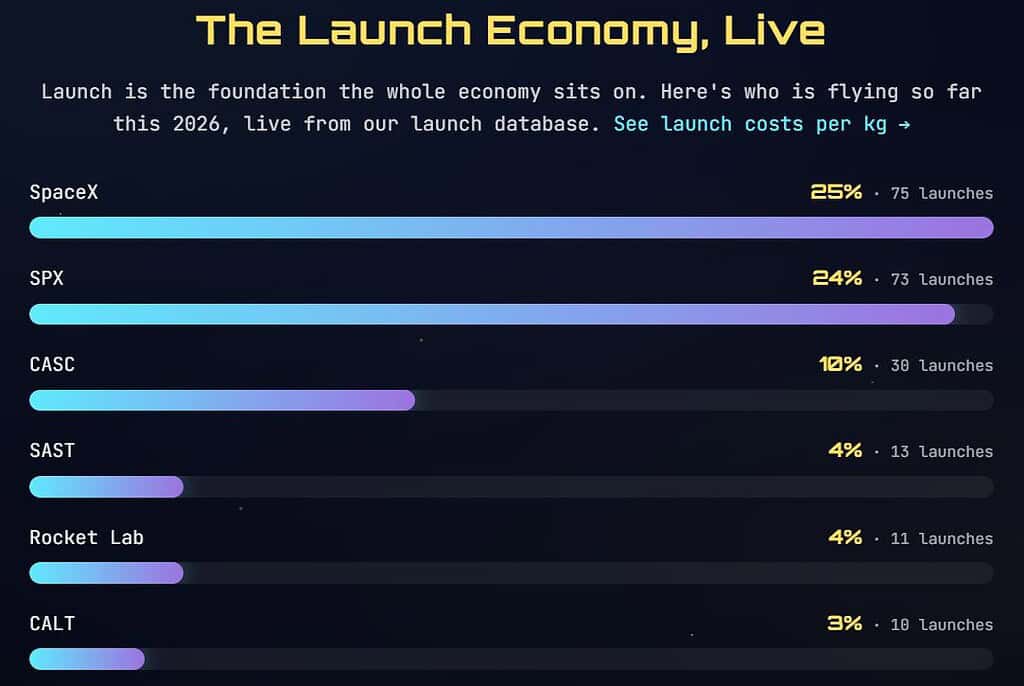
- For 2026, the launch market is led by SpaceX, with 74 launches, around 24% of overall activity. Then, not too far behind, it’s still SpaceX with 74 launches (24%), and after that, CASC with 30 launches (10%).
- There are other visible players too, like SAST with 13 launches (4%), Rocket Lab with 11 launches (4%), and CALT with 10 launches (3%).
- Overall, these figures show launch capacity is increasingly coalescing among a small set of high-frequency operators, rather than being broadly spread.
- Global orbital launches reached a record 324 in 2025. SpaceX alone conducted approximately 165 of those missions (over 50% of global activity), while China (CASC) conducted roughly 92 launches.
Space Division Revenue
(Source: orbitalradar.com)
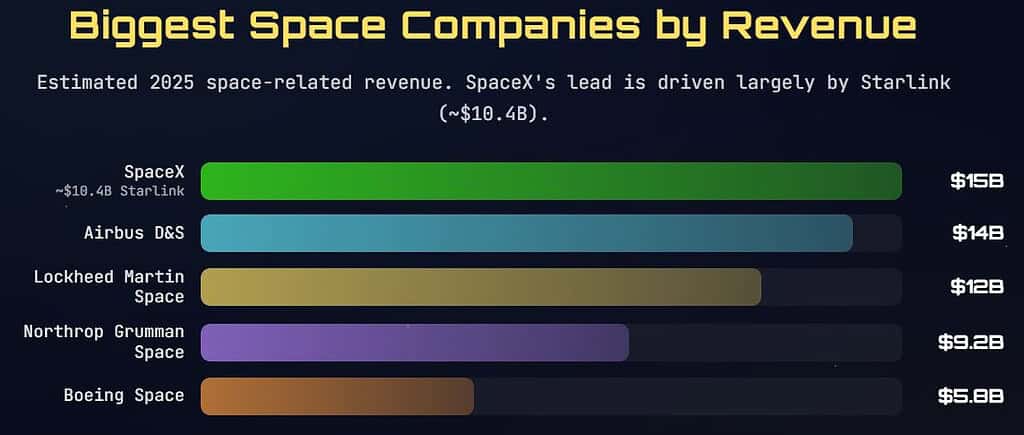
- Revenue rankings keep showing how fast the commercial space arena is getting bigger.
- SpaceX, largely powered by Starlink offerings, is estimated to have pulled in about USD 15 billion in space- related revenue in 2025.
- Airbus Defence and Space came next with roughly USD 14 billion, then Lockheed Martin Space at around USD 12 billion.
- After that, Northrop Grumman Space Systems generated nearly USD 9.2 billion, while Boeing Space contributed approximately USD 5.8 billion.
Space Economy’s Downstream Services – Satellite Broadband and Earth Observation
- Honestly, the current space economy isn’t really run on rockets, satellites, or spacecraft production anymore. It’s more like the heft is in downstream services that take space infrastructure and turn it into connectivity, navigation, Earth observation, and all sorts of data analytics.
- Precedence Research puts the global space economy somewhere between USD 613 billion and USD 630 billion for 2025, and the outlook suggests it could climb to USD 650–700 billion by the end of 2026.
- The overall space technology market, for reference, was valued at about USD 512.08 billion in 2025, and it is expected to rise to USD 551.20 billion in 2026.
- Longer range forecasts even point to USD 1.08 trillion by 2035, which would mean a 7.77% CAGR. These numbers basically underline that recurring, service-style earnings are turning into the main growth motor for the wider global space sector.
- Statista and other commercial analysts note that the downstream services angle shows up in the estimated USD 329 billion space-enabled applications market. That pool covers satellite broadband, television broadcasting, navigation services, and Earth observation analytics.
- Satellite services already are bringing in about USD 180 billion per year, and analysts expect that figure to climb past USD 300 billion before 2030.
- In the communications space, the World Economic Forum forecasts revenue rising from USD 196 billion in 2023 to USD 218 billion by 2035, which basically just doubles down on the idea that this area remains the biggest piece of commercial space income.
- Satellite broadband, meanwhile, looks like one of the quickest movers. Industry projections suggest satellite internet revenues may reach around USD 40 billion by 2030.
- A big part of that momentum is tied to Starlink, which had more than 7,000 satellites running by early 2026.
- The system then went to about 10.3 million subscribers in Q1 2026, up from roughly 5.1 million a year earlier, so that’s 105% year over year growth, pretty wild in telecom terms.
- In a 2026 investment note on SpaceX’s potential IPO, The Motley Fool highlights that Starlink’s customer base roughly doubled each year, starting from about 2.3 million subscribers at the end of 2023, to around 4.6 million at the end of 2024, and then to 9.2 million by the end of 2025.
- It also quotes Payload Space analysts who expect another doubling to something like 18.4 million subscribers in 2026, placing Starlink among the fastest‑growing subscription operations in telecom history.
- Industry work suggests EO analytics are increasing around 15% each year, and the use cases cover agriculture, climate tracking, insurance, infrastructure, and logistics.
- The numbers show, pretty clearly, that space is turning into a data and services kind of economy. So in practice, downstream applications are now the main engine driving the next chapter of commercial space expansion.
Government, Defense and Space Sovereignty
- One of the most significant trends shaping the space sector in 2026 is the rise of space sovereignty. Global government space spending stays exceptionally strong at roughly USD 130–140 billion each year, even while private investment keeps growing.
- Australia, Saudi Arabia, and Taiwan, for example, have kicked off sovereign space programs to reduce reliance on outside providers and keep control over critical space-based capabilities.
- Official EUSPA documentation says Europe’s IRIS² constellation is the scale of sovereign investment that’s happening right now.
- The plan is for 264 Low Earth Orbit satellites at around 1,200 kilometers altitude, and 18 Medium Earth Orbit satellites placed near 8,000 kilometers altitude.
- Government services are expected to start by 2030, which would create a European-controlled communications layer meant to reinforce cybersecurity, resilience, and strategic self-reliance.
- Vestbee’s 2025 “Dual‑Use Founder’s Handbook” says that the dual-use technology market, where new things can serve both commercial use and defence goals, is basically growing at record levels.
- In Europe, money tied to dual-use and defense technology apparently hit USD 2.22 billion in 2024 and then jumped to USD 3.88 billion in 2025, so investors seem pretty convinced about what’s next. They’re especially looking at artificial intelligence, autonomous systems, secure communications, and even space-based sensing.
- The report also tracked 293 dual-use mergers and acquisitions plus 37 secondary transactions, which kind of shows more consolidation, around those strategically important technologies.
- At the same time, global aerospace and defense deal activity rose by 41% in 2025, landing at a new high of 532 announced transactions. A slice of that, deals that focus on supply-chain resilience, came in around USD 14.6 billion in transaction value, which basically reflects efforts to lock in access to key technologies and manufacturing capacity, before shortages or disruptions show up.
- With roughly USD 130–140 billion in annual government spending, 282 satellites planned under IRIS², USD 3.88 billion moving into dual-use technologies, and a record 532 aerospace and defense deals, governments are putting real weight behind independent access to communications, intelligence, and launch competence.
- Space isn’t seen only as an exploration arena anymore; it’s become a core pillar of national security, economic competitiveness, and technological leadership.
Conclusion
The global space economy has pretty much shifted into this strategic, market-led ecosystem where satellite services, broadband links, Earth observation capabilities, defense technologies, and launch operations together push long-term growth. You can see it in the record market valuations, the growing public spending, and how active the private sector has stayed; it all suggests space is not some small corner industry anymore but a real pillar of modern economic infrastructure.
And honestly, the “downstream” use cases are starting to produce more value than the classic hardware plus launch side, while national space programs keep reminding everyone that security and technological autonomy matter. As the whole thing trends toward that trillion-dollar threshold, space-based services are likely to sit even deeper inside everyday economic life.
FAQ
In 2025, it’s valued at around USD 626.4 billion.
Most industry forecasts say it should hit roughly USD 1.01 trillion by 2034.
Commercial firms account for about 78% of the total space economy value.
Globally, there were a record 324 orbital launches.
In Q1 2026, Starlink served about 10.3 million subscribers.

Sources