








Introduction
Exoplanet Statistics: The exoplanet sector has become one of those really dynamic corners of modern astronomy and space science. In 2026, you know, it’s moving fast. Ever since the first confirmed finding of a planet outside our solar system back in 1992, things have changed a lot. Telescope improvements, artificial intelligence, spectroscopy, and space-based observatories all together have basically reshaped how we look for faraway worlds. The work isn’t just about catching exoplanets anymore; researchers are also studying planetary envelopes, pinpointing potentially life-friendly worlds, and trying to track biosignatures that might suggest extraterrestrial life.
With thousands of confirmed planets now on record, billions of dollars poured into observing infrastructure, and next-generation efforts like the Roman Space Telescope, along with the Habitable Worlds Observatory being prepared, exoplanet research feels like it’s stepping into a fresh era, both scientifically and economically speaking.
The article on Exoplanet statistics will show the recent number of exoplanets, growth, and habitability.
Featured Selection
- The confirmed exoplanet catalogue is now sitting at 6,298 worlds, which makes it one of the biggest datasets in today’s astronomy.
- Neptune-like planets are leading the discoveries, with 2,177 confirmed worlds, around 34.6% of all known exoplanets.
- Gas giants come next at 2,090 confirmed planets (33.2%), making them the second largest planetary category.
- Super-Earths are at 1,801 discoveries, contributing roughly 28.6% of the confirmed exoplanet population.
- ESA’s Euclid telescope mapped more than 60 million stars in only 26 hours, resulting in the largest visible-light survey of the Milky Way’s core.
- Scientists think Euclid could push the known exoplanet count from about 6,000 to well over 100,000 planets, roughly a 16-fold jump.
- NASA’s Roman Space Telescope is expected to discover approximately 1,500 exoplanets via microlensing and identify another 100,000 potential planets through transit observations.
- The transit method dominates exoplanet detection with 4,653 confirmed discoveries, representing nearly three-quarters of all known exoplanets.
- NASA’s Kepler mission remains the most productive survey, contributing 2,784 confirmed exoplanets, or about 44% of all discoveries.
- The future Habitable Worlds Observatory aims to directly study at least 25 Earth-like planets while achieving an extraordinary 10-billion-to-one starlight suppression capability.
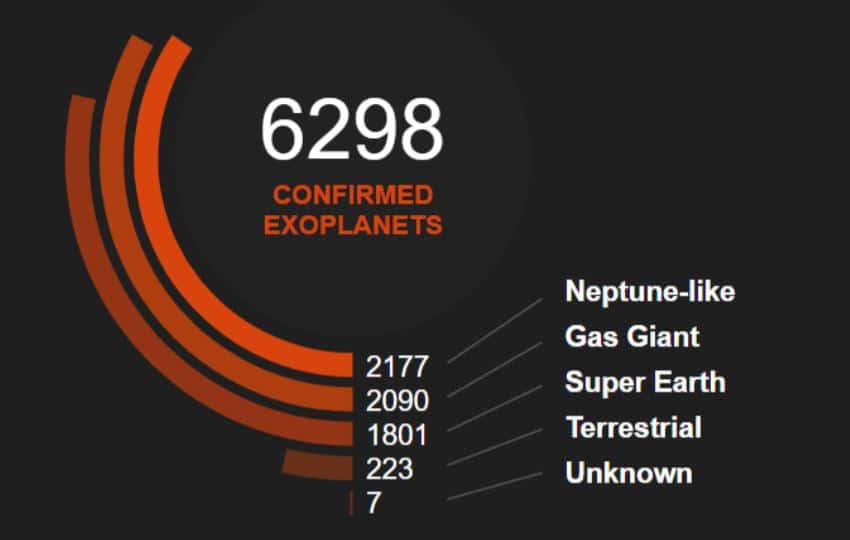
Confirmed Exoplanet
(Source: nasa.gov)
- The latest exoplanet statistics show this kinda crazy, fast pace at which astronomers keep growing humanity’s inventory of worlds outside our solar system.
- The chart reports 6,298 confirmed exoplanets, which is one of the biggest and most important astronomical datasets ever put together, and yeah, it really stands out. These confirmed planets have been backed up by multiple observations, so it becomes a dependable base for studying planetary variety across the Milky Way.
- In the breakdown, Neptune-like planets kind of dominate the whole catalogue, with 2,177 confirmed discoveries. That’s about 34.6% of everything currently known.
- Next in line are Gas Giants, with 2,090 confirmed planets, around 33.2% of the overall count.
- These heavyweights, basically like Jupiter and Saturn in spirit, keep showing up a lot because their huge sizes make detection easier. Transit and radial-velocity methods do especially well here, even when the signals are faint.
- Super-Earths come in third, tallying 1,801 confirmed planets, which is roughly 28.6% of the total. Their numbers matter a lot, because they sit in that in-between zone between Earth and Neptune. So they’re a major target for future work on habitability, plus atmospheric character.
- The terrestrial planets account for 223 confirmed worlds, representing about 3.5% of the catalogue. Even if there are fewer of them, these rocky planets bring big scientific curiosity, because they are the closest analogues to Earth, and people want answers there first.
- The smallest category is labelled Unknown, containing just 7 planets, or roughly 0.1% of the whole dataset. That suggests astronomers have basically managed to sort nearly all verified exoplanets into some recognized planetary buckets, even if the distribution isn’t super even.
- The chart points out that Kepler candidate planets are estimated to have an 80–90% probability of being real exoplanets; they still need additional checks before they can move into the confirmed catalogue.
- The figures make it look like a field that’s growing up fast. With over 6,200 confirmed exoplanets, researchers are shifting from only finding new worlds to doing population analysis, planetary classification, and then trying to identify potentially habitable environments.
- The stats also show that Neptune-like worlds, Gas Giants, and Super-Earths currently dominate the known exoplanet inventory, which gives useful hints about how planetary systems form and change across our galaxy.
Exoplanet Euclid’s Data Signals A Leap From 6,000 To 100,000 Discoveries
- The newest outputs from the European Space Agency’s Euclid telescope mark a big statistical turning point for exoplanet research.
- Even though the mission was first intended to probe dark matter and dark energy, its observations are now expected to strongly speed up both detection and confirmation of worlds outside our solar system.
- Euclid produced the largest and most detailed visible-light picture ever made of the Milky Way’s central region, logging more than 60 million stars in a single survey.
- To build the dataset, the telescope spent 26 hours watching the galactic center, and then stitched nine separate pointings together, each covering an area larger than the full Moon.
- Scientists say humanity currently knows about 6,000 confirmed exoplanets, but with Euclid’s high-precision stellar measurements, that figure could be pushed past 100,000 exoplanets in the next few years.
- An increase of more than 16 times from the current catalogue, and honestly, it looks like one of the biggest expected expansions in planetary science history, ever.
- There is another major chunk of numbers coming from NASA’s upcoming Nancy Grace Roman Space Telescope, which is planned for launch in August 2026.
- Researchers expect Roman to find around 1,500 exoplanets via gravitational microlensing, a method that spots planets by tracking how gravity bends, and then magnifies, the light from a star.
- On top of that, Roman is also projected to uncover about 100,000 additional exoplanets using the transit method, where planets show up when they slide in front of their host stars, like a subtle dimming.
- Euclid’s stellar measurements could improve key exoplanet calculations by as much as a factor of three, so astronomers can confirm planetary masses more confidently, and also tell real worlds apart from false signals, including cases like binary star systems.
- With 60 million stars mapped, 100,000 potential future discoveries on the table, and measurement precision improving by up to threefold, the field is moving away from the simpler era of planet spotting, into a period focused on large-scale planetary census and later characterization.
Exoplanet Astronomy’s Fastest-Growing Discovery Frontier
- The NASA Exoplanet Archive shows that finding exoplanets has kinda moved into this mature, data-heavy chapter, and now there are so many verified worlds that researchers can finally do real statistics about planetary systems all across the galaxy.
- Right now, the archive reports 6,298 confirmed exoplanets, highlighting the wild growth of the field compared with the earliest exoplanet discoveries, which were only a few decades back.
- The Kepler mission remains the top survey in terms of yield, with 2,784 confirmed planets, about 44% of everything confirmed.
- This mission still lists 1,978 candidate planets sitting there, waiting on confirmation, so the mission’s scientific legacy looks like it’s not done yet, not even close.
- The longer-running K2 phase added 549 more confirmed planets, plus it still carries 976 candidates that haven’t been confirmed.
- There’s the newer TESS mission (Transiting Exoplanet Survey Satellite), which has produced 897 confirmed planets and turned up more than 7,900 planetary candidates.
- Out of those, 4,782 are still unconfirmed, which is kinda one of the biggest future discovery streams in astronomy.
- The transit method has found 4,653 planets, basically close to three-quarters of all confirmed exoplanets. Radial velocity methods have identified 1,186, and microlensing is responsible for 278 discoveries.
- Direct imaging is still relatively uncommon, though, with just 97 confirmed planets, which underscores how hard it is to actually capture distant worlds with a camera, in the literal sense.
- Planet characterization data also give a kind of window into how exoplanet science is getting more sophisticated.
- Researchers have measured the radius of 4,703 planets, while 2,110 planets have direct mass measurements. This ever-growing dataset lets astronomers classify planets more exactly, and also trace their composition and long-term evolution, with a little more confidence.
- The archive lists 2,043 planets with radii between 2 and 6 Earth radii, and that’s higher than 1,133 planets between 1.25 and 2 Earth radii.
- There are 551 Earth-sized planets, too, defined with radii less than 1.25 times Earth’s radius.
- In early 2026 alone, weekly additions seemed to hover around 9 to 21 newly confirmed planets, and it keeps nudging the confirmed total up past 6,100, toward what would be record territory today.
- Altogether, these numbers suggest exoplanet science is shifting from first findings to large-scale population analysis.
Exoplanet Habitability and The Search For Biosignatures
- The hunt for habitable exoplanets is becoming more data-driven, and researchers are moving past just “finding planets” toward atmospheric characterization, and then toward upcoming life-detection missions.
- The latest statistics spell out how quickly observational capacity is improving, almost step by step, and in a way that’s easier to measure than before.
- The foundation of this search stays with the habitable zone, you know the “Goldilocks Zone” idea, where planet surface temperatures can, in theory, keep liquid water around.
- ESA says that roughly means about 0°C up to 100°C, but of course, the real picture depends a lot on the atmosphere, so the actual surface environment can shift quite a bit.
- Habitable zones also don’t behave the same for every system; they change with stellar brightness, so it ends up being this crucial first filter for spotting worlds that might support life.
- The James Webb Space Telescope, or JWST, is kind of a huge jump for this whole effort.
- JWST runs with a 6.5-meter primary mirror, and that gives it far stronger light-gathering capacity than older space telescopes.
- With JWST instruments, it can observe wavelengths from around 0.6 microns to beyond 12 microns, which helps capture the spectral clues from key molecules like water vapor, methane, and carbon dioxide.
- JWST uses 11 observation modes, covering eight wavelength ranges, plus six spectral resolutions, so researchers can pull out fine-grained details about what’s going on in planetary atmospheres. Because of this, scientists can map temperature layers, infer atmospheric composition, and evaluate possible habitability indicators, with an accuracy that has not been seen before.
- NASA’s planned Habitable Worlds Observatory (HWO) is being designed to specifically search for life-bearing planets around nearby Sun-like stars, which is a pretty specific framing.
- The HWO idea builds on what they learned from earlier mission studies, and it’s expected to use a mirror roughly on the scale of JWST’s.
- Even so, it is still under development, and the current planning puts its launch no earlier than the 2040s, just showing how difficult the direct exoplanet imaging approach is.
- Putting together the above numbers really shows astronomy moving from merely locating planets toward systematically judging which ones might actually host life.
Conclusion
Exoplanet science kind of moved into a new, more transformative era where the attention is going from just finding fresh worlds to actually trying to get a feel for what they’re like, their atmospheres, and how they might support life. Right now, we already have over 6,000 confirmed exoplanets in hand, and with upcoming missions expected to push that total past 100,000, astronomers are trying to build a pretty huge planetary census, the most complete one ever, basically.
Major platforms like Euclid, JWST, and the soon-to-launch Roman Space Telescope are boosting the way we detect these objects and also improving atmospheric study in a really noticeable way. And later on, missions such as the Habitable Worlds Observatory will go after biosignatures even more aggressively, with a different kind of emphasis. Put together, all of this puts exoplanet research right at the front of modern astronomy and, yes, the longer-term hunt for life outside Earth.
FAQ
Astronomers have confirmed 6,298 exoplanets beyond our solar system.
Neptune-like planets seem to be the most frequent, with 2,177 confirmed detections.
Estimates suggest Euclid might lift the numbers to more than 100,000 exoplanets.
The transit method leads, racking up 4,653 confirmed exoplanet discoveries.
It is meant to study directly at least 25 potentially habitable Earth-sized planets and look for signs of life.

Sources


