





Overview
Telescope Usage Statistics: It’s easy to feel small and wonder about the universe beyond our reach. That’s where telescopes come in. Telescope usage refers to how these incredible instruments are used to explore space, collect data, and help scientists understand everything from distant galaxies to nearby planets.
By studying telescope usage statistics, we can see which telescopes are observing what, how often they’re being used, who’s using them, and what kind of discoveries they are making. Space telescopes like Hubble and James Webb have changed the way we see the universe.
They don’t just take pictures; they gather vital data that helps astronomers answer big questions about the cosmos. In this article, I’ll dive into the trends and more stories behind telescope usage, showing how these tools shape modern astronomy and why they are so important for scientists around the world. Let’s get into it
Best In The Editor’s Eye
- Hubble Space Telescope (HST) has been operating since 1990, completing over 5 million observations and producing more than 22,000 peer-reviewed publications. Its data has been cited over 1.2 million times worldwide.
- Hubble receives around 1,000 observing proposals per year, with only about 20% approved due to high competition, making it one of the most sought-after space telescopes.
- Hubble’s contributions include discovering the accelerating expansion of the universe, studying exoplanet atmospheres, and capturing deep field images that show the earliest galaxies.
- James Webb Space Telescope (JWST) launched in December 2021 and began full science operations in July 2022. It is located at the Sun-Earth L2 point, about 5 million km from Earth, providing unmatched infrared observations.
- JWST Cycle 1 received 1,173 proposals, while Cycle 4 saw 2,377 proposals, showing an oversubscription ratio of 9:1 due to high demand.
- JWST has collected 550 terabytes of data and contributed to over 1,600 scientific publications, focusing on early galaxy formation, star formation, and exoplanet atmospheres.
- Both Hubble and JWST have international participation, with Hubble involving scientists from 39 countries and JWST operating through NASA, ESA, and CSA collaborations.
- Telescope usage statistics show that modern telescopes are highly competitive, heavily data-driven, and essential for advancing our understanding of the universe.
- Continuous public engagement and educational outreach make the data accessible to students, educators, and amateur astronomers worldwide.
- The combination of long-term Hubble observations and the advanced capabilities of JWST ensures that telescope usage will continue to produce groundbreaking discoveries for decades.
| Feature/Metric | Hubble Space Telescope (HST) | James Webb Space Telescope (JWST) |
| Launch Year | 1990 |
2021 |
|
Orbit/Position | Low Earth Orbit (547 km) | Sun-Earth L2 (1.5 million km) |
| Observing Proposals per Year | 1,000 |
Cycle 1: 1,173; Cycle 4: 2,377 |
|
Proposal Acceptance Rate | 20% | 20% |
| Total Observations | 1.5 million |
Ongoing |
|
Peer-Reviewed Publications | 22,000 | 1,600 |
| Citations | 1.2 million |
N/A |
|
Data Volume | N/A | 550 terabytes |
| Oversubscription Ratio | N/A |
9:1 |
|
International Participation | 39 countries | NASA, ESA, CSA |
| Key Contributions | Accelerating universe, deep field images, exoplanets |
Early galaxy formation, exoplanets, and star formation |
|
Public Engagement | High (1,200+ press releases) |
High (image releases & outreach) |
Telescope Usage By Telescopes Launched From Earth
- The Hubble Space Telescope, launched on April 24, 1990, has been operational for over 35 years, capturing more than 5 million observations of over 55,000 astronomical targets, making it one of the most productive scientific instruments in history.
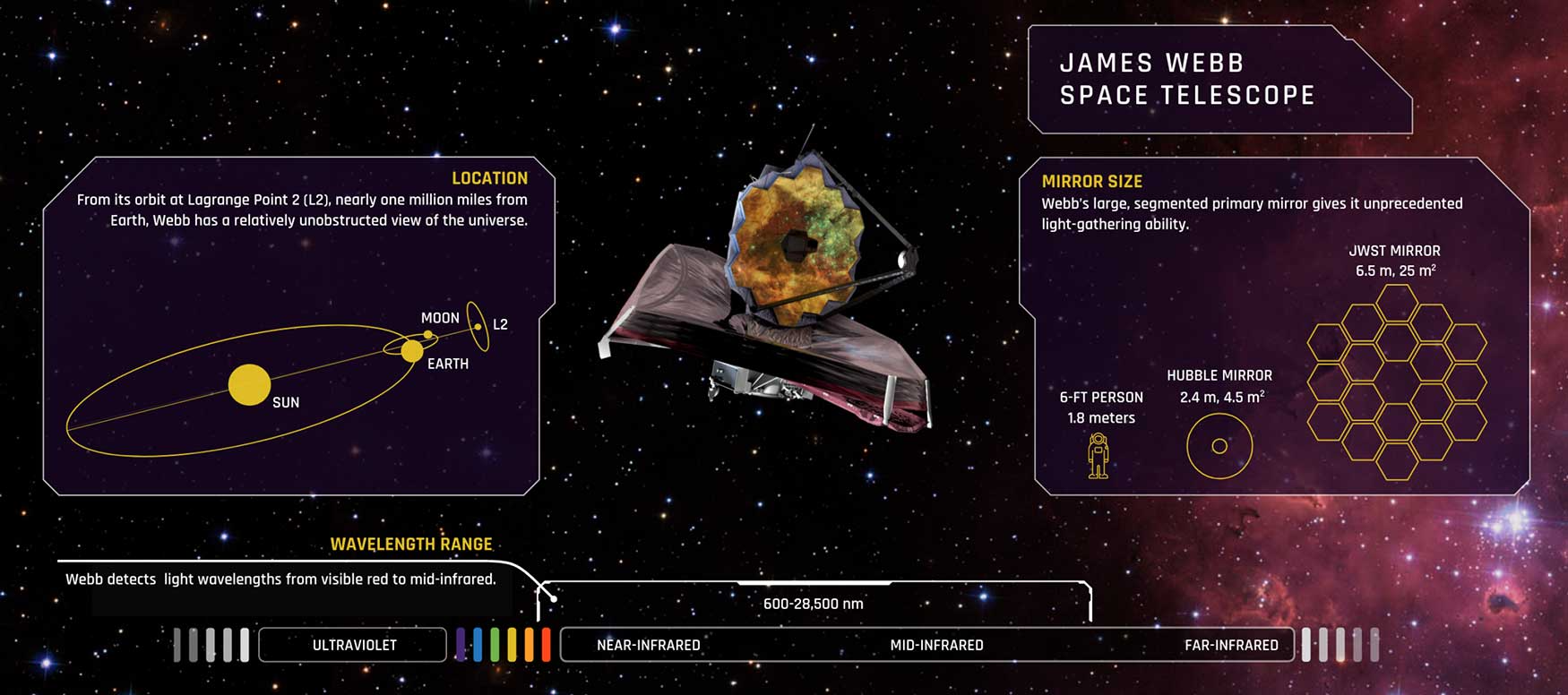
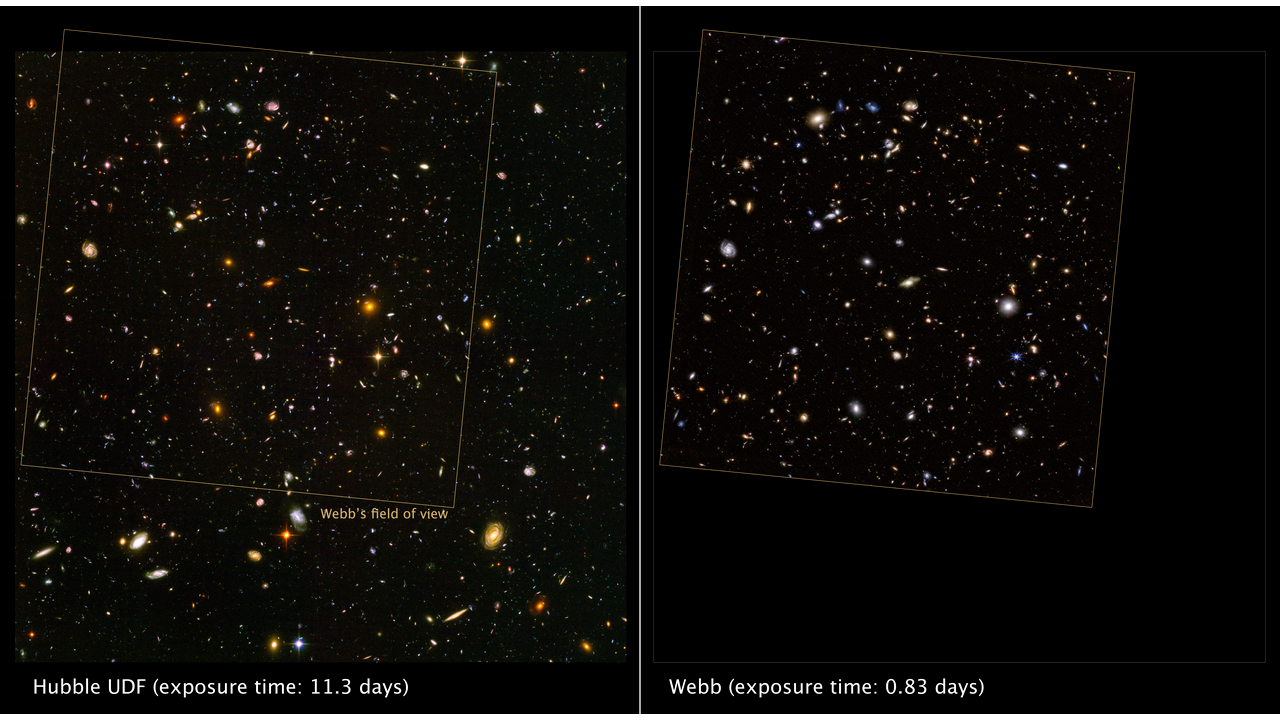
- The James Webb Space Telescope (JWST), launched on December 25, 2021, is the largest and most powerful space telescope ever built, with a primary mirror measuring 6.5 meters (21.3 feet) in diameter, nearly three times larger than Hubble’s 2.4-meter mirror.
- JWST operates approximately 1.5 million kilometers (930,000 miles) from Earth at the second Lagrange point (L2), allowing it to observe the universe in unprecedented infrared detail.
- The Chandra X-ray Observatory, launched on July 23, 1999, orbits Earth at an altitude of up to 139,000 kilometers (86,500 miles) and has provided critical data on black holes, supernovas, and galaxy clusters for over 25 years.
- The European Space Agency’s Gaia Space Telescope, launched on December 19, 2013, has mapped over 1.8 billion stars in the Milky Way, creating the most detailed 3D map of our galaxy ever produced.
- The Spitzer Space Telescope, launched on August 25, 2003, operated for over 16 years before its retirement in January 2020, revolutionizing infrared astronomy and helping discover exoplanets like the TRAPPIST-1 system.
- The Kepler Space Telescope, launched on March 7, 2009, discovered more than 2,600 confirmed exoplanets during its 9-year mission, transforming our understanding of planets beyond our solar system.
- The Euclid Space Telescope, launched by ESA on July 1, 2023, is designed to map the geometry of the dark universe by observing billions of galaxies up to 10 billion light-years away, aiming to unlock the mysteries of dark matter and dark energy.
Hubble Space Telescope (HST)
(Source: researchgate.net)
Launch and Operational Overview
- Launch Date: April 24, 1990
- Orbit: Low Earth Orbit (LEO), approximately 547 km above Earth
- Mission Duration: Over 35 years (as of 2025)
Observing Time and Proposal Statistics
- Annual Proposals: 1,000 proposals per year
- Approval Rate: 20% of the proposals get accepted
- Number of Countries: 39 countries have been involved with the Hubble observations
Scientific Output
- Total Observations: Over 1.5 million observations conducted
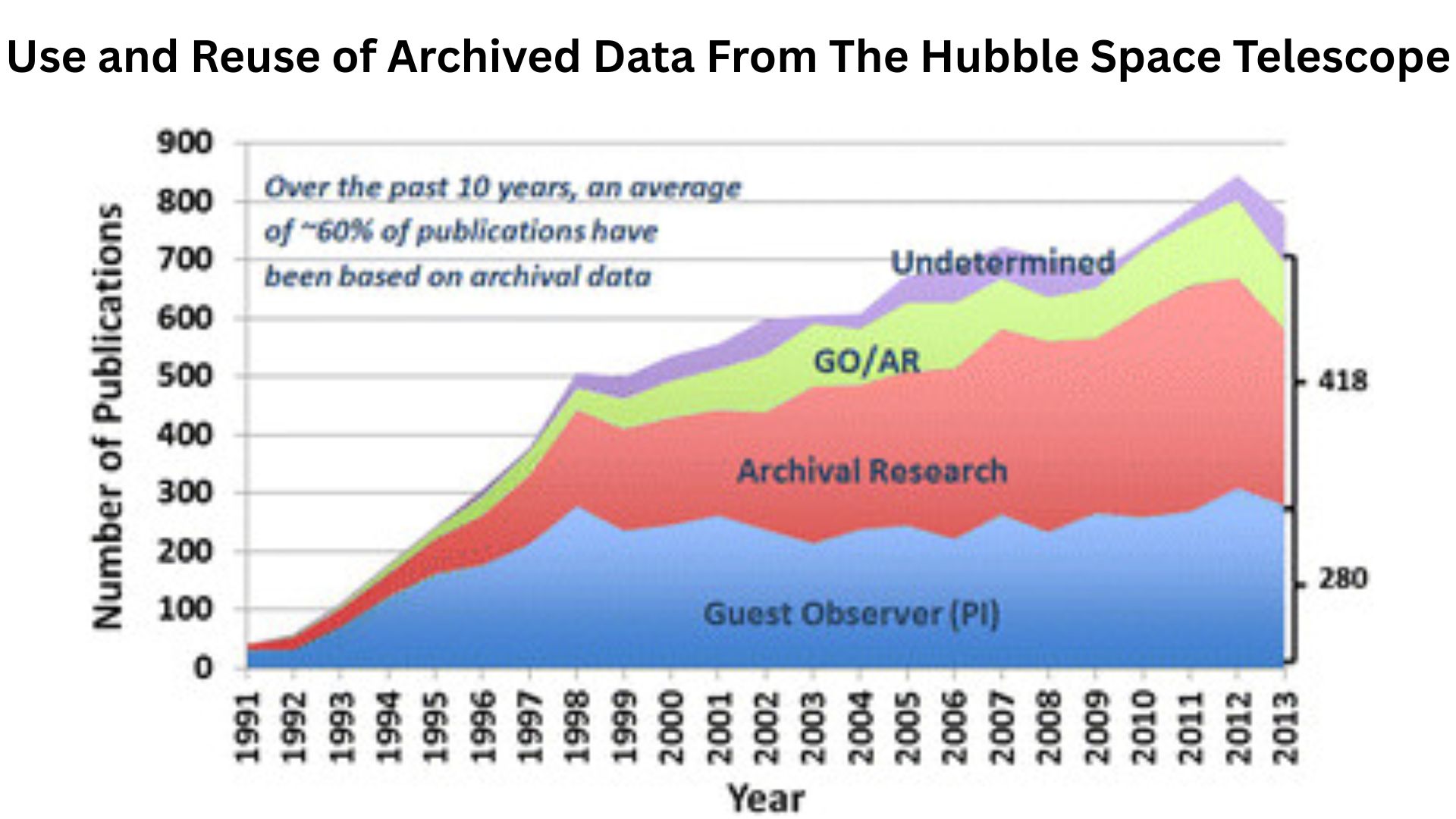
- Peer-Reviewed Publications: More than 22,000 scientific papers published
- Citations: Over 1.2 million citations of Hubble-related research
Key Discoveries
- Accelerating Universe: Evidence of the accelerating universe was provided
- Atmospheres of Exoplanets: Helped in researching the atmospheres of exoplanets
- Deep Field Pictures: Images were taken that showed galaxies formed shortly after the Big Bang
| Metric | Value |
| Annual Proposals | 1,000 |
| Acceptance Rate | 20% |
| Total Observations | 1.5 million |
| Peer-Reviewed Publications | 22,000 |
| Citations | 1.2 million |
| Countries Involved | 39 |
James Webb Space Telescope (JWST)
(Source: webbtelescope.org)
Launch and Operational Overview
- Launch Date: December 25, 2021
- Orbit: Sun-Earth L2 Lagrange Point, approximately 1.5 million km from Earth
Mission Duration: Ongoing since July 2022
Observing Time and Proposal Statistics
- Cycle 1 Proposals: 1,173 proposals submitted, requesting 24,500 hours of observation time
- Cycle 4 Proposals: 2,377 proposals submitted, requesting 78,000 hours of observation time
- Oversubscription Ratio: Approximately 9:1 in Cycle 4
Scientific Output
- Data Volume: Nearly 550 terabytes of data collected
Peer-Reviewed Publications: Over 1,600 research papers published - Key Discoveries: Insights into the formation of early galaxies, detailed observations of exoplanet atmospheres, and unprecedented views of star formation regions.
| Metric | Value |
| Cycle 1 Proposals | 1,173 |
| Cycle 4 Proposals | 2,377 |
| Oversubscription Ratio | 9:1 |
| Data Volume | 550 terabytes |
| Peer-Reviewed Publications | 1,600 |
Comparative Analysis – Hubble vs. Webb
(Source: webbtelescope.org)
| Feature | Hubble Space Telescope (HST) | James Webb Space Telescope (JWST) |
| Launch Year | 1990 | 2021 |
| Orbit | Low Earth Orbit | Sun-Earth L2 Lagrange Point |
| Mission Duration | Over 35 years | Ongoing since 2022 |
| Annual Proposals | 1,000 | 1,000 |
| Acceptance Rate | 20% | 20% |
| Total Observations | 1.5 million | Ongoing |
| Peer-Reviewed Publications | 22,000 | 1,600 |
| Citations | 1.2 million | Ongoing |
| Data Volume | N/A | 550 terabytes |
Global Participation and Impact
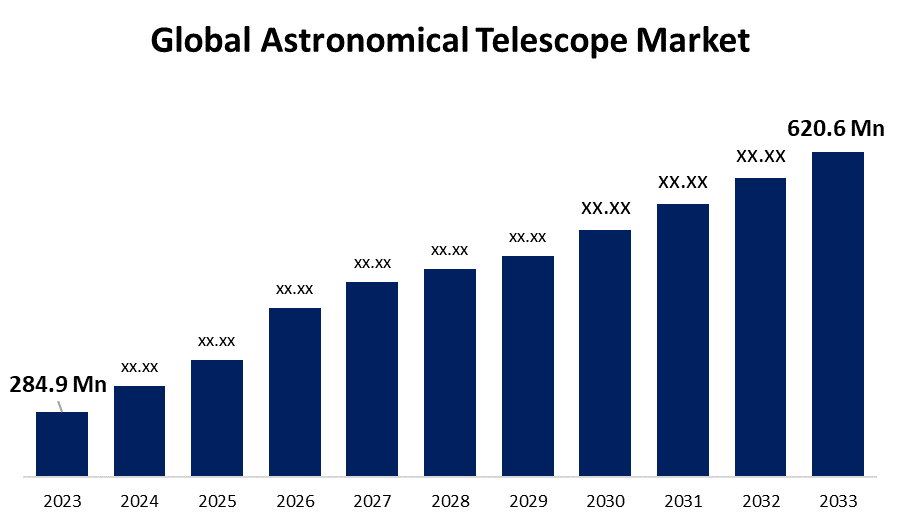
(Source: sphericalinsights.com)
Hubble Space Telescope
- International Collaboration: The participation of 39 nations in the submission of proposals and use of data
- Educational Outreach: High utilization in educational purposes and outreach activities
- Public Engagement: 1,200 scientific press releases that have been read more than 400 million times
James Webb Space Telescope
- International Collaboration: Contributions from NASA, ESA, and CSA
- Educational Outreach: Active engagement with educational institutions worldwide
- Public Engagement: Regular public releases of images and data, fostering global interest in astronomy
Future Prospects and Technological Advancements
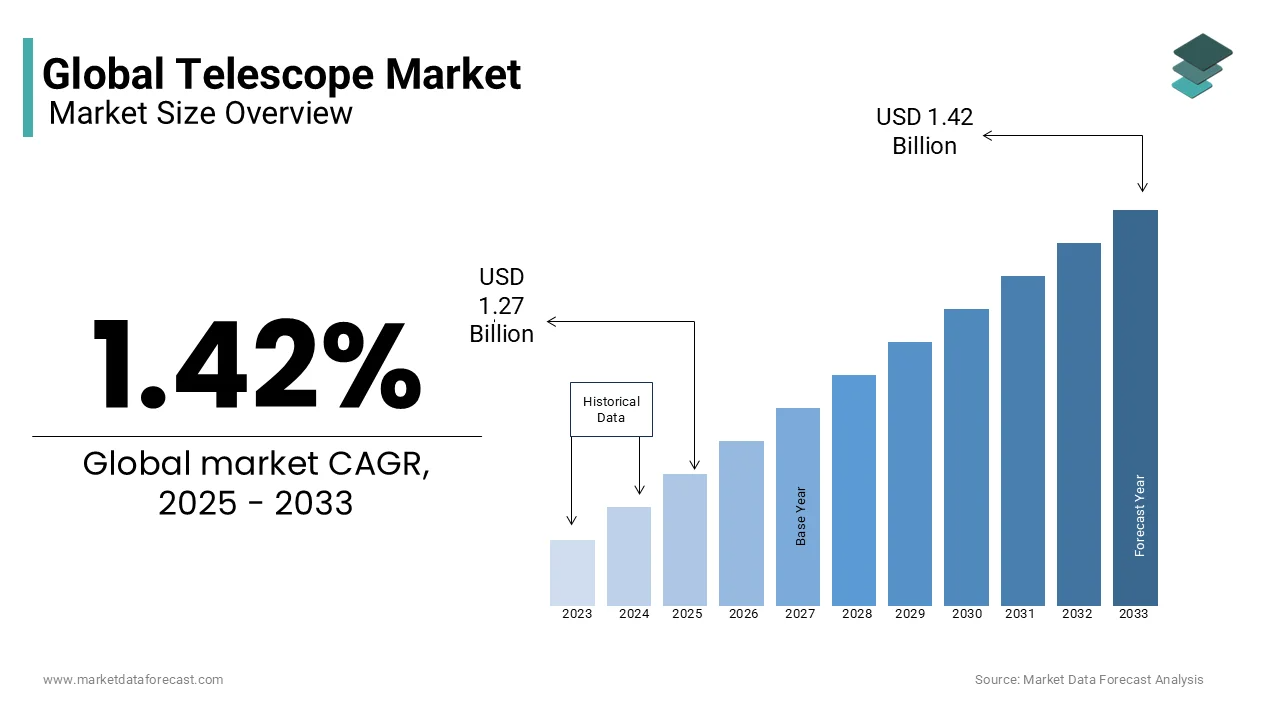
(Source: marketdataforecast.com)
- Hubble Space Telescope: Even though it uses outdated equipment, Hubble will still provide important data, and more observations are planned for the future.
- James Webb Space Telescope: Being the best observatory of the next decade, JWST will continue doing its innovative research and there will be even more missions for it in the future.
Summary
So, exploring these telescope usage statistics gives us a clear picture of how instruments like Hubble and James Webb are helping humanity understand the universe. From millions of observations to thousands of scientific papers, these telescopes are not just tools; they are gateways to discovering new worlds, galaxies, and the history of the cosmos.
As these telescopes continue their work, the data they collect becomes a treasure for scientists, students, and space enthusiasts everywhere. If you’re curious about the universe, keep following these discoveries, explore publicly available telescope data, and see how the stars and galaxies evolve. If you have any questions, kindly let me know in the comments section. Thanks.
FAQ
Astronomy group-1 | PPTXA telescope is a precision instrument designed to gather and focus light from distant objects, magnifying them for observation. Its primary uses span astronomical research, space exploration, terrestrial observation, navigation, and defense, revealing details invisible to the naked eye.
The catadioptric telescopes are the most common kind of telescopes with the most advanced design and sold commercially all over the world in sizes ranging from 3 ½ to 20 inches.
Yes, a 70mm telescope is perfectly capable of seeing Jupiter. You will easily spot the planet as a bright disk and clearly see its four largest moons (Io, Europa, Ganymede, and Callisto) lined up beside it. With steady skies and a good eyepiece, you can also make out its two main equatorial cloud bands.

Sources