








Introduction
Email Personalization Statistics: In 2026, email personalization means much more than swapping in a person’s first name on the subject line. Good marketers use permitted data to build messages based on behaviour, preferences, lifecycle stage, and useful contextual information. That works because inboxes are crowded, to ignore campaign messages, but they are more likely to read and act on relevant emails. Marketers also use AI to adjust copy and send time for large audiences, but bad data or pushy targeting can hurt trust fast.
This article on email personalization statistics will cover what people expect, which challenges tend to work, and how to personalise in a way that keeps privacy, accuracy, and inbox placement in mind.
Key takeaways
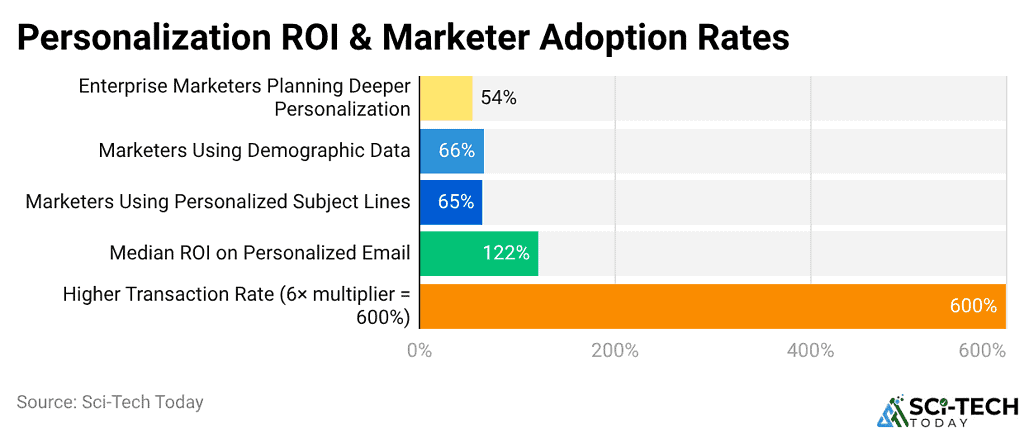
- 66% of marketers say they use demographic data for personalization, while 79% also use at least three other kinds of data.
- Organizations using five or more data types report 58% higher email-driven customer lifetime value than programs that use demographics only.
- 71% of enterprise marketers have moved past basic greeting-based personalization
- 63% of enterprise marketers run AI models with 50 or more behavioral signals per subscriber, also report a 47% drop in email churn.
- Birthday emails can drive 481% higher transaction rates and 342% more revenue per email than standard promos.
- Personalized emails show 29% higher open rates and 41% higher click-through rates than emails without personalization.
- Based on HubSpot, Segmented email campaigns bring 30% more opens and 50% more clicks than unsegmented campaigns.
- Brands that personalize report 43: 1 ROI, compared with brands that rarely personalize report 12: 1.
- In Salesforce data, hyper-personalized campaigns show 38% higher conversions, 61% higher opens, and 73% higher click-through rates.
- McKinsey says smart personalization can lift revenue by about 10% to 15%, with results ranging from 5% to 25%.
- Cold outreach that uses AI to tailor messages often lands around a 6% to 14% reply rate, but tightly defined segments can go past 20%.
- Campaigns that rely on signals tend to see 8% to 15% replies, while in contrast, static lists usually sit closer to 2% to 5%.
- 70%say they use AI tools for personalization, while 55% of brands say they use real-time personalization.
- 50% of marketing teams report trouble combining data, while 45% point to weak data quality as a key problem for personalization.
- 30% of brands have a clear personalization strategy, and 30% say they cannot track personalization ROI well.
What does email personalization mean?
- Email personalization means changing the email for the recipient rather than sending a generic mass message. The approach involves teams using targeted messages to shape what the recipient perceives, such as using a recipient’s name, past interactions, behaviors, and preferences.
- It often involves dynamic content inside the email, product recommendations, personalized subject lines, and increasing engagement by structuring a more personalized and relevant message.
- With 347.3 billion emails sent each day (per Statista or The Radicati Group), personalization is one way to get more value from each send, meaning better open rates and stronger conversions.
Email Personalization Trends and ROI Impact in 2026
(Reference: amraandelma.com)
- Email personalization is moving beyond basic demographics and first-name greetings toward deeper, data-driven experiences.
- MarTech Alliance ran the Global Email Personalization Survey included 6,100 marketing professionals, and reports that 66% said they use demographic details like age and gender for personalization.
- Still, 79% also bring in at least three other kinds of data, while organizations that use five or more data dimensions see 58% higher email-driven customer lifetime value than groups that stick to demographics only.
- Gartner’s annual Marketing Technology Survey pulled input from 4,800 enterprise marketing leaders, which reported that 71% had already rolled out personalization beyond name-based greetings, or were in the process.
- In that same survey, 63% were using AI models with 50 or more behavior signals per subscriber, and the figure was 54% for those planning to start in 2025. Those efforts were tied to an average 47% drop in email churn.
- Email personalization is getting more advanced by using demographic, behavioral, purchase, and context signals together. At the same time, marketers still have to weigh message relevance against careful data use.
- Experian reports that Birthday emails bring 481% higher transaction rates and also generate 342% more revenue per email than standard promotions, showing how timely, context-specific messages can strengthen email performance and ROI.
Consumer Behavior and Email Personalization in 2026
- Consumers now see personalization as a normal part of a relevant brand experience rather than something they expect to be offered only once in a while.
- Data shows strong intent to buy when experiences fit, as 70% of people are more ready to purchase from brands that personalize, while 81% say they will buy more when product picks match them well. Likewise, 60% respond better to personalized product suggestions, and 45% are more likely to return when the shopping flow feels made for them.
- 50% of consumers expect messages that feel personal, while 75% get upset when they do not receive them, and many also want offers that match how they act and what they prefer.
- Another 70% expect deals to reflect behavior and taste, and 70% want brands to guess what they will need next.
- In the results given, 75% say personalization helps them feel respected, while 65% trust brands more when their content is tailored.
- 60% say they would give more data to improve personalization, including 50% who are open to sharing demographic details.
- However, 80% say they feel annoyed by messages that miss the mark, and 40% also feel bothered when the personalization is stale or out of date.
- 30% say they would switch brands if another option felt better, 50% would tell others about a brand that personalizes its interactions, and 35% care most about brands that keep track of their preferences across different channels.
- The analysis shows that consumers reward personalization that feels right, and they punish messages that feel generic, outdated, or disconnected.
Email Personalization Impact in 2026
- Personalization is now treated as a way to improve results, not just a way to write better messages.
- Emails with personalization bring 29% higher open rates and 41% higher click-through rates than emails without it.
- Even so, many sales emails still do not use personalization, with 86 to 90% missing it, and the gap suggests companies have not fully moved beyond the idea.
- Personalized subject lines get opened 26% more often, which holds when the message uses a name, a place, past purchases, or online behavior, which makes the subject line a key place to focus first.
- HubSpot says personalized calls-to-action lead to 202% better conversion results than generic CTAs. Matching the CTA and landing-page experience to a subscriber’s context can therefore make the transition from engagement to action more effective.
- Segmented and personalized campaigns are said to drive 58% of email-based revenue, and it also notes that revenue per email can be 5 to 10 times higher than in campaigns that target less, indicating that being relevant can be more important than sending more emails.
- Personalized emails are reported to have 6 times higher transaction rates than non-personalized ones.
- The above results point to personalization affecting the whole email path, which can improve opens, clicks, conversions, revenue, and transactions, with gains showing up at each step.
Engagement, ROI, and Conversion Impact in 2026
- The personalization of emails is becoming a clear factor that has an impact on engagement, conversions, and revenue.
- Information about more efficient email campaigns can be found at HubSpot, which states that campaigns with segments have 30% more opens and 50% more clicks than without segments.
- The influence of the income that brands earn because of personalization is obvious, as it represents a 43:1 ROI for brands that personalize emails as opposed to the 12:1 ratio for brands that rarely personalize their campaigns.
- As for Salesforce, the data indicates that hyper-personalized campaigns can give 38% higher conversion rates, 61% more opens, and 73% more clicks than campaigns based only on basic personalization methods.
- Personalization is also essential at the business level, as according to McKinsey, proper personalization can increase revenues by 10-15% and reach even 5-25%.
- Companies that develop more actively get 40% more revenue advantages than those with slow development.
- The importance of personalization can be emphasized in cold outreach, as AI-personalized campaigns deliver 6-14% reply rates, while some narrowly defined segments can even exceed 20%.
- According to Autobound, generic outreach gives 1-5% results, basic personalization delivers 5-9% replies for personalization, and 15–25% for event-specific personalization.
- According to Amplemarket, the response rates for signal-based campaigns vary between 8 and 15%, while it is only between 2 and 5% for static-list outreach. Those signals related to job changes are as high as 20–30%, while account-based signals work at 5–8% levels.
- The above statistics show that relevant personalized emails can help improve both engagement and business results.
E-mail Personalization Recent Developments
- E-mail personalization is becoming much more dynamic, visual, and interactive.
- In 64% of cases, personalization APIs are used by enterprise marketers, which means changes to content can be made in real-time depending on the customer information used.
- According to the research, 43% of emails sent in the field of e-commerce use visual personalization methods, especially product images that make emails more relevant and product-oriented.
- Similarly, small companies and teams follow this trend: 71% of small companies and solopreneurs use no-code platforms like Iterable and get rid of technical challenges with heavy personalization usage.
- 25% of campaigns use AMP for Email to utilize interactive tools, like real-time forms or carousel features.
- Location-based personalization has also become more popular, as around 51% of retail campaigns have already started implementing dynamic email previews based on location.
- More experimental formats are emerging too: 15% of interactive campaigns from major fashion brands test AR email previews for virtual try-on experiences.
- 40% of marketers are making use of consent-driven, browser-history-funded personalization, which points out that personalization is becoming more reliant on the right balance between relevance and the right use of data.
- All of the above developments indicate that email marketing is becoming more interactive and efficient.
How Is Technology Used in Implementing Personalization in Email Marketing?
- Personalization technology is becoming more widely spread among modern marketing companies.
- 70% of marketers implement AI-based personalization technologies, whereas another 80% of marketers claim to invest in personalization in 2024.
- Various brands improve their real-time performance levels, with 55% of those using real-time personalization technology and 45% switching to real-time platforms.
- 60% of marketers implement CRM systems into their personalization technologies, while 75% of brands incorporate customer data platforms to bring customer information into a single database of customer data, and 50% of marketing teams still have issues with data integration.
- Institutions using machine learning to recommend products comprise about 35% of users, while 60% utilize predictive analytics to give customers a personalized experience.
- Furthermore, 50% of businesses use segmentation methods and 50% use A/B testing methods.
- About the implementation of these technologies, 60% of brands use personalization in mobile apps, 40% in social media, 35% in chatbots, and 30% via video personalization.
- Moreover, 45% of SMBs use email, and 40% use SMS with the technology.
- Personalization is becoming a more interconnected platform in the B2B sector, with 65% of businesses utilizing personalization techniques in ABM practices and 70% linking third-party applications through personalization APIs.
B2B vs. B2C Email Personalization Benchmarks
| Benchmark dimension | B2C email personalization | B2B email personalization | Best 2026 KPI interpretation |
| Primary personalization unit | Individual shopper or household. | Account, buying group, and stakeholder role. | Keep B2C profiles at customer level and B2B reporting at both contact and account levels. |
| Dominant data signals | Browsing, cart activity, purchase history, product affinity, loyalty, location, and lifecycle stage. | Firmographics, role, CRM history, first-party engagement, third-party intent, buying stage, and technology changes. | Measure whether signals improve incremental conversion against a control group. |
| Typical personalized experience | Dynamic product images, recommendations, offers, replenishment reminders, welcome journeys, and cart or browse recovery. | Role-specific value propositions, account-specific proof, industry use cases, trigger-based outreach, and buying-committee nurture. | Test the message, offer, timing, and creative treatment separately. |
| Transaction benchmark | Cart recovery email programs tend to show about a 3.33% order rate, and they bring roughly $3.65 in sales per person reached. The best performers, the top tier, can hit 7.69% and about $28.89 per recipient. | Straight side-by-side checks of “transaction rate” usually do not make sense in B2B email, since it often supports more than one step before an actual order. | For B2C, focus on placed order rate and revenue per recipient. For B2B, use opportunity metrics and revenue attribution instead. |
| Automation benchmark | Cart, welcome, and browse-abandonment flows make up 87% of the automated orders in the Omnisend data. | Automation should send the right kind of message when someone’s intent or activity shifts. | Then compare those automated journeys to scheduled campaigns, or to cohorts that were not triggered. |
| Signal-based reply benchmark | Reply rate is generally secondary to click-to-purchase behavior. | 6sense recommends an 8%–15% reply-rate target for targeted, high-intent outreach, with 10%–20% of replies progressing to meetings. | Separate total replies, positive replies, meetings, and qualified opportunities. |
| Pipeline benchmark | Revenue is usually tied to an order or to a specific customer. | In Demandbase’s write-up, mature ABM efforts reached a median MQA-to-pipeline conversion of 22.33%. That same metric was 14.19% for less mature programs. | They track reported and influenced pipeline. They also break out results by account tier, sales cycle speed, and closed-won revenue. |
| Main measurement risk | Over-crediting automation for purchases that would have happened without the email. | Over-crediting a single email inside a long, multi-contact buying journey. | Use holdout testing where feasible and report both sourced and influenced results. |
Challenges of Email Personalization in 2026
- The challenge with email personalization is ceasing to be an issue of demand and becoming rather an issue of execution.
- 50% of marketers do not have this skill, and 40% lack resources for implementing personalized systems.
- 40% claim it is complex, 35% mention troubles with cross-device tracking, 30% refer to limited infrastructure for real-time personalization, and another 25% report issues with real-time data processing.
- 45% report poor data quality as the main obstacle, while 50% lack a common view of customer data.
- 35% face problems with data governance, and another 35% cite compliance with regulations, including GDPR, as an issue.
- Privacy plays a role in the acceptance by customers too, as 25% of companies are facing these backlash issues.
- Scaling up personalization brings even more pressure in the communication process; 35% face complications with scaling up personalization. 25% state difficulties with large customer bases, while 40% denote issues with producing hyper-personalized content.
- The lack of an effective personalization strategy, as well as an inability to measure its ROI, are missing links in the way companies operate.
- 30% of firms state they cannot develop a strategy, and the same percentage is unable to calculate the ROI of personalization.
- As many as 40% of companies in the study report low adoption of personalization tools among their team members.
- Furthermore, 45% of companies mentioned inconsistencies in personalization messages among channels, while 30% share a discrepancy in campaign outcomes.
- Effective personalization relies on the lack of skilled specialists, poor data integration, governance, infrastructure, customer experience management, measurement, and a proper corporate environment.
Conclusion
In the near future, email personalization will move from simple name-based channel approaches to data-driven experiences. The numbers highlight that there are observable improvements in terms of opens, clicks, conversion, revenue, and customer value as measured by ROI. With that, AI adapts itself at this moment by using behavioral data to target messages.
Still, implementation of personalization remains challenging because of data quality, integration, skills, privacy, content production, and measurement gaps. Personalization works best when there is usage of data that is well balanced and relevant. To make the process smoother, the marketer should prioritise things such as measurable incremental value, not personalization complexity for its own sake.
FAQ
According to research, around 70% of marketers believe in employing A.I.-based personalization tools to enhance sales and profits.
Email personalization leads to a 29% increase in email open rates and a 41% boost in click-through rates.
Personalized campaigns have seen a remarkable 43:1 return on investment in contrast to 12:1 for brands that do not frequently utilize personalization.
Estimates provided by McKinsey suggest that if personalization is carried out properly, annual revenue can increase by 10%-15%.
According to studies, 50% of marketers lack the knowledge and experience in personalization while 45% experience barriers due to poor data quality.

Sources


