









At a Glance
AI in Event Management Statistics: Planning an event takes time, effort, and careful coordination. AI is making this work easier by helping organizers handle tasks more quickly and connect with attendees more effectively. From managing registrations to suggesting personalized schedules, AI tools are changing how events come together. They can also help create content, answer attendee questions, manage budgets, and measure event performance. Today, event planners are exploring AI for conferences, exhibitions, corporate meetings, and online events.
However, using AI also presents challenges, including costs, staff training, and data privacy concerns. Knowing where AI fits into event planning can help organizers save time, improve attendee experiences, and run more successful events.
Best Overall
- The global AI event management market is forecast to rise from USD 2.7 billion in 2025 to USD 3.3 billion in 2026.
- A Q1 2026 Monentus Technologies survey across 20+ countries found that 64% viewed AI as highly important.
- 64% consider AI highly important, but only 7% are testing or expanding its use.
- AI can reduce planning costs by 30% and increase attendee satisfaction by 20%.
- Around 76% of marketers value AI for personalization, and 75% report better attendee engagement and satisfaction.
- 62.4% of professionals use AI for marketing, while 72% consider it valuable or essential.
- At the 2026 AI Demo Day, EventMobi CEO Bob Vaz stated that 80% of enterprise AI projects fail.
- Only 15% of organizers rated networking as highly effective, down from 46% in 2025.
- AI automation improves staff efficiency by 52% and reduces operational errors by 61%.
- In 2026, 49% of respondents expect AI to have a moderate impact on the industry.
- 95% of event teams plan to increase their use of AI in 2026.
- The event management software market is valued at USD 14.29 billion in 2026.
AI in Event Management Market Size
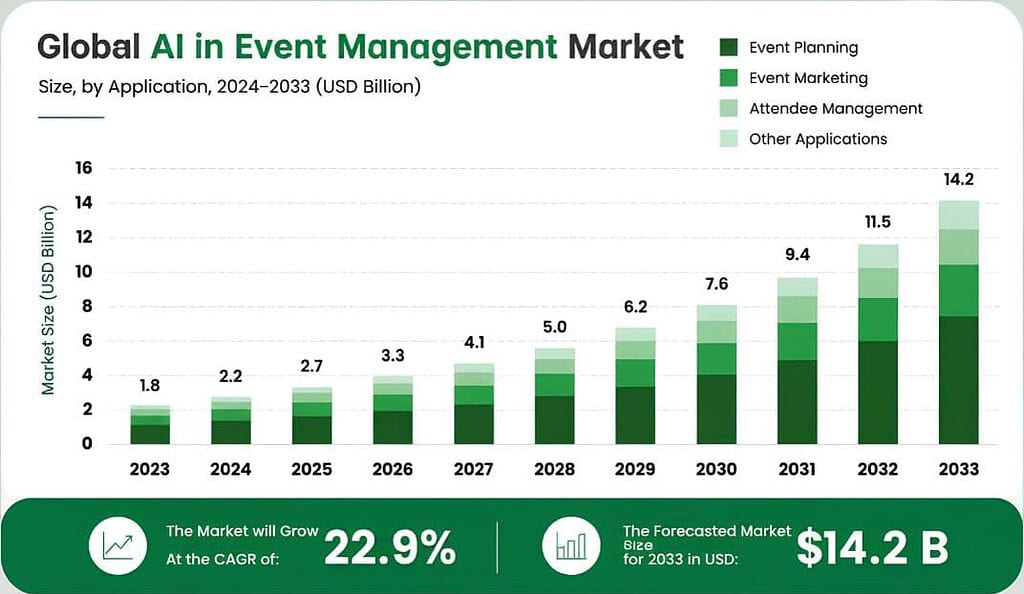
- The global AI in event management market is projected to reach USD 2.7 billion in 2025.
- The market is expected to grow to USD 3.3 billion in 2026.
- By 2033, the market is forecast to reach USD 14.2 billion, reflecting a 22.9% CAGR.
AI Event Management Claims and Key Research Findings
- According to GlueUp reports, more than 2,000 associations use GlueUp for conferences, but AI adoption among these customers remains unclear.
- 72 hours is a suggested deadline for speaker slide submissions, not a measured time-saving.
- 40% is an illustrative engagement threshold for triggering speaker questions.
- 24 hours is a suggested schedule for post-event reports and a vendor-stated delivery capability.
- 15 minutes refers to a product demonstration, not implementation time.
- Under 25 minutes daily is a promotional claim without supporting evidence.
The State of AI in Venue and Event Management
- A Q1 2026 Monentus Technologies survey across 20+ countries found that 64% viewed AI as highly important.
- Only 7% were actively testing or expanding AI applications.
- 52% said AI tools lacked specialized venue knowledge.
Key Trends Shaping AI in Venue and Event Management
- 64% consider AI highly important, but only 7% are testing or expanding its use.
- 75% want AI to reduce administrative work, while 62% want it to provide better operational insights.
- AI supports basic tasks, but staffing, real-time operations, and risk prediction remain underdeveloped.
- Security, reliability, and change management slow adoption.
- 55% report incomplete operational data, limiting AI performance.
- 66% prefer AI to support human decision-making rather than replace it.
AI Adoption in Event Management
- Amazon Web Services plans to invest 2.26 trillion yen (USD 15.24 billion) in Japan by 2027 to expand its cloud computing services.
- Approximately 70% of event planners use AI to improve registration and attendee engagement.
- AI can reduce planning costs by 30% and increase attendee satisfaction by 20%.
- Real-time data analysis can improve event adaptability by 25%.
- Approximately 80% of event professionals see AI as beneficial, while 87% believe it improves productivity.
- Market.us Scoop reported that around 76% of marketers value AI for personalization, and 75% report better attendee engagement and satisfaction.
- About 63% of association planners use AI, but 72% lack AI education and 26% actively develop these skills.
- AI tools can save 200 hours annually, handle 90% of registrations, increase revenue by 30%, and improve ROI by 25%.
- Around 82% of attendees prefer in-person events, while 52.1% reported growth in attendance and 86.4% plan to maintain or expand offerings.
- Event budgets fell for 33% of organizations and rose for 32%.
- Meanwhile, 53% increased event investment, and 47% prioritized hosting.
- Budgets exceed USD 500,000 for 54.5% of organizers; 22.3% manage USD 1 million or more.
AI Use in Event Management, 2026
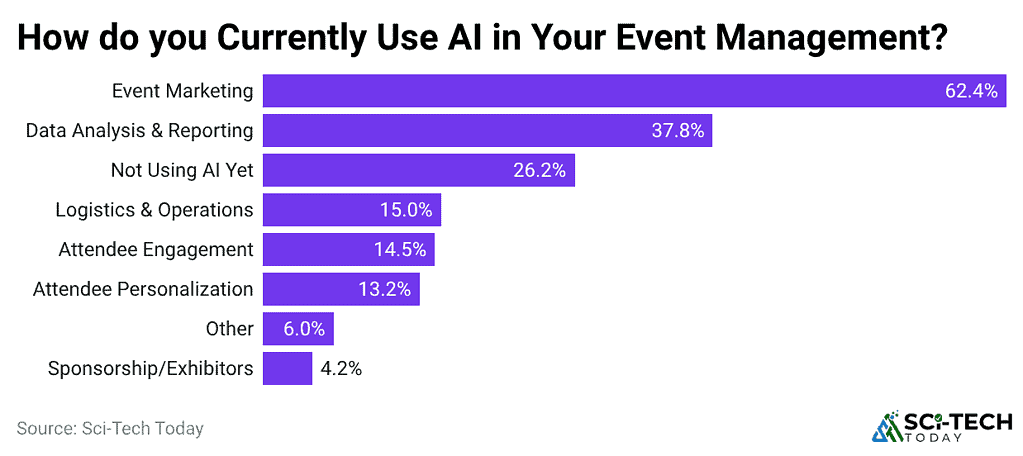
- At 62.4%, event marketing ranks as the most common AI application, with data analysis and reporting following at 37.8%.
- However, 26.2% of respondents have yet to adopt AI.
- Operational applications include logistics and operations at 15%, attendee engagement at 14.5%, and attendee personalization at 13.2%.
- Other uses account for 6%, while sponsorship and exhibitor activities represent 4.2% of AI applications.
Emerging AI Applications in Event Management in 2026
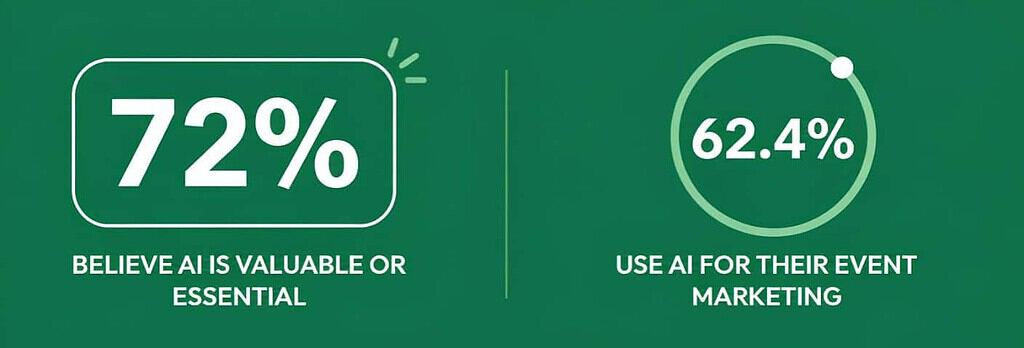
- EventsAir found that 62.4% of professionals use AI for marketing, while 72% consider it valuable or essential.
- Cvent reported that 75% of planners use AI to find venues, and 61% expect greater use in 2026.
- Momentus found that 75% want AI for administrative tasks, while 34% are evaluating, piloting, or scaling these tools.
- Around 62% want AI for operational insights, while 28% are testing or expanding these tools.
- 48% prioritize AI for staffing and resources, but only 16% are testing or scaling related solutions.
- Approximately 43% want AI support for booking calendars, while 11% are evaluating or expanding its use.
- Risk prediction interests 33% of respondents, while 28% are interested in operational monitoring.
- However, only 13% are testing or scaling risk prediction, compared with 9% for operational monitoring.
- Bizzabo found that 95% expect organizational AI use to increase, including 35% anticipating significant growth.
Why AI Implementations in Events Often Underperform
- At the 2026 AI Demo Day, EventMobi CEO Bob Vaz stated that 80% of enterprise AI projects fail.
- A 2026 PCMA and Censuswide survey found that 91% of event professionals use AI, but only 16% report significant improvements.
- According to the Converve 2026 report, 63% of event planners identify poor data quality as their main AI challenge.
AI-Powered Matchmaking and Networking
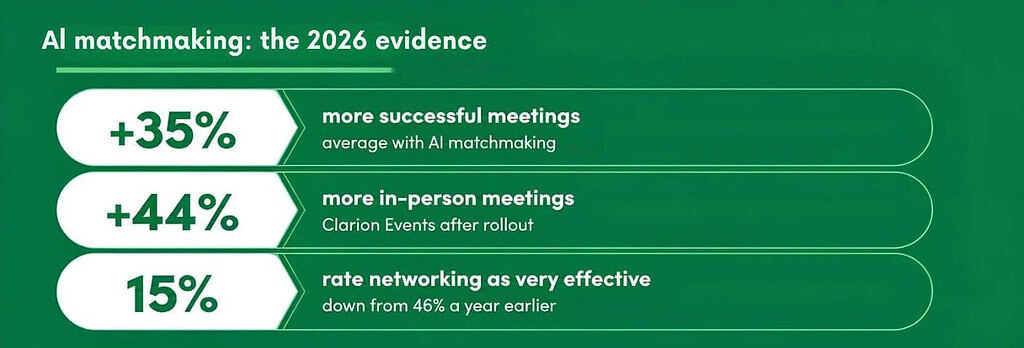
- Only 15% of organizers rated networking as highly effective, down from 46% in 2025.
- AI matchmaking can increase the number of successful meetings by 35%, while Clarion Events reported a 44% rise in in-person meetings.
- Structured AI matching can improve exhibitor lead generation by 30%.
- Bizzy AI simplifies networking, while Bridgd Events fills up to 30% of seats.
Operational Automation Delivers Strong ROI
- AI automation improves staff efficiency by 52% and reduces operational errors by 61%, according to Converve’s 2026 report.
- Wicket enables facial check-in in under one second, while FieldDrive helps organizers analyze past event data.
- EventMobi connects with over 1,000 applications to automate workflows, and Alethia converts hotel proposals into budget presentations in under five minutes.
Expected AI Impact on Meetings and Events
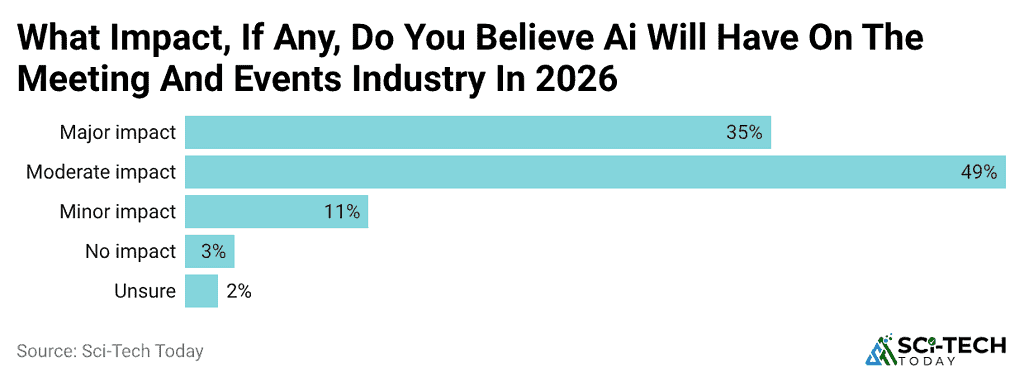
- Most respondents expect AI to influence the meetings and events industry in 2026, with 49% anticipating a moderate impact and 35% expecting a major impact.
- Another 11% believe AI will have only a minor impact, suggesting more limited expectations.
- Meanwhile, 3% expect no impact from AI, while 2% remain unsure about its influence.
AI Tools for Event Planning in 2026
| Tool | Best For | Uses | Price |
| Bizzabo | Enterprise conferences and multi-event programs | Manages registration, speakers, sponsors, networking, and event analytics. | Starts at USD 17,999/year, with a minimum of 3 users. An alternative is USD 499/user/month, billed annually. |
| Eventbrite | Public events, workshops, and meetups | Creates event listings, sells tickets, manages registrations, and tracks attendance. | Free events are available. US paid-ticket fees are 3.7% + USD 1.79/ticket, plus 2.9% per order. Premium costs USD 69/month or USD 708/year. |
| ChatGPT | Event ideas, agendas, and planning documents | Drafts invitations, creates schedules, prepares checklists, and summarizes feedback. | Free plan available. Plus costs USD 20/month; Pro costs USD 200/month. |
| Canva | Event marketing and visual design | Creates invitations, posters, presentations, banners, and social media graphics. | Free plan available. India pricing lists Pro Lite at INR 1,590/year, Pro at INR 4,000/year, and Business at INR 6,800/person/year. |
| Otter.ai | Planning meetings and event reviews | Transcribes meetings, summarizes discussions, and identifies action items. | Basic is free. Pro costs USD 16.99/user/month or USD 8.33/user/month with annual billing. |
Why Are Event Planners Using AI?
- A Lensmor survey found that 95% of event teams plan to increase their use of AI in 2026.
- In 2025, approximately 50% of meeting planners used AI in their workflows, according to Amex GBT.
- AI can reduce 6-8 weekly admin hours by 40%-60%, potentially saving USD 300 per week at USD 75 per hour.
How to Choose an AI Tool for Event Planning
- Spend 30 minutes testing one common task, such as creating a 12-week plan, comparing 3 venues, or prioritizing 20 target accounts.
- Evaluate accuracy, missing information, approval time, integration effort, and data security.
- A 50-person retreat may need ChatGPT and Canva, while a 5,000-attendee trade show may require specialized event platforms.
- Free tools support basic tasks, while paid plans may offer higher limits, integrations, team collaboration, and additional controls.
- Focus on the time needed to approve the final result, not just on generating the first draft.
- Choose tools that deliver accurate, secure, and practical results with minimal corrections.
Event Management Software Market Statistics
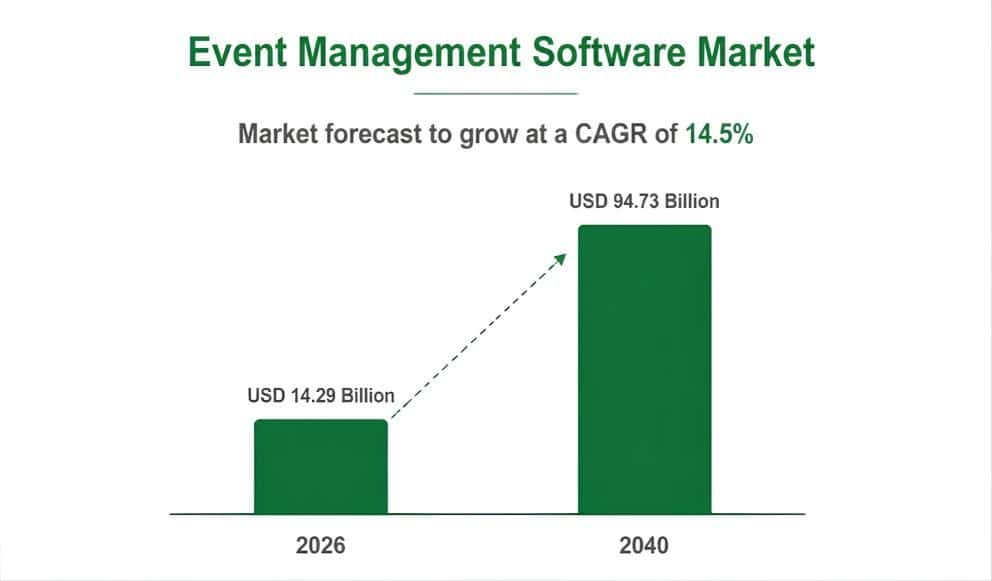
- The event management software market is valued at USD 14.29 billion in 2026.
- It is forecast to reach USD 94.73 billion by 2040, growing at 14.5% annually.
Commercial Use Cases Across Industries
- Markets and Markets reported that Cvent helped Capital Group manage global events, tripling event volume and boosting client engagement by 30 times
- The platform also reduced average event costs by 66% through centralized management and automation.
- Experity hosted 365 attendees at its conference using Bizzabo.
- The event achieved a 19-fold ROI, influencing a USD 9 million sales pipeline and generating USD 5.4 million in post-event sales.
- Sponsorships generated USD 80,000, while closed/won rates increased by 30%.
- Ellucian Live achieved 87.6% mobile app adoption through RainFocus’s event management platform.
- Meeting registrations rose by 231%, while the likelihood of attending a meeting increased by 134%.
- vFairs helped Semex grow virtual conference attendance from approximately 150 to 500 participants worldwide.
Main Concerns About AI in Event Operations
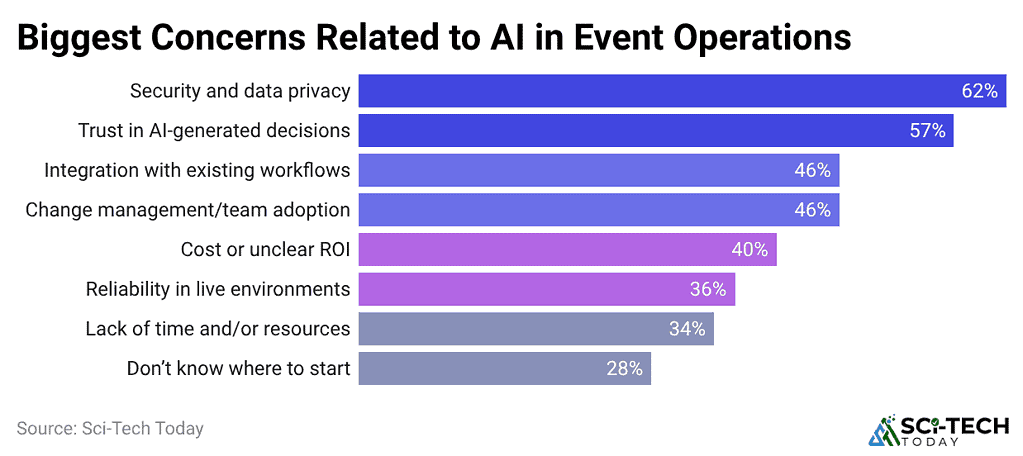
- Security and privacy remain the biggest concerns for 62% of respondents, while 57% question the trustworthiness of AI-generated decisions.
- Workflow integration and team adoption pose challenges for 46% of respondents each.
- Meanwhile, 40% are concerned about costs or uncertain returns.
- Live-event reliability worries 36% of respondents.
- Additionally, 34% cite limited time or resources, while 8% are unsure where to begin.
The Bottom Line
AI is changing how events are planned and managed. It helps organizers save time, control costs, and give attendees a better experience. From handling registrations to suggesting sessions, AI tools can make many tasks easier.
However, human creativity and personal connections still matter. Event organizers who use AI wisely while keeping people at the center can plan smoother events, engage attendees, and achieve better results.
FAQ
AI supports every stage of an event, from planning and budgeting to marketing, attendee matchmaking, registration, on-site assistance, engagement, and post-event performance analysis.
AI personalizes event content, recommends relevant sessions, simplifies networking, and provides instant attendee support.
Event managers use ChatGPT, AI chatbots, predictive analytics, matchmaking tools, and automated scheduling platforms.