








Introduction
Sales Proposal Statistics: Sales proposals are a critical step in complex B2B buying processes, but they should be more than just a simple presentation of the terms and price involved. The most successful proposals in 2026 are the ones that offer buyer assistance, clearly expressing what value the proposal contains, informing stakeholders to make decisions with ease, and removing obstacles from the approval stage of the process. Throughout this article, we will show you how sales proposal statistics will inform your decision-making process for future proposals.
Featured Selection
- 82% of sales proposals are opened within one hour, with 48% within 24 hours, and only 8% within one week.
- After reviewing over 1.3 million sales document sessions, 92% of bottom-of-the-funnel sales proposals are started, while 69% of the sales materials at the top of the funnel are started.
- Sales proposals that receive a response within four hours close at a 35% higher rate than those that take longer than 24 hours to respond.
- Proposals containing customer case studies and testimonials have a 73% higher probability of winning a deal.
- Visuals are a powerful tool in proposals, increasing closing rates by 72% and helping close deals 20% faster.
- The highest-performing sales proposals included client logos, while 81% featured testimonials or case studies.
- Sales proposals seen by stakeholders closed 20% faster.
- Organizations using interactive pricing won twice as many proposals and were 21% more likely to close.
How Quickly Does Interest in a Sales Proposal Decline?
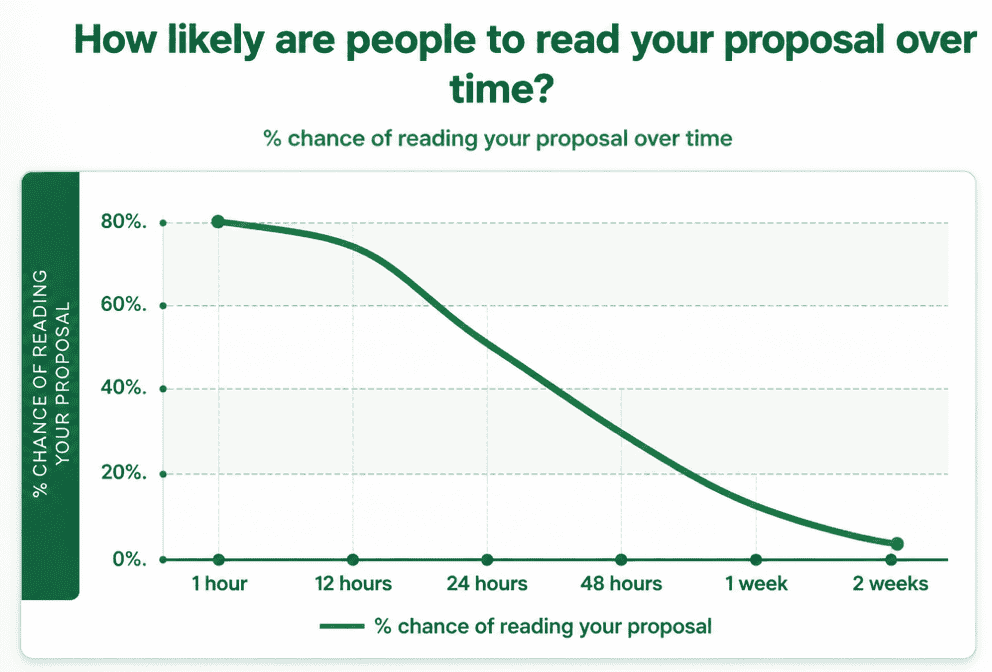
- Sales proposals are quickly forgotten if not followed up. Proposals that take more than an hour to be opened will be read by only 71% of potential clients.
- If it takes longer than 24 hours, only half of prospective clients will ever open it.
- In order to capitalize on client interest, sales proposals should be followed up promptly.
- The numbers don’t get much better after that, and it only takes a week to reach an abysmal 8%.
- Beyond that point, the chance of the proposal being opened is almost nonexistent, as only 2.1% of prospective clients open a sales proposal more than two weeks old.
- The best chance to check engagement, respond to questions, and resolve any confusion is on the first day.
- If a prospect has not yet opened a sales proposal, then a prompt and relevant follow-up can serve as a friendly reminder.
- If you wait for a week, you may have trouble picking up where you left off.
- A sales proposal being unopened can mean a few different things. Prospective clients can lose interest, but there are other reasons that proposals go unopened, as well.
- The above statistics are helpful but are not a substitute for active follow-ups that support thoughtful interactions in order to keep deals from becoming stagnant.
How Buyer Intent Influences Proposal Engagement
- Buyers’ interest in sales content changes according to what content they’re viewing and their place in the buying process.
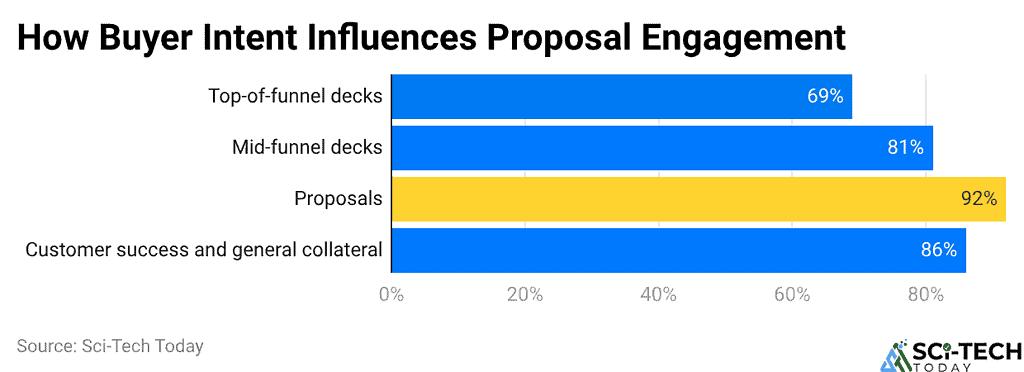
- Storydoc’s analysis of 1.3 million sessions showed four categories of reading starting rates.
- Brochures and one-pagers have a 69% reading-start rate, pitch decks (which are in the mid-funnel) have an 81% reading-start rate, and post-sales documents (case studies, product sheets, and QBRs) have an 86% reading-start rate.
- Proposals, which are at the bottom of the funnel, have the highest rate at 92%.
- Potential buyers at an early stage might still be surveying the field and figuring out whether a solution is even relevant to them.
- A prospective buyer who is opening a proposal, however, is probably weighing their options regarding cost and outcomes, and figuring out what steps they need to take next.
- The findings illustrate how sales documents should align with the needs of the buyer.
- A proposal shouldn’t rehash basic concepts that have been presented to a prospective buyer multiple times.
- Rather, the document should focus on key points that are of high importance, like pricing and next steps.
- For businesses, creating strong engagement begins with understanding their buyers’ intent.
- Each sales document should serve its purpose in the sales process to provide the necessary information and improve the buying experience.
Proposal Timing Statistics
- Effectiveness of sales proposals requires balancing speed and timeliness with careful preparation.
- For instance, according to an article in the Harvard Business Review, proposals that receive responses from a customer in under four hours close 35% more often than proposals that receive responses after 24 hours.
- Promptness in replying is obviously valued by prospects that have questions, and rightly so from an analyst’s point of view.
- When it comes to the optimal length of a sales proposal, prospects will not accept offers that are either too brief to include enough detail or too complex and cluttered to read.
- After analysing over two million proposals, the folks at Proposify found that successful sales proposals were around 10 pages in length.
- When you send follow-up proposals, you will likely wait between 2 and 3 days to send the follow-up, after which prospects will typically respond with a higher degree of interest.
- When sending cold sales emails, the data that Martal Group published indicates that there is less than a 1% difference between a Monday and Friday email open rate.
- According to the research, the best times to send sales emails are between 11 AM and 12 PM and 4 PM to 5 PM.
- Rather than focusing exclusively on the timing of sales communications, the research highlights that quick, concise, and well-thought-out proposals and communications are key to a successful sales communication process.
Sales Proposal Statistics: What Makes a Proposal More Effective?
- A good sales proposal should be structured to make information clear, evidence believable, and information easy to understand.
- As per Zomentum, the best length of a sales proposal should be in the range of 6-10 pages.
- With a few hundred words per page, the structure should support decision-making rather than overwhelming a customer with too many words.
- Trust in a business and product are both increased by including social proof in a sales proposal.
- Sales proposals are likely to be won 73% more when including customer testimonials and case studies.
- Testimonials and case studies enable customers to assess the value and impact the product or service could have on their business.
- The use of images, diagrams, and charts also improves the conversion of proposals.
- Data gathered from Proposify’s review of one million proposals suggests the use of diagrams and images significantly increased proposal conversion.
- A proposal is likely to close 72% faster and convert 72% more when charts, images, and diagrams are used to illustrate complex concepts.
- However, it takes a significant amount of time to prepare these types of visuals and may not improve proposal conversion.
- When presenting a sales proposal, pricing tables improve a proposal’s conversion. Based on pricing tables, a sales proposal’s conversion was 54% better than pricing without a table. Pricing tables are clearer and easier for customers to digest.
- Overall, a business should combine writing that is brief and customer-focused with helpful graphics and transparent pricing.
- As a business begins to grow, there are many tools on the market that help streamline the proposal process and make repetitive tasks automated.
Top-Performing Sales Proposals
- There are elements and sections that every effective proposal needs such as company reputation, information about the product, customer testimonials and a few commercial points are vital for every proposal.
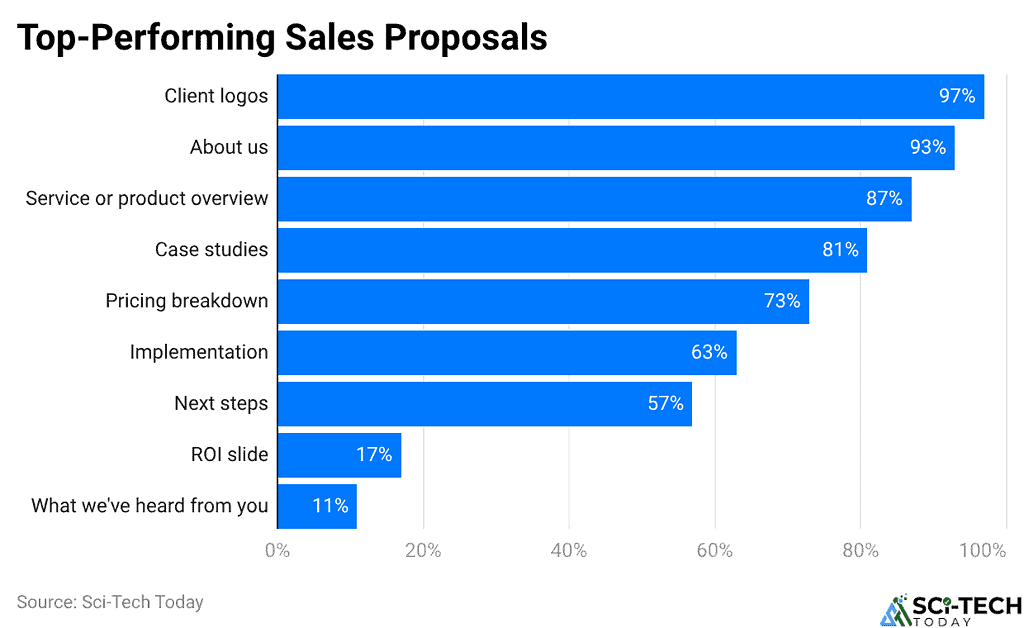
- A report from Storydoc on the top proposals shows that almost 100% of the winning proposals contained a logo of their customers.
- Almost 93% included a section for About Us, while 87% of them contained a summary for the product and service being provided.
- The section with case studies and testimonials was included in 81%, which helps us understand what matters to customers and builds trust in the provider.
- Pricing and timelines are as important as the commercial and delivery information.
- Most proposals contained some type of pricing structure, as 73% had a section with the pricing breakdown and 63% had the timelines of the implementation.
- The proposal structure and content help prospective clients understand the overall costs and what delivery will entail. However, it also shows room for improvement in proposals.
- There is a significant gap in the “Next Steps” slide section in many top-performing proposals, as only 57% of proposals contain this section.
- Buyers should be clear on what action they need to take after receiving a proposal.
- Proposals that provide a brief description of approvals, follow-up, and starting a new project help simplify the buyer’s decision-making process.
The Role of Interactive Proposals and Digital Sales Rooms (DSRs)
- Interactive proposals and Digital Sales Rooms (DSRs) are transforming the way B2B organizations exchange information, offering an advanced way to replace conventional PDFs with secure solutions.
- According to Gartner’s 2025 Market Guide, DSRs aim to enhance client satisfaction and the effectiveness of sales.
- As projected by Forrester, in 2025, more than half of big B2B transactions of more than a million dollars will utilize some sort of electronic self-service channel.
- Proposify’s 2026 State of Proposals stated that during the research, 742,137 proposals from various spheres of business were analyzed, representing sales worth more than US$3 billion.
- The results showed that the proposals are opened approximately 34 minutes after delivery, while the deals that have been closed were opened nearly 2.5 days after first view.
- Engagement of stakeholders is also important since Proposify mentions that the approval rate is 20% higher when several people have interacted with a proposal.
- An average buyer spends approximately 7.72 minutes reviewing pricing or investment-related sections, thus underscoring the necessity to present clear prices, scopes of work, alternatives, and terms.
- According to Proposify research, whenever organizations apply interactive pricing in their sales proposals, they end up winning double the number of proposals and closing those successfully by 21%.
- The highlighted relations outline that interactive tools can help achieve a trend, although they do not provide grounds for establishing causal relations. In general, digital proposal systems have good engagement statistics.
Sales Proposal Mistakes That Can Cost You Deals
- Strong sales commitments can help move a deal forward, while common mistakes such as delays, too generic messaging, and poor follow-up can ruin everything.
- The statistics presented in the analysis reveal five typical mistakes to avoid making in sales.
Timing is of utmost importance:
- According to research, proposals sent out roughly three to four days after interacting with them are linked to lower conversion rates.
- Sales teams should ensure that they send the proposals in a timely manner so that the discussion and buyer interest are still fresh in their minds.
The length of the proposals is also important:
- Proposals more than 11 pages long do not tend to perform as well.
- Therefore, the proposal must consist of only concise and specific information and should not include unnecessary details.
Follow-up process:
- The number itself shows that 80% of successful sales require 5 to 12 follow-ups that the salesperson should make.
- If a salesperson stops calling after just one or two times, it could mean losing a deal in the future.
Concentrate on the outcomes instead of features:
- The research provides proof that 73% of buyers think that the sales conversations are a bit too transactional and fail to take their needs into consideration.
- Improved effectiveness of proposals hinges on prompt sending of documents, succinct writing, tailored personalization, completing follow-ups, and an obvious link between a solution and the buyer’s objectives.
- To compound matters, 17% included a slide on return on investment (ROI), which could be very useful while comparing suppliers or when needing to justify expenditures.
- A mere 11% provided a “What We’ve Heard From You” slide, which depicts the purchaser’s expectations and priorities.
- The sales team must relate the proposal to the needs of the customer, highlight the business advantages, and indicate the future steps to take.
- Leveraging ready templates or intelligent proposal systems will allow sales teams to produce meaningful and uniform documents in a time-saving way.
Conclusion
Sales proposal effectiveness in 2026 will be impacted by punctual submission, appropriate content, open pricing, proven evidence, and well-defined next steps. Research indicates that the interest of potential buyers decreases if they do not open a proposal, making follow-up instantly important.
Even though there might be a correlation between visual content in a proposal and the level of buyer engagement, it will not cause the effect of one tool over the other. In many cases, the usage of concise proposals allows buyers to make decisions based on simple information, whereas case studies and references fulfill supportive evidence.
Thus, sales services should focus on delivering value for every buyer, answering questions at once, and monitoring the effectiveness of sales proposal use.
FAQ
According to Proposify, nearly 2 million proposals were analyzed, showing that a length of 10 pages is perfect for successful proposals.
It is best to follow up right away, ideally within the first 24 hours after sending it out, to determine if they have engaged with the proposal.
Useful visuals, straightforward pricing, a concrete call to action, and customer reviews are important elements for a buyer’s assessment of the proposal.
According to Proposify, organizations applying interactive pricing tend to double the number of won proposals, with a success rate that is 21% higher.
Case studies and testimonials help prove the efficiency of the product and thereby help buyers assess the credibility of the offer.


