









Introduction
Buyer Intent Statistics: Buyer intent is evidence that someone is researching, comparing, or preparing to buy a product or service. In 2026, it is not limited to form submissions or demo requests, because it shows up in AI answer tools, review pages, peer chats, vendor pages, product trials, search clicks, reading activity, and other signals across a buying group.
The buyer intent statistics below will discuss why sales teams should join multiple types of evidence, third-party research signals, account fit, buying-group coverage, and human validation rather than treat one event as the same thing as buying readiness.
Top Highlights
- SalesIntel says buyer intent data can raise sales pipeline by as much as 4 times.
- EaseClaw reviewed 34,116 public posts. Only 125 posts, or 0.4%, were seen as true buyer talk, and 5,789 posts, or 17%, were pulled into an AI scoring step for intent.
- In one scrape of 275 B2B contacts, only 28% passed email checks, while a verified list of 77 contacts led to a 14.3% reply rate and 5 new opportunities.
- 6sense reports that the typical B2B deal cycle went from 11.3 months in 2024 to 10.1 months in 2025.
- 94% of buyers had already set a short list before talking to sales.
- 95% of the winning vendors were already in the Day One short list.
- 94% of buyers use LLM tools, and 58% said that checking AI setup made them reach out to sellers sooner.
- Bombora says its intent network covers 5,500 plus B2B publisher sites, with its topic map growing to 17,210 plus topics by March 2025.
- WhiteWhale reports that 2+ stacked signals achieved a 2.1× baseline win rate in its internal data.
- Forrester reports that more than 85% of companies using intent data achieve business benefits, whereas SalesIntel indicates up to 300% higher marketing ROI.
What is Buyer Intent Data?
- Buyer intent means behavioral signals that hint someone is likely looking at a product or service.
- Common signs include repeat website visits, downloading content, doing product checks, or searching with terms that compare options.
- These signals show how far along a person might be in the buying process, and help sales teams decide which accounts deserve more focus when research looks strong.
- SalesIntel frames its buyer intent data as useful for lead work and for checking fit; rather than handling every lead in the same way, teams can use intent signals to pick out people who show real interest over time.
- SalesIntel claims the right intent data can raise sales pipeline by as much as 4×; that should be treated as a vendor result, not a promise.
- This figure should be viewed as a vendor-reported outcome that can shift due to the market, data quality, targeting, and execution rather than a universal benchmark.
- SalesIntel also says its method pulls combined signals from several busy third-party sources goal is to spot accounts with clear signs of active interest.
- With that wider set of inputs, marketers can craft outreach that feels more specific and sort prospects by what they have been doing.
Buyer Intent Signals and Conversion Insights
| Stage | Posts | Share of scanned | What it means |
|---|---|---|---|
| Posts scanned | 34,116 | 100% | Every public post pulled from 12 platforms since monitoring began. |
| AI-scored for intent | 5,789 | 17.0% | Posts that survived keyword and relevance prefiltering and were sent to an AI scorer. |
| Genuine buyer conversations | 125 | 0.4% | Posts scoring 40 or higher out of 100 for buying intent. A real person with the problem, asking. |
(Source: easeclaw.com)
- EaseClaw’s review of production work in August 2026 suggests a gap between keyword activity and real buying talk. In total, the team looked at 34,116 public posts across 12 sites.
- Only 125 posts, or 0.4%, counted as true buyer conversations, whereas 5,789 posts, or 17%, were tagged for AI intent scoring.
- Most keyword hits did not come from people ready to buy, pointing to a clear limit of prospecting based only on keywords.
(Source: easeclaw.com)
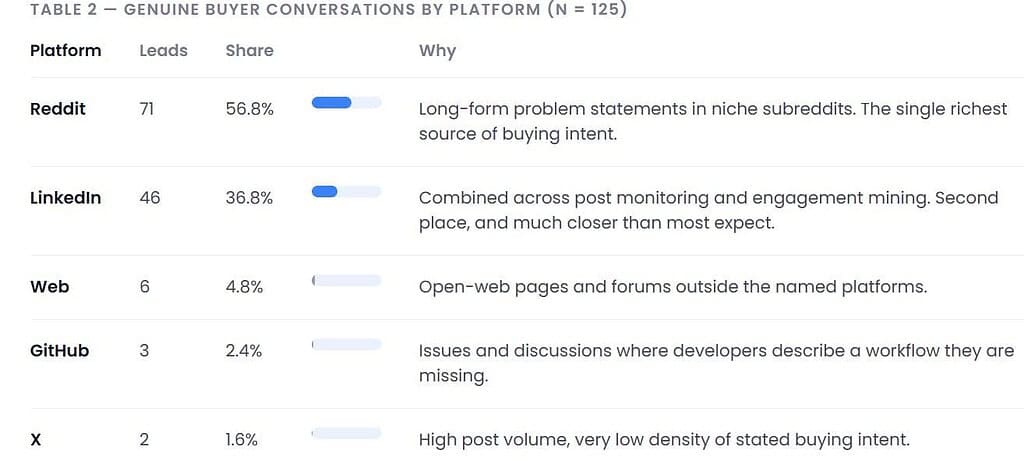
- The 125 genuine buyer conversations in the dataset were concentrated mainly on Reddit and LinkedIn.
- Reddit led with 71 leads (56.8%), followed by LinkedIn with 46 (36.8%), whereas web contributed 6 (4.8%), GitHub 3 (2.4%), and X 2 (1.6%).
- The platform counts total 128 because some conversations had multiple source attributions, while shares were calculated against the 125-lead total.
- The dataset also recorded 1,136 Reddit posts collected through a free push stream over seven days, highlighting Reddit’s strong contribution to identified buyer conversations without relying solely on paid data collection.
| Stage | Count | Rate | Note |
|---|---|---|---|
| Contacts scraped | 275 | — | Raw list before any verification. |
| Passed email verification | 77 | 28% | Nearly three in four scraped addresses were not safe to send to. |
| Emails sent | 77 | 100% of verified | One campaign, one product, one sender. |
| Replies | 11 | 14.3% | Human replies of any kind, positive or negative. |
| Opportunities | 5 | 6.5% of sends | Replies that turned into a real conversation. |
(Source: easeclaw.com)
- The outreach data also emphasizes that only 28% of 275 scraped B2B contacts passed email verification, while a verified 77-contact campaign generated a 14.3% reply rate and 5 opportunities, equal to 6.5% of sends.
- LinkedIn work-email enrichment produced a usable address for 22% of 51 leads.
- EaseClaw also reports that monitoring 18,740 public posts weekly across 12 platforms costs approximately $11 per week in AI and data costs.
- The company stresses that the ratios provide directional evidence rather than universal benchmarks because these figures come from its own production database rather than an industry-wide survey.
6sense’s 2025 B2B Buyer Experience Report
- 6sense released its 2025 global report on close to 4,000 B2B buyers, suggesting the deal timeline is getting faster.
- In 2024, the average buying cycle was 11.3 months, and it dropped to 10.1 months in 2025.
- At the same time, buyers made their first contact with a seller earlier, as the percentage went from 69% of the way through the journey to 61%, which is about 6 to 7 weeks sooner.
- Most buyers set their shortlist based on their own preferences, as 94% said they chose the order of vendor options before they talked to sellers. For winning vendors, the pattern was similar.
- 95% were already on the Day One shortlist, and buyers also considered multiple options, with an average of 5.1 vendors.
- Buyers had prior experience with 3.8 of them, and on Day One they placed 3.6 vendors on the shortlist.
- The report also highlights that the Selection Phase leader later became the overall winner in 77% of cases.
- The vendor that buyers contacted first also did well, and in a companion survey, it won 81%.
- If buyers did not rank their shortlist ahead of time, the first contacted vendor won less often, at only 57%.
- Many buyers look for proof before they speak to vendors, as 94% of buyers use LLM tools, while 585% said they engaged sellers earlier because they needed to judge how vendors apply AI in their products.
- The study also reports that close to 90% of buyers saw AI features in the solutions they purchased.
- Overall, the buying process still runs from the buyer side: about 80% of seller talks start because the buyer reached out first.
- Buyers also bring experience from past buys, as they reported an average of 8 to 9 prior purchases in related categories, suggesting that intent work should spot early account preferences and research signals.
- It should not focus only on late form fills or outreach that happens after buying momentum has already formed.
Best Buyer Intent Data Platforms
| # | Tool | Best For | Signal Type | Starting Price |
| 1 | Bombora | Third-party topic intent at the source | Co-op publisher intent | $25K to $30K/yr |
| 2 | 6sense | Predictive ABM and ad activation | Predictive + topic intent | $60K/yr median |
| 3 | Demandbase | ABM advertising and account analytics | Intent + programmatic ads | $50K+/yr |
| 4 | ZoomInfo | Contact data bundled with intent | Database + topic intent | $15K to $60K+/yr |
| 5 | G2 Buyer Intent | Review-site buyer signals | Second-party review intent | $10K to $40K/yr |
| 6 | WhiteWhale | Custom buying signals with verified sources | Event signals + custom AI | $200-1,000/mo |
| 7 | Cognism | European contact data + intent | Contact data + Bombora intent | Custom (quote-based) |
| 8 | Apollo.io | Budget-friendly intent + outbound | Contact data + Bombora intent | $49/user/mo |
| 9 | DemandScience | B2B demand gen and lead qualification | Content syndication + intent | Custom (quote-based) |
(Source: getwhitewhale.com)
Bombora: Broad Third-Party Intent Data
- Bombora runs a data co-op across 5,500+ business-to-business publisher sites. More than 200 publishers share anonymized views on what people read and consume.
- In March 2025, Bombora added to its topic list, reaching 17,210+ topics, and the co-op also grew by 20%, while Bombora says 86% of its data is exclusive.
- Forrester put Bombora in the Leader group in its Q1 2025 Intent Data Wave, and Bombora also connects to 80+ B2B tools and systems.
- Vendr contract figures in the source put Company Surge around $25,000 to $30,000 each year, with Mid-market deals listed closer to $40,000 to $80,000.
- Enterprise work is shown at about $100,000 to $150,000+, and Bombora mostly gives account-level signals and does not offer contact-level data or outreach tools.
6sense and Demandbase
- 6sense uses intent signals plus AI models tied to where a buyer is in the process, which maps activity across awareness, consideration, decision, and purchase.
- It has been listed as a Gartner Magic Quadrant Leader for ABM Platforms for five years in a row, and the source also cites $200M+ ARR, a $5.2B valuation, and $526M in funding. G2 shows a rating of 4.0 out of 5 from 2,000+ reviews.
- Vendr data reports a median deal size of $62,820 across 204 deals, and the reported contract range runs from $11,500 up to $175,000.
- Demandbase combines intent, account details, and advertising, and its Advertising Cloud supports account-based display, social, and CTV campaigns.
- Buyer reports name annual contracts in the source list from $24,000 to $165,000, with a median near $68,000.
ZoomInfo and Cognism
- ZoomInfo mixes intent data with a huge contact list, claims 500M+ contacts, lists 135M+ phone numbers and 200M+ work emails that it says are verified.
- The intent feature is said to run around $15,000 to $40,000, whereas some full deals reportedly land between $15,000 and $60,000 or more each year.
- On G2, users rate it 4.5 out of 5, whereas on Trustpilot, it scores 1.8 out of 5.
- Cognism leans more toward Europe-focused outreach, which includes phone-verified Diamond Data. It also uses Bombora intent. It adds DNC checks across 15 countries.
- On G2, the score is 4.6 out of 5 based on 1,201 reviews, and intent is described as Bombora-licensed, not built from scratch.
G2 Buyer Intent and WhiteWhale
- G2 gets signals from how people use its review site, including browsing categories, checking competitors, and viewing product pages.
- Pricing is listed as custom and often falls in the low to mid five-figure range each year.
- WhiteWhale looks at public material and tracks sources such as 8,000+ news feeds, SEC filings, earnings calls, job postings, press releases, and company posts on LinkedIn.
- Users can set up to 35 custom buying signals; data shows accounts with two or more stacked signals close at 2.1 times the baseline win rate.
- One Simpli example says it found 279 accounts people had not seen before within 30 minutes.
- Price starts at $200 per month, with teams of about 5 to 10 reps often paying around $500 to $1,000 per month. Setup can take about 15 minutes.
Apollo and DemandScience
- Apollo has 275M+ contacts plus Bombora-style intent and outreach features, with pricing going from $0 to $119 per user each month.
- G2 lists 9,344+ reviews and a 4.8 out of 5 score, but some teams should note the data-quality details: reported bounce rates are around 20% to 30%, while Trustpilot shows 1.9 out of 5.
- DemandScience mixes intent with lead finding and content syndication. Its PureContact set includes 150M+ verified B2B contacts, while PureSignal looks at billions of online actions.
- Bombora leans on wide third-party research signals. 6sense and Demandbase add predictive ABM and ad use.
- ZoomInfo and Cognism connect intent to contact records. G2 points to software research habits. WhiteWhale focuses on custom signals that are tied back to sources.
- Apollo pairs basic intent with low-cost outreach, and DemandScience links intent straight to demand-generation work.
The ROI of Buyer Intent Data: Does It Work?
- Buyer intent data can be useful, but the result is not automatic; the value depends on signal accuracy, ICP fit, contact coverage, activation speed, message relevance, CRM integration, and measurement discipline.
- Forrester says that 85% of companies using intent data report business gains, including better outbound response and more effective prospecting.
- SalesIntel also claims big upside, like pipeline growth up to 4x and marketing ROI up to 300% when the data is set up well, but these figures come from vendors, so they should not be treated as neutral, industry-wide proof.
- EaseClaw’s 2026 field test offers a smaller snapshot with a 14.3% reply rate, which came from 11 replies out of 77 contacts. In that same set, they recorded five opportunities as opportunity yield, that is 6.5%, but the group is too small to claim it will hold across the market, and it cannot confirm added revenue by itself.
- WhiteWhale reports stronger results when accounts show 2 or more stacked signals, citing a 2.1x win rate versus baseline in those cases, and posted 90-day examples range from 0.9x baseline for a generic leadership hire to 2.1x baseline when a hiring surge and a budget signal show up together.
- Multiple relevant signals may help you rank and act on accounts better than using one signal alone.
- Forrester advises a small, narrow proof-of-concept test, while SalesIntel suggests testing about 3 to 5 key signals for 60 days before expanding.
- Gartner also pushes for metrics that start with early pipeline value, then pipeline conversion rate, plus pipeline slippage, along with revenue outcomes.
- A good ROI study should start with incremental gross profit and should count provider fees, enrichment costs, setup and implementation work, CRM tasks, training time, campaign expenses, and time from the seller team.
- McKinsey says better tracking of marketing return can free up about 15% to 20% of marketing money for either more spend or the bottom line. That point is about wider marketing measurement, not intent tech by itself.
- The strongest evaluation compares similar test and control groups, clear CRM links, recent signals, and enough coverage of contacts, buying groups, and closed revenue.
- The small Sample size means the results can swing a lot, so numbers from vendors, like claims of 4x pipeline or 2.1x win rate, should be treated as ideas to test rather than used as fixed assumptions in forecasts.
- Buyer Intent data is worth it only when it adds measurable incremental gross profit and helps sales teams work more efficiently.
Conclusion
As more B2B buyers look things up on their own, intent signals matter more. In many cases, true intent is only a small part of all the activity a company can see, and it can judge signal quality and verify it. 6sense says buyers often pick a vendor set before they ever talk to a seller, while AI tools are now shaping research and how buyers judge vendors.
Intent tools can vary a lot in the data they cover, what kinds of signals they track, how well they can activate those signals, and what they cost. The ROI evidence remains encouraging, but it often relies on what the vendor says, or it comes from small samples. A solid review should compare results in areas like added pipeline, deal rate, revenue, gross profit, coverage, and sales efficiency.
FAQ
6sense says 94% of buyers made a vendor shortlist before speaking with sellers.
EaseClaw found 0.4% of 34,116 public posts showed genuine buyer conversations.
6sense reports 94% of B2B buyers use LLMs.
WhiteWhale reports a 2.1 times higher win rate versus a baseline for accounts with two or more stacked signals, based on its internal data.
It should track added pipeline, conversion, revenue, gross profit, coverage, and sales efficiency. It should use test and control groups that are comparable.