








Introduction
Investment Apps Statistics: Investment apps are phone-based platforms that let people buy and sell stocks, funds, bonds, and other assets directly from their smartphones. Many offer low or zero fees, the option to buy small parts of a share, automatic portfolios, and learning tools. This has made investing cheaper and easier for people who once felt it was too costly or too hard to start. Users include young beginners making their first purchase as well as experienced traders who want speed and flexibility.
The category is changing fast as apps add retirement accounts, crypto, banking features, and AI tools that give personal suggestions and watch portfolios. Regulators are also paying closer attention, focusing on protecting investors, showing clear prices, and responsible app design. As competition grows, the apps that combine a simple experience with clear information, strong security, and long-term investor education are most likely to earn lasting trust.
Picked by Our Editorial Team
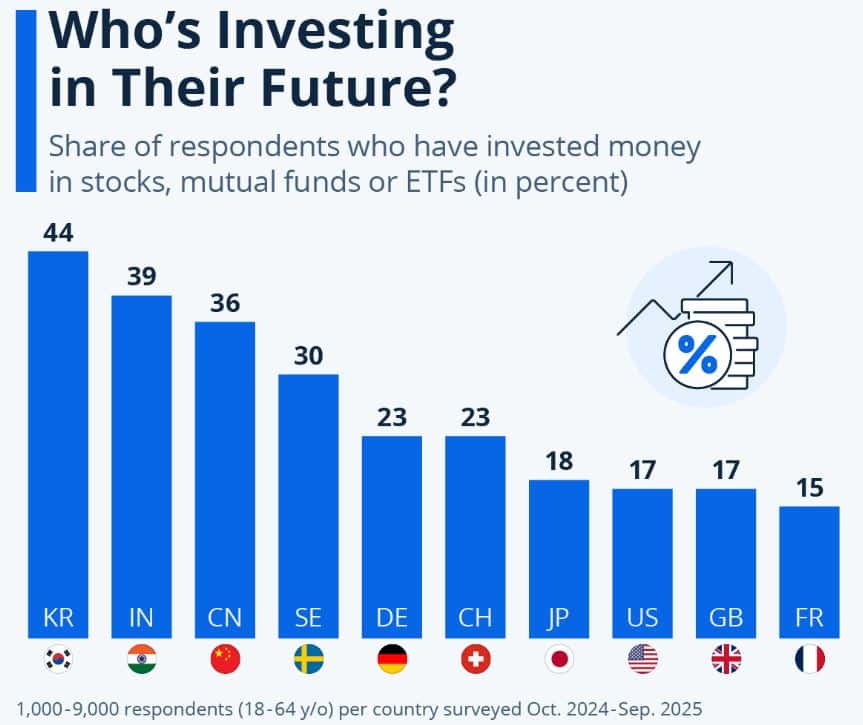
- South Korea has the highest investment participation at 44%, followed by India at 39% and China at 36%, while France has the lowest at 15%.
- Groww and Angel One both show 100 million+ downloads on Google Play, the highest bracket among the apps reviewed.
- Revolut has more than 80 million customers across its full financial app, which covers banking as well as investing.
- SoFi’s membership grew 35% to 15.8 million, up from 11.7 million, after adding 1.1 million members in Q2 2026.
- Binance leads by scale with 323 million registered users across 100+ countries.
- Robinhood has 28.6 million funded customers and USD 384 billion in platform assets as of August 31, 2026.
- The worldwide digital gold market is valued at USD 45–55 billion, less than 1% of the roughly USD 13 trillion physical investment gold market, yet nearly 9 in 10 retail investors say they are willing to invest.
- In Southeast Asia, 49% of Thai investors and 48% of Indonesian investors use investment or trading apps as their primary channel.
Recent Investment Apps Developments
- On August 11, 2026, eToro announced its proposed TradeZero acquisition for up to USD 231 million, including up to 2.5 million newly issued shares.
- On October 1, 2025, Public launched direct indexing across 100+ indices, requiring a USD 1,000 minimum investment and charging a 0.19% annual management fee.
- On June 30, 2025, Robinhood expanded into 30 European countries and introduced stock tokens covering over 200 U.S. stocks and ETFs.
- On June 2, 2025, Robinhood completed its Bitstamp acquisition, adding a cryptocurrency exchange holding over 50 active licenses and registrations globally.
- On May 30, 2025, Robinhood announced Strategies had surpassed USD 250 million in assets under management across more than 75,000 funded accounts.
- On May 13, 2025, eToro priced its expanded IPO at USD 52 per share, offering 11,923,018 shares ahead of its Nasdaq debut.
- On March 26, 2025, Robinhood announced Strategies, Cortex, and Banking, expanding its offering across managed investing, AI-powered assistance, and banking services.
- On February 26, 2025, Robinhood completed its TradePMR transaction, reporting approximately USD 300 million in consideration and post-close equity compensation.
- On August 11, 2026, eToro reported funded accounts increased 18% year-over-year to 4.32 million, while quarterly net contribution rose 9% to USD 229 million.
Investment Apps Market Growth
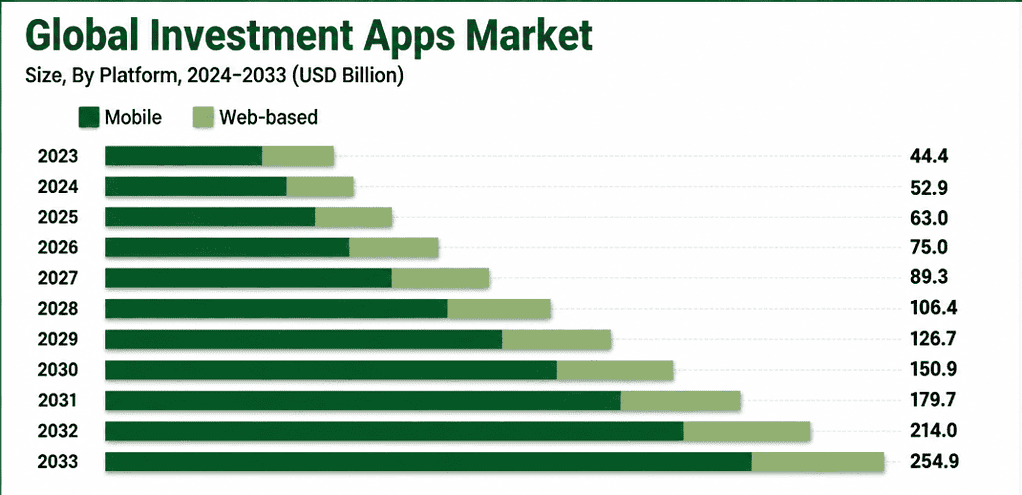
- According to Market.us, the global investment apps market is projected to grow at a 19.1% CAGR during the 2024–2033 forecast period.
- The market stood at USD 44.4 billion in 2023, with its value estimated to increase to USD 52.9 billion in 2024.
- The market is projected to reach USD 63.0 billion in 2025 and USD 75.0 billion in 2026.
- By 2033, the global investment apps market is projected to reach USD 254.9 billion, the final value in the forecast.
Countries Actively Investing
- South Korea recorded the highest investment participation among the countries shown, with 44% of respondents investing in stocks, mutual funds, or exchange-traded funds (ETFs).
- India ranked second, with 39% of respondents reporting investments in these financial products.
- China followed with an investment participation rate of 36%, placing it third among the countries listed.
- In Sweden, 30% of respondents had invested money in stocks, mutual funds, or ETFs.
- Germany and Switzerland recorded equal investment participation rates, with 23% of respondents in each country reporting investments.
- Japan reported an investment participation rate of 18%, below Germany and Switzerland but above the U.S. and Great Britain.
- The U.S. and Great Britain each recorded a 17% investment participation rate among respondents.
- France had the lowest investment participation among the countries shown, with 15% of respondents investing in stocks, mutual funds, or ETFs.
Leading Investment Apps by Download
- Groww’s official Google Play listing shows 100 million+ downloads, placing it in the highest download bracket among these selected investment apps.
- Angel One’s official Google Play listing records 100 million+ downloads, matching Groww’s published threshold without establishing which app has more downloads.
- Robinhood’s main investing app shows 10 million+ downloads on Google Play; this excludes its separately listed banking and cryptocurrency wallet apps.
- Webull’s main investing and trading app records 10 million+ Google Play downloads.
- eToro’s investing app shows 10 million+ Google Play downloads.
- Trading 212 records 10 million+ Google Play downloads.
Worldwide Users of Investment Apps
| Investment app | Latest 2026 user figure | Reported growth or supporting data |
| Revolut | More than 80 million customers | The figure covers Revolut’s full financial app, including banking and investing users; investment-only users were not disclosed. |
| Angel One | More than 40.0 million users | Angel One’s user base covers its digital broking, mutual fund, credit and advisory services. |
| Robinhood | 28.6 million funded customers | Customers increased by approximately 120,000 monthly and 1.90 million yearly, equal to 7% year-over-year growth. |
| Webull | 28.2 million registered users | Registered users grew 13%, while funded accounts increased 8% to 5.13 million, including approximately 810,000 international accounts. |
| Groww | 24.0609 million transacting users | Transacting users grew 26.6% year over year, while active users reached 18.1545 million. |
| SoFi | 15.8 million members | Membership grew 35% from 11.7 million, after SoFi added 1.1 million members during Q2 2026. |
| Interactive Brokers | 5.576 million client accounts | Client accounts increased 35% year over year and 2% from August 2026. |
| eToro | 4.32 million funded accounts | Funded accounts increased 18% year over year, including users with completed onboarding, trading activity and positive balances. |
| XTB | 2.83 million total clients | XTB reported 1.49 million active clients and added 703,000 new clients during H1 2026. |
Investment Apps Usage by Countries
- Thailand leads Southeast Asia: 49% of investors use investment or trading apps as their primary channel, based on a September 2026 survey of 1,200 consumers.
- Indonesia ranks second, with 48% of investors primarily using investment or trading apps; its retail-investor base has exceeded 20 million.
- Singapore records 44% primary investment-app usage among investors; leading digital wealth platforms reach 9% of internet users monthly.
- Malaysia’s GOfinance had over 5 million investment-product users by September 30, 2026, including over 4.7 million GO+ and over 700,000 e-Mas users.
- The United Kingdom had 1.6 million trading-app users, representing 3% of adults; 47% were aged 18–34 and 18% were 55 or older.
Key Competitors in the Investment Apps Market
- Binance leads by scale with 323 million registered users across 100+ countries and USD 156 trillion in cumulative trading volume by July 2026.
- Charles Schwab reported 40.3 million active brokerage accounts, 48.6 million total client accounts, and USD 13.33 trillion in client assets as of September 30, 2026.
- Robinhood had 28.6 million funded customers and USD 384 billion in platform assets at August 31, 2026; funded customers grew approximately 7% year-over-year.
- Fidelity administered USD 19.9 trillion in assets and managed USD 7.8 trillion at June 30, 2026, increasing 22% and 23% year-over-year.
- Interactive Brokers reached 5.576 million client accounts in September 2026, up 35% year-over-year and 2% month-over-month.
- E TRADE launched Bitcoin, Ethereum, and Solana spot trading in July 2026, enabling eligible Morgan Stanley clients to trade 3 cryptocurrencies.
Digital Gold Investment Apps Stats
| Statistic | 2026 numerical information | Reporting period/basis |
| Worldwide digital gold market value | USD 45–55 billion | World Gold Council report published 19 October 2026 |
| Digital gold’s share of the physical investment gold market | Less than 1% | October 2026 report |
| Physical investment gold market used as the comparison base | Approximately USD 13 trillion | October 2026 report |
| Gold-backed token spot trading volume | Approximately USD 90 billion | Q1 2026 |
| Retail investors expressing willingness to invest in digital gold | Nearly 9 in 10 | Research published October 2026 |
| Digital gold penetration advantage in markets with mainstream app distribution | Up to 7 times higher | October 2026 research |
| Retail-investor survey sample | 12,365 respondents | Research published October 2026 |
| Expert interviews supporting the research | 20 interviews | October 2026 report |
Cost of Creating an Investment App
| App category/development scope | Published 2026 cost estimate | Typical functionality/qualification |
| Investment or trading app MVP | USD 70,000–USD 130,000 | Core investment functionality; market data, portfolio tracking, execution and related integrations vary by scope. |
| Advanced investment or trading platform | USD 180,000–USD 300,000+ | More sophisticated performance, analytics, transaction processing and infrastructure resilience. |
| Stock trading MVP / prototype | USD 60,000–USD 120,000 | Entry-level trading-product estimate; confirm whether a quotation covers a prototype or production-ready MVP. |
| Full-featured stock trading platform | USD 200,000–USD 600,000+ | Broader trading capabilities, integrations, security and compliance requirements. |
| Focused custom investment client using a partner brokerage | Mid-six figures; no exact dollar range specified | Estimate for a regulated, operational trading product rather than just mobile screens. |
| Multi-asset platform with real-time data, two mobile apps and web | High-six to seven figures; no exact dollar range specified | Includes richer operational tooling and broader product scope. |
| Enterprise fintech platform broader comparison, not investment-specific | USD 200,000–USD 300,000+; some multi-region platforms USD 400,000+ | Advanced reporting, resilience, permissions, analytics and extensive integrations. |
Ending Statement
Investment apps are expanding fast, driven by growing user bases, new asset classes, and rising interest in digital gold and crypto. Established brokers and fintech challengers are competing on scale, features, and trust, while participation still varies widely across countries. Building a full trading platform remains costly.
Platforms that pair simple, low-cost experiences with transparency, security, and investor education are best positioned to earn lasting loyalty.
FAQ
Investment apps can be safe if they are regulated, use strong security, and are used carefully. In the U.S., for example, brokerage accounts may be protected by SIPC if the broker fails, but that does not protect you from market losses. Always check regulation, encryption, 2FA, fees, and reviews.
There is no single best investment app, it depends on your goals, experience, country, fees, account types, and whether you want stocks, ETFs, index funds, crypto, or robo-advisory. The best app is usually a regulated, low-cost platform that fits your investing strategy.
Yes, many investment apps are designed for beginners, often with low minimums, educational content, fractional shares, and simple portfolios. Beginners should start with low-cost, diversified investments and avoid high-risk products like options, leverage, or crypto until they understand the risks.
Many investment apps let you start with USD 0 or as little as USD 1 through fractional shares. However, some apps require minimum deposits, account fees, or minimum investments for certain products. Always check the fee schedule before depositing.
Many investment apps advertise commission-free trading, but they may still make money through spreads, payment for order flow, premium subscriptions, advisory fees, fund expense ratios, or other charges. “Free” does not always mean zero cost.
Usually, you sell your investments, wait for the trade to settle often T+1 or T+2 for stocks/ETFs in many markets and then transfer the cash to your linked bank account. Withdrawal time depends on the app, your bank, and the investment type.