









Introduction
Robo Advisory Statistics: Managing money is becoming easier with robo-advisory services. These digital tools help people invest based on their financial goals, budget, and risk tolerance. By using AI and automated systems, robo-advisors can suggest investments, track portfolios, and adjust them when needed. They also offer a more affordable option for people who may not want to hire a traditional financial advisor.
As digital investing gains popularity, more individuals and businesses are exploring these services to make informed financial decisions. Robo-advisory statistics reveal how quickly the market is growing, who is using these platforms, and which trends are shaping the industry.
These insights also show how technology is changing the future of investment management.
Editor’s Choice
- The global robo-advisory market grew to USD 13.3 billion in 2025 and is projected to reach USD 17.4 billion in 2026.
- By 2027, global robo-advisor assets could reach USD 4,664.0 billion, generating USD 188.1 billion in revenue.
- North America’s robo-advisor market is forecast to reach USD 6.15 billion in 2026.
- The average robo-advisor account holds approximately USD 42,000.
- Around 83% of users choose robo-advisors because they are affordable and easy to use.
- Robo-advisors attract smaller investors by charging annual fees as low as 0.25%.
- Hybrid robo-advisors are expected to capture 56.53% of the total market share in 2026.
- Approximately 55% of Gen Z and 42% of Millennials use robo-advisors.
- In 2026, US robo-advisors reached 4.4 million users, with growth slowing to 5.3%.
- Vanguard, Betterment, Wealthfront, Schwab, and Fidelity collectively account for approximately 58% of the global robo-advisory market.
- Betterment reported over USD 70 billion in assets under management and more than 1 million customers in 2026.
Global Robo Advisory Market Size
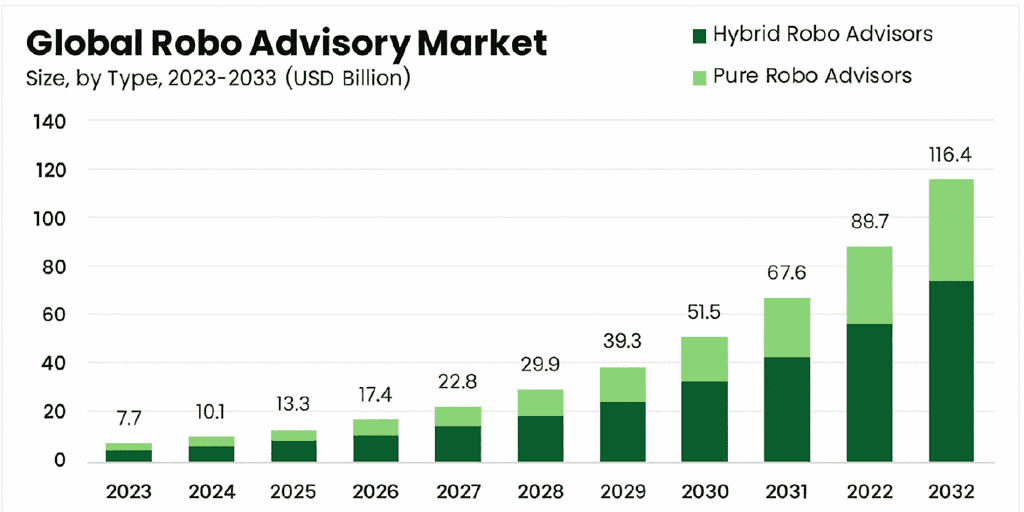
- In 2025, the global robo-advisory market reached USD 13.3 billion.
- In 2026, the market is projected to grow to USD 17.4 billion, reflecting rising demand for automated investment services.
- By 2033, the market is forecast to reach USD 116.4 billion, growing at a CAGR of 31.2% over the forecast period.
Robo-Advisory Growth Report
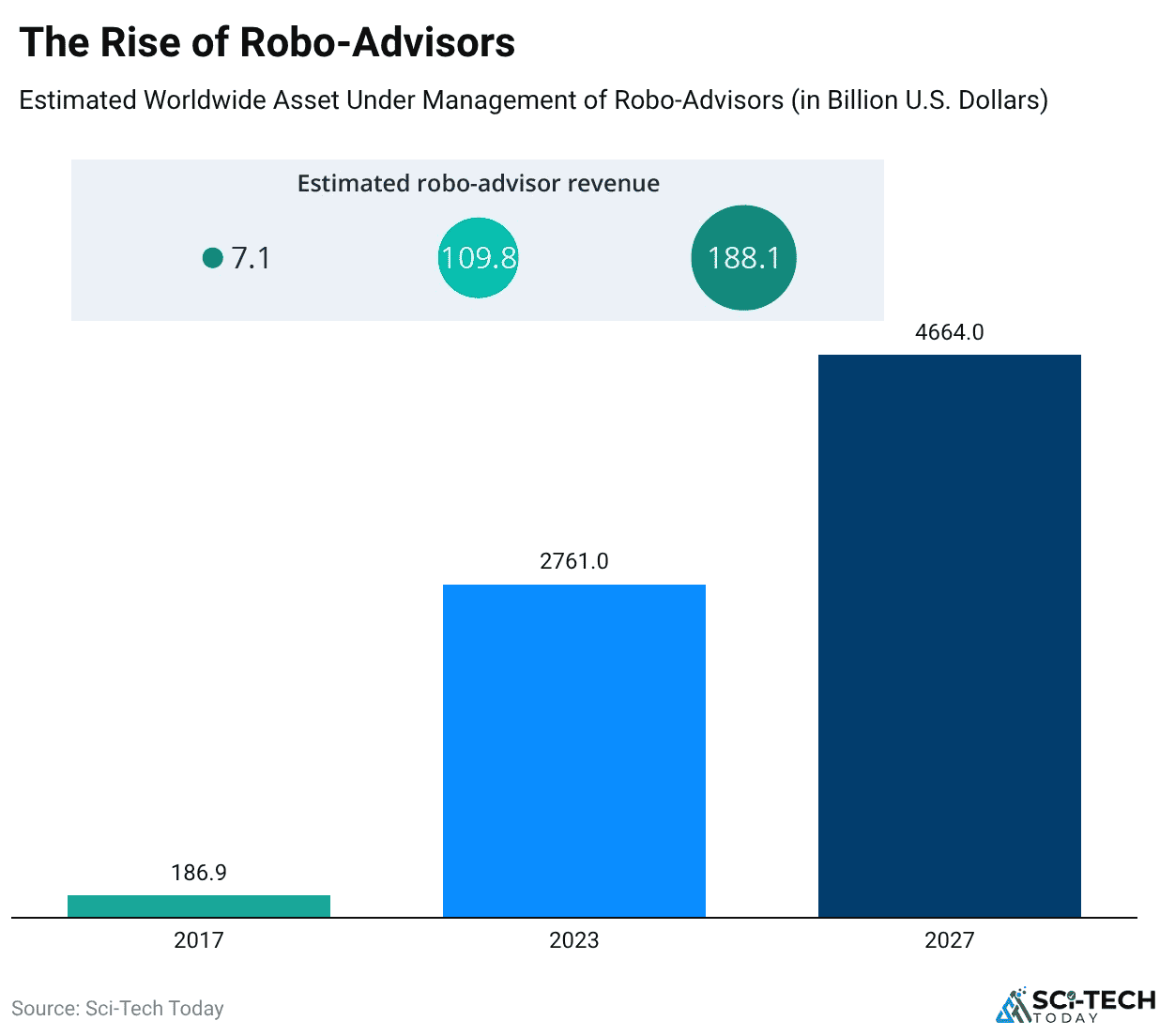
- Worldwide robo-advisor assets rose from USD 186.9 billion in 2017 to USD 2,761.0 billion in 2023; estimated revenue increased from USD 7.1 billion to USD 109.8 billion.
- By 2027, assets could reach USD 4,664.0 billion, with revenue of USD 188.1 billion.
Robo-Advisor Market Share and Industry Trends
- Coin Law report further mentioned that Vanguard, Betterment, Wealthfront, Schwab, and Fidelity collectively account for approximately 58% of the global robo-advisory market.
- Independent robo-advisors generate around 33% of total market revenue.
- In North America, major financial institutions control approximately 67% of the market.
- Leading platforms achieve user retention rates above 87% by offering AI-powered tools and personalized investment options.
- The average robo-advisor account holds approximately USD 42,000.
- Around 83% of users choose robo-advisors because they are affordable and easy to use.
- Europe’s robo-advisory market is growing at a reported 27.5% CAGR as fintech firms develop services suited to local regulations.
- Hybrid robo-advisors, which combine automated investing with human guidance, account for approximately 64% of the market.
Key Drivers of the Robo-Advisory Market
- Robo-advisors attract smaller investors by charging annual fees as low as 0.25%, compared with 1%-3% for traditional wealth managers.
- According to market.us, online banking adoption reaches 61% of adults.
- Average robo-advisor investments were USD 69,174 in the U.S., USD 12,931 in Europe, and USD 7,552 in China.
- Morgan Stanley found that over 77% of global investors favor sustainable investing.
- More than 57% reported increased interest over the past two years.
- Additionally, 54% expect to increase sustainable investments in the coming years.
Key Segment Trends of Robo Advisory
- Fortune Business Insights reported that hybrid robo-advisors are expected to capture 56.53% of the total market share in 2026.
- However, pure-play platforms are expected to expand at a 34.35% CAGR through 2031.
- Wealth management generated 38.15% of revenue in 2025, while tax-loss harvesting is projected at a 33.20% CAGR from 2026 to 2031.
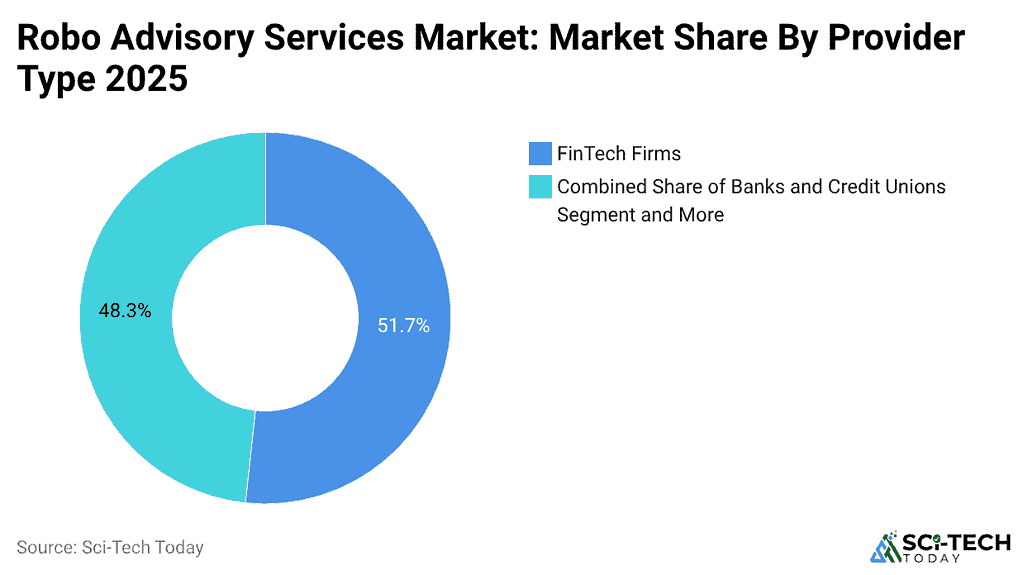
- Fintech companies accounted for 51.65% of revenue in 2025.
- Whereas banks and credit unions are forecast to grow at a 34.40% CAGR.
- High-net-worth individuals are projected to account for 44.82% of the market in 2026, but the retail segment is expected to grow at a CAGR of 33.10%.
- Moreover, direct plan-based and goal-based services are projected to capture 59.38% of the market in 2026.
Regional Robo-Advisory Market Data
| Region / Country | 2025 Market Size(USD Billion) | 2025 Market Share | 2026 Forecast Market Size(USD Billion) |
| North America | 4.75 | 43.70% | 6.15 |
| United States | – | 4.54 | |
| Asia-Pacific | 2.73 | 25.20% | 3.61 |
| Japan | – | 0.76 | |
| China | 0.92 | ||
| India | 0.51 | ||
| Europe | 2.77 | 25.50% | 3.61 |
| UK | – | 0.95 | |
| Germany | 0.79 | ||
| Latin America | 0.21 | 2% | 0.25 |
| Middle East and Africa | 0.39 | 3.60% | 0.46 |
Robo-Advisor User Statistics
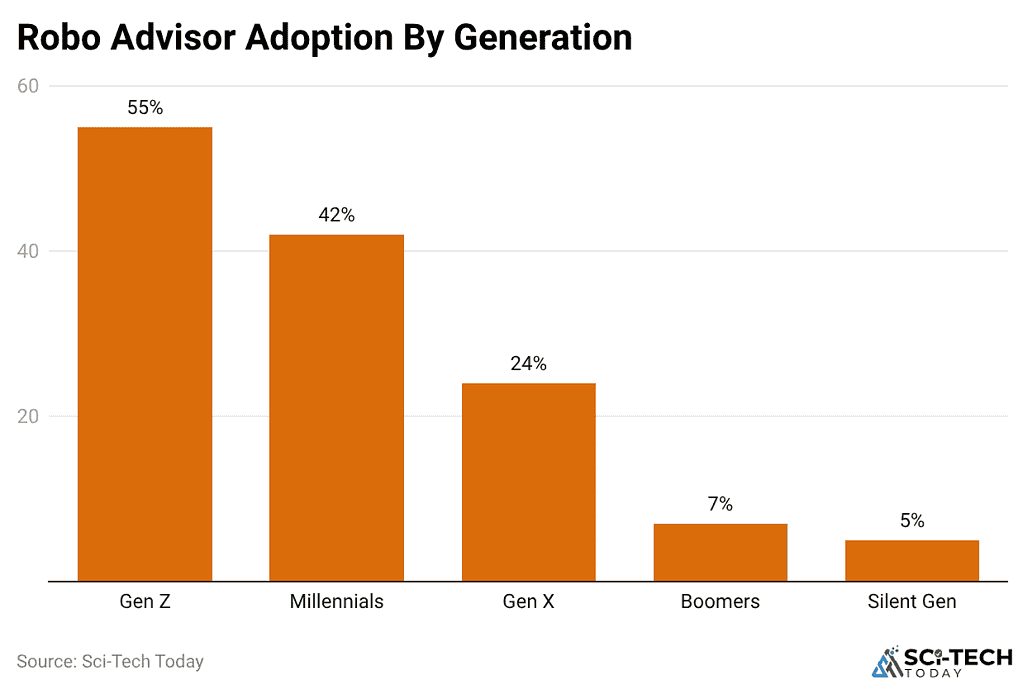
- Approximately 55% of Gen Z and 42% of Millennials use robo-advisors.
- Around 24% of Gen X, 3%-7% of Boomers, and 5% of the Silent Generation use robo-advisors.
- Approximately 28% of US adults prefer robo-advisors.
Robo-Advisor Account Holder and Penetration
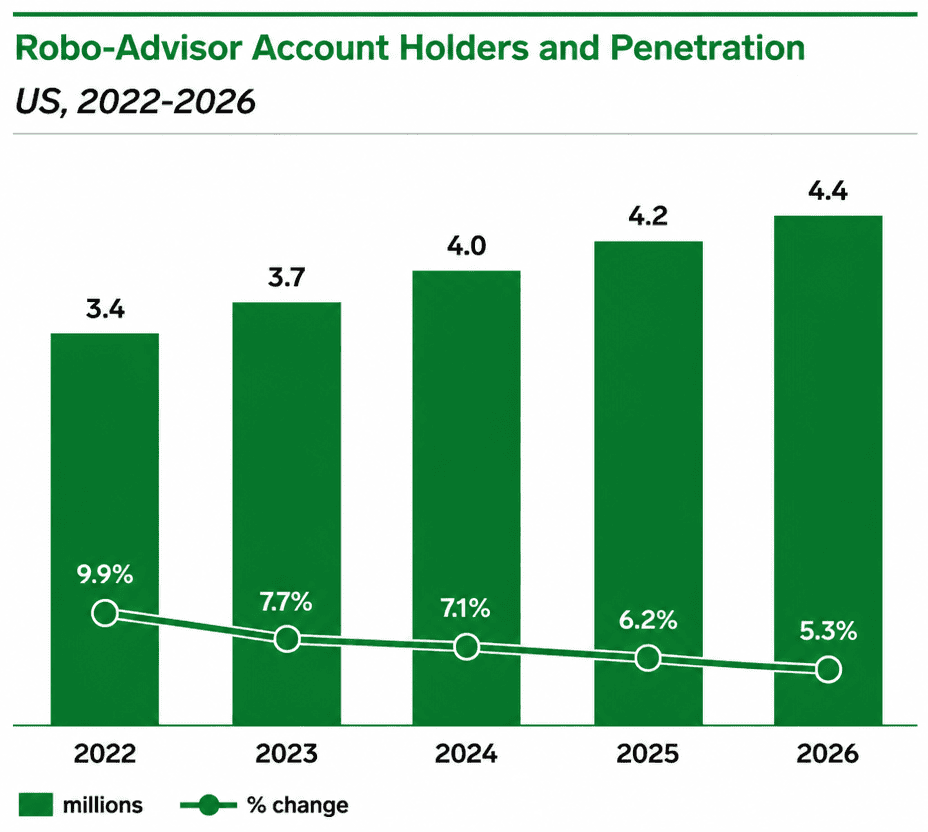
- In 2025, the United States market had 4.2 million users, representing 6.2% growth.
- As of 2026, users increased to 4.4 million, while growth slowed to 5.3%.
Top Robo-Advisory U.S. Providers Market Overview
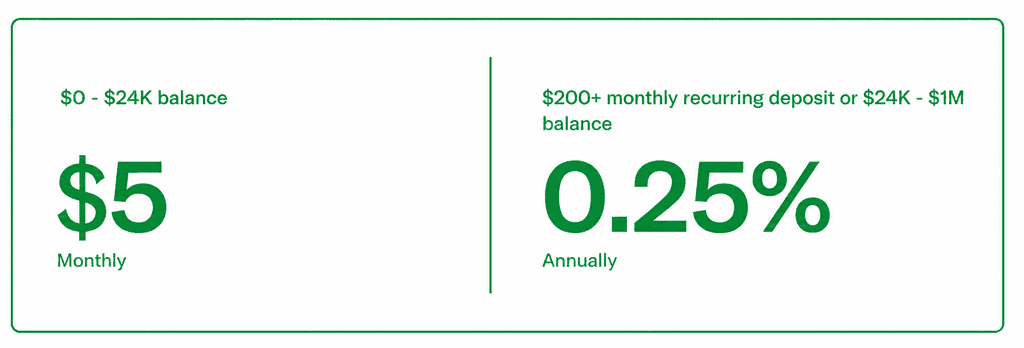
- Betterment reported over USD 70 billion in assets under management and more than 1 million customers in 2026. Its digital plan costs USD 5 monthly or 0.25% annually for eligible accounts.
- Wealthfront managed over USD 100 billion in total platform assets and served more than 1.5 million funded clients. Its automated investing fee is 0.25% annually, with a minimum of USD 500.
- SigFig requires USD 2,000 to open a managed account. It charges 0% on the first USD 10,000 and 0.25% annually on additional assets.
- Vanguard Digital Advisor requires a minimum of USD 100 to start, with gross annual advisory fees of 0.20%-0.25%.
- Charles Schwab offers automated investing with no advisory fee, a USD 5,000 minimum, and more than 80 portfolio variations.
- SoFi charges 0.25% annually and requires a starting investment of USD 50.
- Acorns reported approximately USD 13.39 billion in regulatory AUM and 5,152,940 accounts in its August 2026 filing. Subscription plans cost USD 4, USD 8, or USD 12 monthly.
Largest Robo-Advisors
| Platform | AUM(USD billion) | Clients | Accounts | Fee |
| Vanguard Digital + Personal Advisor | 344.6 | 791,528 | 791,528 | 0.15%-0.30% |
| Schwab Intelligent Portfolios | 89.5 | n/a | n/a | – |
| Betterment | 69.5 | 1,021,682 | 1,344,483 | 0.25% or USD 4/moNTH |
| Wealthfront | 55.2 | 544,863 | 726,127 | 0.25% |
| U.S. Bancorp Automated Investor | 19.3 | 52,436 | n/a | 0.24% |
| Acorns | 10.4 | 7.77 million | 4.81M funded | 3-12/month |
| Stash | 4.2 | 1,290,843 | n/a | 3–9/month |
| SoFi Robo Investing | 1.5 | 265,019 | n/a | 0.25% |
Robo-Advisor Assets Under Management in 2026
- According to Axis Intelligence, Vanguard Personal Advisor managed USD 456 billion as of June 30, 2026.
- Schwab Managed Investing Solutions reported average fee-based assets of USD 763.716 billion in Q2 2026.
- Betterment reported more than USD 65 billion in assets on November 11, 2025.
- Wealthfront Advisers LLC reported USD 47.728 billion as of March 31, 2026, while Vanguard Digital Advisor managed USD 31 billion as of June 30, 2026.
- Vanguard Advisers, Inc. reported total advisory assets of USD 344.620 billion as of December 31, 2025.
Robo-Advisor Portfolio Performance
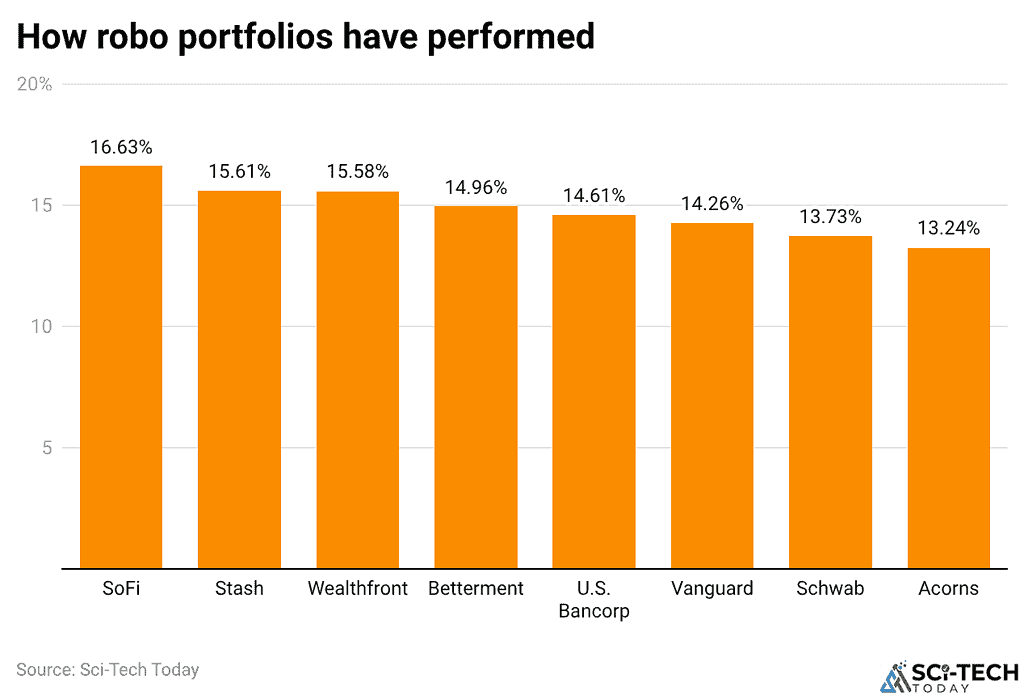
- SoFi delivered a 16.63% return, followed by Wealthfront at 15.58% and Betterment at 14.96%.
- Schwab returned 13.73%, while Acorns recorded 13.24%.
- Three-year annualized returns for moderate portfolios ranged from 13% to 17% through September 30, 2025.
Technological Innovations in Robo-Advisory
- CoinLaw noted that around 28% of platforms use blockchain to improve data security and transparency.
- Approximately 21% of platforms offer voice-based services, benefiting Gen Z and users with accessibility needs.
- Real-time risk tools reduce portfolio losses by around 17%.
- Natural language processing-based customer support increases user satisfaction by approximately 34%.
- Machine learning delivers returns approximately 8.5% higher than traditional methods.
- Around 64% of platforms support external app integrations.
Most Popular Robo-Advisor Services and Features
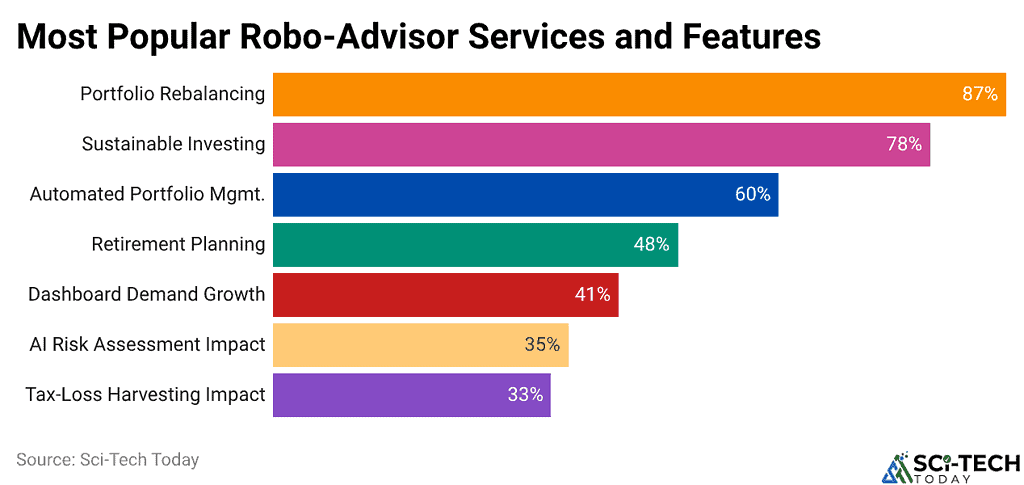
- Portfolio rebalancing leads with 87%, followed by sustainable investing at 78% and automated portfolio management at 60%.
- Retirement planning attracts 48% interest, while demand for investment dashboards has grown by 41%.
- AI-based risk assessment shows a 35% impact, and Tax-loss harvesting records a 33% impact.
Robo-Advisor Appearance Rate by AI Engine
| Brand | Perplexity (sonar-pro) Rate | ChatGPT (OpenAI) Rate | Gemini (Google) Rate | Claude (Anthropic) Rate |
| Betterment | 93.8% | 84.8% | 50.0% | 47.8% |
| Vanguard | 91.7% | 97.8% | 45.7% | 30.4% |
| Fidelity | 95.8% | 82.6% | 39.1% | 45.7% |
| Wealthfront | 87.5% | 73.9% | 41.3% | 45.7% |
| SoFi | 81.3% | 67.4% | 30.4% | 26.1% |
| Charles Schwab | 56.3% | 91.3% | 21.7% | 30.4% |
| Acorns | 66.7% | 39.1% | 37.0% | 6.5% |
| M1 Finance | 64.6% | 34.8% | 17.4% | 10.9% |
| Robinhood | 41.7% | 28.3% | 15.2% | 10.9% |
| Empower | 31.3% | 30.4% | 6.5% | 8.7% |
Robo-Advisors vs. Traditional Financial Advisors
- Robo-advisors typically charge 0.25%- 0.50% annually, while traditional advisors charge an average of 0.96%, with many charging 1%- 1.5%.
- For USD 100,000, robo-advisors may cost USD 0-350, compared with about USD 960 at a 0.96% fee.
- Robo-advisors often require USD 0-500, while traditional advisors may require USD 100,000 or more, with some setting a USD 250,000 minimum.
- Robo-advisors automate investing, rebalancing, and available tax-loss harvesting. Traditional advisors offer personal guidance for complex taxes, retirement, estates, and business sales.
- Robo-advisors suit simple goals and low-cost investing, while traditional advisors suit clients needing personalized planning and human support.
Pros and Cons of Using a Robo-Advisor
| Pros | Cons |
| Robo-advisors typically charge 0%-0.35% in fees, compared with 1% or more for traditional financial advisors. | Limited customization with mostly pre-built portfolios |
| Low minimum investment requirements, ranging from 0 to USD 500, make robo-advisors accessible to beginners. | Less human guidance for complex financial situations |
| Automated rebalancing removes emotional bias | Keeping 6%-30% of a portfolio in low-yield cash can limit overall investment returns. |
| 24/7 access via apps and web portals. | Not ideal for estate planning, business-owner taxes, or concentrated stock. |
| Automated tax-loss harvesting improves tax efficiency. | Tax-loss harvesting is not universal and helps less in lower tax brackets. |
Conclusion
Robo-advisory is changing how people invest by offering simple, low-cost, and automated financial services. These platforms help investors build and manage portfolios based on their goals. However, concerns about data privacy, market risks, and the lack of personal guidance still exist.
As digital technology advances, robo-advisors may become an important part of wealth management. Their success will depend on how well they protect investor information, earn customer trust, and balance automated services with human expertise.
FAQ
Yes, robo-advisors are beginner-friendly, offering automated investing, low fees, and simple portfolio management.
Robo-advisors offer investments in stocks, bonds, ETFs, mutual funds, and sometimes real estate and cash equivalents.
Robo-advisory typically costs 0.25%-0.50% of assets annually, though some platforms charge flat fees.