








Opening
AI In Teaching Statistics: AI in teaching means using smart software to help teachers plan lessons, teach, check student work, and support each student’s needs. It includes learning platforms that adjust to each student, automatic grading, AI tutors, tools that create lesson content, and dashboards that show which students may need extra help. The AI in education market is worth USD 8.9 billion in 2026 and is expected to grow at a 35.10% CAGR, which shows how quickly schools and colleges are adopting it.
For teachers, AI is more about saving time than being replaced. When AI handles routine jobs like marking, scheduling, and making resources, teachers can spend more time guiding students, leading discussions, and giving personal help. There are still challenges, such as data privacy, unfair results from biased systems, students relying too much on instant answers, and unequal access to technology. Schools that combine AI tools with teacher training, clear rules, and human supervision are most likely to improve learning results in a responsible way.
Must Read from the Editor
- The AI in education market is estimated at USD 6.6 billion in 2025 and USD 8.9 billion in 2026, and is forecast to reach USD 73.3 billion by 2033, at a 35.10% CAGR.
- Between April and May 2026, a survey of 545 US K–12 teachers found that 62% had used AI for work or tasks.
- In December 2025, 82% of primary teachers and 78% of secondary teachers in England reported using generative AI in their roles, based on a survey of 991 teachers.
- The European School Education Platform’s April 2026 survey of 1,130 respondents found that 73% used AI at least partially for planning and materials, and 67% for creating tests, tasks, or rubrics.
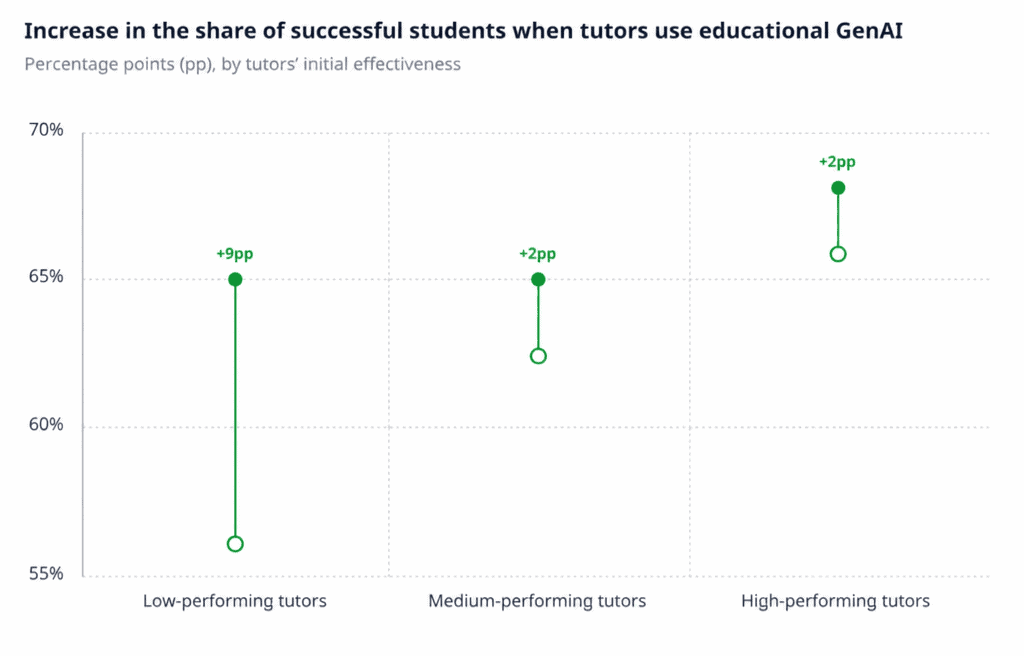
- Low-performing tutors using educational generative AI raised the share of successful students by 9 percentage points, compared with 2 points for medium and high performers.
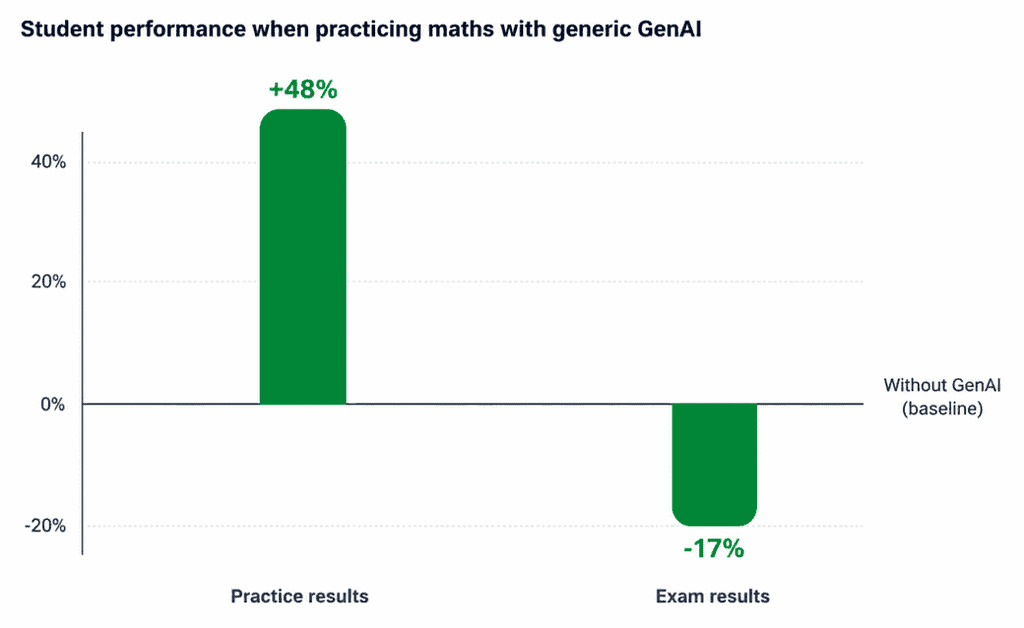
- Students practising maths with generic generative AI scored 48% higher in practice than the baseline, but their exam results were 17% lower.
- In a May 2026 Cambridge-led study, AI matched human degree classifications for 63% of Cambridge essays, 53% at Nottingham, and 35% at Manchester Metropolitan.
- On October 21, 2026, the UK Treasury reported that the education department’s AI lesson-planning tool saves teachers about 3 hours weekly.
- In April 2026 findings, 72% of educators were very concerned about unethical pupil AI use and 71% about pupil over-reliance.
AI Use Among Teachers Across Different Surveys
- Between April and May 2026, a survey of 545 US K–12 teachers found that 62% had used AI for work or tasks.
- Between March and April 2025, a survey of 2,232 US public K–12 teachers found that 60% used AI for work during 2024–2025.
- Between April and June 2025, a survey of 8,601 US English language arts, mathematics, and science teachers found that 53% used AI for planning or teaching.
- In December 2025, a survey of 991 teachers in England found that 82% of primary teachers and 78% of secondary teachers had used generative AI in their roles.
- Between January and May 2025, a survey of 1,211 state-school teachers in England found that 44% used generative AI at least sometimes for 5 teaching tasks.
- In 2024, a survey covering about 280,000 lower-secondary teachers across 55 education systems reported an OECD average of 36% using AI for work during the previous year.
| Fieldwork | Who | Sample | What was measured | Result |
| Apr to May 2026 | US K-12 teachers | 545 | Ever used AI for work or tasks | 62.00% |
| Mar to Apr 2025 | US public K-12 teachers | 2,232 | Used AI for work in 2024-25 | 60.00% |
| Apr to Jun 2025 | US ELA, math and science teachers | 8,601 | Used AI for planning or teaching | 53.00% |
| Dec 2025 | Teachers in England | 991 | Ever used generative AI in their role | 82% primary, 78% secondary |
| Jan to May 2025 | State school teachers in England | 1,211 | Use generative AI at least sometimes for 5 teaching tasks | 44% |
| 2024 | Lower-secondary teachers, 55 systems | About 280,000 | Used AI in their work in the past year | 36% (OECD average) |
How Teachers Apply AI in Their Daily Work
- The European School Education Platform’s April 2026 survey gathered 1,130 responses across 50+ countries; 73% used AI at least partially for planning and materials.
- Preparing assessments was another major use: 67% of respondents used AI at least partially to create tests, tasks, or rubrics, the 2026 survey reported.
- Supporting student learning attracted 63% adoption, with respondents using AI at least partially to generate explanations, practice exercises, or learning hints, according to 2026 findings.
- Administrative work attracted 53% adoption, with respondents using AI at least partially for emails, reports, meeting notes, or school organisation, the 2026 survey found.
- Evaluation remained more sensitive: 41% reported no AI use for grading or summative assessment, while 31% avoided formative feedback, according to the 2026 survey.
Main Benefits AI Could Offer Teachers and Schools
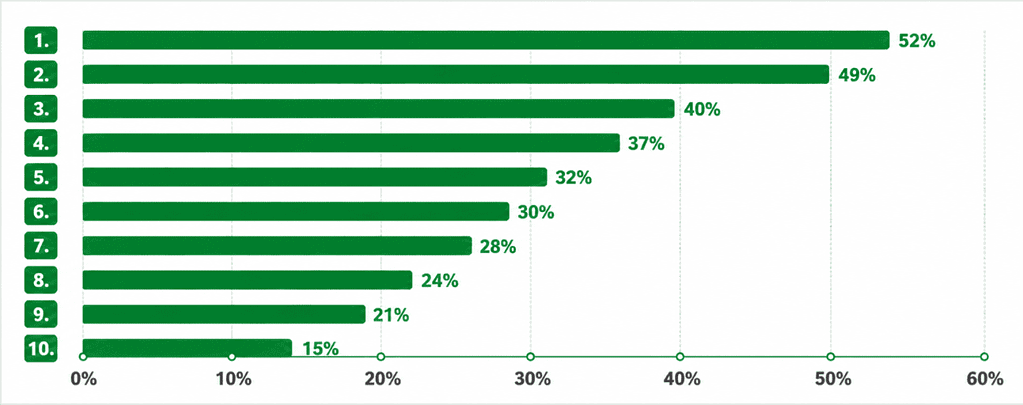
- Saving time on teaching-related tasks ranked highest, with 52% of respondents identifying workload reduction as a key potential benefit of AI.
- Creating customised teaching resources followed closely, with 49% highlighting AI’s ability to develop materials tailored to classroom needs.
- Reducing administrative work was valued by 40% of respondents, suggesting opportunities to simplify routine school tasks.
- Supporting different learning needs attracted 37%, who recognised AI’s potential to help teachers adapt instruction for individual pupils.
- Encouraging innovative teaching practices was identified by 32% as a potential benefit for teachers and schools.
- Supporting language learning and translation was highlighted by 30%, reflecting AI’s potential to help pupils overcome language barriers.
- Improving access to learning materials was recognised by 28% as a way AI could broaden educational opportunities.
- Helping pupils with special educational needs was valued by 24%, indicating potential for more inclusive classroom support.
- Increasing pupil engagement was identified by 21% as a potential benefit of using AI in education.
- Improving ongoing assessment and feedback was cited by 15%, making it the least-selected benefit among the 10 listed.
Student Maths Performance with Generative AI
- Students practising maths with generic generative AI achieved practice results 48% higher than the baseline without generative AI.
- However, their exam results were 17% lower than the baseline without generative AI.
- The 0% baseline represents performance without generative AI, rather than a student score of zero.
How Generative AI Improves Tutoring Outcomes
- Low-performing tutors recorded the largest improvement when using educational generative AI, increasing the share of successful students by 9 percentage points.
- Medium-performing tutors increased the share of successful students by 2 percentage points when using educational generative AI.
- High-performing tutors also increased the share of successful students by 2 percentage points, despite starting from a higher success rate.
How Students Use AI to Support Their Studies
- HEPI’s 2026 survey found 61% used AI to explain concepts, based on 1,054 UK undergraduates surveyed in December 2025.
- Summarising relevant articles supported assessed work for 49% of students, according to HEPI’s 2026 findings.
- Research preparation was another application: 40% used AI to suggest research ideas, while 39% used it to structure their thoughts.
- For assessed work, 36% used AI to search the internet, while 13% generated visual aids, audio, or other media.
- Writing support included generating text and editing it before submission, reported by 25%; another 12% included AI-generated text directly in assessed work.
What Worries Educators About AI in Schools
- April 2026 findings showed 72% were very concerned about unethical pupil AI use, 71% about pupil over-reliance, and 55% about plagiarism.
- Regarding teachers’ behaviour, 42% were very concerned about inappropriate or unethical AI use, while 36% feared teacher over-reliance, according to the 2026 survey.
- 60% were very concerned about privacy, 55% about bias and limited transparency, and 34% about unequal access in 2026.
- 48% were very concerned about unclear policies, 41% about insufficient pupil digital-skills resources, and 37% about inadequate teacher training in 2026.
How Well AI Tools Support Language Learning
- A 2026 Duolingo study surveyed 122 undergraduates using a 21-item questionnaire; 83.6% considered it effective for speaking development, reflecting perceptions rather than measured proficiency.
- A 2026 ELSA Speak experiment involving 60 university learners, divided equally between groups, found greater pronunciation improvement across 3 assessment points than the control.
- An October 2026 ELSA Speak study involving 20 learners reported vocabulary scores rising from 65.40 to 78.20; no control group was included.
- An October 2026 ChatGPT experiment involving 50 Grade 9 students reported speaking-score gains of 20.44 points, versus 1.04 for the control group.
- An August 2026 ChatGPT study involving 65 learners over 10 weeks reported speaking rates of 79.33 versus 70.56 words per minute for controls.
How Reliably Can AI Assess Student Work?
- A May 2026 Cambridge-led study tested 3 AI systems on 761 psychology essays from 125 students across 3 universities.
- AI matched human-awarded degree classifications for 63% of Cambridge essays, 53% at Nottingham, and 35% at Manchester Metropolitan.
- An August 2026 study tested 2 ChatGPT versions on 50 bioscience essays using 7 criteria and 4 prompting conditions.
- That study found individual AI–human marking differences reaching 40 points out of 100, questioning reliability for consequential grading.
- A September 2026 experiment involving 54 language learners, 3 AI models, and 3 human raters identified culturally associated scoring differences.
- An August 2026 preprint assessed 520 handwritten submissions across 10,364 pages, reporting AI–human score correlations of 0.91–0.97.
AI in Education Market Growth
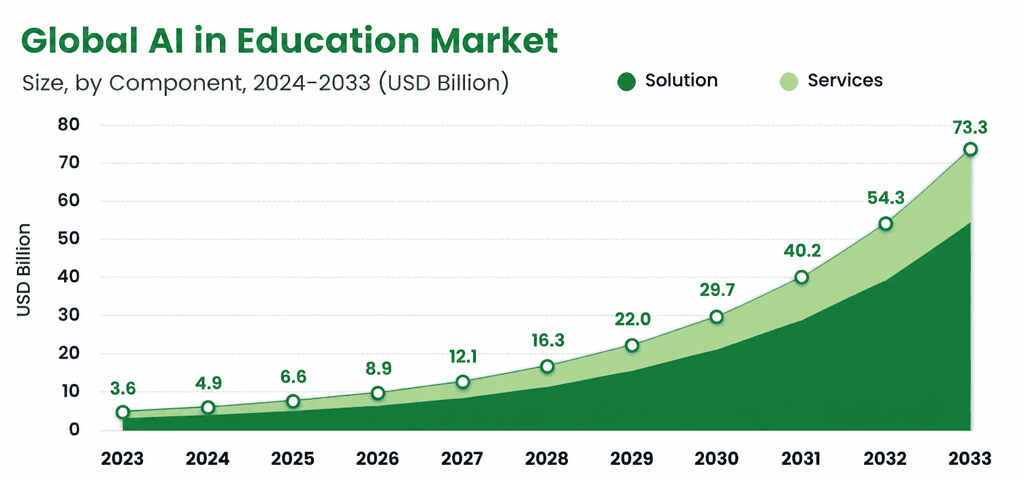
- Market.us estimates the market at USD 6.6 billion in 2025 and USD 8.9 billion in 2026.
- By 2033, the global AI in education market is forecast to reach USD 73.3 billion, covering both solutions and services.
- The market is projected to grow at a compound annual growth rate of 35.10% during the 2024–2033 forecast period.
Recent AI in Teaching Stats
- On October 26, 2026, Google launched its 3rd AI Quest for ages 11–14, reporting 400,000+ completions across the series in 10 languages.
- On October 21, 2026, the UK Treasury reported that the education department’s AI lesson-planning tool saves teachers approximately 3 hours weekly.
- On October 20, 2026, Microsoft introduced Education for Cowork, adding 10 AI skills and 20 tasks for academic and administrative workflows.
- On October 15, 2026, Google expanded Indian AI teacher training after reaching 80,000+ educators, while supporting STEM instruction across 100 Atal Tinkering Labs.
- In August 2026, OpenAI expanded ChatGPT for Teachers to 55 additional systems across 20 states, adding 100,000+ educators and staff and reaching 300,000+ overall.
- In July 2026, Anthropic launched Claude for Teachers with curricula aligned across 50 states, offering 1 free year for registrations by June 30, 2027.
- In June 2026, Microsoft announced AI teaching tools, reporting that 88% of educators used AI, 53% lacked formal training, and 66% wanted recurring training.
- In July 2025, AFT announced a USD 23 million AI academy targeting 400,000 educators, approximately 10% of US teachers and 7.2+ million students over 5 years.
The Bottom Line
AI is becoming a normal part of teaching. Many teachers in the surveys already use it for planning lessons, making materials, and doing admin work. The biggest benefit teachers expect is saving time, and new AI tools from big technology companies are reaching more schools. Still, the results are mixed.
Students may do better in practice but not on exams; AI marking can differ from human marking, and teachers worry about ethics and privacy. Teacher training and human supervision are still very important.
FAQ
AI is used for adaptive learning platforms, automated grading, chatbots, content generation, and early identification of struggling students. Teachers often use it as an assistant rather than a replacement.
No, AI can automate repetitive tasks, but it cannot replace human judgment, mentorship, classroom management, or emotional support. Effective teaching still depends on educators using AI thoughtfully.
AI can improve learning through personalization, instant feedback, and extra practice. Results depend on quality, teacher oversight, student needs, and how the tool is implemented.
Safety depends on the provider’s privacy practices, encryption, and data-sharing policies. Schools should review compliance with laws like GDPR, FERPA, or local student-data rules before adoption.
Risks include bias, inaccurate outputs, over-reliance, privacy concerns, and unequal access. Teachers should verify AI-generated content and keep human oversight in assessment and decision-making.
Start with low-risk tasks like lesson ideas, quiz drafts, and feedback templates. Test outputs, protect student data, and follow school or district policies before using AI with students.