








Beginning
Mobile Payment Statistics: Mobile payment means paying for things with a smartphone or another connected device, instead of using cash or cards. You can tap, scan, or approve a payment inside an app. It includes digital wallets, QR code payments, tap-to-pay, and sending money to other people. These tools use technologies such as near-field communication, tokenization (which hides real card details), and fingerprint or face checks. They make payments faster, easier, and simpler to track for both customers and businesses.
Mobile payment is changing how money moves in shops, transport, food service, and online shopping. Banks, fintech companies, and big technology firms are all competing to win customers. Growth is especially strong in places where more people have smartphones than bank accounts, which helps bring them into the financial system.
Still, providers must deal with fraud, data security, making different platforms work together, and changing rules. Companies that offer a smooth experience, strong security, and wide acceptance in shops are most likely to lead the next stage of digital payments.
Handpicked by the Editor
- The global mobile payment market was valued at USD 6.26 trillion in 2025 and USD 6.83 trillion in 2026, and is forecast to reach USD 13.74 trillion by 2034, at a 9.13% CAGR during 2026–2034.
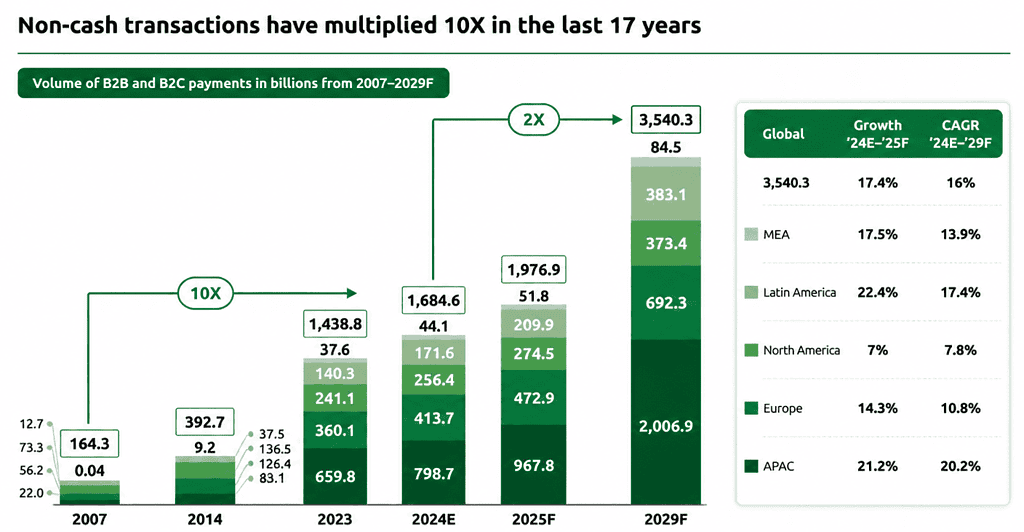
- Global payments are forecast at 1,976.9 billion transactions in 2025, rising to 3,540.3 billion by 2029, at a 16% CAGR during 2024–2029.
- Asia-Pacific accounted for 967.8 billion transactions in 2025 and is forecast to reach 2,006.9 billion by 2029, the fastest regional CAGR at 20.2%.
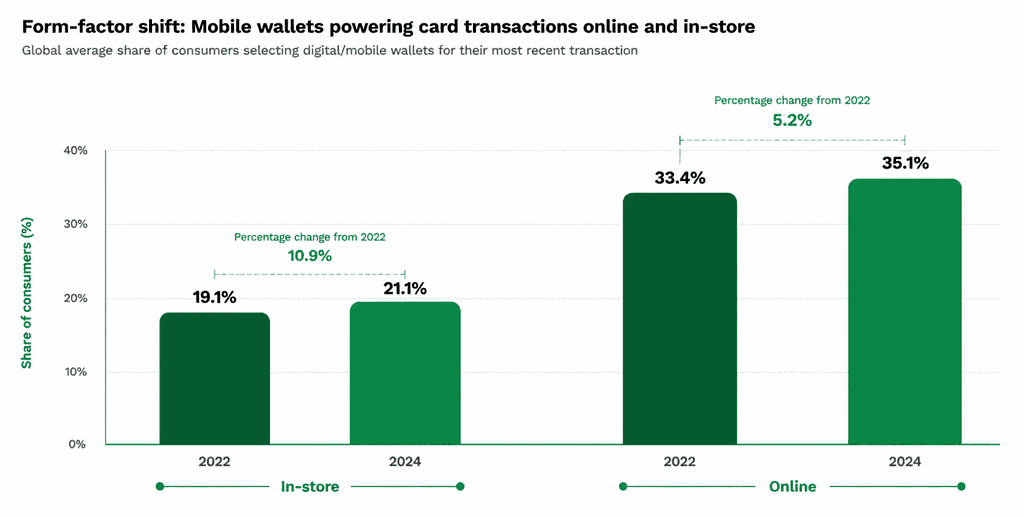
- Globally, mobile wallet use for in-store purchases rose from 19.1% in 2022 to 21.1% in 2024, while online use rose from 33.4% to 35.1%.
- US smartphone shopping and retail app users are estimated at 176.7 million in 2025 (68.3% of smartphone users) and forecast to reach 193.2 million (71.1%) by 2029.
- Visa reported 200% annual growth in Tap to Phone adoption globally in March 2025, with combined growth reaching 234% across the US, UK, and Brazil.
- In April 2026, Ant International reported connecting 150+ million merchants with more than 2 billion user accounts globally.
- In September 2026, Mastercard launched Wallet Pay, enabling transfers between cards, wallets, and accounts across 200+ countries and territories in 150 currencies.
- Zimperium identified 34 malware families targeting 1,243 banking and fintech apps across 90 countries, with Android malware-driven financial transactions up 67% year over year in 2025.
Recent Mobile Payment Stats
- In September 2026, Mastercard launched Wallet Pay, enabling transfers between cards, wallets, and accounts across 200+ countries and territories in 150 currencies.
- In April 2026, Ant International reported connecting 150+ million merchants with more than 2 billion user accounts globally, expanding its payment ecosystem.
- In September 2025, Apple expanded Tap to Pay on iPhone into 5 additional European countries, bringing availability to 43 countries and regions.
- In July 2025, PayPal announced PayPal World, proposing interoperability among payment systems and digital wallets whose launch partners represented nearly 2 billion users.
- In May 2025, Apple launched Tap to Pay on iPhone in 8 additional European countries, enabling merchants to accept contactless payments without separate terminals.
- In May 2025, PayPal announced its first contactless mobile wallet for Germany, alongside planned in-store financing over 3, 6, 12, or 24 months.
- In March 2025, Visa reported 200% annual growth in Tap to Phone adoption globally, with combined growth reaching 234% across the US, UK, and Brazil.
- In March 2025, Apple introduced Tap to Pay on iPhone in 9 additional European countries, expanding smartphone-based acceptance of contactless cards and digital wallets.
- In February 2025, Alipay+ reported connecting 35+ wallet and bank payment partners, 1.6 billion user accounts, and 90+ million merchants across 66 markets.
Usage of Mobile Payment
- India’s UPI processed 24.068 billion transactions in September 2026, with 756 banks participating in the payment network.
- In August 2026, India’s UPI processed 24.509 billion transactions, compared with 23.658 billion in July and 22.716 billion in June.
- Biometric-authenticated UPI payments exceeded 6.29 billion cumulative transactions by August 31, 2026, according to NPCI.
- Worldpay’s 2026 report shows digital wallets accounted for 56% of global online spending and 33% of in-person spending in 2025.
- Across Asia-Pacific, wallets represented 77% of online spending, worth USD 2.7 trillion, and 63% in-store, worth USD 6.3 trillion, in 2025.
- India’s digital wallets accounted for 68% of e-commerce spending and 61% of point-of-sale spending in 2025, according to Worldpay’s 2026 report.
- Hong Kong’s digital wallets captured 41% of online spending and 45% of in-store spending in 2025, overtaking cards, Worldpay reported in 2026.
- Singapore’s wallets represented 40% of online spending, worth USD 10 billion, and 36% in-store, worth USD 49 billion, in 2025, Worldpay reported.
Mobile Payment Market Growth
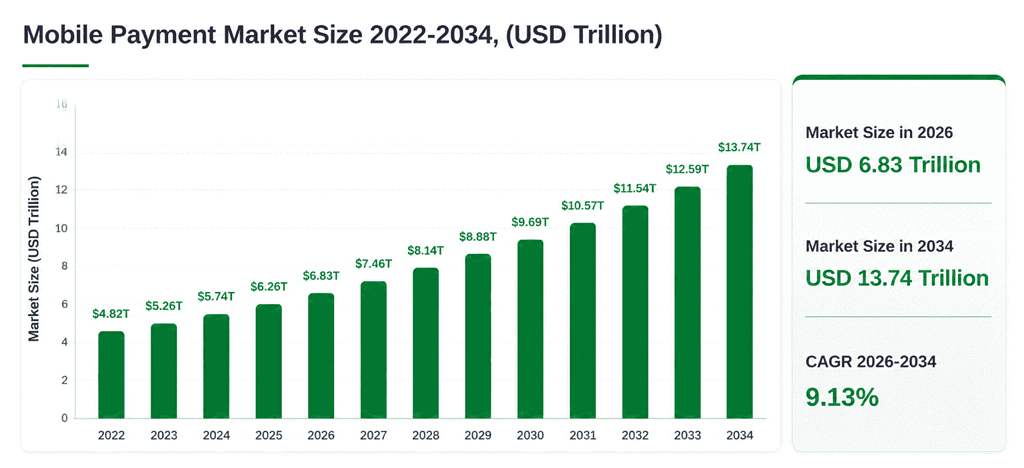
- The global mobile payment market was valued at USD 6.26 trillion in 2025 and USD 6.83 trillion in 2026.
- By 2034, the mobile payment market is forecast to reach USD 13.74 trillion, approximately double its estimated 2026 value.
- The market is projected to grow at a compound annual growth rate of 9.13% from 2026 to 2034.
Global Non-Cash Payment Growth
- Global business-to-business (B2B) and business-to-consumer (B2C) payment volumes increased approximately 10-fold over 17 years, from 2007 to 2024, and are forecast to roughly double by 2029.
- In 2025, global payments were forecast at 1,976.9 billion transactions: Asia-Pacific accounted for 967.8 billion, Europe 472.9 billion, North America 274.5 billion, Latin America 209.9 billion, and the Middle East and Africa 51.8 billion.
- By 2029, global payments are forecast to reach 3,540.3 billion transactions: Asia-Pacific leads with 2,006.9 billion, followed by Europe at 692.3 billion, Latin America at 383.1 billion, North America at 373.4 billion, and the Middle East and Africa at 84.5 billion.
- Globally, payment volumes are forecast to grow 17.4% from 2024 to 2025, with a compound annual growth rate (CAGR) of 16% during 2024–2029.
- Asia-Pacific is forecast to grow 21.2% from 2024 to 2025 and deliver the fastest regional CAGR, at 20.2%, during 2024–2029.
- Europe is forecast to record 14.3% growth from 2024 to 2025, followed by a 10.8% CAGR during 2024–2029.
- North America is forecast to grow 7% from 2024 to 2025, with a 7.8% CAGR during 2024–2029.
- Latin America is forecast to deliver the strongest 2024–2025 growth, at 22.4%, with a 17.4% CAGR during 2024–2029.
- The Middle East and Africa are forecast to grow 17.5% from 2024 to 2025, with a 13.9% CAGR during 2024–2029.
Mobile Wallet Use for In-Store and Online Payments
- Globally, mobile wallets gained popularity for consumers’ most recent purchases, with higher adoption both in stores and online between 2022 and 2024.
- For in-store purchases, mobile wallet use increased from 19.1% in 2022 to 21.1% in 2024, with reported growth of 10.5%.
- For online purchases, mobile wallet use rose from 33.4% in 2022 to 35.1% in 2024, with reported growth of 5.1%.
- Online adoption remained higher, but in-store use grew faster, indicating that mobile wallets are gaining ground for physical purchases.
- The in-store findings covered 74,940 respondents in 2022 and 56,006 in 2024 who had made an in-store transaction within the previous 30 days.
- The online findings covered 69,933 respondents in 2022 and 52,560 in 2024 who had made an online transaction within the previous 30 days.
How Consumers Use Mobile Phones for Shopping
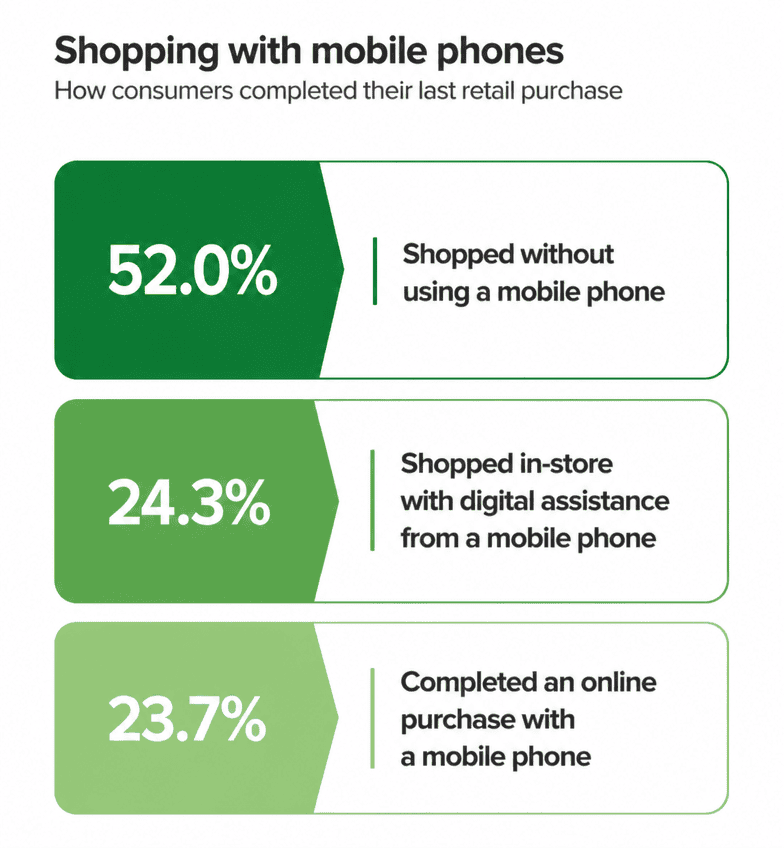
- Most consumers, representing 52.0%, completed their latest retail purchase without using a mobile phone.
- Another 24.3% shopped in a physical store while using a mobile phone for digital assistance.
- The remaining 23.7% completed their latest retail purchase online using a mobile phone.
US Smartphone Shopping and Retail App Users
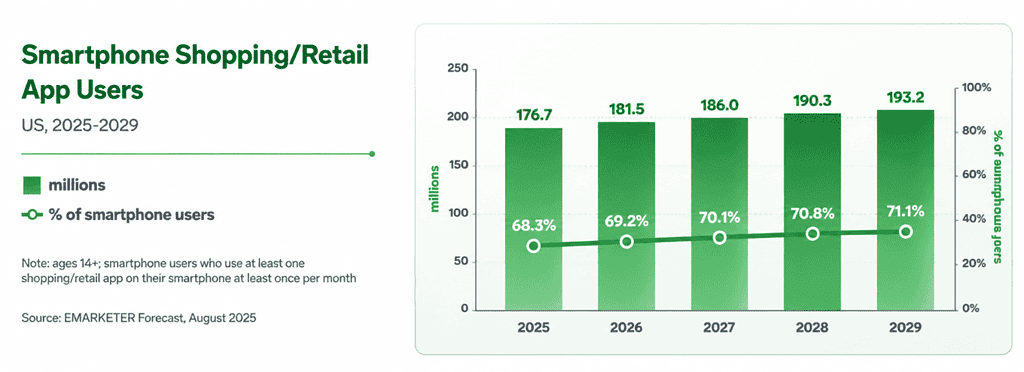
- In 2025, smartphone shopping and retail app users are estimated at 176.7 million, representing 68.3% of US smartphone users.
- In 2026, the number of users is forecast to reach 181.5 million, accounting for 69.2% of US smartphone users.
- In 2027, users are projected to increase to 186.0 million, representing 70.1% of US smartphone users.
- In 2028, the user base is expected to reach 190.3 million, accounting for 70.8% of US smartphone users.
- By 2029, users are forecast to total 193.2 million, representing 71.1% of US smartphone users.
- The forecast covers people aged 14+ who use at least 1 shopping or retail app on their smartphone at least once per month.
Impact of FI and Slice on Mobile Payment
- Fi Money’s March 2026 banking shutdown affected 3.5 million+ customers, redirecting account access to Federal Bank’s channels rather than ending their underlying accounts.
- Fi’s website reports 1 billion+ completed payments, demonstrating its historical scale; this cumulative figure should not be interpreted as 2026 payment volume.
- Fi stopped reward accrual on March 20, 2026, and redemption after March 31, removing its rewards incentive as banking services transitioned.
- Slice’s app listing, updated October 19, 2026, shows 10 million+ downloads; this indicates distribution reach, not active mobile-payment users.
- Slice advertises 1-second UPI transactions in its October 2026 listing, positioning payment speed alongside automated bill payments; independently measured performance is unavailable.
- Slice’s January 2026 announcement advertised up to 3% cashback and zero joining, renewal, or annual fees, encouraging credit-funded merchant payments through UPI.
Security Threats Involving Mobile Payment
- Zimperium’s 2026 report identified 34 malware families targeting 1,243 banking and fintech apps across 90 countries, based on monitoring throughout 2025.
- Android malware-driven financial transactions increased 67% year-over-year during 2025, according to Zimperium’s 2026 report, highlighting growing risks to mobile banking and payments.
- TsarBot, CopyBara, and Hook collectively targeted over 60% of banking and fintech apps analyzed in Zimperium’s 2026 report, concentrating threats across major platforms.
- Zimperium’s September 2026 analysis identified 24 malware families targeting 214 banking and fintech apps across 19 Asia-Pacific and Japan markets.
Payment QR Scams Involving Mobile Payment
- In September 2026, Manhattan investigators found 64 fake payment QR stickers on parking meters, directing drivers to a fraudulent website collecting financial information.
- The alleged parking scam involved a 39-year-old defendant charged with 5 identity-theft counts and 6 criminal-impersonation counts in September 2026.
- By June 2026, PG&E customers reported over USD 211,000 in losses amid a barcode-and-QR payment scam threatening utility disconnection.
- Microsoft detected 146% growth in QR phishing from January–March 2026, rising from 7.6 million to 18.7 million attacks; these were not exclusively payment scams.
- On September 3, 2026, the FTC warned that scammers replace parking-meter QR codes to steal payments or personal information; no loss total was disclosed.
Payment Fees on Mobile Payment
- As of October 2026, US PayPal purchases cost USD 0 without currency conversion; domestic card-funded personal payments cost 2.90% plus USD 0.30.
- PayPal’s 2026 US schedule charges 1.75% for personal-account instant withdrawals, with a USD 0.25 minimum and USD 25 maximum; standard withdrawals exclude conversion fees.
- Cash App’s published US instant-transfer fee is 0.5%–2.5%, with minimums of USD 0.25–USD 1 and a USD 75 maximum; standard transfers are free.
- Venmo’s US fee schedule lists USD 0 for bank-, balance-, or debit-funded personal payments, 3% for credit-card funding, and 1.75% for instant withdrawals.
- Venmo charges US businesses 1.9% plus USD 0.10 per received payment, or 2.29% plus USD 0.09 for Tap to Pay transactions.
Final Thoughts
Mobile payment is now a key part of modern shopping and business. The market is expected to roughly double by 2034, and more people are using mobile wallets in stores and online. Asia-Pacific is leading the growth, while big companies keep making wallets work together and adding tap-to-pay.
Security is a growing worry, as malware and QR code scams are on the rise. Companies that offer easy payments, wide acceptance, and strong protection against fraud will lead the next stage of digital payments.
FAQ
You link a payment method bank account, card, or wallet balance to an app or device. The payment is authorized by PIN, biometrics, QR scan, or tap-to-pay technology.
They can be safe with encryption, tokenization, device locks, and two-factor authentication. Still, risks like phishing, lost devices, and fake apps mean you should use trusted providers.
Not always, NFC tap-to-pay may work offline for small transactions in some systems. QR payments, app transfers, and balance checks usually require an internet connection.
Many consumer payments are free, but fees can apply for business payments, cross-border transfers, card funding, or instant withdrawals. Always check the app’s fee schedule.
Sometimes, some wallets allow cash-in, prepaid balances, or agent-based top-ups. Full access may still require identity verification and a linked account or card.
Key risks include fraud, phishing, stolen devices, fake apps, privacy issues, and accidental payments. Use official apps, enable locks and alerts, and never share PINs or OTPs.

Sources