








Preliminary Analysis
AI In Tourism Statistics: Travel is becoming easier and more personalized with the growing use of Artificial Intelligence. Whether it is choosing a destination, booking a hotel, finding the best flight, or planning an itinerary, AI is helping travelers make better decisions. At the same time, tourism businesses are using this technology to understand customer preferences, manage bookings, set prices, and improve customer service.
AI-powered chatbots, virtual travel assistants, and recommendation tools are also changing how people interact with travel companies. As adoption grows, AI is creating new opportunities for the tourism industry while changing the overall travel experience.
This article covers the latest statistics on AI in tourism, market trends, adoption rates, and industry developments.
Editorial Choice
- The global AI in tourism market is expected to rise from USD 888.8 million in 2025 to USD 1,199.9 million in 2026.
- Hotels are expected to invest an average of USD 319,000 per property in AI in 2026.
- By 2025, AI-powered chatbots were projected to facilitate 30% of travel bookings.
- Virtual travel agents handle 25% of initial booking consultations, and 80% of users complete their bookings after receiving assistance.
- Around 80% of airport self-service kiosks reportedly use AI for translation and personalized assistance, reducing waiting times by 50%.
- Around 60% of global travelers prefer AI-powered personalized recommendations.
- In 2026, China recorded the highest use of AI chat tools for travel inspiration at 44%, followed by India at 42% and the UAE at 35%.
- AI virtual assistants handle 40% of travel app inquiries, reducing response times by 50%.
- 62% of travelers use AI-powered tools, such as chatbots and virtual assistants.
- 76% of travel and tourism leaders believe generative AI can improve customer service and personalized experiences.
- Approximately 60% of travel companies have adopted or are considering AI for personalized recommendations and customer loyalty.
Global AI in Tourism Market Size
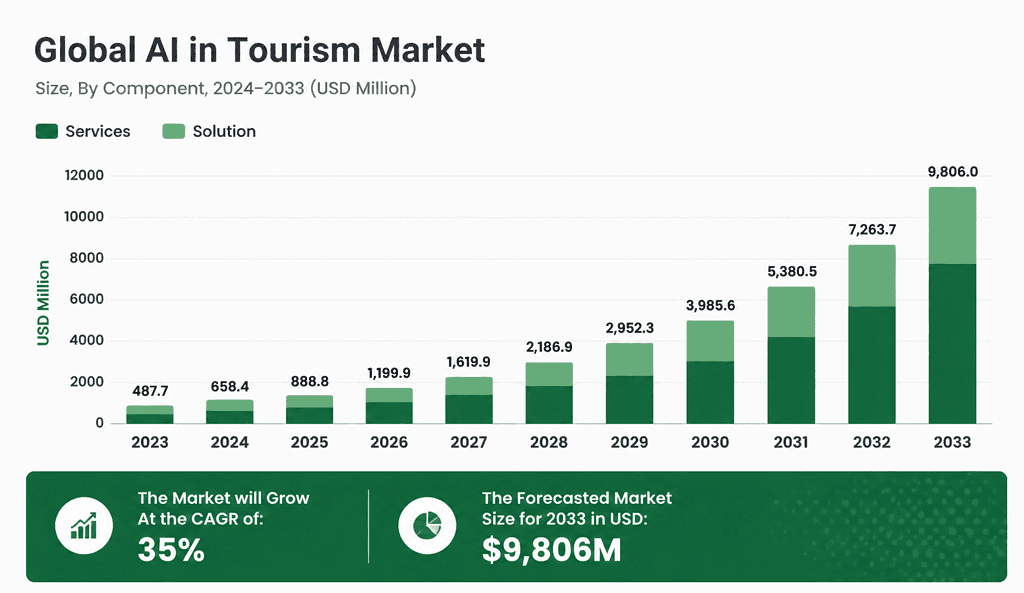
- The global AI in tourism market is estimated at USD 888.8 million in 2025.
- The market is projected to grow to USD 1,199.9 million in 2026.
- By 2033, the market is forecast to reach USD 9,806.0 million, with a compound annual growth rate of 35% from 2024 to 2033.
AI Market Size and Investment Trends in the Travel Industry
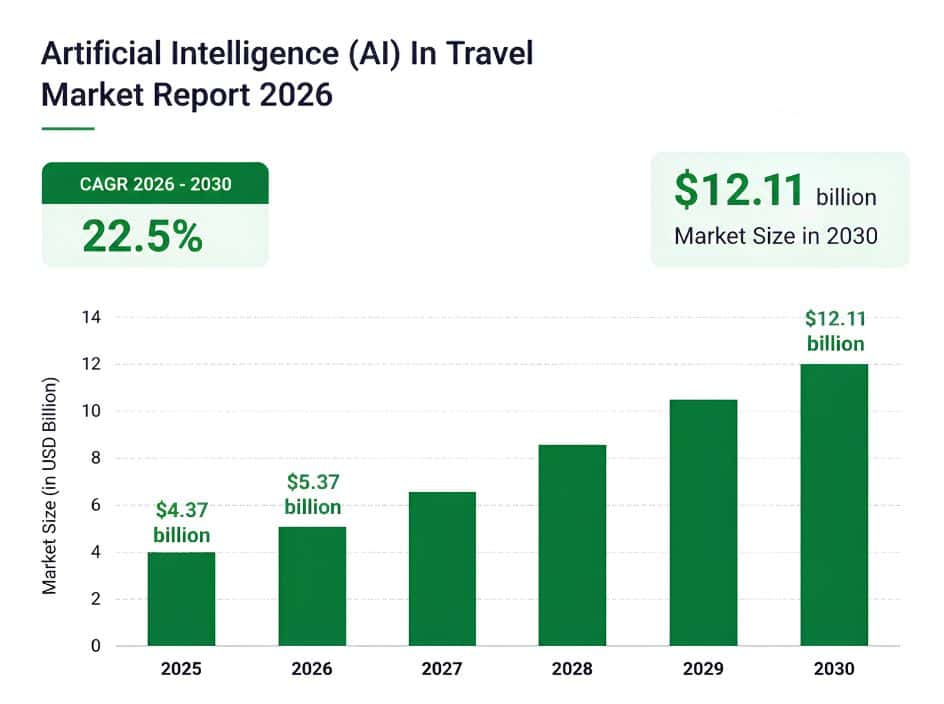
- The AI Travel market was valued at USD 4.37 billion in 2025 and is forecast to reach USD 5.37 billion in 2026.
- It could reach USD 12.11 billion by 2030, with a 22.5% compound annual growth rate from 2026 to 2030.
- Hotels are expected to invest an average of USD 319,000 per property in AI in 2026, with 499 out of 500 hoteliers planning AI investments.
- Additionally, 84% of travel executives consider AI essential for business growth.
AI in Travel and Tourism: Booking and Reservation Optimization Statistics
- Deloitte reported that by 2025, AI-powered chatbots were projected to facilitate 30% of travel bookings.
- AI-based dynamic pricing tools have increased airline revenue by an average of 12%-18%.
- Around 92% of major travel agencies use AI for real-time booking optimization, reducing processing time by 40%.
- Virtual travel agents handle 25% of initial booking consultations, and 80% of users complete their bookings after receiving assistance.
- Car rental companies using AI reservation systems report an 18% reduction in no-show rates.
- By 2026, 45% of travel bookings are projected to use AI for real-time price comparisons.
- AI chatbots resolve 85% of booking-related customer inquiries without human support, reducing service costs by 30%.
- AI personalization increases luxury travel booking conversion rates by 22%.
- AI-powered airline seat mapping improves seat utilization by 7%-9%.
- Travel apps with AI price prediction features report 35% higher user retention.
AI Adoption and Growth in the Travel Industry
- Around 80% of airport self-service kiosks reportedly use AI for translation and personalized assistance, reducing waiting times by 50%.
- AI-powered cruise booking systems reduce administrative errors by 45%.
- By 2025, voice assistants were projected to handle 25% of travel bookings.
- AI-driven hotel discounting algorithms improve the effectiveness of filling vacant rooms by 24%.
- Around 90% of budget travel aggregators use AI to bundle services, increasing average order value by 15%.
- AI chatbots in travel apps report 90% customer satisfaction, compared with 65% for human agents.
- By 2026, AI is projected to automate 40% of travel booking compliance checks, reducing errors by 90%.
- AI-powered sustainable travel recommendations increase eco-friendly bookings by 28%.
- AI-based dynamic packaging increases cross-selling by 30% through personalized travel packages.
- By 2025, 35% of travel bookings were projected to be personalized based on customers’ past behavior.
Consumer Preferences and Adoption of AI in Tourism Planning
- According to CareerTrainer’s AI in Travel and Tourism Statistics report, 62% of travelers use AI-powered tools, such as chatbots and virtual assistants.
- 58% say AI-generated recommendations make trip planning easier and improve their experience.
- 54% of consumers expect brands to personalize offers based on their interests and behavior.
- 73% expect companies to use the customer data they collect to deliver personalized messages.
- 81% believe a company’s customer experience is as important as its products or services.
- 40% of leisure travelers would consider AI planning tools if they reduced research and comparison time.
- 28% have used AI features, including AI search and trip-planning tools, in the past 12 months.
- 36% prefer AI-generated itineraries over creating daily travel plans manually.
Traveler Preferences and Customer Experience
- Around 60% of global travelers prefer AI-powered personalized recommendations.
- According to a study by Amadeus in the travel industry, 85% are willing to share personal data to improve their travel experiences.
- 82% of travelers feel more understood with AI personalization, leading to 25% more repeat bookings.
- 91% of travelers are more likely to book with brands that use AI to predict their preferences.
- AI-powered memory features increase engagement with travel apps by 40%.
AI Automation and Customer Service
- AI virtual assistants handle 40% of travel app inquiries, reducing response times by 50%.
- NLP-powered chatbots achieve 88% user satisfaction, compared with 62% for rule-based chatbots.
- By 2025, AI agents are expected to handle 30% of travel customer service interactions.
- AI chatbots that recognize customer frustration can reduce negative sentiment by 50%.
AI Use for Holiday Planning and Booking
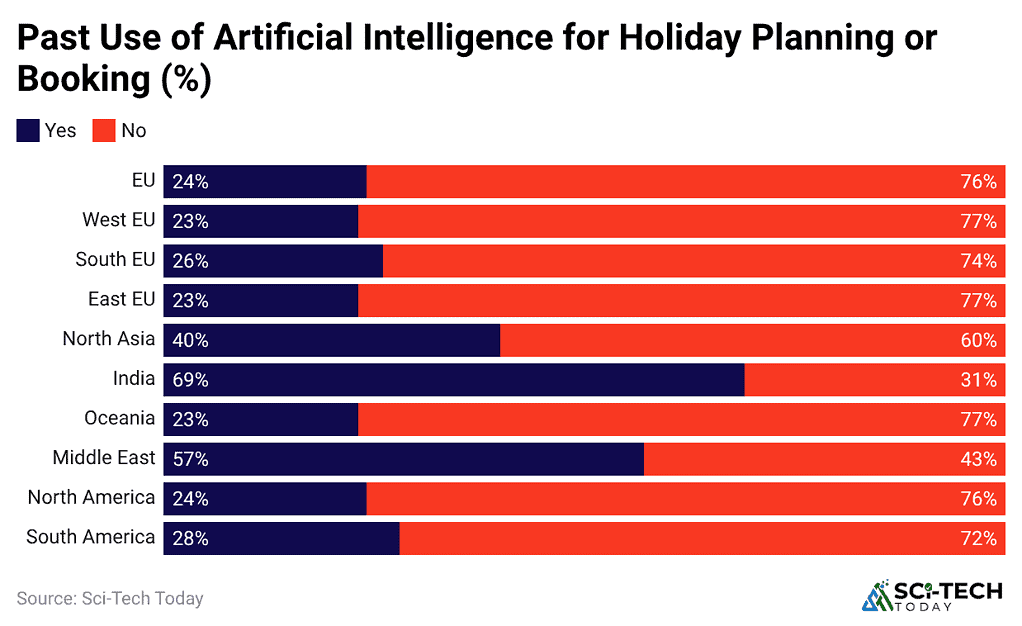
- India reported the highest use of AI for holiday planning or booking, with 69% having used it and 31% not.
- The Middle East followed, with 57% reporting AI use and 43% reporting no use.
- North Asia recorded 40% adoption, while 60% had not used AI.
- South America recorded 28% use, compared with 72% who had not used it.
- The EU and North America each reported 24% AI use, while 76% had not used it.
- Within the EU, the South EU led at 26% use and 74% non-use. West EU and East EU each recorded 23% use and 77% non-use.
- Oceania also reported 23% use and 77% non-use.
AI Use in Travel Planning by Country
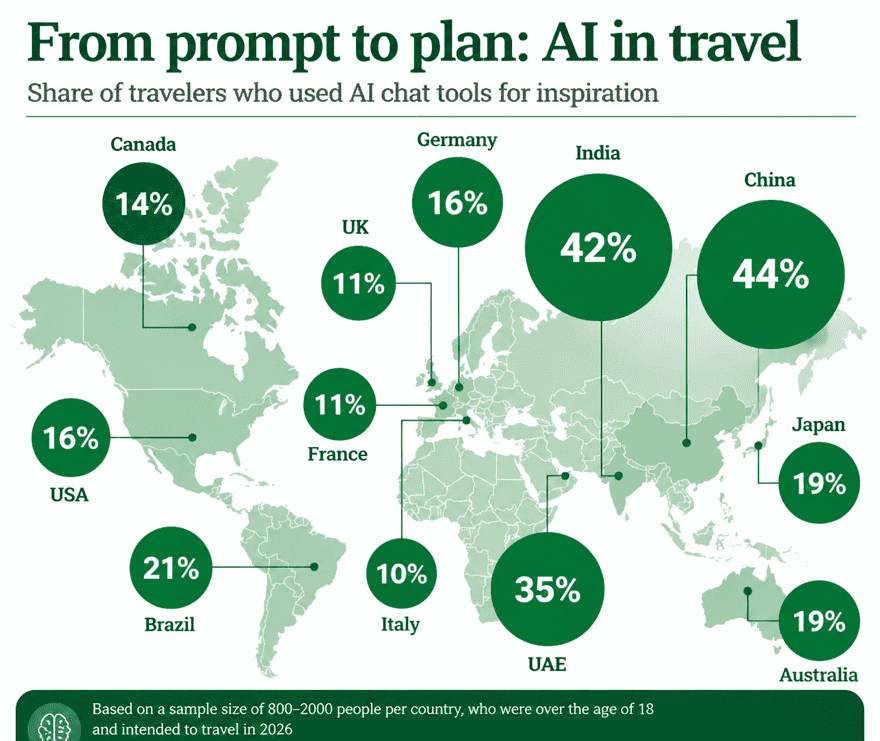
- In 2026, China recorded the highest use of AI chat tools for travel inspiration at 44%, followed by India at 42% and the UAE at 35%.
- Brazil reported 21% adoption, while Japan and Australia each recorded 19%.
- Meanwhile, Germany and the United States both reached 16%.
- Canada recorded 14%, followed by the United Kingdom and France at 11% each, while Italy reported the lowest adoption at 10%.
Corporate Adoption and Business Applications of AI in Travel
- CareerTrainer’s report further stated that 76% of travel and tourism leaders believe generative AI can improve customer service and personalized experiences.
- 63% of enterprises planned to increase their generative AI investment in 2025.
- 55% of travel companies have adopted or are testing AI for personalized services.
- 31% of hospitality businesses use AI for revenue management and dynamic pricing.
- Around 58% of airlines use AI-based forecasting to improve operational planning.
- 46% of travel companies use AI to automate customer service responses.
- 44% of enterprises planned to introduce AI assistants for employees within 12 months.
- 24% of companies already use generative AI for software development and IT operations.
AI Applications and Business Impact in the Tourism Industry
- Zipdo reported that approximately 60% of travel companies have adopted or are considering AI for personalized recommendations and customer loyalty.
- AI predictive analytics can improve hotel occupancy by 10%, while revenue management systems can increase hotel revenue by 10%.
- Airlines can boost revenue by an additional 10%-15% through personalized upselling and by 3%-5% through dynamic pricing.
- AI chatbots can handle 80% of customer interactions and reduce costs by 50%.
- AI-powered predictive maintenance could save hotels USD 800 million annually.
- Virtual assistants can increase travel agency cross-selling revenue by 10%, and AI-based customer segmentation can improve conversion rates by 30%.
Major AI Companies: 2026 Financial Performance and Market Valuations
| Company | Reporting Period | Revenue and Growth | Key Business Performance | Market Valuation (USD) |
| IBM Corporation | Q3 2026 | Revenue of USD 17.1 billion, up 5% YoY. | Software revenue rose 8% to USD 7.8 billion. | 244 billion |
| Alphabet (Google) | Q3 2026 | Revenue of USD 127.6 billion, up 25%. | Google Cloud revenue rose 103% to USD 30.7 billion | 3.44 trillion |
| Amazon (AWS) | Q3 2026 | AWS revenue of USD 46.0 billion, up 39%. | AWS operating income reached USD 17.8 billion. | 2.60 trillion |
| Microsoft | 2026 | Revenue of USD 331.8 billion, up 18%. | Operating income rose 21% to USD 155.2 billion. | 3.88 trillion |
| Oracle | Q1 2027 | Revenue of USD 19.3 billion, up 30%. | Cloud revenue rose 62% to USD 11.6 billion | 396 billion |
| Salesforce | Q2 2027 | Revenue of USD 11.3 billion, up 11%. | Agentforce’s annual recurring revenue exceeded USD 1.5 billion, growing over 240%. | 189 billion |
| SAP | Q3 2026 | – | Cloud revenue grew 26%; cloud backlog rose 28% to EUR 24.1 billion. | 320 billion |
| Intel | Q3 2026 | Revenue of USD 16.5 billion, up 21%. | Data Center and AI revenue rose 78% to USD 7.3 billion. | 100 billion |
| NVIDIA | Q2 2027 | Revenue of USD 96.2 billion, up 106%. | Data Center revenue rose 117% to USD 89.0 billion. | 4.94 trillion |
| Alibaba | June quarter | AI Cloud and Compute Services revenue of USD 7.14 billion, up 45%. | AI-related product revenue reached USD 1.82 billion. | 220 billion |
AI Applications in Tourism Statistics
- Phocuswright reported that 56% of United States travelers used AI for trip planning, booking, or travel assistance in 2026.
- According to EY’s Future Travel Behaviors Observatory 2026, 56% of travelers would use AI assistants for trip planning, including destination experiences (34%), accommodation (29%), and destination selection (27%).
- BCG Global’s report further stated that 37% of travelers already use AI language models on online travel platforms to plan and book trips.
- AI-driven visits to travel websites rose 233% year over year in Q1 2026. Additionally, 48% used AI for research and 44% for travel inspiration.
- Travel business adoption: 65% of travel distributors were already using AI.
- A study of 10+ million hotel guest interactions found that 60% of AI responses were personalized. Guests interacting with AI were 11% more likely to leave five-star ratings, according to Canary Technologies.
- Hotels using AI messaging achieved an average 54% increase in upsell revenue during their first six months.
- AI achieved a median customer-service containment rate of 45% across 3 documented deployments.
blits.ai - According to blits.ai, AI revenue management systems delivered a median 25.2% revenue uplift across 4 documented deployments.
- AI booking assistants achieved a median automation rate of 88% across 3 documented deployments.
- One documented AI deployment reported a 97% automation rate for flight disruption and rebooking.
Economic Impact of AI on the Tourism Industry
- According to a 2026 Gitnux report, AI in tourism could create 5 million new jobs by 2030 and boost tourism GDP by 18% by 2028.
- AI personalization can increase traveler spending by 15% per trip and loyalty program value by 20%.
- AI could save the tourism industry USD 80 billion annually through operational efficiencies.
- Hotels adopting AI report 22% revenue growth, 28% higher profit margins, and an 11% improvement in RevPAR.
- AI-powered predictions reduce booking no-shows by 30%, while marketing ROI averages 8:1.
- AI chatbots cut customer service costs by 40% and generate USD 300 million in annual upselling revenue.
- AI dynamic pricing adds USD 2.5 billion to airline revenues, while fraud prevention saves OTAs USD 500 million annually.
- AI supply chain tools reduce resort food waste costs by 25%, while predictive maintenance cuts fleet repair costs by 35%.
- AI analytics could unlock USD 1 trillion in tourism value and create a USD 400 billion market opportunity.
- AI marketing automation saves USD 10 billion in advertising costs and increases direct bookings by 25%.
- AI adoption reduces labor costs by 12% and energy expenses by USD 5 billion.
- AI recommendations increase ancillary revenue by 24%, guest satisfaction by 22%, and inventory turnover by 30%.
- AI adoption could help regional tourism economies grow 16% faster and improve SME survival rates by 15% after crises.
- AI-driven sustainability and risk management can reduce carbon costs by 20% and insurance premiums by 15%, while AI credit scoring can increase bookings by 18%.
Final Verdict
AI is making travel easier by helping people choose destinations, compare prices, and plan trips based on their interests. Tourism companies are also using it to improve customer service, manage bookings, and reduce daily workloads.
Still, issues such as data safety and privacy need attention. As technology evolves, businesses that use AI wisely while maintaining human support will be better prepared to meet changing traveler expectations.
FAQ
Travelers use AI to plan itineraries, discover destinations, compare prices, book accommodations, translate languages, and receive personalized travel recommendations.
AI chatbots assist tourists with bookings, travel recommendations, itinerary planning, and instant customer support.
AI improves travel planning, personalization, customer service, safety, and operational efficiency while reducing costs.